On the surface, a cough is one of the most common, almost mundane, human experiences. It is a reflexive protective mechanism, a sudden explosive forcing of air from the lungs to clear the airways of irritants, secretions, or foreign matter. In medical coding, the instinct might be to reach for a single, simple code—R05.9, Cough, unspecified—and move on. However, this instinct belies a profound and intricate clinical reality. A cough is not a diagnosis; it is a messenger. It can be the first whisper of a transient viral illness or the relentless, booming herald of a serious cardiopulmonary disease. It can last for three days or three decades. Its character—dry or productive, barking or whooping, nocturnal or diurnal—provides critical diagnostic clues.
For medical coders, healthcare providers, and health informatics professionals, accurately classifying this symptom within the International Classification of Diseases, Tenth Revision, Clinical Modification (ICD-10-CM) system is a task of significant consequence. It transcends mere bureaucratic necessity. Precise coding directly impacts patient care continuity, drives appropriate reimbursement, fuels critical public health surveillance, and advances medical research. A mis-coded cough can distort community illness trends, hinder quality measurement, and even affect resource allocation.
This article, exceeding a detailed examination of code R05, will embark on a comprehensive journey through the labyrinth of cough-related ICD-10-CM coding. We will explore its place as a symptom, delve into the vast array of underlying conditions it represents, and dissect the nuanced documentation required for precision. Through detailed explanations, clinical scenarios, and practical tables, this guide aims to transform the simple act of coding a cough from a reflexive action into a sophisticated exercise in clinical understanding and administrative accuracy.
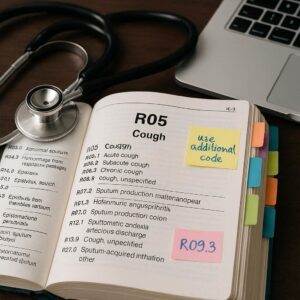
ICD-10-CM coding for cough
2. The ICD-10-CM Framework: Understanding the System
Before addressing the cough specifically, one must grasp the architecture of ICD-10-CM. It is a hierarchical, alphanumeric system used in the United States to classify diagnoses and reasons for patient encounters. Each code tells a story.
-
Chapters: Diseases are grouped into chapters based on etiology or body system (e.g., Chapter 10, Diseases of the Respiratory System (J00-J99)).
-
Categories & Subcategories: The first three characters denote the category (e.g., J44, Other chronic obstructive pulmonary disease). Characters four through six provide increasing specificity regarding etiology, anatomic site, severity, or other clinical details.
-
The 7th Character: For certain categories (like injuries or obstetrics), a 7th character is required to describe the encounter (initial, subsequent, sequela).
-
Code First/Use Additional Code Notes: These crucial instructions govern the sequencing of codes when a symptom is due to a confirmed underlying disease.
The system prioritizes etiology (the cause) over manifestation (the symptom). This principle is central to accurate cough coding.
3. The Central Code: A Deep Dive into R05 (Cough)
The code category R05 resides in Chapter 18: Symptoms, Signs, and Abnormal Clinical and Laboratory Findings, Not Elsewhere Classified (R00-R99). This chapter is for use when no definitive diagnosis can be made, or when the symptom is the primary reason for encounter in the absence of a known cause.
-
R05.1 – Acute cough: Generally used for a cough lasting less than three weeks. Often associated with acute upper respiratory infections (URI).
-
R05.2 – Subacute cough: Lasting between three and eight weeks. This can be a gray zone, often post-infectious.
-
R05.3 – Chronic cough: Lasting more than eight weeks. This code flags a need for further investigation.
-
R05.4 – Cough syncope: A rare but serious condition where coughing triggers a brief loss of consciousness.
-
R05.8 – Other specified cough: May include terms like “brassy cough,” “hacking cough,” etc., if documented.
-
R05.9 – Cough, unspecified: The default when duration or character is not documented. Its overuse represents a loss of clinical and data granularity.
Crucial Rule: If a definitive cause for the cough is known or established during the encounter, R05 is generally not the primary code. Instead, you must “code the cause.”
4. The Cough as a Symptom: Coding Underlying Etiologies
This is where coding becomes clinically integrated. A cough is a manifestation of countless conditions. The coder must be a detective, relying on provider documentation to identify the underlying etiology.
Hierarchy of Code Selection:
-
First, seek a definitive diagnosis in the respiratory chapter (J00-J99) or elsewhere.
-
If a cause is documented, code that condition first. In many cases, you will also code R05.x as a secondary symptom if it is a significant part of the clinical picture and adds information (though payer policies may vary on this).
-
If no cause is found, or the encounter is solely for the symptom, use the appropriate R05 code.
5. The Respiratory System Chapter (J00-J99): A Primary Home for Cough
Most coughs originate here. Key categories include:
-
Acute Upper Respiratory Infections (J00-J06):
J00for the common cold (often with cough). -
Influenza and Pneumonia (J09-J18): Always code confirmed influenza (
J09.x-,J10.x-,J11.x-) or specific pneumonia (J12.x-,J13,J14,J15.x-,J16.x-,J17.x-,J18.x-) first. -
Other Acute Lower Respiratory Infections (J20-J22):
J20.9, Acute bronchitis, unspecified, is a very common cause of acute cough. -
Chronic Lower Respiratory Diseases (J40-J47): This is critical for chronic cough.
-
J44.9 – Chronic obstructive pulmonary disease (COPD), unspecified.
-
J45.909 – Unspecified asthma, uncomplicated. (Asthma variants like cough-variant asthma are specified elsewhere).
-
J47.9 – Bronchiectasis, unspecified.
-
-
Lung Diseases due to External Agents (J60-J70): e.g.,
J69.0– Pneumonitis due to inhalation of food and vomit.
6. Infectious Causes: From the Common Cold to Tuberculosis
| Infectious Cause | Example ICD-10-CM Code(s) | Coding & Clinical Notes |
|---|---|---|
| Common Cold (Acute URI) | J00 – Acute nasopharyngitis [common cold] | Cough is a typical symptom; code J00 covers the syndrome. |
| Acute Bronchitis | J20.9 – Acute bronchitis, unspecified | Often viral; for bacterial, if specified, use a more specific code from J20.0-J20.8. |
| Pertussis (Whooping Cough) | A37.90 – Whooping cough, unspecified species without pneumonia | A bacterial cause; requires an A-code (Certain infectious and parasitic diseases). |
| Tuberculosis | A15.0 – Tuberculosis of lung, confirmed by sputum microscopy with or without culture | Always sequence the specific TB site code first. Cough is a hallmark symptom. |
| COVID-19 | U07.1 – COVID-19 | For 2025, always follow current-year guidelines. Cough is a common manifestation; code U07.1 first for confirmed cases, then respiratory manifestations (e.g., J12.82 Pneumonia due to COVID-19, or R05). |
7. Chronic and Environmental Causes: COPD, Asthma, and Beyond
Chronic cough demands investigation. Common etiologies and their codes:
-
Gastroesophageal Reflux Disease (GERD):
K21.9– Gastro-esophageal reflux disease without esophagitis. A leading cause of chronic cough, often worse at night. -
Postnasal Drip Syndrome (Upper Airway Cough Syndrome): Often coded as
J31.2– Chronic pharyngitis orR09.82* - Postnasal drip. (*Note: R09.82 is in the symptoms chapter; J31.2 may be used if chronic inflammation is diagnosed). -
Angiotensin-Converting Enzyme (ACE) Inhibitor Use: Code for the adverse effect:
T46.4X5A* - Adverse effect of angiotensin-converting-enzyme inhibitors, initial encounter, PLUSR05. The drug code is sequenced first, followed by the nature of the adverse effect (R05). -
Interstitial Lung Diseases: e.g.,
J84.10– Pulmonary fibrosis, unspecified. -
Lung Cancer:
C34.90– Malignant neoplasm of unspecified part of unspecified bronchus or lung. Cough may be the presenting symptom.
8. The Alarm Symptoms: When Cough Points Beyond the Lungs
Cough can signal non-respiratory disease. Heart failure (I50.9) can cause a cough (especially a nocturnal one) due to pulmonary edema. Psychogenic cough (F45.8) is a diagnosis of exclusion. Coding follows the same rule: code the underlying condition.
9. Documentation is King: What Providers Must Specify for Accurate Coding
Ambiguous documentation leads to unspecified codes and poor data quality. Providers should document:
-
Duration: Acute, subacute, or chronic.
-
Character: Dry, productive, bloody (hemoptysis –
R04.2), barking, whooping. -
Timing: Nocturnal, with exercise, after eating.
-
Established Etiology: “Cough due to exacerbation of known COPD,” “Chronic cough secondary to GERD.”
-
Severity: If impacting activities of daily living.
A note stating “COPD with chronic cough” allows for J44.9 (COPD) as primary, and potentially R05.3 as secondary. A note saying just “cough” forces R05.9.
10. Case Studies in Complexity: Applying Codes to Real-World Scenarios
Case 1: A 65-year-old with a history of COPD presents with a 10-day worsening of his chronic cough, now productive of yellow sputum, and increased shortness of breath. Diagnosis: Acute exacerbation of COPD.
-
Coding:
J44.1(COPD with acute exacerbation) is primary.R05.1(acute cough) orR05.3(chronic cough) may be added, butJ44.1already implies the symptom.
Case 2: A previously healthy 40-year-old presents for a 9-week dry cough that started after a cold. Exam and chest X-ray are normal. Diagnosis: Post-infectious chronic cough.
-
Coding: As no more specific respiratory diagnosis is made, the correct code is
R05.3(Chronic cough).
Case 3: A patient is admitted with confirmed COVID-19 pneumonia and severe productive cough.
-
Coding:
U07.1(COVID-19) is sequenced first, followed byJ12.82(Pneumonia due to COVID-19).R05.1could be added as a tertiary code for specificity regarding the severe cough.
11. The Impact of Accurate Coding: From Reimbursement to Public Health
-
Reimbursement: DRGs (Diagnosis-Related Groups) and APC (Ambulatory Payment Classifications) rely on diagnosis codes. Specifying
J44.1vs.R05.9justifies a higher level of resource use. -
Public Health Surveillance: Tracking
A37.90(Pertussis) outbreaks orU07.1(COVID-19) trends depends on accurate coding at the point of care. -
Quality Measurement and Research: Studies on the effectiveness of a new asthma drug require clean data on
J45.*codes, not obscured by unspecified cough codes. -
Patient Care: Accurate problem lists in Electronic Health Records (EHRs), built from codes, help future providers understand a patient’s chronic conditions.
12. Looking Ahead: ICD-11 and the Future of Symptom Classification
ICD-11, which the U.S. will eventually adopt, offers even greater granularity. In ICD-11, cough (MD11) is found under “Symptoms, signs or clinical findings of the respiratory system.” It allows for more detailed combinations with etiology through “post-coordination,” potentially allowing a single coded entity to represent “chronic cough due to asthma” more seamlessly, further enhancing data utility for precision medicine.
13. Conclusion
Accurately coding a cough in ICD-10-CM requires moving beyond the symptom code R05 to identify and sequence any underlying etiology, from common respiratory infections to complex chronic diseases. Precise provider documentation of duration, character, and cause is the essential foundation for this process. Mastering this skill ensures correct reimbursement, generates high-quality data for public health and research, and ultimately supports better-informed patient care by creating a more accurate digital record of the patient’s health story.
14. Frequently Asked Questions (FAQs)
Q1: When do I use R05 vs. a code from the Respiratory chapter (J00-J99)?
A: Use a J-code (or other definitive diagnosis code) when the provider documents a cause (e.g., acute bronchitis, COPD). Use R05 when the cough is idiopathic, of unknown cause, or is the sole reason for the encounter without a established diagnosis.
Q2: Can I code both a definitive diagnosis (like J44.9) and R05.3 together?
A: Yes, in many cases. The underlying condition (J44.9) is sequenced first. Adding the symptom code (R05.3) can provide additional clinical detail, though you must follow payer-specific guidelines and ensure the symptom is not inherent to the diagnosis (per ICD-10 conventions).
Q3: How do I code a cough due to a medication side effect, like an ACE inhibitor?
A: This is an adverse effect. First, code the drug causing the effect (e.g., T46.4X5A for ACE inhibitor). Then, code the manifestation (R05). Use a 7th character for encounter (A, D, S).
Q4: What is the most common mistake in cough coding?
A: The overuse of R05.9 (Cough, unspecified) when the documentation supports a more specific acute/chronic R05 code or, more importantly, a definitive underlying condition code.
Q5: Where can I find the most authoritative and up-to-date coding guidelines?
A: The official source is the ICD-10-CM Official Guidelines for Coding and Reporting, published annually by the Centers for Medicare & Medicaid Services (CMS) and the National Center for Health Statistics (NCHS). Always refer to the fiscal year you are coding for.
Disclaimer: This article is for educational and informational purposes only. It is not a substitute for professional medical coding advice, clinical guidance, or the official ICD-10-CM coding manuals. Always consult the most current official code sets, payer-specific guidelines, and clinical documentation for definitive coding and billing decisions. The author is not responsible for any coding errors or compliance issues arising from the use of this information.
Date: December 29, 2025
Author: A. Clinical Coding Specialist