Navigating the world of medical coding can feel like deciphering a complex language. When it comes to documenting a condition as common and varied as peripheral neuropathy, finding the precise ICD-10-CM code is crucial. It ensures accurate patient records, proper billing, and clear communication between healthcare providers, insurers, and researchers.
This guide is designed to demystify the process. We’ll walk you through the ICD-10-CM coding system, break down the specific codes for different types of peripheral neuropathy, and provide practical tips to code confidently and correctly. Whether you’re a medical coder, a healthcare provider, a student, or a patient seeking to understand your records, this article will serve as your trusted resource.
ICD-10-CM Codes for Peripheral Neuropathy
Table of Contents
ToggleUnderstanding the ICD-10-CM System
Before we dive into specific codes, let’s establish a foundational understanding of what we’re working with.
What is ICD-10-CM?
The International Classification of Diseases, Tenth Revision, Clinical Modification (ICD-10-CM) is the standard system used in the United States to classify and code all diagnoses, symptoms, and procedures. It’s more than just a billing tool; it’s a universal language for health information. These codes are used for:
-
Submitting insurance claims for reimbursement.
-
Tracking public health statistics and disease prevalence.
-
Conducting medical research and clinical trials.
-
Informing treatment pathways and quality of care measures.
Why Specificity is Non-Negotiable
ICD-10-CM is vastly more detailed than its predecessor (ICD-9-CM). This specificity is its greatest strength. For peripheral neuropathy, a generic code is rarely sufficient. The system requires you to specify:
-
Type: What is the underlying cause (etiology)?
-
Location: Which nerves are affected?
-
Laterality: Is it the left side, right side, or both?
Using an unspecified code can lead to claim denials, inaccurate patient data, and missed opportunities for proper disease management. As one seasoned medical coder puts it:
“In ICD-10, ‘unspecified’ is the code of last resort. Your mission is always to find the most specific code supported by the physician’s documentation.”
Decoding the Core: G62.9 and Its Family
The most general entry point for peripheral neuropathy in ICD-10-CM is within category G62: Other polyneuropathies.
The “Unspecified” Code: G62.9
-
G62.9: Polyneuropathy, unspecified.
This is a catch-all code used when the medical documentation does not specify the type of polyneuropathy. It should only be used when more detailed information is unavailable. Reliance on this code is often a red flag for incomplete documentation.
To move beyond unspecified, you must identify the etiology. Here are the primary subcategories under G62:
| Code | Description | Clinical Context & Notes |
|---|---|---|
| G62.0 | Drug-induced polyneuropathy | Use when neuropathy is a documented side effect of medication (e.g., certain chemotherapies). An additional code from T36-T50 with fifth or sixth character 5 is used to identify the drug. |
| G62.1 | Alcoholic polyneuropathy | Used for neuropathy directly attributable to chronic alcohol use. |
| G62.81 | Critical illness polyneuropathy | Often seen in patients in intensive care units with sepsis and multi-organ failure. |
| G62.82 | Radiation-induced polyneuropathy | Results from radiation therapy, often with a delayed onset. |
| G62.89 | Other specified polyneuropathies | A crucial “other” code for neuropathies with a known cause not listed elsewhere (e.g., nutritional, toxic, metabolic not covered below). |
| G62.9 | Polyneuropathy, unspecified | Last-resort code when etiology is unknown or undocumented. |
The Major Player: Diabetic Neuropathy (E11.4-)
Diabetic polyneuropathy is arguably the most frequently encountered type. It has its own dedicated coding structure outside the G62 category, underscoring its prevalence.
Coding Diabetic Neuropathy: A Step-by-Step Approach
-
Start with the Diabetes Code: First, you must code the type of diabetes. For the most common type, Type 2 Diabetes Mellitus, the category is E11.
-
Add the 4th Character for Neuropathy: Diabetic polyneuropathy is coded as E11.4.
-
Add a 5th Character for Specificity: This is where ICD-10-CM demands detail.
-
E11.40: Diabetic polyneuropathy, unspecified. (Again, avoid if possible).
-
E11.41: Diabetic mononeuropathy.
-
E11.42: Diabetic polyneuropathy.
-
E11.43: Diabetic autonomic (poly)neuropathy.
-
E11.44: Diabetic amyotrophy.
-
E11.49: Other diabetic neurological complication.
-
Important Note for Coders:
“Always follow the ICD-10-CM official coding guidelines. For diabetic neuropathy, you must code the diabetes first. The neuropathy code is not used alone; it’s part of the diabetes code combination. Also, remember to use additional codes to identify any associated conditions like chronic kidney disease (N18.-) or ulceration.”
Other Crucial Neuropathy Categories
Peripheral neuropathy is a umbrella term. Let’s explore other common categories and their codes.
Hereditary and Idiopathic Neuropathy
-
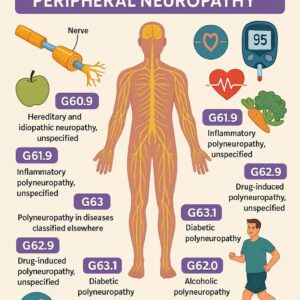
G60.0: Hereditary motor and sensory neuropathy (HMSN), such as Charcot-Marie-Tooth disease.
-
G60.8: Other hereditary and idiopathic neuropathies. This includes conditions like hereditary sensory neuropathy.
-
G60.9: Hereditary and idiopathic neuropathy, unspecified.
Inflammatory Polyneuropathy (G61.-)
This category covers immune-mediated nerve damage.
-
G61.0: Guillain-Barré syndrome.
-
G61.1: Serum neuropathy.
-
G61.81: Chronic inflammatory demyelinating polyneuritis (CIDP).
-
G61.89: Other inflammatory polyneuropathies.
Mononeuropathies of the Upper and Lower Limb (G56.- / G57.-)
When a single nerve is affected, you code from these categories. Specificity is key:
-
Example – Carpal Tunnel Syndrome: G56.01 (Carpal tunnel syndrome, right upper limb) or G56.02 (left upper limb).
-
Example – Meralgia Paresthetica: G57.11 (Lateral cutaneous nerve of thigh, right lower limb).
A comparative table can help visualize the decision-making process:
| Patient Presentation | Documented Cause | Primary ICD-10-CM Code | Additional Code(s) Needed? |
|---|---|---|---|
| Numbness & tingling in feet, long-standing Type 2 Diabetes | Diabetic Polyneuropathy | E11.42 | Codes for any diabetic complications (retinopathy, nephropathy). |
| Progressive weakness in hands & feet, family history | Charcot-Marie-Tooth Disease | G60.0 | Possibly codes for foot deformities (e.g., pes cavus). |
| Ascending paralysis after a viral infection | Guillain-Barré Syndrome | G61.0 | Code for the precipitating infection (if known). |
| Wrist pain & numbness, office worker | Carpal Tunnel Syndrome | G56.01 or G56.02 | Code for occupational risk factors, if relevant (Z57.8). |
| Neuropathy following chemotherapy | Drug-induced | G62.0 | T45.1x5A (Adverse effect of antineoplastic drugs, initial encounter). |
The Art of Accurate Coding: A Practical Guide
Finding the right code is a process. Here is a reliable workflow:
-
Start with the Physician’s Documentation: This is your source of truth. Look for key terms: “polyneuropathy,” “mononeuropathy,” “diabetic,” “chemotherapy-induced,” “idiopathic,” “hereditary.”
-
Identify the Etiology: Determine the underlying cause. This is the single most important step.
-
Determine the Location and Laterality: Is it generalized (poly-) or focal (mono-)? If focal, which limb? Left, right, or bilateral?
-
Consult the ICD-10-CM Index: Look up the main term (e.g., “Neuropathy, diabetic”) and follow the subterms.
-
Verify in the Tabular List: Never code from the index alone. Always go to the tabular list to confirm the code, check for excludes notes, and see if any additional characters are required.
-
Code to the Highest Specificity: Use the most detailed code available that matches the documentation.
-
Sequence Codes Correctly: Follow coding guidelines for sequencing (e.g., diabetes before its complications).
Common Documentation Pitfalls to Avoid:
-
Using “neuropathy” alone without specifying type.
-
Documenting “diabetic neuropathy” without specifying polyneuropathy, mononeuropathy, etc.
-
Not documenting laterality for conditions like carpal tunnel syndrome.
-
Failing to link a neuropathy to a documented cause like alcohol use or a specific medication.
Special Considerations and Resources
Chronic Pain and Neuropathy: If chronic pain is a significant component, consider adding a code from category G89.2- (Chronic pain) as per coding guidelines.
The Importance of Regular Updates: ICD-10-CM is updated annually on October 1st. It is imperative to use the current year’s code set. The 2025 code set may have additions or revisions relevant to neuropathy.
Helpful Lists for Coders and Providers:
For Providers to Improve Documentation:
-
Always specify the type of neuropathy (polyneuropathy, mononeuropathy).
-
Always state the presumed or confirmed etiology.
-
For limb neuropathies, always document laterality (right, left, bilateral).
-
Link complications (like neuropathy) directly to their cause (e.g., “diabetic polyneuropathy”).
-
Avoid using “neuropathy” as a standalone diagnosis.
For Coders to Ensure Accuracy:
-
Bookmark the official CDC ICD-10-CM page for updates and resources.
-
Invest in a reputable, updated ICD-10-CM code book or software subscription.
-
Use the AHA Coding Clinic for ICD-10-CM as the definitive source for official advice.
-
When in doubt, query the provider for clarification. It’s a vital part of the job.
Conclusion
Accurate ICD-10-CM coding for peripheral neuropathy is a blend of clinical understanding and meticulous attention to detail. By moving from the unspecified (G62.9) to specific codes based on etiology—like diabetic (E11.4-), hereditary (G60.-), or drug-induced (G62.0)—you ensure clarity in communication, support proper reimbursement, and contribute to valuable health data. Always remember that precise physician documentation is the indispensable foundation for this entire process.
Frequently Asked Questions (FAQ)
Q: What is the most common ICD-10 code for peripheral neuropathy?
A: There isn’t one single “most common” code, as it depends on the cause. However, E11.42 (Type 2 diabetic polyneuropathy) is among the most frequently used due to the high prevalence of diabetes. The unspecified code G62.9 is also commonly used but should be avoided when more information is available.
Q: Can I use multiple neuropathy codes for one patient?
A: Yes, absolutely. A patient can have more than one type of neuropathy. For example, a patient with diabetes might have diabetic polyneuropathy (E11.42) and also carpal tunnel syndrome (G56.01). Both codes would be reported, sequenced according to the reason for the encounter.
Q: What’s the difference between G62.9 and G60.9?
A: G62.9 is a broad “polyneuropathy, unspecified” code. G60.9 is more specific, meaning “hereditary and idiopathic neuropathy, unspecified.” You would use G60.9 if the provider has indicated the neuropathy is hereditary or idiopathic (of unknown cause) but hasn’t specified the exact type. G62.9 is less specific.
Q: Where can I find the official ICD-10-CM coding guidelines?
A: The official guidelines are published by the Centers for Medicare & Medicaid Services (CMS) and the National Center for Health Statistics (NCHS). They are available for free on the CMS website and are also included in the front of most commercial ICD-10-CM code books.
Additional Resource
For the most authoritative and up-to-date information, including the full code set, official guidelines, and training materials, visit the Centers for Disease Control and Prevention (CDC) ICD-10-CM page: https://www.cdc.gov/nchs/icd/icd-10-cm.htm. This is the primary source for all official updates and resources in the United States.
Date: December 30, 2025
Author: The Web Health Insights Team