Navigating the world of medical billing and diagnostic codes can feel like deciphering an ancient language. For patients reviewing their medical statements or professionals handling historical records, understanding these codes is crucial. A common query that arises is: what is the ICD-9 code for elbow pain? This article serves as your definitive, original guide to this topic, clarifying the codes, their context, and their modern equivalents.
It’s vital to begin with a critical note: The ICD-9-CM (International Classification of Diseases, 9th Revision, Clinical Modification) code set was officially retired in the United States on October 1, 2015. It has been replaced by ICD-10-CM. However, knowledge of ICD-9 remains relevant for dealing with older medical records, certain insurance claims, and historical data analysis. Our exploration will be both accurate and realistic, respecting this important transition.
ICD-9 Codes for Elbow Pain
The Foundation: What is the ICD-9 Code System?
Before we dive into the specific codes for elbow pain, let’s establish what ICD-9 is. Created by the World Health Organization (WHO), the ICD system is the global standard for diagnosing and classifying diseases and health conditions. The “9th Revision” represents a specific iteration of this system, used in the U.S. in a modified clinical form (ICD-9-CM) for decades.
The primary purpose of these codes is to translate medical diagnoses, symptoms, and procedures into standardized alphanumeric codes. This standardization is essential for:
-
Billing and Reimbursement: Insurance companies require specific codes to process claims.
-
Medical Records: Ensuring consistent and clear documentation across healthcare providers.
-
Epidemiology and Research: Tracking the incidence and prevalence of diseases across populations.
As one medical coder aptly put it, > “ICD codes are the universal language of healthcare administration. They turn a doctor’s clinical notes into data that the entire system can understand and act upon.”
Decoding Elbow Pain in ICD-9: It’s Rarely Just One Code
Here’s the key insight many search results miss: There is no single, generic “ICD-9 code for elbow pain.” Instead, the system requires precision. The code used depends entirely on the specific diagnosis or, if a diagnosis isn’t yet confirmed, the specific location and type of symptom.
Elbow conditions are primarily found in Chapter 13 of ICD-9-CM: “Diseases of the Musculoskeletal System and Connective Tissue” (codes 710-739). Within this chapter, codes are further organized by anatomical site.
Common ICD-9 Codes for Specific Elbow Diagnoses
The table below outlines the most frequently used ICD-9 codes for diagnosed elbow conditions. This precision is what the coding system demands.
| Condition / Diagnosis | ICD-9 Code | Code Description & Notes |
|---|---|---|
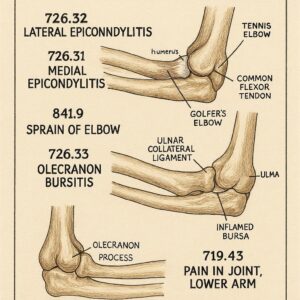
| Lateral Epicondylitis | 726.32 | Lateral epicondylitis. This is the specific code for “Tennis Elbow.” |
| Medial Epicondylitis | 726.31 | Medial epicondylitis. This is the specific code for “Golfer’s Elbow.” |
| Olecranon Bursitis | 726.33 | Olecranon bursitis. Inflammation of the bursa at the tip of the elbow. |
| Unspecified Epicondylitis | 726.30 | Enthesopathy of elbow region, unspecified. Used when the type (lateral/medial) is not specified. |
| Arthritis of the Elbow | 715.0X | Osteoarthrosis, generalized, involving specified sites. The 5th digit specifies the site. For example, 715.02 is for the upper arm (which includes the elbow joint). |
| Elbow Sprain/Strain | 841.XX | Sprains and strains of elbow and forearm. The 4th and 5th digits specify the exact ligament or muscle. (e.g., 841.8 for “Other specified sites”). |
| Other Enthesopathies | 726.39 | Other enthesopathy of elbow region. Used for other attachment-point disorders not specified above. |
Important Note for Readers: The codes in the 726.3x series are for “Enthesopathies,” which are disorders of the attachment sites of tendons or ligaments to bone. This is the core category for most chronic overuse elbow injuries.
The Code for “Undiagnosed” Elbow Pain: The Symptom Code
What if a patient presents with elbow pain, but the physician hasn’t yet determined if it’s epicondylitis, arthritis, or something else? In that case, a symptom code is used. For generalized pain in the elbow and forearm, the relevant ICD-9 code is:
729.5 – Pain in limb
This code is found in Chapter 13 under “Other disorders of soft tissues.” It is a non-specific code used for pain where a more definitive diagnosis is not yet made. It is a temporary placeholder, and further investigation is typically required to assign a more precise code.
The Critical Transition: From ICD-9 to ICD-10-CM
Understanding the modern equivalent is essential. ICD-10-CM is far more detailed and specific. Below is a comparison of how the common elbow conditions transitioned from the old system to the new.
| Condition | ICD-9 Code | ICD-10-CM Code | Key Difference in Specificity |
|---|---|---|---|
| Lateral Epicondylitis | 726.32 | M77.10 (unspecified side) / M77.11 (right) / M77.12 (left) | ICD-10 specifies laterality (right, left, bilateral). |
| Medial Epicondylitis | 726.31 | M77.00 (unspecified) / M77.01 (right) / M77.02 (left) | ICD-10 specifies laterality. |
| Olecranon Bursitis | 726.33 | M70.20 (unspecified) / M70.21 (right) / M70.22 (left) | ICD-10 specifies laterality and has separate codes for septic vs. non-septic bursitis. |
| Unspecified Limb Pain | 729.5 | M79.604 (Pain in right arm) / M79.605 (left) / M79.606 (unspecified arm) | ICD-10 specifies the exact limb and side for pain. |
| Elbow Arthritis | 715.02 | M19.021-M19.032 (Primary, secondary, post-traumatic) | ICD-10 has distinct codes for the type of osteoarthritis and the specific joint. |
This table highlights a fundamental shift: ICD-10-CM requires significantly greater detail, including which arm is affected. This enhances clinical data quality but also increases coding complexity.
Practical Application: How Codes Are Used in Healthcare
To make this concrete, let’s follow a typical patient journey and see how these codes are applied.
-
Initial Visit: John presents with pain on the outside of his right elbow. The physician suspects lateral epicondylitis but orders an X-ray to rule out arthritis. The initial encounter might be coded with the symptom code 729.5 (Pain in limb) or, if the physician is confident, 726.32 (Lateral epicondylitis).
-
Follow-Up & Confirmation: The X-ray confirms no arthritis. The physician formally diagnoses “Right Tennis Elbow.” In an ICD-9 system, the final code would be 726.32. In today’s ICD-10 system, it would be M77.11.
-
Billing & Reimbursement: The medical coder at the clinic assigns the appropriate code to the encounter form. This code, along with a procedure code (CPT code) for the office visit, is sent to John’s insurance company for payment.
-
Medical Record: The code becomes a permanent part of John’s electronic health record, allowing any future provider to quickly understand his medical history related to his elbow.
Helpful Lists: Common Causes of Elbow Pain and Their Code Paths
To aid in understanding, here are common causes and where you’d typically find their ICD-9 codes:
-
Overuse/Repetitive Stress Injuries:
-
Lateral Epicondylitis (726.32)
-
Medial Epicondylitis (726.31)
-
Other Enthesopathies (726.39)
-
-
Inflammation:
-
Olecranon Bursitis (726.33)
-
Various forms of Arthritis (715.0x, 714.0 for rheumatoid)
-
-
Acute Trauma:
-
Sprains/Strains (841.xx)
-
Fractures (codes in the 813.xx series, e.g., 813.07 for olecranon fracture)
-
-
Nerve-Related Pain:
-
Ulnar Nerve Entrapment (354.2) – This is found in the Nervous System chapter (Chapter 6).
-
-
Undiagnosed Pain:
-
Pain in Limb (729.5)
-
Why This Knowledge Matters: Beyond the Code
Understanding these codes isn’t just an administrative exercise. It empowers both patients and professionals.
-
For Patients: Reviewing your Explanation of Benefits (EOB) or medical records becomes less mysterious. You can verify that the code matches your diagnosed condition. If you see a generic code like 729.5, it might indicate that your provider needs to update your record with a specific diagnosis from a specialist’s report.
-
For Healthcare Professionals and Billers: Accuracy is paramount. Using an incorrect or insufficiently specific code can lead to claim denials, delays in payment, and inaccurate patient records. Knowing the history of ICD-9 is essential for auditing older charts or processing legacy claims.
-
For Researchers and Analysts: Historical data locked in ICD-9 codes is still valuable. Understanding the mapping to ICD-10 is necessary for conducting long-term studies on disease trends related to musculoskeletal disorders.
A Final, Critical Disclaimer: This article is for informational and educational purposes only. It is not a substitute for professional medical coding advice. Medical coding is complex and governed by official guidelines. Always consult the current, official ICD-10-CM code set and guidelines for all present-day coding, and refer to archival ICD-9 materials only for historical record analysis. Coding decisions should always be made by qualified professionals based on the complete clinical documentation.
Conclusion
While the ICD-9 code for generalized elbow pain is 729.5, the system prioritized specificity, using codes like 726.32 for tennis elbow and 726.33 for bursitis. These codes were essential for decades of healthcare administration but were replaced by the more detailed ICD-10-CM in 2015. Understanding this transition and the logic behind diagnostic coding provides valuable insight into medical records, billing processes, and the importance of precise clinical language.
Frequently Asked Questions (FAQ)
Q1: Can I still use ICD-9 codes on medical claims today?
A: No. As of October 1, 2015, all HIPAA-covered entities in the United States must use ICD-10-CM for diagnosis coding. Using ICD-9 will result in claim denials.
Q2: I’m looking at an old medical bill from 2014 with code 726.32. What does that mean?
A: Code 726.32 is the ICD-9 code for Lateral Epicondylitis, or “Tennis Elbow.” This was the appropriate code for that condition at the time of your service.
Q3: What is the main difference between ICD-9 and ICD-10 for elbow problems?
A: The main difference is specificity. ICD-10 requires you to specify which arm is affected (right, left, or bilateral). ICD-9 codes did not specify laterality. ICD-10 also offers many more specific codes for different types of the same condition.
Q4: Where can I find the official, current ICD-10 codes?
A: The official ICD-10-CM code set is maintained by the Centers for Disease Control and Prevention (CDC) and the Centers for Medicare & Medicaid Services (CMS). The best resource is the CDC’s official site or licensed professional coding manuals.
Additional Resources
For the most authoritative and up-to-date information on medical coding, please visit the Centers for Disease Control and Prevention (CDC) ICD-10 page: https://www.cdc.gov/nchs/icd/icd-10-cm.htm
Disclaimer: This article was created for educational and informational purposes on January 17, 2026. Medical coding guidelines and standards are subject to change. The author is a professional writer and not a certified medical coder. For definitive coding advice, always consult the latest official coding guidelines and resources or a certified professional coder.