Navigating the world of medical billing can sometimes feel like learning a new language. If you are a chiropractor, a chiropractic assistant, or a billing specialist working in a wellness clinic, you know exactly what we are talking about. At the heart of this language is a very specific vocabulary: ICD-10 codes.
These alphanumeric strings are more than just bureaucratic red tape. They are the universal language we use to tell a patient’s story of injury, dysfunction, and recovery. Getting them right is crucial—not just for getting paid, but for painting an accurate clinical picture that stands up to scrutiny.
In this guide, we are going to walk through the essential ICD-10 codes for chiropractic practice. We will break down the categories, explain how to pair them with modifiers, and help you avoid the common pitfalls that lead to claim denials. Whether you are dealing with a new patient with acute neck pain or a long-term wellness patient, this resource is designed to have your back.
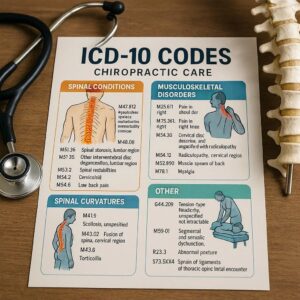
icd 10 codes for chiropractic
Understanding the “Why” Behind the Code
Before we dive into the specific numbers, it is worth taking a moment to appreciate why we use this system. The ICD-10 (International Classification of Diseases, 10th Revision) was designed to be far more specific than its predecessor.
For chiropractors, this specificity is a double-edged sword. On one hand, it allows you to document exactly where the problem is—down to the specific spinal region. On the other hand, it requires a level of detail in your clinical notes that must match the codes you submit.
Think of your documentation and your coding as two sides of the same coin. Your notes justify the code, and the code justifies the treatment. If they don’t match, you risk an audit or a denial.
The Golden Rule of Coding
“Code what is documented, and document what you code.” If your examination notes reveal a loss of lumbar lordosis and restricted range of motion, your code should reflect that specific dysfunction, not just a general symptom.
The Heavy Hitters: Most Common Chiropractic Codes
While there are hundreds of codes you might use over the course of a year, the reality of clinical practice is that a handful of codes do the majority of the heavy lifting. These are the codes for the mechanical back and neck pain that brings most patients through your door.
M99.01 Subluxation Complex (Segmental and Somatic Dysfunction) of the Cervical Region
This is arguably one of the most important codes in the chiropractic lexicon. It signifies a biomechanical problem in the neck area.
-
When to use it: When your assessment reveals segmental dysfunction, misalignment, or restricted movement in the cervical spine (C1-C7).
-
Clinical Context: Often used for patients with “tech neck,” whiplash-associated disorders, or general stiffness.
M99.02 Subluxation Complex of the Thoracic Region
Moving down the spine, this code targets the mid-back. The thoracic spine is unique because it attaches to the ribs, making restrictions here feel different than in the neck or low back.
-
When to use it: For patients presenting with stiffness between the shoulder blades, upper back pain exacerbated by sitting, or postural issues like rounded shoulders.
-
Clinical Context: This is a common code for desk workers and those with respiratory issues that affect rib mobility.
M99.03 Subluxation Complex of the Lumbar Region
The low back is the workhorse of the body and, consequently, the most common source of patient complaints. This code is your go-to for lower back issues.
-
When to use it: For patients reporting pain in the lower spine, often related to lifting, bending, or prolonged standing.
-
Clinical Context: Perfect for cases of acute lumbago where a specific segmental dysfunction is identified.
M99.04 Subluxation Complex of the Sacral Region
The sacrum is the triangular bone at the base of the spine. Dysfunction here can often mimic or contribute to low back pain and pelvic issues.
-
When to use it: When your palpation and motion analysis reveal restrictions in the sacroiliac joints or the sacrum itself.
-
Clinical Context: Frequently used for pregnant patients or those with sacroiliac joint dysfunction.
M54.2 Cervicalgia
Sometimes, the patient presents with neck pain, but the specific segmental dysfunction isn’t as clear-cut, or you are in the initial evaluation phase.
-
When to use it: For pain located in the cervical spine region, regardless of the specific cause. It is a symptom-based code.
-
Clinical Context: Use this when the primary complaint is “neck pain,” but you haven’t yet fully correlated it with a specific subluxation complex noted in your first visit.
M54.5 Low Back Pain (Lumbago)
Similar to cervicalgia, this is a broad code for pain in the lower back. It is non-specific but highly effective when paired with other codes.
-
When to use it: For general complaints of low back pain.
-
Coding Tip: Insurance companies prefer to see this paired with a more specific code like
M99.03to justify the medical necessity of an adjustment.
M54.6 Pain in Thoracic Spine
This code fills the gap for mid-back pain. While it is less common than cervicalgia or lumbago, it is essential for patients who complain of a “burning” sensation between the shoulder blades or pain related to poor ergonomics.
Beyond the Spine: Extremities and Secondary Codes
Chiropractic isn’t just about the spine. Many patients come in because of issues in their shoulders, knees, or feet. These codes help you bill for extremity adjusting.
| Common Condition | ICD-10 Code | Description |
|---|---|---|
| Shoulder Pain | M25.51 | Pain in shoulder. Often used for rotator cuff issues or general glenohumeral joint pain. |
| Knee Pain | M25.56 | Pain in knee. Useful for patellofemoral syndrome or general knee discomfort. |
| Headache | R51 | Headache. A general code. Best used with a secondary code specifying type, like G44.1 (vascular headache). |
| Torticollis | M43.6 | Torticollis. Specifically for wry neck or acquired neck distortion. |
| Sciatica | M54.3 | Sciatica. Refers to pain radiating along the sciatic nerve. Do not confuse with general low back pain. |
The Nuance of “Maintenance” vs. “Medically Necessary”
This is arguably the most important distinction in chiropractic billing. Insurance companies live and die by the concept of “medical necessity.”
-
Medically Necessary Care: This is active treatment aimed at correcting a specific dysfunction, reducing symptoms, and improving function. It is coded with the specific diagnosis (e.g.,
M99.01for cervical subluxation). -
Maintenance Care: This is supportive care designed to prevent relapses, maintain current functional status, or promote general wellness.
The Coding Trap: Maintenance
There is a specific code for encounters where no new condition is being treated, and the patient is simply there for a “tune-up.”
-
Code: Z02.6
-
Description: Encounter for examination for administrative purposes (often interpreted as “maintenance”).
-
The Reality: Most traditional health insurance plans do not reimburse for
Z02.6. It is considered a non-covered service. If you provide a standard adjustment and bill it under a subluxation code (M99.0-) but your notes read like a maintenance visit (“Patient feels good, no complaints, just here for their weekly adjustment”), you are creating a massive red flag for auditors.
Important Note for Readers:
Always ensure your clinical documentation supports the level of care. If you are correcting a new exacerbation of an old injury, that is treatment. If you are simply keeping a patient well, that is maintenance. Mixing the two on a claim form is a fast track to a recoupment request from the insurance company.
The Art of the Combination: How to Use Multiple Codes
Rarely does a patient walk in with a single, isolated issue. Most clinical pictures are complex. A patient might have chronic low back pain that is currently flaring up, causing them to walk differently, which then triggers knee pain.
When this happens, you don’t have to pick just one code. You can (and should) use multiple codes to tell the full story.
The Primary Diagnosis
This is the main reason for the visit. The condition that is being treated on that specific day.
-
Example: Acute exacerbation of lumbar subluxation (
M99.03).
The Secondary Diagnosis
These are co-morbidities or related conditions that affect the treatment of the primary diagnosis.
-
Example: The resulting knee pain from the altered gait (
M25.56).
How it Looks on Paper
A claim for the patient above would list:
-
M99.03 (Subluxation complex of lumbar region) – Primary
-
M25.56 (Pain in knee) – Secondary
This tells the insurance company: “We are treating the low back, and we are also aware of the knee issue, which is related to the back problem.”
ICD-10 Codes for Specific Conditions
Let’s look at some common clinical scenarios and the specific codes that apply. This goes beyond simple pain and into the actual pathological diagnosis.
Disc Issues
Herniated or bulging discs are common in chiropractic offices. These codes fall under the “Dorsopathies” section.
-
M51.26 – Other intervertebral disc displacement, lumbar region
-
M50.21 – Other cervical disc displacement, high cervical region
-
M51.34 – Other intervertebral disc degeneration, lumbar region
-
M50.30 – Other cervical disc degeneration, unspecified cervical region
Sprains and Strains
Accidents happen. Whether it is a sports injury or a slip on the ice, sprains (ligament) and strains (muscle/tendon) are common.
-
S13.4XXA – Sprain of ligaments of cervical spine, initial encounter
-
S33.5XXA – Sprain of ligaments of lumbar spine, initial encounter
-
S39.012A – Strain of muscle, fascia and tendon of lower back, initial encounter
Note the “A” at the end of these codes. This stands for “initial encounter” for an active injury. Once the patient is in the healing phase, it changes to “D” (subsequent encounter), and when they are seen for a problem that is a result of the old injury, it becomes “S” (sequela).
Headaches
Headaches often have a cervical component. In fact, we have a specific term for it.
-
G44.20 – Tension-type headache, unspecified (often related to upper cervical or suboccipital tension)
-
G44.1 – Vascular headache, not elsewhere classified (migraine)
-
R51 – Headache (general)
-
M53.0 – Cervicocranial syndrome (This is a great code for headaches originating from the neck structures)
A Practical Look at the Code Set: The “M99” Family
Since the subluxation complex is the hallmark of chiropractic, let’s break down the M99.0- codes in a way that is easy to visualize.
M99.00 Segmental and Somatic Dysfunction of Head Region
-
Clinical Indicator: Tension headaches, TMJ dysfunction, restricted occipital-atlantal joint.
M99.01 Segmental and Somatic Dysfunction of Cervical Region
-
Clinical Indicator: Neck pain, stiffness, reduced cervical range of motion, upper trapezius tension.
M99.02 Segmental and Somatic Dysfunction of Thoracic Region
-
Clinical Indicator: Mid-back pain, stiffness when twisting, costovertebral joint restrictions, shoulder blade pain.
M99.03 Segmental and Somatic Dysfunction of Lumbar Region
-
Clinical Indicator: Low back pain, muscle spasms in the erector spinae, reduced flexion.
M99.04 Segmental and Somatic Dysfunction of Sacral Region
-
Clinical Indicator: Sacroiliac joint pain, pelvic unleveling, pain when rising from a seated position.
M99.05 Segmental and Somatic Dysfunction of Pelvic Region
-
Clinical Indicator: Pubic symphysis dysfunction, pelvic floor tension, coccydynia (tailbone pain).
M99.06 Segmental and Somatic Dysfunction of Lower Extremity
-
Clinical Indicator: Hip pain, knee tracking issues, foot pronation affecting gait.
M99.07 Segmental and Somatic Dysfunction of Upper Extremity
-
Clinical Indicator: Shoulder impingement, tennis elbow, carpal tunnel syndrome related to nerve root tension.
M99.08 Segmental and Somatic Dysfunction of Rib Cage
-
Clinical Indicator: Difficulty taking a deep breath, sharp pain with inspiration, “slipping rib” sensation.
M99.09 Segmental and Somatic Dysfunction of Abdomen and Other
-
Clinical Indicator: Rare, but can be associated with visceral-somatic reflexes.
Common Pitfalls and How to Avoid Them
Even seasoned billers make mistakes. Here are the most common coding errors we see in chiropractic practices.
1. Coding by Habit, Not by Condition
It is easy to fall into the trap of using the same code for every patient. Mrs. Jones always gets M99.01 because she always has neck pain. But what if she came in today because she hurt her back gardening? Using the cervical code would be incorrect.
The Fix: Treat every visit as a new coding opportunity. Review the daily SOAP note and code for that day’s primary complaint.
2. Undercoding (Being Too Vague)
Submitting a claim with only M54.5 (Low back pain) is better than nothing, but it doesn’t tell the full story. It doesn’t justify the specificity of a chiropractic adjustment.
The Fix: Pair the symptom code with the dysfunction code. Use M54.5 and M99.03 together.
3. Ignoring the “Excludes1” and “Excludes2” Notes
The ICD-10 manual has notes that tell you when two codes cannot be used together. For example, you generally wouldn’t code a sprain and a strain of the same area separately if a combined code exists.
The Fix: Keep an up-to-date coding manual or software that alerts you to these conflicts.
4. The “7th Character” Confusion (Initial, Subsequent, Sequela)
As mentioned with the injury codes (S-codes), the 7th character matters.
-
A = Active treatment (the patient just fell yesterday).
-
D = Routine healing (the patient is coming for follow-up care, but the wound is healing).
-
S = Late effects (the scar tissue, the chronic pain resulting from the old injury).
Using “A” three months after a car accident for a patient who is now in the chronic phase will raise eyebrows.
Practical Tips for a Cleaner Claims Process
Beyond just picking the right code, the process of submitting a claim requires strategy. Here are a few tips from the front lines of billing.
-
Check your LCDs (Local Coverage Determinations): Medicare and many private insurers have specific rules about what conditions they cover and how many visits they allow. Always check your local MAC’s (Medicare Administrative Contractor) website for the latest LCD on chiropractic services. What works in Florida might not work in California.
-
Sync Your Notes and Codes: Before you hit “submit,” do a quick mental check. If you were an auditor, would you be able to look at the doctor’s notes and find the justification for the
M99.03code you used? The notes must mention segmental dysfunction, motion palpation findings, or specific orthopedic test results. -
Don’t Fear the Z-Codes: While
Z02.6(maintenance) is often not reimbursable, other Z-codes are useful. For example, if a patient has a family history of osteoporosis, you can useZ82.62(Family history of osteoporosis) to support why you are being extra cautious with your adjusting technique.
Frequently Asked Questions (FAQ)
Q: What is the difference between a “subluxation” code and a “pain” code?
A: A subluxation code (M99.0-) describes a biomechanical dysfunction of the joint. A pain code (M54.-) describes the symptom. Using them together provides a complete picture: the patient has neck pain due to a cervical subluxation.
Q: Can I use a chiropractic code for extremity adjustments?
A: Yes. The M99.0- series includes codes for upper extremity (M99.07) and lower extremity (M99.06) dysfunction. You can also use joint pain codes (M25.5-) for the specific joint.
Q: What happens if I use the wrong ICD-10 code?
A: It depends. If it’s a simple error, the claim may be denied, and you can resubmit with the correct code. If the error is part of a pattern of upcoding (using a more severe code to get paid more), you could face an audit, fines, or even legal action for fraud.
Q: My patient feels fine and just wants an adjustment for wellness. What code do I use?
A: The most accurate code is Z02.6 (Encounter for examination for administrative purposes). However, you must be aware that most insurance plans do not cover this. You should collect payment from the patient at the time of service.
Q: Do I need to use different codes for acute vs. chronic conditions?
A: The ICD-10 system often does not differentiate in the code itself (except for injury codes). However, the “acute” or “chronic” nature should be documented in your clinical notes and can sometimes be indicated with a 7th character in specific circumstances. For standard M-codes, the chronicity is part of your written diagnosis, not the code number.
Additional Resource
For the most up-to-date official information, cross-referencing, and to check for any annual code updates, the best resource is the Centers for Medicare & Medicaid Services (CMS) ICD-10 website. You can find the full code set and guidelines here:
Visit the Official CMS ICD-10 Resource Page
Conclusion
Mastering ICD-10 codes for chiropractic is an ongoing process of learning and adaptation. By focusing on specificity—pairing the right symptom with the right dysfunction, and ensuring your documentation tells a consistent story—you protect your practice from audits and ensure you are fairly reimbursed for the excellent care you provide. It’s about accuracy, not just for the insurance companies, but for the integrity of your clinical records.
Disclaimer: This article is intended for informational and educational purposes only and does not constitute legal or billing advice. Coding rules and payer policies vary and change frequently. Always consult with a qualified professional billing specialist and refer to the official ICD-10 manual and your specific payer contracts for final determination.