Navigating the world of medical coding can sometimes feel like learning a new language. With thousands of codes, each representing a specific diagnosis, symptom, or finding, accuracy is everything. It’s not just about paperwork; it’s about patient care, clear communication, and ensuring proper reimbursement.
One term that frequently pops up in hematology and cardiology settings is “PTT.” If you are a medical coder, a biller, a nurse, or a physician trying to find the precise code, you’ve likely searched for the “icd 10 code for ptt” and found a few different options. This can be confusing.
Is PTT a diagnosis? Is it a symptom? Is it a test result?
The short answer is that PTT itself isn’t a disease. It’s a lab test. Therefore, you don’t code for the test; you code for the reason the test was ordered or the result it revealed. In the ICD-10 system, we document what is wrong with the patient, not the procedure used to find it out.
This comprehensive guide is designed to clear up the confusion once and for all. We will explore the ins and outs of coding for issues related to the Partial Thromboplastin Time, providing you with the knowledge to code accurately and confidently.
ICD-10 Code for PTT
What is PTT? Understanding the Lab Test
Before we dive into the codes, it’s crucial to understand what PTT actually is. This context is the foundation of accurate coding.
PTT stands for Partial Thromboplastin Time. It’s a blood test that measures how long it takes for your blood to clot. It’s a way of evaluating the function of specific proteins in your blood, called clotting factors, that are part of a pathway known as the intrinsic and common coagulation pathways.
Think of it as a stopwatch for a specific part of your body’s complex clotting system. When a patient has a cut or an internal injury, a cascade of events happens to form a clot and stop the bleeding. The PTT test checks if a specific section of that cascade is working correctly.
Why is a PTT Test Ordered?
A doctor might order a PTT test for several reasons:
-
Monitoring Heparin Therapy: This is one of the most common reasons. Heparin is a powerful blood thinner (anticoagulant) used to prevent and treat blood clots. The PTT is used to ensure the patient is in the “therapeutic range”—not too high (risk of bleeding) and not too low (risk of clotting).
-
Investigating Unexplained Bleeding or Clotting: If a patient has frequent nosebleeds, heavy menstrual bleeding, bruises easily, or has a blood clot (like a deep vein thrombosis or DVT) for no apparent reason, a PTT test can help find the cause.
-
Pre-Surgery Screening: Before a major surgery, a doctor might order a PTT to check for any hidden bleeding disorders.
-
Diagnosing Bleeding Disorders: It is a key test in diagnosing conditions like hemophilia or von Willebrand’s disease.
Understanding that the test is a tool to investigate an underlying issue is the key to understanding the “icd 10 code for ptt.” You are, in essence, coding the “why.”
The Cardinal Rule of Coding Lab Tests
This is the most important concept to grasp. In the ICD-10-CM coding system, you do not assign a code to a laboratory finding if the underlying condition is documented.
Let’s say a patient is on heparin and their PTT is high. If the physician documents “Prolonged PTT due to heparin therapy,” you will not code the prolonged PTT. You will code the condition that necessitates the heparin (e.g., a pulmonary embolism) and possibly a code for long-term drug use.
You only turn to the “abnormal findings” codes when the physician has not yet made a connection or a diagnosis. These are often referred to as “unspecified” or “provisional” diagnoses while an investigation is ongoing.
Important Note: Always code what the physician has documented. If the note says “Prolonged PTT,” and nothing else, you can use an abnormal findings code. If the note says “Prolonged PTT due to Lupus Anticoagulant,” you code the Lupus Anticoagulant syndrome.
With that foundational rule in mind, let’s look at the most common codes used for situations involving a PTT test.
Primary ICD-10 Codes for PTT-Related Scenarios
When searching for the “icd 10 code for ptt,” you will likely land in one of two places: Chapter 18 (Symptoms and Abnormal Findings) or Chapter 3 (Diseases of the Blood). Here are the most relevant codes.
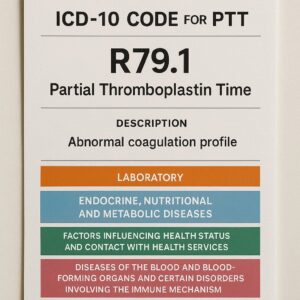
R79.1: Abnormal Coagulation Profile
This is your go-to code when a PTT comes back abnormal, and the doctor hasn’t yet determined a specific cause. It’s the most direct answer to the search for “icd 10 code for ptt” when the PTT is the specific abnormality.
-
Description: Abnormal coagulation profile.
-
What it includes: This code is used for abnormal results from bleeding time tests, coagulation studies, partial thromboplastin time (PTT), and prothrombin time (PT).
-
When to use it:
-
A patient presents with easy bruising. The physician orders a panel of coagulation tests. The PTT comes back prolonged, but the INR (International Normalized Ratio) is normal. The physician’s note reads: “Prolonged PTT, likely a factor deficiency. Will refer to hematology.” You would code R79.1 for the abnormal finding.
-
A pre-operative PTT screening comes back slightly elevated. The anesthesiologist cancels the surgery and writes an order to “Repeat PTT in one week to confirm.” The diagnosis for the cancelled surgery case would be R79.1.
-
Z79.01: Long-term (Current) Use of Anticoagulants
This code is critical for patients on medications like warfarin (Coumadin), heparin, or other injectable anticoagulants. It’s not a code for the condition itself, but for the drug therapy. This is almost always a secondary code.
-
Description: Long-term (current) use of anticoagulants.
-
When to use it:
-
A patient with a history of a pulmonary embolism is on chronic warfarin therapy and comes in for a routine PTT/INR check. The primary diagnosis would be the history of the PE (Z86.71). The secondary diagnosis would be Z79.01 to indicate the reason for the test (monitoring drug therapy).
-
A patient on heparin in the hospital for a DVT. You would code the DVT (I82.4-) as the primary diagnosis and Z79.01 as a secondary code.
-
Codes for Specific Coagulation Defects
Sometimes the investigation is complete, and a definitive diagnosis is made. In these cases, you move from the general “abnormal finding” (R79.1) to a more specific diagnosis code. These are found in Chapter 3 (D50-D89).
D68.4: Acquired Coagulation Factor Deficiency
This code is used when a deficiency in clotting factors is not inherited but develops later in life. Common causes include liver disease, vitamin K deficiency, or the presence of an inhibitor like a lupus anticoagulant.
-
Example: A patient with advanced liver disease has a prolonged PTT due to decreased production of clotting factors. The physician documents “Prolonged PTT secondary to liver disease.” You would code the liver disease first, and then D68.4 to capture the acquired deficiency.
D68.31: Hemorrhagic Disorder Due to Intrinsic Circulating Anticoagulants
This code covers conditions where the body produces substances that attack its own clotting factors. The most common example is a lupus anticoagulant (which, confusingly, promotes clotting, not bleeding).
-
Example: A patient with a history of recurrent miscarriages is found to have a prolonged PTT. Further testing reveals the presence of a lupus anticoagulant. The physician diagnoses “Antiphospholipid Syndrome.” You would code the syndrome (D68.61) or the specific finding D68.31.
D68.32: Hemorrhagic Disorder Due to Extrinsic Circulating Anticoagulants
This code is specifically for bleeding caused by drugs, like heparin. If a patient on heparin has a major bleed and it is directly attributed to the drug’s anticoagulant effect, this code may be used.
-
Example: A patient on therapeutic heparin develops a large hematoma. The physician documents “Heparin-induced bleeding.” You would code the hematoma (e.g., T14.8) and then D68.32 to specify the cause.
Codes for Hereditary Deficiencies (D67, D66)
-
D67 (Hemophilia B): Hereditary deficiency of factor IX. This will cause a prolonged PTT.
-
D66 (Hemophilia A): Hereditary deficiency of factor VIII. This is the most common cause of a prolonged PTT due to a congenital factor deficiency.
Quick Reference Table: Choosing the Right Code
To help you visualize the decision-making process, here’s a handy table based on a real clinical scenario.
| Scenario | Physician’s Documentation | Correct ICD-10 Code(s) | Rationale |
|---|---|---|---|
| Scenario 1: Routine Monitoring | “Patient on warfarin for chronic atrial fibrillation. Routine INR today is 2.5, which is therapeutic.” | I48.91 (Unspecified atrial fibrillation) Z79.01 (Long-term use of anticoagulants) |
The PTT/INR is normal. You code the condition being treated and the drug therapy. No abnormal finding code is needed. |
| Scenario 2: Unexplained Finding | “Pre-op labs show a mildly prolonged PTT. Patient has no bleeding history. Will repeat.” | R79.1 (Abnormal coagulation profile) | The physician has not linked this to a specific diagnosis. It is an unexplained abnormal finding. |
| Scenario 3: Known Cause (Acquired) | “Patient with cirrhosis has prolonged PTT due to synthetic liver dysfunction.” | K74.60 (Unspecified cirrhosis of liver) D68.4 (Acquired coagulation factor deficiency) |
The physician has identified the cause (liver disease). The abnormal finding is now a manifestation of the primary disease. |
| Scenario 4: Known Cause (Hereditary) | “Established patient with Hemophilia A (Factor VIII deficiency) presents for joint pain.” | D66 (Hereditary factor VIII deficiency) M25.50 (Pain in unspecified joint) |
Hemophilia A is a definitive diagnosis in Chapter 3. This is the cause of any prolonged PTT. |
| Scenario 5: Therapeutic Effect | “Patient on heparin drip for PE. PTT is elevated but within therapeutic range.” | I26.99 (Other pulmonary embolism without acute cor pulmonale) Z79.01 |
The elevated PTT is the intended effect of the medication. You do not code it as abnormal. Code the PE and the drug use. |
Common Clinical Scenarios and Correct Coding
Let’s walk through a few more detailed patient stories to see how these rules apply in practice.
Scenario A: The Post-Surgical Patient
Mr. Jones, 65, underwent a total knee replacement two days ago. He is on a low-dose heparin injection to prevent post-operative blood clots. Today, his nurse notices a large, spreading bruise around the surgical site. The physician orders a stat PTT, which comes back significantly prolonged. The physician writes in the note: “Prolonged PTT likely due to heparin accumulation. Will hold next dose and monitor closely.”
Coding for Scenario A:
-
Primary Diagnosis: T45.515A (Adverse effect of anticoagulants, initial encounter). This captures the fact that the drug has caused an unintended, harmful reaction.
-
Secondary Diagnosis: Z47.1 (Aftercare following joint replacement surgery). This provides context for why the patient is on the medication.
We are not using R79.1 here because the cause has been explicitly identified: an adverse effect of the heparin.
Scenario B: The Diagnostic Workup
Ms. Smith, 22, visits her primary care physician. She reports that she has always bruised easily and that her menstrual periods are very heavy. The physician, suspecting a bleeding disorder, orders a coagulation panel, including a PTT, PT, and platelet function tests. The PTT comes back prolonged, but the other tests are normal. The physician’s assessment reads: “Unexplained prolonged PTT. Suspect possible mild hemophilia or von Willebrand’s disease. Referral to hematology for further factor assays.”
Coding for Scenario B:
-
Primary Diagnosis: R79.1 (Abnormal coagulation profile). The physician has a suspicion, but no definitive diagnosis has been made yet. The workup is in progress. This code accurately reflects the current state of the patient’s workup.
Scenario C: The Established Diagnosis
Mr. Garcia, 8, has a known diagnosis of Hemophilia B (Factor IX deficiency). He is brought to the clinic by his mother because he fell and bumped his knee, which is now swollen and painful. The physician examines him and orders a PTT to check his current clotting status before possibly administering factor concentrate.
Coding for Scenario C:
-
Primary Diagnosis: D67 (Hereditary factor IX deficiency). This is the definitive, chronic condition.
-
Secondary Diagnosis: S80.11XA (Contusion of right knee, initial encounter). This explains the acute event that prompted the visit and the PTT test.
The PTT result is just a measure of his known condition; you don’t code it separately.
The Crucial Role of Z-Codes for Encounters
Don’t overlook the power of Z-codes! They are essential for providing the full picture of a patient encounter, especially when dealing with lab tests.
-
Z01.812 (Encounter for preprocedural laboratory examination): Use this code for pre-op testing when no signs or symptoms of a disorder are present. If the pre-op PTT comes back abnormal and the surgery is canceled, you would then use the abnormal finding code (R79.1) as the primary diagnosis for the cancellation encounter.
-
Z00.00 (Encounter for general adult medical examination without abnormal findings): If a PTT is ordered as part of a routine physical and comes back normal, this would be the primary code. You do not code the normal lab value.
-
Z79.01 (Long-term (current) use of anticoagulants): As mentioned, this is a staple for any patient on chronic blood thinners who is being monitored.
Disclaimer
The information provided in this article, including all codes, descriptions, and guidelines, is for general informational purposes only and is not a substitute for professional medical coding advice. Medical coding regulations, guidelines, and payer policies are complex and subject to change. While we strive to provide accurate and up-to-date information, we make no representations or warranties of any kind, express or implied, about the completeness, accuracy, reliability, or suitability of this information for any particular purpose. You should always consult the official ICD-10-CM code set, your organization’s coding policies, and qualified coding professionals to ensure accurate and compliant coding for specific patient encounters. Reliance on any information provided in this article is solely at your own risk.
Conclusion
Finding the right “icd 10 code for ptt” is less about memorizing a single number and more about understanding the clinical context. The code you choose—whether it’s an abnormal findings code like R79.1, a drug monitoring code like Z79.01, or a specific diagnosis like D66—depends entirely on why the test was done and what the physician found. By focusing on the physician’s documented diagnosis and the reason for the encounter, you can navigate these coding scenarios with clarity and confidence.
Frequently Asked Questions (FAQ)
1. Is there a specific ICD-10 code for a “therapeutic” PTT level?
No. A therapeutic range is the intended outcome of medication. You code the condition being treated (e.g., a pulmonary embolism) and the long-term use of the anticoagulant (Z79.01). A normal or therapeutic lab value is never coded.
2. Can I use R79.1 and a specific diagnosis code together?
Generally, no. If the physician has made a definitive diagnosis (like Hemophilia A) that explains the abnormal PTT, you should code the definitive diagnosis only. The “abnormal finding” code (R79.1) is for when a specific cause has not yet been identified.
3. My patient is on Eliquis (a DOAC), not warfarin or heparin. Does Z79.01 still apply?
Yes. The code Z79.01 is for “Long-term (current) use of anticoagulants.” This includes direct oral anticoagulants (DOACs) like apixaban (Eliquis), rivaroxaban (Xarelto), and edoxaban (Savaysa), as well as warfarin and heparin.
4. What if the PTT is high, but the doctor just writes “PTT high” in the note?
Code R79.1 (Abnormal coagulation profile). You are coding the documented abnormal finding. However, if the doctor’s note elsewhere states the patient has a known condition like liver failure, you would prioritize that condition and its manifestations.
5. What is the difference between coding a prolonged PT and a prolonged PTT?
Both fall under the same “abnormal coagulation profile” code (R79.1) if the cause is unknown. However, they point to different problems. PT measures the extrinsic pathway (factors VII), while PTT measures the intrinsic pathway (factors VIII, IX, XI, XII). A definitive diagnosis for a prolonged PT might be a vitamin K deficiency (E56.1), while for PTT it might be hemophilia (D66, D67).