Finding the correct medical code can sometimes feel like searching for a needle in a haystack. When it comes to respiratory issues, precision is everything—not just for billing, but for ensuring a patient’s medical record accurately reflects their condition.
If you are looking for the ICD 10 code for mucous plugging, you have likely realized it isn’t always a one-size-fits-all answer. In the world of medical coding, context is king. A thick buildup of mucus can be a minor annoyance for one patient and a life-threatening emergency for another. The code you use must tell that story.
In this guide, we will walk through the nuances of coding for mucous plugging, explore the most common codes used, and help you navigate the tricky waters of respiratory documentation.
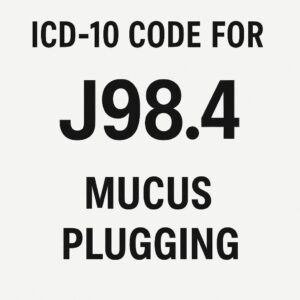
ICD 10 Code for Mucous Plugging
What is Mucous Plugging? A Brief Clinical Overview
Before we dive into the codes, it helps to understand exactly what we are coding for. Mucous plugging occurs when thick, inspissated (dried or thickened) mucus accumulates in the airways. Instead of being cleared by the body’s natural cilia or by coughing, it sticks to the walls of the bronchi or bronchioles, potentially blocking the airway partially or completely.
Common causes include:
-
Asthma: During an exacerbation, mucus production increases and becomes more viscous.
-
Chronic Obstructive Pulmonary Disease (COPD): Chronic inflammation leads to mucus hypersecretion.
-
Cystic Fibrosis: A genetic disorder that causes thick, sticky mucus.
-
Post-surgical complications: Patients who are immobile or have difficulty coughing after surgery.
-
Mechanical Ventilation: The presence of an artificial airway can inhibit the cough reflex and dry out secretions.
Note for Readers: From a clinical perspective, mucous plugging is often a symptom or a complication of an underlying condition, rather than a standalone disease. This is why the ICD-10 coding can point in several different directions.
The Primary ICD 10 Code for Mucous Plugging: A Breakdown
There is no single, standalone code titled “mucous plugging.” Instead, we use codes that describe the result of the plugging or the condition associated with it. The two main contenders are codes for “other specified diseases of respiratory system” and codes linked to asthma.
J98.09: Other Diseases of Bronchi, Not Elsewhere Classified
This is the most common code used when the primary documentation specifies a mucus plug in the bronchus without a specific associated disease like asthma being the active focus at that encounter.
-
What it covers: Broncholithiasis, calcification of bronchi, ulceration of bronchus, and yes—tracheobronchial collapse and mucus plugging when specified.
-
When to use it: If a patient presents with a mucus plug seen on a bronchoscopy, or if a physician documents “mucous plugging of the airway” in a patient without an active asthma exacerbation.
J45.998: Other Asthma
This is another heavy hitter. If a patient has asthma and the mucous plugging is a direct result of an asthma exacerbation, this code is your starting point.
-
What it covers: This code is for “other asthma” with (or without) status asthmaticus.
-
When to use it: If a patient comes in wheezing, short of breath, and the diagnosis is an asthma exacerbation with mucus plugging contributing to the airflow obstruction.
The Difference Between Manifestation and Diagnosis
To clarify, here is a simple breakdown of how these codes are applied in a medical setting.
| Clinical Scenario | Likely Primary Code | Rationale |
|---|---|---|
| Asthma Attack | J45.998 (Other asthma) | The asthma is the underlying disease; the mucus plug is a manifestation of the asthma. |
| Post-op Atelectasis | J98.09 (Other bronchial diseases) | The plug caused the lung to collapse; you are coding the bronchial issue. |
| COPD with Mucus Hypersecretion | J44.1 (COPD with exacerbation) | The plug is part of the exacerbation. You would likely add J98.09 as a secondary code. |
| Incidental Finding | Z03.89 (Encounter for observation) | If a plug is seen but the patient is asymptomatic, you might code the observation. |
Beyond the Basics: Other Relevant ICD 10 Codes
Coding rarely stops at the primary diagnosis. To capture a complete picture, you often need to add codes for the symptoms or the results of the mucous plugging.
Coding for Symptoms (Manifestations)
Often, the patient isn’t complaining of a “plug.” They are complaining of what the plug is doing to them. In these cases, you code the symptom first, and then the cause (the plug) second.
-
R05.1: Acute cough: If the plug is causing a sudden, intense cough.
-
R06.02: Shortness of breath: A very common companion code.
-
R09.82: Chest pain: Patients often report chest discomfort or tightness.
-
R04.2: Hemoptysis: If the coughing up of mucus is streaked with blood due to irritation.
Coding for Complications
This is where things get serious. A mucus plug can lead to significant respiratory events.
J98.11: Atelectasis
This is one of the most common complications. When a mucus plug blocks the airway, the air trapped in the alveoli beyond the blockage gets absorbed into the bloodstream, causing the lung tissue to collapse.
-
Coding tip: You would typically code the atelectasis first (J98.11) and then use J98.09 for the mucous plugging as a secondary code to indicate the cause.
J96.01 – J96.02: Acute Respiratory Failure
In severe cases, widespread mucous plugging can prevent sufficient oxygenation.
-
Coding tip: Respiratory failure is always coded first if it is the reason for admission and meets the clinical definition.
Common Questions from Medical Coders
Coding for respiratory issues can be tricky. Here are answers to some frequently asked questions based on real-world coding scenarios.
“What if the doctor just writes ‘mucus plug’?”
This is a common documentation challenge. If the physician documents only “mucus plug,” you need to look at the encounter.
-
If it was found during a bronchoscopy for a collapsed lung, you have a link: Atelectasis due to mucous plug. Code J98.11 (Atelectasis) first.
-
If it was found in a patient with a chronic cough and no other lung disease, J98.09 is likely your best bet.
“Is it the same code for a newborn?”
No. This is critical. A “mucus plug” in a newborn is often related to a condition called “meconium aspiration” or transient tachypnea, which have their own specific codes in the P00-P96 range (Perinatal period). Never use adult respiratory codes for neonates unless specifically directed to by a coding guideline.
“Can I code mucous plugging with pneumonia?”
Yes, but be cautious. Pneumonia (J12-J18) involves infection and inflammation of the lung parenchyma. A mucus plug can obstruct a bronchus and lead to post-obstructive pneumonia. In this case, you would code the pneumonia first, and then the mucous plugging as a secondary code to show the mechanism.
How to Write a Query for “Mucous Plugging”
Sometimes, the documentation just isn’t clear enough. If you are a coder and you see “mucous plugging” in a note but no clear link to an underlying disease, it is acceptable (and professional) to query the physician.
Example Query:
“Dear Dr. [Name],
In reviewing the chart for patient [Name], I noticed the diagnosis of ‘mucous plugging’ documented in the procedure note.
To ensure the most accurate coding, could you please clarify if this mucous plugging was associated with an underlying condition such as an acute asthma exacerbation, or if it should be classified as an isolated bronchial abnormality?
Thank you for your clarification.”
Best Practices for Documentation
For physicians and clinicians reading this: clear documentation makes the coder’s job easier and ensures your department gets proper reimbursement.
-
Link the dots: Instead of writing “Mucus plug,” write “Atelectasis due to mucus plug in the right mainstem bronchus.”
-
Specify the context: Is this a chronic issue? Is it acute? Is the patient asthmatic? (e.g., “Acute asthma exacerbation with mucus plugging.”)
-
Document the treatment: Did you perform a bronchoscopy for removal? Did you prescribe nebulized medications? This supports the severity of the diagnosis.
Important Note: Always code to the highest level of specificity. If the chart says “asthma,” but you know the patient has “mild intermittent asthma,” use the specific code J45.20 (Mild intermittent asthma, uncomplicated), not the general “other asthma” code.
Real-World Coding Scenarios
Let’s look at how this works in practice with three different patient stories.
Scenario 1: The Emergency Room Visit
The Story: A 35-year-old with a history of asthma presents with severe wheezing and difficulty breathing after a cold. The ER physician diagnoses an acute asthma exacerbation with suspected mucus plugging.
The Coding:
-
Primary: J45.998 (Other asthma)
-
Secondary: R06.02 (Shortness of breath)
Scenario 2: The Inpatient Hospital Stay
The Story: A 68-year-old post-operative hip replacement patient develops a fever and low oxygen levels. A chest X-ray shows a collapsed left lower lobe (atelectasis). Respiratory therapy performs chest physiotherapy, and the patient coughs up a large mucus plug.
The Coding:
-
Primary: J98.11 (Atelectasis)
-
Secondary: J98.09 (Other diseases of bronchus – for the plug)
Scenario 3: The Outpatient Clinic
The Story: A 50-year-old smoker with chronic bronchitis (COPD) comes in for a follow-up. He reports still coughing up thick mucus but feels better than his last visit. The physician notes “Chronic productive cough due to COPD with mucus hypersecretion.”
The Coding:
-
Primary: J44.9 (Chronic obstructive pulmonary disease, unspecified)
-
Secondary: R05.3 (Chronic cough)
Additional Resources
Navigating the ICD-10 manual can be complex. For official guidelines, always refer to the Centers for Medicare & Medicaid Services (CMS) and the National Center for Health Statistics (NCHS) .
Conclusion: Context is Everything
To summarize, there isn’t a single magic ICD 10 code for mucous plugging. The correct choice depends entirely on the patient’s underlying condition and the clinical circumstances. Remember that J98.09 is your go-to for isolated bronchial issues, while J45.998 applies when asthma is the root cause. Always prioritize coding the complication first—like atelectasis or respiratory failure—and then link the plug as the cause. Accurate documentation and coding ensure the patient’s story is told correctly and the facility is reimbursed fairly.
Frequently Asked Questions (FAQ)
Q1: What is the specific ICD-10 code for a mucus plug?
A: There is no single “specific” code. The most common codes used are J98.09 (Other diseases of bronchus) for general plugging, and J45.998 (Other asthma) when related to an asthma exacerbation.
Q2: Can I use J98.09 for a plug found during surgery?
A: Yes, if the plug is in the bronchus and is documented as a distinct finding. However, if the plug is causing a collapsed lung, you would code the atelectasis (J98.11) first and then J98.09 as a secondary code.
Q3: Is mucous plugging the same as “chest congestion”?
A: No, not exactly. “Chest congestion” is a vague, patient-friendly term. Mucous plugging is a specific clinical finding where mucus is obstructing an airway. You would never code “chest congestion” as mucous plugging without clinical evidence.
Q4: What if the mucus plug is in the nose or throat?
A: The codes we discussed (J98.09, J45.998) are for the bronchi (the lung airways). For the upper airway, you would look at codes for the nose or pharynx, such as J34.89 (Other specified disorders of nose and nasal sinuses).
Disclaimer: This article is for informational purposes only and does not constitute legal or professional coding advice. Medical coding guidelines and payer policies can change. Always consult the current official ICD-10-CM code set and your facility’s coding guidelines before assigning codes.