Navigating the world of medical billing can sometimes feel like learning a new language. If you are a healthcare provider, a medical coder, or a patient trying to understand a recent diagnosis, you have likely encountered a string of letters and numbers that seem confusing at first glance.
One of the most common searches in this field is for the “icd 10 code for pelvic floor dysfunction.” It sounds like there should be one simple answer, but the reality is a bit more nuanced—and that nuance is important for proper treatment and insurance purposes.
This guide is designed to be your friendly, reliable roadmap. We will explore the specific codes, explain why the “unspecified” code isn’t always your best friend, and break down the different diagnoses that fall under the pelvic floor umbrella. Whether you are a seasoned professional or just starting to learn, this article will provide the clarity you need.
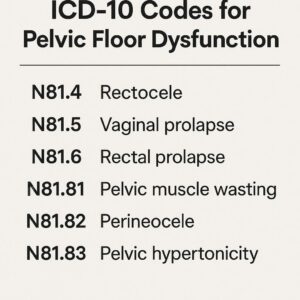
ICD-10 Codes for Pelvic Floor Dysfunction
What is Pelvic Floor Dysfunction? A Quick Overview
Before we dive into the codes, let’s make sure we are all on the same page about what we are actually coding. The pelvic floor is a group of muscles and ligaments that act like a supportive hammock at the bottom of the pelvis. It does a remarkable job: it holds up the bladder, uterus, and rectum, and it helps control bowel and bladder function.
Pelvic Floor Dysfunction (PFD) happens when these muscles aren’t working correctly. They might be too weak, too tight, or uncoordinated. This can lead to a surprising variety of symptoms, which is why the ICD-10 codes need to be so specific.
Common Symptoms Associated with PFD
Because the pelvic floor touches so many bodily systems, symptoms can vary widely. Patients might experience:
-
Urinary issues: Leakage of urine (incontinence), a sudden strong urge to urinate (urgency), or feeling like the bladder isn’t empty.
-
Bowel issues: Leaking stool (fecal incontinence), straining during bowel movements, or chronic constipation.
-
Pain: Persistent pain in the lower back, pelvic region, genitals, or rectum. Pain during intercourse is also a common sign.
-
Pressure: A feeling of heaviness, fullness, or pulling in the vagina or rectum, as if something is falling out (prolapse).
Understanding these symptoms is the first step, because the correct ICD-10 code will often describe the primary symptom or the specific diagnosis, rather than just the umbrella term “dysfunction.”
Why Specificity Matters in ICD-10 Coding
You might be tempted to search for one single code and be done with it. In the world of medical coding, however, specificity is your best friend. Here’s why:
-
Accuracy of Medical Records: A specific code paints a clearer picture of the patient’s health journey. It tells a story that “unspecified” simply cannot.
-
Insurance Reimbursement: Insurance companies use these codes to determine coverage and reimbursement. An incorrect or vague code can lead to claim denials, delays, or even audits. They want to know exactly what was treated.
-
Guiding Treatment: The code helps communicate the diagnosis to other healthcare providers, ensuring everyone is on the same page from the start.
-
Public Health Data: On a larger scale, accurate coding helps researchers and public health officials track the prevalence of specific conditions.
In short, using the most precise code is a win for everyone involved.
The Primary Code: N81.84 and Why It’s Important
If there is one code that comes closest to being the “go-to” for our main keyword, it is N81.84.
This code falls under the category “Other female genital prolapse” and is specifically titled: “Pelvic muscle wasting.”
Now, you might think, “But my patient doesn’t have muscle ‘wasting’!” In clinical practice, N81.84 has become the standard, accepted code for generalized pelvic floor weakness or atony (loss of muscle tone) in women. It is the most common code used when the primary issue is that the muscles have lost their strength and are no longer providing adequate support.
Important Note: This code is specific to female patients. There are separate codes for male patients, which we will cover later.
Beyond N81.84: A Detailed Breakdown of PFD Codes
Pelvic floor dysfunction is rarely just one thing. It’s often a constellation of symptoms. Therefore, the most accurate coding often comes from identifying the dominant symptom or the specific condition. Let’s break down the most common codes by category.
Codes for Pelvic Organ Prolapse (POP)
Pelvic organ prolapse occurs when the pelvic muscles are too weak to hold an organ in place, and it descends into the vaginal canal. There are specific codes for which organ is prolapsed.
| Condition (Prolapse of…) | ICD-10 Code | Description |
|---|---|---|
| Bladder (Cystocele) | N81.10 | Anterior vaginal wall prolapse, unspecified (often used for cystocele). More specific codes exist for mild, moderate, and severe. |
| Uterus | N81.2 | Incomplete uterovaginal prolapse. |
| Uterus (Complete) | N81.3 | Complete uterovaginal prolapse. |
| Vaginal Vault | N81.12 | Prolapse of the vaginal vault after hysterectomy. |
| Rectum (Rectocele) | N81.6 | Posterior vaginal wall prolapse (rectocele). |
| Small Bowel (Enterocele) | N81.5 | Vaginal enterocele. |
Codes for Incontinence
Incontinence is one of the most common reasons patients seek help. The codes differentiate between the type of leakage.
-
Stress Incontinence (R32.1): This is leakage that happens with physical exertion—coughing, sneezing, laughing, or jumping. It happens when the sphincter muscle is weak.
-
Urge Incontinence (R39.41): This is a sudden, intense urge to urinate followed by an involuntary loss of urine. The bladder muscles are overactive.
-
Mixed Incontinence (R39.42): As the name suggests, this is a combination of both stress and urge incontinence. It is very common.
-
Overflow Incontinence (R39.48): This occurs when the bladder doesn’t empty completely, and it later leaks small amounts of urine. This is more common in men with prostate issues.
Codes for Pelvic Pain and Other Symptoms
Pain and discomfort are also key indicators of pelvic floor issues, often related to muscle tension rather than weakness.
-
Pelvic and Perineal Pain (R10.2): This is a broad code for pelvic and perineal pain. It is useful when pain is the primary complaint, but the specific cause is still being investigated.
-
Female Chronic Pelvic Pain (N94.4): A more specific code for long-standing pelvic pain in women. This is a very common diagnosis related to hypertonic (too tight) pelvic floor muscles.
-
Dyspareunia (N94.10): This is the medical term for persistent or recurrent pain during or after sexual intercourse. It is a classic symptom of a tense pelvic floor.
-
Levator Ani Syndrome (K59.31): This is a specific condition involving spasm in the levator ani muscle, one of the main pelvic floor muscles. It causes a dull ache or pressure in the rectum that can worsen with sitting.
ICD-10 Codes for Pelvic Floor Dysfunction in Men
While PFD is often thought of as a women’s health issue, men have pelvic floors too, and they can experience dysfunction. Prostate surgeries, chronic constipation, and heavy lifting can all contribute. For male patients, you will generally use codes from the genitourinary system for males, combined with symptom codes.
-
N51.-: Disorders of male genital organs in diseases classified elsewhere. (This requires a combined coding approach).
-
N49.81: Cystitis and urethritis in diseases classified elsewhere. (Used for inflammation-related issues).
-
N49.9: Inflammatory disorder of unspecified male genital organ. (A less specific option for general inflammation).
-
R32: Unspecified urinary incontinence. (This is a gender-neutral code often used for male incontinence).
-
N50.8: Other specified disorders of male genital organs. (This can sometimes be used for muscle-related issues when specified by the provider).
For male PFD, it is absolutely critical to document the specific symptoms (e.g., urinary hesitancy, pelvic pain, constipation) as the primary diagnosis, with the PFD as a related condition if the provider has made that link.
Important Reader Note: The codes provided here are a guide. Always verify the final diagnosis and code selection with the treating physician and follow the official ICD-10-CM coding guidelines for the current year.
The “Unspecified” Trap: When to Use R10.2, R32, and N81.9
In the fast-paced world of healthcare, it is tempting to use an “unspecified” code like N81.9 (Female genital prolapse, unspecified) or R32 (Unspecified urinary incontinence) . These codes have their place, but think of them as a temporary placeholder.
When is it okay to use them?
-
During an Initial Visit: If a patient comes in with complaints but the exact type of prolapse or incontinence hasn’t been diagnosed yet, an unspecified code is appropriate for that first encounter.
-
When Documentation is Lacking: If the physician’s notes do not provide enough detail to assign a more specific code, you must code to the highest level of specificity documented.
However, the goal should always be to move toward a more specific code. Using unspecified codes for too long can make it look like the diagnosis was never refined, which can impact treatment plans and reimbursement. It’s like telling a story and only reading the title—you miss all the important details.
How to Code Pelvic Floor Physical Therapy
Pelvic floor physical therapy (PFPT) is a highly effective, non-invasive treatment for many of these conditions. Coding for PFPT usually involves two parts:
-
The Diagnosis Code (ICD-10): This is what we have been discussing. It justifies why the patient needs therapy. You would use the most specific code that matches the patient’s diagnosis (e.g., N81.10 for a cystocele, N94.4 for chronic pelvic pain).
-
The Procedure Code (CPT): This describes what the therapist does during the session. Common CPT codes for PFPT include:
-
97112: Therapeutic procedure to re-educate neuromuscular function (e.g., biofeedback).
-
97110: Therapeutic exercises to develop strength and endurance.
-
97530: Therapeutic activities to improve functional performance.
-
97140: Manual therapy techniques (e.g., myofascial release, trigger point release).
-
The ICD-10 code provides the medical necessity for the CPT codes. So, a claim for PFPT might look like this: A patient diagnosed with dyspareunia (N94.10) receives manual therapy (97140) and neuromuscular re-education (97112) to relax their hypertonic pelvic floor muscles.
A Step-by-Step Guide to Choosing the Right Code
Feeling overwhelmed? Don’t worry. Here is a simple, friendly process to follow when you need to code for pelvic floor dysfunction.
-
Start with the Documentation: Always begin by carefully reading the provider’s notes. What specific problem are they treating? Is it pain? Leakage? A feeling of pressure?
-
Identify the Key Term: Pull out the main diagnosis word. Is it “cystocele,” “rectocele,” “incontinence,” or “pain”?
-
Use the ICD-10 Alphabetic Index: Look up that key term in the back of your coding manual or in your coding software. This will point you toward a potential code range.
-
Verify in the Tabular List: This is the most important step. Go to the code you found in the official Tabular List of Diseases and Injuries. Read the code’s full description and, crucially, check for any “includes,” “excludes,” and “code also” notes. These notes guide you to the right choice or tell you if you need an additional code.
-
Code to the Highest Specificity: Based on the notes and the documentation, select the code with the most detail available. If the note says “moderate cystocele,” don’t use the code for “unspecified.” Use the code that specifies the degree.
-
When in Doubt, Ask: If the documentation is unclear, don’t guess. Send a query to the provider for clarification. It is always better to ask than to submit an incorrect claim.
Conclusion
Finding the right ICD-10 code for pelvic floor dysfunction is a journey of discovery, not a single destination. While N81.84 is a common starting point for female patients, the true art of coding lies in recognizing the unique story behind each diagnosis. Whether it’s the pressure of a prolapse (N81.10), the urgency of incontinence (R39.41), or the specific pain of dyspareunia (N94.10), each code tells a specific story that leads to better care and accurate reimbursement. By focusing on the details, you move beyond the generic and ensure every patient’s condition is properly understood and treated.
Frequently Asked Questions (FAQ)
1. What is the most common ICD-10 code for pelvic floor dysfunction?
For female patients, the most commonly used code is N81.84 (Pelvic muscle wasting) . It is used to indicate a general weakening of the pelvic floor muscles. However, it is not the only code, and a more specific diagnosis is always preferable.
2. Is there a specific ICD-10 code for pelvic floor dysfunction in men?
There is no single code that says “male pelvic floor dysfunction.” Instead, you code the specific symptoms or associated condition. This might include codes for urinary incontinence (R32), pelvic pain (R10.2), or disorders of the male genital organs (N50.8), with the dysfunction documented in the patient’s chart.
3. Can I use N81.84 for a patient with pelvic pain?
It depends on the cause of the pain. If the pain is due to muscle weakness and fatigue, it might be appropriate. However, pelvic pain is often caused by muscles that are too tight (hypertonic). In those cases, a code like N94.4 (Chronic pelvic pain) or R10.2 (Pelvic pain) would be more accurate, possibly paired with a code for a specific condition like levator ani syndrome (K59.31).
4. Why was my insurance claim for pelvic floor therapy denied?
Denials can happen for many reasons, but a common one is a mismatch between the diagnosis code (ICD-10) and the treatment code (CPT). For example, if you use a code for a prolapse (a structural issue) but bill only for “therapeutic activities” without linking it to the specific deficit being treated, it might be denied. Always ensure your ICD-10 code clearly establishes the medical necessity for the specific therapy being performed.
5. Where can I find the most up-to-date list of ICD-10 codes?
Medical codes can change annually (every October 1st). The most reliable source is the CMS (Centers for Medicare & Medicaid Services) website or the WHO (World Health Organization) ICD-10 webpage. Your professional coding organization or updated coding software will also have the latest revisions.
Additional Resources
For the most current and official information, please refer to the Centers for Medicare & Medicaid Services (CMS):
CMS ICD-10-CM Official Guidelines for Coding and Reporting
Disclaimer
The information provided in this article is for general informational and educational purposes only and is not a substitute for professional medical advice, diagnosis, or coding advice. Always seek the advice of your physician or other qualified health provider with any questions you may have regarding a medical condition. For coding, always refer to the official ICD-10-CM coding manuals and guidelines for the current year. While we strive to keep the information accurate and up-to-date, medical and coding guidelines can change.