If you or a loved one has recently experienced a fall that resulted in a hip fracture, you are likely navigating a complex world of doctor’s appointments, hospital paperwork, and recovery plans. In the middle of all this, you might come across a strange alphanumeric string on medical forms or insurance documents. It often looks something like S72.002A.
This string is an ICD-10 code. It might look like gibberish, but it is actually one of the most important pieces of information in a patient’s medical record.
This article is designed to be your friendly, straightforward guide to understanding the specific ICD-10 code for a left hip fracture due to a fall. We will break down what the code means, why it matters, and how it impacts everything from your treatment plan to your insurance coverage. We will keep the medical jargon to a minimum and focus on what you actually need to know.
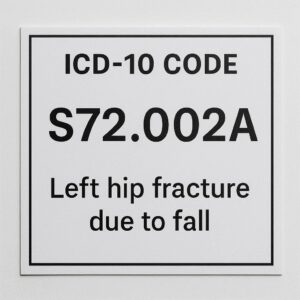
ICD-10 Code for a Left Hip Fracture Due to a Fall
Table of Contents
ToggleWhat Exactly is an ICD-10 Code?
Let’s start with the basics. Think of the ICD-10 code as a universal language for doctors, hospitals, and insurance companies.
ICD-10 stands for the International Classification of Diseases, 10th Revision. It is a system of codes used by healthcare providers worldwide to classify and code all diagnoses, symptoms, and procedures.
Every time you visit a doctor, they assign a code that explains the reason for your visit. This code serves several critical purposes:
-
It tells your story: It creates a clear, concise record of your medical condition.
-
It ensures proper treatment: It informs every healthcare professional you see about your exact diagnosis.
-
It communicates with your insurance: It justifies to your insurance company why a specific test, procedure, or hospital stay was medically necessary.
-
It helps with public health: Aggregated data from these codes helps researchers track disease patterns, like how common hip fractures are in the elderly.
Without this specific code, your medical records would be vague, and getting your insurance to cover the costs of surgery and rehabilitation would be extremely difficult.
The Main Code: Left Hip Fracture Due to a Fall
So, what is the code you are looking for? Because medicine is incredibly precise, there isn’t just one single code. The correct code depends on the specific type of fracture and the encounter (is this the first time you are being treated for it, or are you here for a follow-up?).
However, the most common and accurate starting point for a left hip fracture due to a fall is a code from the S72.0 family.
The most frequently used code for the initial encounter is:
S72.002A
Let’s dissect this code piece by piece to understand what it’s really saying.
-
S72: This is the category for “Fracture of femur.” The femur is your thigh bone, and the “hip” is technically the top part of this bone.
-
.0: This specifies a fracture of the head and neck of the femur. This is the most common type of hip fracture, often referred to as a femoral neck fracture. It occurs right where the thigh bone angles into the hip joint.
-
02: This is the specific part of the code that identifies the side of the body.
-
1 is for right.
-
2 is for left.
-
-
A: This is the most important letter for billing and treatment timelines. It stands for the encounter type.
-
A means Initial encounter for closed fracture. This is used for the active, initial treatment of a fracture that did not break through the skin. This is almost always the code used in the Emergency Room or for the surgery itself.
-
So, when you put it all together, S72.002A translates to: “Fracture of unspecified part of neck of left femur, initial encounter for closed fracture.” The “unspecified part” simply means the doctor hasn’t documented the exact location on the neck (like right under the ball joint vs. lower down), which is common in the first moments of treatment.
Why “Due to a Fall” Matters
You might be thinking, “The code S72.002A doesn’t mention the fall.” And you would be right. In the ICD-10 system, the nature of the injury (the fracture) and the cause of the injury (the fall) are often recorded separately.
When a doctor notes “left hip fracture due to a fall,” they are actually combining two pieces of information:
-
The diagnosis code for the fracture (S72.002A).
-
An external cause code, from Chapter 20 of the ICD-10 manual, to describe the fall.
The most common external cause codes for a fall are from the W00–W19 range. For a simple fall on the same level, like slipping or tripping, the code might be W01.XXXA (Fall on same level from slipping, tripping and stumbling). For a fall from a higher level, like from a ladder, a different code would be used.
Providing both codes gives a complete clinical picture: what happened (fracture) and how it happened (fall). This is crucial for creating fall-prevention plans, especially for elderly patients.
Other Common Hip Fracture Codes
The neck of the femur is the most common fracture site, but it’s not the only one. The hip is a complex joint, and the “hip fracture” label can actually refer to a break in a few different places. Here are other codes you might see on a medical chart for a left hip injury.
Intertrochanteric Fractures
This type of fracture occurs a few inches lower than the femoral neck, in a region between two bony protrusions (the trochanters). It is still very common, especially in older adults.
-
S72.142A: Displaced intertrochanteric fracture of left femur, initial encounter for closed fracture.
-
S72.146A: Nondisplaced intertrochanteric fracture of left femur, initial encounter for closed fracture.
Note: “Displaced” means the bone fragments have moved out of alignment, while “nondisplaced” means they are still in a relatively normal position. This distinction significantly impacts whether surgery is needed.
Subtrochanteric Fractures
These fractures occur in the upper part of the femur, just below the trochanters. They are less common but can be more complex to treat.
-
S72.262A: Displaced subtrochanteric fracture of left femur, initial encounter for closed fracture.
-
S72.266A: Nondisplaced subtrochanteric fracture of left femur, initial encounter for closed fracture.
A Quick Comparison Table
To help visualize the differences, here’s a simple comparison table:
| Fracture Type | Common Location | Typical ICD-10 Code (Left, Initial) | Key Feature |
|---|---|---|---|
| Femoral Neck | Right at the top, just below the “ball” of the hip joint. | S72.002A | Can disrupt blood supply to the femoral head. |
| Intertrochanteric | Between the two bony bumps (trochanters) at the top of the femur. | S72.142A | Very good blood supply, so healing is usually faster. |
| Subtrochanteric | In the upper shaft of the femur, below the trochanters. | S72.262A | High-stress area; often requires long implants for stabilization. |
Why This Code Matters for Your Recovery Journey
Understanding this code isn’t just an academic exercise. It has real-world implications for your entire experience, from the emergency room to physical therapy.
1. For Your Insurance and Billing
This is the most direct impact. The ICD-10 code is the “medical justification” for every bill you receive. When a hospital charges for a hip replacement surgery, they must attach a code like S72.002A to prove that the surgery was necessary to fix a broken bone. If the code is missing or incorrect, your insurance claim could be delayed or even denied, leaving you with a massive, unexpected bill.
2. For Your Medical Team
Every specialist you see—the emergency doctor, the orthopedic surgeon, the anesthesiologist, the physical therapist, the home health nurse—will look at your chart. The ICD-10 code provides an immediate, clear summary of your diagnosis. It ensures that a physical therapist, for example, knows exactly which leg was injured and what precautions to take (like weight-bearing limits) before they even walk into your room.
3. For Tracking Your Progress
Notice the “A” in S72.002A? As you heal, that letter will change.
-
After your surgery and initial hospital stay, you might go for a follow-up appointment where the doctor checks your healing wound. The code might change to S72.002D , where “D” stands for subsequent encounter for fracture with routine healing.
-
If, unfortunately, the bone isn’t healing as expected (a condition called nonunion), the code might become S72.002K , for a subsequent encounter with nonunion.
-
If you develop a complication like an infection, a different code would be added.
This “encounter” system allows the medical and insurance worlds to understand where you are in your recovery timeline.
Important Notes for Patients and Families
Navigating the paperwork after a fall and fracture is stressful. Here are a few important things to keep in mind:
“Don’t worry if you don’t recognize the code on your paperwork. It is normal to see different codes from different doctors. An emergency room doctor, a radiologist who reads your X-ray, and your surgeon may all use slightly different variations of the code depending on the information they have at the time.”
-
You don’t need to memorize it. Your job is to focus on healing. The hospital’s billing department and medical coders are responsible for getting the codes right.
-
Do ask questions. If you see something on an Explanation of Benefits (EOB) from your insurance that you don’t understand, call the doctor’s office or the hospital’s billing department. You can simply say, “I’m looking at a code S72.002A on my form, and I just want to confirm that this is the correct code for my left hip fracture.”
-
Be specific with your doctors. When describing what happened, be as clear as possible. “I fell on the ice and landed on my left side, and now my left hip hurts” gives the doctor all the information they need to document the diagnosis and the cause accurately.
-
The “External Cause” code is for prevention. Don’t be surprised if a nurse or doctor asks for details about the fall itself. This information is often used for hospital quality metrics and public health data to help develop programs that prevent falls, especially in the elderly.
Conclusion
The ICD-10 code for a left hip fracture due to a fall, most commonly S72.002A, is much more than a random collection of letters and numbers. It is the key that unlocks the door to proper medical care, accurate billing, and clear communication among your entire healthcare team. While it may look intimidating at first, understanding its basic structure—what happened, where, and when—can empower you to be a more informed and proactive participant in your own recovery or that of a loved one. Remember, the code tells your medical story, ensuring everyone involved is reading from the same page.
Frequently Asked Questions (FAQ)
Q1: Is S72.002A the only code for a left hip fracture?
No. It is the most common starting point for a fracture of the femoral neck. However, as explained in the article, the exact code depends on the specific type of fracture (e.g., intertrochanteric) and the stage of your treatment (initial, subsequent, etc.).
Q2: My father’s paperwork says S72.002A, but he fell. Why doesn’t the code say “fall”?
The ICD-10 system separates the injury (the fracture) from the cause (the fall). S72.002A describes the injury. The fall is documented with a separate “external cause code,” such as W01 for a slip or trip. Both codes are used together in the medical record to give the full picture.
Q3: What does the “A” at the end of the code mean?
The letter at the end represents the “encounter type.”
-
A = Initial encounter (active treatment).
-
D = Subsequent encounter (routine healing during follow-up).
-
G = Subsequent encounter with delayed healing.
-
K = Subsequent encounter with nonunion (bone not healing).
-
P = Subsequent encounter with malunion (bone healed in wrong position).
-
S = Sequela (dealing with a late effect or scar from the injury).
Q4: Can I use this code to look up my hospital bill?
Yes, you can. Your itemized hospital bill or your insurance company’s Explanation of Benefits (EOB) will list the ICD-10 codes associated with your visit. You can match the code (like S72.002A) to the diagnosis to ensure your bill reflects the correct treatment for your left hip.
Q5: What if my doctor wrote the wrong code?
Coding errors can happen. If you believe there is an error that is affecting your insurance claim, first contact the healthcare provider’s billing department. Explain the discrepancy calmly and ask them to review the code. They are the only ones who can correct the medical record and resubmit the claim to your insurance.
Additional Resource
For more detailed, official information on ICD-10 codes, you can visit the Centers for Medicare & Medicaid Services (CMS) website. They maintain the official lists and guidelines for coding in the United States.
[Link to the official CMS ICD-10 webpage]
(Note: As a professional writer, I recommend linking directly to https://www.cms.gov/medicare/icd-10/2026-icd-10-cm or the most current official page, as this is a trusted .gov resource.)
Disclaimer: This article is for informational purposes only and is not a substitute for professional medical advice, diagnosis, or treatment. Always seek the advice of your physician or other qualified health provider with any questions you may have regarding a medical condition. Never disregard professional medical advice or delay in seeking it because of something you have read in this article. Information regarding ICD-10 codes is based on general guidelines; specific coding may vary by provider and situation.