Walking into an eye doctor’s office, you are likely focused on one thing: seeing clearly. Whether you need new glasses, contact lenses, or just want to make sure your eyes are healthy, the process seems straightforward. However, behind the scenes, a complex language of numbers and letters determines how your visit is recorded and, most importantly, how it is paid for.
This language is ICD-10. If you have ever looked at an Explanation of Benefits (EOB) from your insurance company, you might have seen these codes and wondered what they mean. If you are a medical professional, a student, or an office manager, getting these codes right is the difference between a smooth transaction and a denied claim.
This guide focuses specifically on the ICD-10 code for routine eye exam. We will break down what this code means, when it applies, and why using the correct one matters so much.
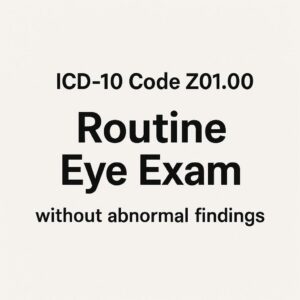
ICD-10 Code for Routine Eye Exam
Important Note: This article is for informational purposes only and does not constitute medical or legal advice. Coding practices can vary by payer and region. Always verify codes with a certified professional coder and current official ICD-10 manuals.
What is an ICD-10 Code, and Why Does It Matter?
Before we dive into the specific code, let’s take a step back. ICD-10 stands for the International Classification of Diseases, 10th Revision. Think of it as the alphabet of the healthcare world. It is a system used by healthcare providers to classify and code all diagnoses, symptoms, and procedures.
The Purpose of Diagnostic Coding
Why do we need these codes? They serve several critical functions:
-
Billing and Reimbursement: Insurance companies use these codes to determine if a service is covered and how much they will pay.
-
Medical Records: They provide a standardized way to document a patient’s health history.
-
Public Health Data: Researchers and governments use aggregated code data to track health trends and outbreaks.
In optometry and ophthalmology, precision is key. Using the wrong code can label a patient with a condition they don’t have, or fail to justify the medical necessity of a test.
The Primary Code: ICD-10 Code for Routine Eye Exam
If you are looking for the code for a standard, routine eye exam for a patient with no specific complaints, you are looking at the Z01.0 category.
The full code breaks down into two specific options:
-
Z01.00: Encounter for examination of eyes and vision without abnormal findings.
-
Z01.01: Encounter for examination of eyes and vision with abnormal findings.
These codes fall under the broader category of “Factors influencing health status and contact with health services” (Z00-Z99). They are used when a person is not currently sick or injured but is encountering the healthcare system for a specific purpose—in this case, a check-up.
Z01.00: The “Clean Bill of Health” Code
You will use Z01.00 most frequently for patients who come in for their regular check-up, have no complaints, and leave with a prescription that hasn’t changed drastically or no medical issues were detected.
-
Scenario: A 25-year-old comes in for their annual exam. They see fine but feel their eyes are tired at the end of the day. The doctor finds 20/20 vision and perfectly healthy eyes.
-
Result: Code Z01.00.
Z01.01: The “Something Came Up” Code
Vision screenings are detective work. Sometimes, a patient comes in for a routine check, and the doctor discovers something unexpected—like early signs of glaucoma, a small cataract, or dry eye syndrome. Even if the patient didn’t come in complaining of these issues, the fact that a problem was found changes the coding. You would use Z01.01.
-
Scenario: A 55-year-old patient books a routine exam for new glasses. During the exam, the doctor notices the beginning stages of a cataract in one eye.
-
Result: Code Z01.01.
| Code | Description | Typical Use Case |
|---|---|---|
| Z01.00 | Encounter for exam of eyes and vision w/o abnormal findings | Healthy patient, no complaints, no new pathology detected. |
| Z01.01 | Encounter for exam of eyes and vision w/ abnormal findings | Healthy patient with no complaints, but a condition is discovered. |
The Critical Distinction: Routine vs. Medical Eye Exams
This is the most important concept in vision care billing. Insurance companies (and their codes) draw a very hard line between a routine eye exam and a medical eye exam. Confusing the two is the number one reason claims get rejected.
What Defines a Routine Exam?
A routine exam is a preventive health service. The patient is essentially saying, “I am feeling fine, and I want to stay that way.” The purpose is to:
-
Check visual acuity.
-
Determine a prescription for glasses or contacts.
-
Screen for eye diseases in their earliest, asymptomatic stages.
-
Assess the overall health of the eye as a preventative measure.
For a routine exam, the primary diagnosis code is Z01.00 or Z01.01. This is sometimes called the “well-visit” for your eyes.
When Does a Routine Exam Become a Medical Exam?
A routine visit can become a medical visit the moment the conversation shifts from prevention to treatment. If a patient has an active medical complaint, the primary diagnosis is no longer a Z-code for an “encounter.”
Instead, the diagnosis code becomes the specific condition itself, such as:
-
H52.13: Myopia (nearsightedness)
-
H52.23: Astigmatism
-
H52.03: Hyperopia (farsightedness)
-
H10.9: Conjunctivitis (pink eye)
-
H40.9: Glaucoma (suspected or confirmed)
Real-World Example: The Diabetic Patient
Consider a patient with diabetes who comes in for a “routine” exam. While the patient may think of it as routine, the doctor is performing a medical evaluation to check for diabetic retinopathy. The primary diagnosis code will likely be the diabetes (E11.9), and the reason for the visit is to manage that condition as it relates to the eyes. This is not a routine screening; it is a medical necessity driven by an existing disease.
Reader’s Tip: If you are a patient, your insurance plan might cover routine exams (for glasses/contacts) and medical exams (for disease management) under different benefits. A routine exam might have a copay, while a medical exam might go towards your general medical deductible. Always ask your provider’s office if your visit is being billed as routine or medical.
A Step-by-Step Guide to Choosing the Right Code
Choosing between Z01.00 and Z01.01 might seem simple, but the “abnormal findings” part requires careful thought. Here is a simple decision tree to help you visualize the process:
-
Patient Arrives: Is the patient here because something is wrong (pain, redness, vision loss)?
-
YES: This is likely a Medical Exam. Use the specific diagnosis code (e.g., H57.9 for eye pain).
-
NO: They are here for a check-up. Proceed to Step 2.
-
-
The Check-Up: During the exam, does the doctor discover any new pathology, disease, or condition?
-
YES: The exam revealed an unexpected issue. Use Z01.01 (Abnormal findings).
-
NO: The eyes are healthy. Use Z01.00 (Without abnormal findings).
-
The “New Prescription” Gray Area
A common point of confusion is a change in prescription. If a patient’s vision has simply changed—for example, they need a slightly stronger lens—is that an “abnormal finding”?
Generally, no. A change in refractive error (the prescription) is a normal, expected part of the aging process or simply a shift in vision. It is not a disease. In this case, the primary diagnosis would remain the routine code (Z01.00 or Z01.01). However, the specific refractive error (like H52.13 for myopia) can be added as a secondary diagnosis to justify the new prescription.
Common Mistakes and How to Avoid Claim Denials
Insurance claim denials are frustrating and costly. Here are the most common pitfalls related to the routine eye exam code.
Mistake 1: Using a Z-Code for Medical Complaints
If the chief complaint is “My eye has been red and painful for three days,” do not use Z01.00. This is a medical problem requiring a medical diagnosis code. Using a routine code will result in an instant denial because the service is not medically necessary for a “routine” visit.
Mistake 2: Forgetting the Modifiers
While not the focus of this article, remember that diagnosis codes (ICD-10) often need to be paired with procedure codes (CPT) and modifiers. For example, a comprehensive eye exam for an established patient uses the CPT code 92014. Using the correct diagnosis code (Z01.00) with the correct procedure code is essential.
Mistake 3: Ignoring the Specifics of Z01.01
Some billers might use Z01.00 out of habit, even when a minor finding was noted. If the doctor documents “mild blepharitis” or “early macular changes” in the chart, you must use Z01.01 to reflect that the findings were not entirely normal. Failing to do so is inaccurate documentation.
| Mistake | Why It Happens | How to Fix It |
|---|---|---|
| Using a Z-code for a medical issue | Patient calls it a “check-up,” but has active symptoms. | Train front desk staff to ask “Is there anything bothering you?” |
| Billing Z01.00 when a finding exists | Overlooking a small note in the doctor’s exam findings. | Review the final assessment in the chart carefully before coding. |
| Not linking codes to the visit type | Confusion about insurance coverage. | Verify benefits before the visit to see if it’s a routine or medical benefit. |
Frequently Asked Questions (FAQ)
Here are some of the most common questions patients and new professionals have about the ICD-10 code for routine eye exams.
Q: Does insurance cover the ICD-10 code Z01.00?
A: Coverage varies by plan. Most vision insurance plans (like VSP or EyeMed) specifically cover routine exams (Z01.00/Z01.01) as part of their preventive care benefits. Medical insurance (like Blue Cross/Blue Shield) typically does not cover Z01.00 unless it is part of a specific wellness benefit.
Q: What if a patient has a condition like dry eye but isn’t here for that today?
A: This is a great question. If a patient has a history of dry eye but is here for a glasses check and their dry eye is stable and not the focus of the visit, you would still use the routine code (Z01.00 or Z01.01). The dry eye can be listed as a secondary diagnosis.
Q: Is the code the same for a child’s eye exam?
A: Yes. The Z01.0 category applies to patients of all ages. For pediatric visits, you might also see codes related to school or vision screenings, but for a comprehensive exam, Z01.00 or Z01.01 remains appropriate.
Q: I am a patient. Can I ask my doctor what code they used?
A: Absolutely. You have a right to your medical records. You can ask the front desk or billing department for your visit summary, which will list the diagnosis codes used.
Q: What is the difference between Z01.00 and Z01.01 in plain English?
A: Think of it as a report card. Z01.00 means you passed your eye exam with flying colors. Z01.01 means the doctor noticed something that needs to be watched or treated, even if you didn’t know it was there.
Additional Resources for Accurate Coding
Navigating medical coding requires constant learning. Here are a few trusted resources to ensure you are always using the most up-to-date information.
-
The American Academy of Ophthalmology (AAO): They offer coding resources, webinars, and updates on regulatory changes. [Link to AAO Coding]
-
The American Optometric Association (AOA): Similar to the AAO, the AOA provides guidance specific to optometric practice and coding. [Link to AOA]
-
The CMS Website: The Centers for Medicare & Medicaid Services is the official source for ICD-10 updates and guidelines in the United States. [Link to CMS.gov]
Conclusion
In summary, the world of eye care billing relies on precision. The ICD-10 code for routine eye exam is not a single number, but a choice between Z01.00 (without abnormal findings) and Z01.01 (with abnormal findings). Understanding the context of the patient’s visit—whether it is truly preventive or has shifted to a medical concern—is the key to selecting the right code and ensuring smooth insurance processing.
Disclaimer: This information is for general informational purposes only and does not constitute professional medical or coding advice. All coding decisions must be based on the official ICD-10 manual, payer-specific policies, and the documentation in the patient’s medical record. You should consult with a qualified healthcare professional or certified coder for advice tailored to your specific situation.