If you’ve been digging through medical records or billing sheets lately, you might have come across the term “secondary hypercoagulable state” and wondered about the correct way to classify it. You are not alone. In the world of medical coding, few things cause as much head-scratching as the nuances between primary and secondary clotting disorders.
This guide is here to clear up the confusion. We are going to focus specifically on the ICD-10 code for a secondary hypercoagulable state, what it means, when to use it, and how it differs from other coagulation codes. Whether you are a medical coder, a healthcare provider, or a patient trying to understand a chart, you will find straightforward answers here.
Let’s break it down, piece by piece.
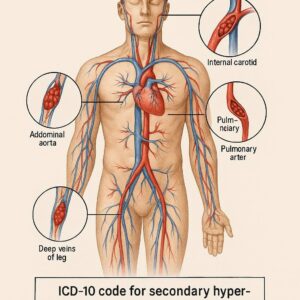
ICD-10 Code for Secondary Hypercoagulable State
What Exactly Is a Secondary Hypercoagulable State?
Before we jump into the code itself, it is vital to understand the condition it represents. In simple terms, a hypercoagulable state means your blood has a higher tendency than normal to form clots. Think of it as your body’s clotting system being stuck with its foot on the gas pedal.
Medical professionals split these conditions into two main camps: primary (genetic) and secondary (acquired).
-
Primary Hypercoagulable State: You are born with this. It is in your DNA. Examples include Factor V Leiden mutation or the Prothrombin gene mutation. Your body makes clots because it is programmed to do so.
-
Secondary Hypercoagulable State: You develop this over time. It is caused by something else happening in your body or your environment. It is a reaction, not an inherited trait.
A secondary hypercoagulable state is essentially a clotting disorder that is a complication of another condition. It is not something you inherently are; it is something that happens to you because of external or acquired factors.
Common Triggers for Secondary Hypercoagulability
So, what causes this “foot on the gas” effect? The list is surprisingly broad. The body’s clotting cascade is sensitive to changes, and several life events or illnesses can tip the balance.
-
Prolonged Immobilization: This is a big one. Sitting on a long-haul flight or being bedridden after surgery slows blood flow, which encourages clotting.
-
Cancer: Certain malignancies, particularly adenocarcinomas (like pancreatic or lung cancer), release substances that trigger clotting.
-
Pregnancy and the Postpartum Period: Hormonal changes and physical pressure on veins increase clot risk.
-
Hormone Therapy: Oral contraceptives and hormone replacement therapy containing estrogen can increase clotting factor activity.
-
Major Trauma or Surgery: The body’s natural healing response involves clotting, but sometimes that response goes into overdrive.
-
Inflammatory Diseases: Conditions like lupus or rheumatoid arthritis create a state of chronic inflammation, which can damage blood vessels and promote clots.
-
Antiphospholipid Syndrome (APS): This is an autoimmune condition where the body mistakenly attacks certain proteins, leading to a high risk of both arterial and venous clots. While technically “acquired,” it is a distinct diagnosis often coded separately.
-
Obesity: Excess weight puts pressure on veins and is linked to a chronic inflammatory state.
The Primary Code: D68.69
Now, let’s get to the heart of the matter. The ICD-10 code for a secondary hypercoagulable state is D68.69.
This code falls under the broader category of “Other thrombophilia.” It is the go-to code when a patient presents with a clotting disorder that is clearly linked to an acquired cause, not a genetic one.
The full code description in the ICD-10 manual is: “Other thrombophilia.” However, within the coding guidelines, this specifically includes acquired or secondary hypercoagulable states.
When to Use D68.69
You should assign D68.69 when the documentation clearly states that the hypercoagulable state is secondary to another condition. For example:
-
A patient with metastatic cancer develops a deep vein thrombosis (DVT). The cancer is the cause, making the hypercoagulability secondary. You would code the cancer first, followed by D68.69 to explain why the patient is clotting.
-
A patient who has been on bed rest for six weeks following a hip replacement develops a pulmonary embolism. You would code the encounter for the PE and then use D68.69 to indicate the secondary hypercoagulable state due to immobilization.
-
A woman on oral contraceptives develops a clot. The contraceptives are the acquired risk factor.
Important Note: D68.69 is a “catch-all” for acquired thrombophilia that doesn’t have its own specific code elsewhere. It tells the story that the clotting tendency is a result of something else.
Decoding the Family: D68 and Its Subcategories
To use D68.69 correctly, it helps to see where it lives in the coding “family tree.” The parent category is D68 (Other disorders of coagulation). This is a large group, and choosing the right branch is critical.
Here is a quick breakdown of the related codes to help you distinguish D68.69 from its neighbors.
The D68 Code Family at a Glance
| ICD-10 Code | Description | Typical Use Case |
|---|---|---|
| D68.69 | Other thrombophilia (Secondary/Acquired) | Clotting due to cancer, immobilization, hormones, etc. |
| D68.51 | Activated protein C resistance | Genetic condition; often a stand-in for Factor V Leiden. |
| D68.52 | Prothrombin gene mutation | Genetic mutation increasing clot risk. |
| D68.59 | Other primary thrombophilia | Other genetic clotting disorders not listed above. |
| D68.61 | Antiphospholipid syndrome | Specific autoimmune, acquired clotting disorder. Has its own code. |
| D68.62 | Lupus anticoagulant syndrome | Often related to APS, but sometimes specified separately. |
| D68.8 | Other specified disorders of coagulation | A miscellaneous code for coagulation issues not fitting elsewhere. |
| D68.9 | Coagulation defect, unspecified | Use only when the physician doesn’t specify the cause. |
As you can see, D68.69 is specifically for those cases where the cause is not genetic (primary) and not the specific autoimmune condition of Antiphospholipid Syndrome.
D68.61 vs. D68.69: A Critical Distinction
One of the most common points of confusion in medical coding is the difference between D68.61 (Antiphospholipid Syndrome) and D68.69 (Other thrombophilia). While both are technically acquired (secondary) conditions, they are treated differently in the coding world.
D68.61 is a specific diagnosis. It is an autoimmune disease with specific diagnostic criteria (clinical symptoms like clots or pregnancy loss, plus lab tests positive for antiphospholipid antibodies). It is a named condition.
D68.69 is a broader descriptor for a state or condition caused by another factor.
Think of it this way:
-
If a patient has Lupus and also has Antiphospholipid Syndrome, you code D68.61.
-
If a patient has Lupus and develops a clot due to the chronic inflammation from the Lupus (but does not have the specific antibodies for APS), you might code the clot and then D68.69 to indicate the acquired hypercoagulable state secondary to the autoimmune disease.
Reader Tip: Always check the physician’s documentation. If they explicitly write “Antiphospholipid Syndrome,” you must use D68.61. If they write “Acquired hypercoagulable state secondary to malignancy,” you use D68.69.
Real-World Coding Scenarios
Theory is helpful, but application is everything. Let’s walk through a few common patient scenarios to see how D68.69 is applied in practice.
Scenario 1: The Post-Surgical Patient
-
Clinical Story: A 65-year-old man undergoes total knee replacement. He is recovering well but on day 10 post-op, he develops swelling and pain in his calf. A venous Doppler confirms an acute DVT. The physician notes the clot is due to post-operative immobilization.
-
Coding Logic:
-
Primary Diagnosis: I82.409 (Acute embolism and thrombosis of unspecified deep veins of lower extremity) – You code the specific event first.
-
Secondary Diagnosis: D68.69 (Other thrombophilia) – This captures the reason he clotted (the acquired state of immobilization).
-
External Cause Code: You might also add a code for the knee replacement (Z96.651) to provide full context, though this is often for data collection.
-
Scenario 2: The Cancer Patient
-
Clinical Story: A 58-year-old woman with stage IV ovarian cancer is admitted for shortness of breath. A CT scan reveals multiple pulmonary emboli. The oncologist links the clots directly to the malignancy.
-
Coding Logic:
-
Primary Diagnosis: I26.99 (Other pulmonary embolism without acute cor pulmonale) – The PE is the reason for the admission.
-
Secondary Diagnosis: C56.9 (Malignant neoplasm of ovary) – The underlying cancer is documented.
-
Secondary Diagnosis: D68.69 (Other thrombophilia) – This links the cancer to the clotting event, showing the mechanism.
-
Scenario 3: The Young Woman on Birth Control
-
Clinical Story: A 32-year-old woman presents to the ER with a sudden onset of chest pain and a swollen left leg. She has no personal or family history of clots. She has been taking oral contraceptives for three years. Tests confirm a DVT and a small PE.
-
Coding Logic:
-
Primary Diagnosis: I26.99 (Pulmonary embolism) and I82.409 (DVT) – Depending on the focus of the encounter, one may be listed first.
-
Secondary Diagnosis: Z79.3 (Long-term use of oral contraceptives) – This identifies the external risk factor.
-
Secondary Diagnosis: D68.69 (Other thrombophilia) – This clarifies that the hypercoagulable state is acquired, secondary to the medication.
-
Why Accurate Coding Matters
You might be thinking, “Why is it so important to get this code right?” It goes beyond just filling out forms. Accurate coding has real-world consequences.
1. Impact on Patient Care and Future Treatment
The ICD-10 code tells a story. If a patient is coded with D68.69 (secondary), a future physician will know that the clotting was likely a one-off event related to a specific trigger. They may not recommend lifelong blood thinners once the trigger (like cancer or surgery) is resolved.
However, if a patient is incorrectly coded with a primary thrombophilia (like D68.51), a future physician might assume a lifelong genetic risk and prescribe anticoagulants indefinitely, which carries its own risks.
2. Financial and Reimbursement Implications
Payers, including Medicare and private insurance, look at diagnosis codes to determine medical necessity.
-
Was the blood thinner justified? D68.69 helps justify it.
-
Was the hospital stay appropriate? The diagnosis codes help paint that picture.
Incorrect coding can lead to denied claims or audits. For example, using an unspecified code (D68.9) when a specific code like D68.69 is available might be seen as a lack of clinical detail, potentially reducing reimbursement.
3. Data and Research
Public health data and medical research rely heavily on ICD-10 codes. Accurate use of D68.69 helps researchers track how often clotting is caused by things like cancer or modern lifestyles. This data can then inform prevention strategies and public health guidelines.
Guidelines for Medical Documentation
For physicians and clinical staff, clear documentation is the best friend of the medical coder. If the coder cannot find a specific link in your notes, they cannot assign D68.69.
Here is what coders need to see to justify using the code for a secondary hypercoagulable state:
-
The “Linkage” Statement: Instead of just noting “DVT” and “Cancer” separately, a simple statement like, “The patient’s hypercoagulable state is secondary to her underlying malignancy,” makes all the difference.
-
Specify the Cause: If it is secondary to immobilization, state that. If it is due to pregnancy, note the trimester.
-
Rule Out Genetics: If you suspect an acquired cause but want to be thorough, note in the chart that genetic testing was negative. This helps confirm the “secondary” nature of the condition.
Common Mistakes to Avoid
Even seasoned professionals can slip up. Here are some pitfalls to watch out for when dealing with D68.69.
-
Coding the Symptom, Not the Cause: The biggest mistake is coding D68.69 as the primary diagnosis. Remember, it is a secondary code. The thrombosis (the clot) is the acute problem and should usually be coded first.
-
Confusing Primary and Secondary: Using a primary code (like D68.51) for a patient with an acquired clot is a major error that can affect a patient’s lifelong treatment plan.
-
Forgetting the External Cause: When the secondary state is caused by a drug (like contraceptives) or an activity, using the appropriate Z-code (for long-term drug use) or V-code (for external causes) provides a complete picture.
-
Using “Unspecified” Lazily: Code D68.9 (Coagulation defect, unspecified) should be a last resort. If you know the hypercoagulable state is secondary to something, D68.69 is always the better, more specific choice.
The Patient’s Perspective: What This Code Means for You
If you are a patient reading your medical records and you see the code D68.69, it is natural to feel a bit anxious. Let’s translate what that code is actually saying about your health.
First, it tells you and your doctor that your blood clot likely happened for a reason. Something in your environment or health triggered it. This is often reassuring news compared to finding out you have a permanent genetic mutation.
Second, it guides your treatment plan. Your doctor will likely focus on managing the trigger. Can the cancer be treated? Can you stop the birth control? Can you start moving more after surgery? Once the trigger is gone, your risk of another clot may drop significantly.
However, it is still a serious condition. Even if it is “secondary,” it means your body reacted strongly to a stimulus. You will need to be vigilant in the future. If you face another high-risk situation (another surgery, another pregnancy), you and your doctor will know that you have a history of reacting with clots, and you can take preventive measures, such as using blood thinners prophylactically.
Future Trends in Hypercoagulability Coding
The world of ICD-10 is not static. As we learn more about medicine, codes are updated. While D68.69 is the current standard for secondary hypercoagulable state, we may see more specific codes emerge in the future.
For instance, as we learn more about the specific clotting risks of different cancer types or immunotherapies, we might eventually see codes like “Hypercoagulable state due to lung cancer” or “Coagulation disorder due to immune checkpoint inhibitors.”
For now, D68.69 serves its purpose well as a flexible, inclusive code that allows providers to specify the acquired nature of the clotting disorder while linking it to the primary cause through additional coding.
FAQ: Your Questions Answered
Q1: Is D68.69 a billable code?
Yes, D68.69 is a valid and billable ICD-10 code. It is specific and accepted by all major insurance payers in the United States.
Q2: Can I use D68.69 if the patient has a history of clots but no current event?
For an office visit where a patient is being managed for a previous clot due to a secondary cause, you can use D68.69 as a chronic condition code, along with a personal history code like Z86.71 (Personal history of venous thrombosis and embolism).
Q3: What if the patient has both a genetic mutation and an acquired risk factor?
In this case, you would code both. For example, a patient with Factor V Leiden (D68.51) who develops a clot while on birth control. You would code the clot, the D68.51 for the genetic predisposition, and you might still use Z79.3 for the contraceptives. You would likely not use D68.69, as the primary mechanism is the genetic one.
Q4: Does pregnancy have a specific code for hypercoagulability?
Pregnancy-related clotting is complex. You will typically code the specific complication of pregnancy first (like O22.3 for deep phlebothrombosis in pregnancy). However, if the physician notes a general hypercoagulable state due to the pregnancy, D68.69 can be used as an additional code to fully capture the patient’s condition.
Q5: Is Antiphospholipid Syndrome considered a secondary hypercoagulable state?
Yes, it is acquired, but it has its own specific code (D68.61). Because it is a distinct autoimmune disease with its own management protocols, it is coded separately and not grouped under the general D68.69 umbrella.
Conclusion
The ICD-10 code for a secondary hypercoagulable state, D68.69, is more than just a string of characters. It is a critical tool for telling the story of why a patient developed a dangerous blood clot. It differentiates between a lifelong genetic hand and a temporary, acquired condition triggered by factors like cancer, surgery, or medication.
Using this code correctly ensures patients receive the right long-term care, providers are reimbursed fairly, and public health data remains accurate. By understanding the nuances between D68.69 and its related codes, you can navigate the complexities of coagulation disorders with confidence.
Additional Resource
For the most up-to-date information on ICD-10 coding guidelines and annual updates, the definitive source is the website of the Centers for Medicare & Medicaid Services (CMS). You can access the official ICD-10-CM files and guidelines here: CMS.gov ICD-10 Homepage
Disclaimer
The information provided in this article is for educational and informational purposes only and is not a substitute for professional medical advice, diagnosis, or treatment. Always seek the advice of your physician or other qualified health provider with any questions you may have regarding a medical condition. Coding guidelines are subject to change, and it is the responsibility of the billing professional to consult the most current official coding manuals and guidelines.