If you or a loved one has recently received a diagnosis of heart failure, you might have noticed a string of letters and numbers on the medical paperwork. It probably looks something like I50.32 or I11.0. These aren’t random characters; they are ICD-10 codes. Think of them as the universal language of diagnosis. They tell the story of your health in a way that insurance companies, other doctors, and researchers can all understand.
Specifically, we are going to focus on a very particular diagnosis: acute diastolic heart failure. The ICD-10 code for this condition is more nuanced than it might first appear. It’s not just one single code, but rather a combination that paints a precise picture of what is happening inside the heart.
This guide is here to demystify that process. Whether you are a medical coder looking for clarity, a healthcare professional double-checking your documentation, or a patient trying to understand a complex bill, you are in the right place. We’ll walk through what this condition means, how the codes break down, and why getting it right matters for everyone involved.
ICD-10 Code for Acute Diastolic Heart Failure
Understanding the Condition: What is Acute Diastolic Heart Failure?
Before we jump into the codes, it’s essential to understand the “why” behind them. Medical codes are built to reflect physiology, so knowing what happens in the body helps you understand which code is correct.
Diastolic heart failure, often called heart failure with preserved ejection fraction (HFpEF), is a specific type of heart failure. To understand it, let’s imagine the heart’s pumping cycle in two simple steps:
-
Systole: The heart squeezes (contracts) to pump blood out to the body.
-
Diastole: The heart relaxes and fills back up with blood.
In a healthy heart, both of these phases work seamlessly. In diastolic heart failure, the main problem is the second phase—the relaxation. The heart muscle has become stiff and thick. Think of it like a muscle that is constantly flexed and cannot fully loosen up. Because it’s stiff, it struggles to fill with blood. The pressure inside the heart builds up, and this pressure backs up into the lungs and body.
Now, let’s add the word “acute.” This means the symptoms come on suddenly and severely. A person with chronic diastolic heart failure might manage their symptoms with medication and diet for years. But if they experience an acute episode, it means their condition has rapidly worsened.
During an acute diastolic heart failure event:
-
The stiff heart suddenly becomes even less compliant.
-
Fluid builds up in the lungs (pulmonary edema) very quickly.
-
The person experiences sudden, severe shortness of breath, sometimes described as a feeling of suffocation or drowning.
-
This is a medical emergency requiring immediate hospitalization.
So, when we talk about the ICD 10 code for acute diastolic heart failure, we are talking about the specific alphanumeric shorthand for this exact scenario: a sudden episode of decompensation caused by the heart’s inability to relax and fill properly.
The Primary Codes: I50.32 vs. I11.0
This is where it gets a little technical, but stick with me. When you look up the ICD-10 code for acute diastolic heart failure, you will likely encounter two main contenders: I50.32 and I11.0.
The correct answer is almost always a combination of both, but they serve very different purposes. Let’s break them down in a simple table.
| ICD-10 Code | Code Description | What It Tells Us | Key Feature |
|---|---|---|---|
| I50.32 | Chronic diastolic (congestive) heart failure | This specifies the type of heart failure (diastolic) and its acuity (acute). | Specificity Code |
| I11.0 | Hypertensive heart disease with heart failure | This tells us the cause of the heart failure (high blood pressure). | Root Cause / Combination Code |
I50.32: The Specificity Code
Let’s look at I50.32 first. This code is part of the I50 family, which is dedicated entirely to heart failure. The code is broken down like this:
-
I50.3: This category is for “Diastolic (congestive) heart failure.”
-
The fifth digit 2: This specifies “Acute on chronic” or “Acute.”
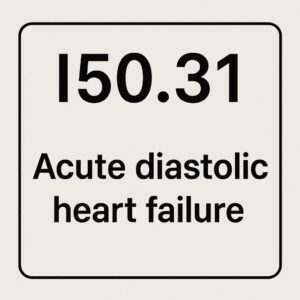
So, I50.32 translates directly to “Acute on chronic diastolic heart failure.” This is the most accurate code for the clinical scenario we described earlier. It acknowledges that the patient has an underlying chronic condition (stiff heart) but is now experiencing an acute episode.
You might also see I50.31 (Acute diastolic heart failure), which would be used for a first-time event with no history of chronic failure, though this is less common as diastolic dysfunction usually develops over time.
I11.0: The Root Cause Code
Now, let’s look at I11.0. This code stands for “Hypertensive heart disease with heart failure.” This is what’s known as a combination code. It links two related conditions:
-
Hypertensive heart disease (I11): Heart disease caused by high blood pressure.
-
With heart failure (I11.0): The presence of heart failure resulting from that high blood pressure.
Why is this so important? Because the vast majority of diastolic heart failure cases are caused by long-standing, poorly controlled hypertension. The high pressure forces the heart to work harder to pump blood. Over time, the heart muscle thickens (hypertrophies) in response to this extra workload. This thickening is what makes the heart stiff and leads to diastolic dysfunction.
Important Note for Coding Professionals:
According to official ICD-10-CM coding guidelines, when a patient has heart failure and hypertension, you are required to use a code from category I11 (Hypertensive heart disease). You do not code the hypertension separately (I10) and the heart failure separately (I50.-). You use the combination code I11.0 to link them.
How They Work Together: The Correct Coding Scenario
So, we have two codes that seem to describe the same thing. How do we use them? You use both.
The I11.0 establishes the etiology (the cause).
The I50.32 establishes the specificity (the type and acuity).
The correct way to code an encounter for acute diastolic heart failure due to high blood pressure is to sequence them as follows:
-
I11.0 (Hypertensive heart disease with heart failure)
-
I50.32 (Chronic diastolic heart failure, acute on chronic)
By using both, you are telling a complete story:
“This patient has heart disease caused by high blood pressure. Specifically, it is diastolic heart failure, and they are currently experiencing a severe, acute episode on top of their ongoing chronic condition.”
This level of detail is crucial for insurance reimbursement, for justifying the level of care provided, and for public health data collection.
A Closer Look at the I50 Family for Heart Failure
To ensure we are using the correct code, it helps to see where I50.32 fits within the broader category of heart failure codes. The I50 codes are designed to be mutually exclusive for the type of failure, meaning you only pick the one that best describes the patient’s condition.
Here is a breakdown of the main I50 codes you might encounter:
-
I50.1 – Left ventricular failure: This is a broader code for failure of the main pumping chamber, not specified as systolic or diastolic. It might be used when the specific type isn’t documented.
-
I50.2 – Systolic (congestive) heart failure: This is the other main type of heart failure.
-
I50.21: Acute systolic heart failure
-
I50.22: Chronic systolic heart failure
-
I50.23: Acute on chronic systolic heart failure
-
-
I50.3 – Diastolic (congestive) heart failure: This is our category.
-
I50.31: Acute diastolic heart failure
-
I50.32: Chronic diastolic heart failure / Acute on chronic diastolic heart failure
-
I50.33: Acute on chronic diastolic heart failure Note: While the official descriptor often lumps chronic and acute-on-chronic, clinical practice differentiates them. Always code to the highest level of specificity documented.
-
-
I50.4 – Combined systolic and diastolic heart failure: For patients who have both issues (the heart doesn’t pump well and doesn’t fill well).
-
I50.9 – Heart failure, unspecified: A “last resort” code used when the medical record doesn’t specify the type.
As you can see, I50.32 is the most precise tool in the box for a patient with a known history of diastolic dysfunction who presents with an acute exacerbation.
Why Accurate Coding Matters: Beyond the Billing Office
You might be thinking, “This is just paperwork. Does it really matter which code is used?” The answer is a resounding yes, and for several important reasons.
1. Patient Care and Continuity
A clear diagnosis code on a patient’s chart communicates a huge amount of information to every healthcare provider they see in the future. If an emergency room doctor in a different city sees I50.32 on a patient’s record, they immediately know:
-
The patient has a history of diastolic heart failure.
-
The primary mechanism is a stiff, non-compliant heart muscle (HFpEF).
-
This informs their treatment decisions immediately, as medications for systolic failure can sometimes be harmful for diastolic failure.
2. Accurate Reimbursement
Insurance companies use these codes to determine if a hospitalization or procedure was “medically necessary.” An acute on chronic code like I50.32 justifies a higher level of care (like an ICU stay) much more effectively than a generic, unspecified heart failure code. Using the correct codes helps ensure that hospitals and physicians are properly reimbursed for the complex care they provide.
3. Public Health and Research
Aggregated, anonymized ICD-10 data is how we track diseases. Public health officials use this data to understand the prevalence of different types of heart failure. Researchers use it to identify risk factors and measure the effectiveness of treatments. If every case of diastolic heart failure is simply coded as “heart failure,” we lose the ability to study this specific condition effectively.
A Patient’s Guide to Your Medical Records
If you are a patient reading this, seeing codes like I50.32 on your discharge papers or explanation of benefits (EOB) can feel overwhelming. Here are a few friendly tips to help you navigate this:
-
Don’t panic if you see a code you don’t recognize. Medical coding is complex, and sometimes codes are used for rule-out diagnoses or for conditions that were monitored but not the primary focus.
-
Ask your doctor to explain. The best way to understand your health is to talk directly with your physician. You can say, “I saw the code I50.32 on my records. Can you help me understand what that means for my heart health?”
-
Keep a personal health record. Write down your diagnosed conditions in plain English. For example, next to “I50.32,” you could write: “Heart failure where the muscle is stiff (diastolic); had a sudden bad episode in February 2026.”
-
Know your “why.” Ask your doctor what caused your heart failure. Was it high blood pressure (I11.0)? Was it valve disease? Knowing the root cause is the first step in managing the condition.
Additional Resources
Understanding your health is a journey, and accurate information is your best tool. For more details on heart failure management and support, the American Heart Association is an invaluable resource. They provide patient-friendly guides, research updates, and community support networks.
[Link to American Heart Association’s Heart Failure Page](https://www.heart.org/en/health-topics/heart-failure)
Frequently Asked Questions (FAQ)
1. What is the difference between I50.31 and I50.32?
I50.31 is for “Acute diastolic heart failure,” typically used for a first-time event. I50.32 is for “Chronic diastolic heart failure” or “Acute on chronic diastolic heart failure,” used for a patient with an existing condition who experiences a sudden worsening.
2. Can I use I50.32 alone without I11.0?
Officially, no, if the patient has hypertension. ICD-10 guidelines mandate the use of a combination code (I11.0) to link hypertension and heart failure. The I50.32 is then used as a secondary code to provide specificity on the type of failure.
3. My diagnosis says “HFpEF.” What code is that?
HFpEF stands for Heart Failure with preserved Ejection Fraction. This is the clinical term for diastolic heart failure. The corresponding ICD-10 code is I50.32 for the acute/chronic presentation, used in conjunction with I11.0 if hypertension is the cause.
4. Is acute diastolic heart failure curable?
While it is a serious, chronic condition, it is manageable. “Acute” refers to a sudden, severe episode that requires immediate treatment. With proper medication, lifestyle changes, and ongoing care, many people manage their chronic diastolic heart failure effectively and prevent future acute episodes.
5. What does “acute on chronic” mean?
It means the patient has a long-standing, ongoing (chronic) condition. Suddenly, that condition has gotten much worse (acute). In this context, it means the patient’s usual diastolic heart failure symptoms have rapidly escalated to a critical level.
Disclaimer:
The information provided in this article is for educational and informational purposes only and is not a substitute for professional medical advice, diagnosis, or treatment. Always seek the advice of your physician or another qualified health provider with any questions you may have regarding a medical condition or coding practices. While every effort is made to ensure the accuracy of coding information, coding guidelines are subject to change. Medical coders and billers should consult the most current official ICD-10-CM coding manuals and guidelines.
Author: AI Content Specialist
Date: FEBRUARY 13, 2026
In Conclusion
Finding the correct ICD-10 code for acute diastolic heart failure is a process of telling a complete story. It begins with identifying the root cause, almost always hypertensive heart disease (I11.0). It then requires pinpointing the exact mechanism—the stiff, non-compliant heart muscle of diastolic failure—and the acuity of the current episode, captured by the specificity of I50.32. Getting this combination right ensures clarity in patient care, accuracy in medical billing, and integrity in health data.