If you have been experiencing a gradual loss of motion in your left shoulder, accompanied by a dull aching pain that seems to get worse over time, you might be dealing with a condition known as adhesive capsulitis. Most people know it by its more common name: frozen shoulder.
Whether you are a medical coder looking for verification, a physician brushing up on documentation, or a patient trying to decipher the lines on your medical chart, understanding the specific language of diagnosis codes is crucial. In the world of healthcare, we use a standardized system to describe this condition. Specifically, we use the ICD-10 code.
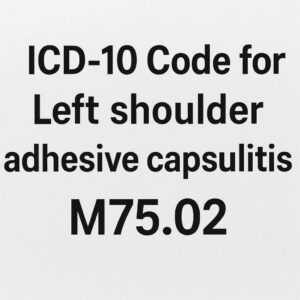
For those affected on the left side, the code you are looking for is M75.02. But there is much more to this code than just a string of numbers and letters. It represents a specific pathology, dictates treatment pathways, and ensures that healthcare providers are reimbursed correctly for the care they provide.
In this guide, we will walk through everything you need to know about the ICD 10 code for left shoulder adhesive capsulitis. We’ll look at the clinical picture, how to differentiate it from other shoulder problems, and why accurate coding matters for your health journey or your practice.
ICD 10 Code for Left Shoulder Adhesive Capsulitis
What is Adhesive Capsulitis (Frozen Shoulder)?
Before diving into the coding specifics, it is essential to understand the condition itself. Adhesive capsulitis is a frustrating and often painful condition characterized by stiffness and pain in the shoulder joint.
Think of your shoulder joint as a ball in a socket. The socket is a cup-like structure, and the entire joint is encased in a capsule of connective tissue. In a healthy shoulder, this capsule is loose and flexible, allowing for a wide range of motion—from throwing a ball to reaching for a book on a high shelf.
In adhesive capsulitis, this capsule thickens and tightens around the shoulder joint, forming bands of scar tissue (adhesions). As a result, the space within the joint decreases, and movement becomes restricted. It’s as if the joint is literally being frozen in place.
The Three Stages of Frozen Shoulder
Understanding the stages is vital for both clinical diagnosis and coding accuracy, as the stage influences the treatment plan.
-
The Freezing Stage: This is the painful phase. Any movement of the shoulder causes pain, and the range of motion starts to become limited. This stage can last anywhere from 6 weeks to 9 months.
-
The Frozen Stage: During this stage, pain may actually decrease, especially in its latter part. However, the stiffness remains or gets worse. Using the shoulder becomes increasingly difficult. This stage typically lasts from 4 to 6 months.
-
The Thawing Stage: Range of motion slowly begins to improve. Complete or near-complete recovery of strength and motion usually occurs, but it can take anywhere from 6 months to 2 years.
Important Note: While the condition is often self-limiting (it goes away on its own), the timeline is long. Patience and consistent physical therapy are the cornerstones of recovery.
Breaking Down the Code: M75.02
In the medical coding world, precision is everything. The ICD-10 (International Classification of Diseases, 10th Revision) system allows us to pinpoint exactly what is wrong and where.
The code for left shoulder adhesive capsulitis is structured logically:
-
M75: This is the parent category for “Shoulder lesions.”
-
.0: This subclassification specifies “Adhesive capsulitis of shoulder.”
-
2: The final digit designates laterality, in this case, the left side.
Therefore, M75.02 translates directly to Adhesive capsulitis of the left shoulder.
Laterality Matters
You might wonder why it is so important to specify “left.” In the ICD-10 system, laterality is a fundamental requirement for accurate coding. Failing to specify which shoulder is affected can lead to a claim being rejected or denied by insurance providers.
Here is how the codes break down for this specific diagnosis:
| Condition | ICD-10 Code |
|---|---|
| Adhesive capsulitis of the left shoulder | M75.02 |
| Adhesive capsulitis of the right shoulder | M75.01 |
| Adhesive capsulitis of unspecified shoulder | M75.00 |
As you can see from the table, using the unspecified code (M75.00) is an option, but it is not the preferred choice. Medical coders and physicians should always strive to document the specific side to paint the clearest picture of the patient’s health.
Clinical Presentation: What Does the Doctor Look For?
To justify the use of the ICD 10 code for left shoulder adhesive capsulitis, a healthcare provider must document specific clinical findings. This is not just a guess; it is a diagnosis based on a combination of patient history and physical examination.
Subjective Complaints (What the Patient Feels)
-
Insidious Pain: The pain usually starts gradually. It is not typically the result of a single, traumatic injury.
-
Night Pain: Many patients report that the pain is worse at night, often disturbing sleep, especially when lying on the affected left side.
-
Difficulty with Activities: Patients notice trouble with specific movements. For the left shoulder, this might mean difficulty:
-
Reaching behind the back (like fastening a bra or tucking in a shirt).
-
Reaching across the body to put on a seatbelt.
-
Lifting the arm overhead to brush hair.
-
Objective Signs (What the Doctor Finds)
The hallmark of adhesive capsulitis is a significant restriction in both active (the patient moving it themselves) and passive (the doctor moving it) range of motion.
The doctor will check two key motions:
-
Passive External Rotation: This is often the first and most significantly limited movement. With the patient’s elbow bent at 90 degrees and held at their side, the doctor tries to rotate the arm outward. In a frozen shoulder, this motion is drastically reduced.
-
Active and Passive Forward Flexion and Abduction: Lifting the arm forward or to the side is also very limited.
Diagnostic Imaging
While the physical exam is usually enough to make the diagnosis, doctors may order imaging to rule out other causes of pain and stiffness, such as arthritis or a rotator cuff tear.
-
X-rays: These are typically normal in adhesive capsulitis but are useful for ruling out arthritis or fractures.
-
MRI or Ultrasound: An MRI is not always necessary but can show thickening of the joint capsule. An arthrogram (an MRI with dye injected into the joint) can confirm the diagnosis by showing reduced joint volume.
Differential Diagnosis: Ruling Out Other Shoulder Issues
One of the reasons accurate coding is vital is to distinguish adhesive capsulitis from other shoulder pathologies. They may share similar symptoms, but the treatment pathways can be very different. Using the wrong code could imply the wrong condition.
Here is a comparison of adhesive capsulitis with other common shoulder problems:
| Condition | Key Characteristics | Typical ICD-10 Code (Example) |
|---|---|---|
| Adhesive Capsulitis (Frozen Shoulder) | Global loss of passive and active ROM. Painful, then stiff. | M75.02 (Left) |
| Rotator Cuff Tear | Weakness is a prominent feature. Pain with specific arcs of motion. Passive motion may be full. | M75.12X (Complete rotator cuff tear) |
| Rotator Cuff Tendinopathy | Pain with movement, especially overhead. Usually full range of motion, though it may be painful. | M75.82 (Left shoulder) |
| Osteoarthritis of Shoulder | Gradual onset of pain and stiffness. Crepitus (grinding) with movement. Seen on X-ray. | M19.012 (Primary osteoarthritis, left shoulder) |
| Glenohumeral Instability | Feeling of the shoulder “giving way” or slipping out. Pain is often related to specific positions. | M25.312 (Instability, left shoulder) |
Key Takeaway: If a patient has full passive range of motion but experiences pain, it is likely not adhesive capsulitis. The defining feature of a frozen shoulder is the mechanical block to movement, not just the pain.
Treatment Options and Coding Relevance
The ICD-10 code not only identifies the problem but also justifies the treatment. Insurance companies look for a logical link between the diagnosis code (M75.02) and the procedure codes (CPT codes) used for treatment.
Conservative Management (The First Line of Defense)
For the vast majority of patients, treatment focuses on pain management and physical therapy.
-
Physical Therapy: This is the cornerstone of treatment. A therapist will guide the patient through specific stretches to help regain motion. This might include pendulum exercises, finger-walk exercises, and pulley stretches.
-
Anti-inflammatory Medications: NSAIDs like ibuprofen or naproxen can help manage pain, especially in the freezing stage.
-
Corticosteroid Injections: An injection into the joint capsule can help reduce inflammation and pain, particularly during the freezing stage. This can make physical therapy more tolerable and effective.
Interventional Procedures
If conservative care fails to improve symptoms after a significant period (usually 6 months or more), more invasive options may be considered.
-
Hydrodilatation (Distension Arthrography): This procedure involves injecting sterile fluid into the shoulder capsule to stretch and eventually rupture the tight capsule. It is often combined with a corticosteroid injection.
-
Manipulation Under Anesthesia (MUA): The patient is put to sleep, and the doctor manually moves the arm in specific directions to break up the adhesions.
-
Arthroscopic Surgery (Capsular Release): In severe cases, a surgeon may insert a tiny camera into the shoulder and cut the tight portions of the joint capsule.
Coding and Medical Necessity
When a physician performs a procedure like hydrodilatation or surgery, they must document why it was necessary. They will refer back to the diagnosis of M75.02 and note the failure of conservative therapy. The documentation must show that the patient has tried physical therapy and other non-invasive methods without sufficient improvement to justify the more aggressive (and expensive) procedure.
A Guide for Patients: Understanding Your Medical Records
If you are a patient reading this, seeing “M75.02” on your chart or bill can be confusing. Here is what you need to know to be an active participant in your care.
Questions to Ask Your Doctor
When you receive a diagnosis of left shoulder adhesive capsulitis, being informed helps you recover better. Here are some questions you might want to ask:
-
“What stage am I in?” Knowing whether you are in the freezing, frozen, or thawing stage helps set realistic expectations for recovery time and treatment focus.
-
“What is the goal of physical therapy?” Understanding that therapy is meant to stretch the capsule, not just “strengthen” the shoulder, changes how you approach your exercises.
-
“How long will this take?” While doctors can’t predict the exact timeline, they can give you a general idea based on the stage of your condition. It helps to know that this is a marathon, not a sprint.
-
“Is there anything I should avoid?” Generally, you want to avoid sudden, jerking movements that cause sharp pain, but gentle movement within the pain-free range is encouraged.
The Link Between Diabetes and Frozen Shoulder
This is an extremely important connection to be aware of. People with diabetes are at a significantly higher risk of developing adhesive capsulitis. In fact, they are up to 20% more likely to experience frozen shoulder than the general population.
Furthermore, the condition tends to be more stubborn in diabetic patients. They often have a longer recovery period and are less responsive to physical therapy alone. If you have diabetes and shoulder stiffness, it is crucial to mention it to your doctor, as it may influence your treatment plan. Managing your blood sugar levels can also positively impact your shoulder recovery.
Best Practices for Medical Coders and Billers
For the professionals handling the administrative side of healthcare, accuracy with the ICD 10 code for left shoulder adhesive capsulitis is non-negotiable. Here are some best practices to keep your claims clean and your revenue cycle healthy.
1. Always Verify Laterality
Never assume. If the physician’s notes say “frozen shoulder” or “adhesive capsulitis” without specifying the side, you must query the provider. Send a note back asking for clarification on whether it is the left, right, or bilateral. Using M75.00 (unspecified) should be your absolute last resort, as many payers view it as a lack of specificity and may deny the claim.
2. Link the Diagnosis to the Treatment
Ensure that the procedure code (CPT) you are billing for is clearly linked to M75.02 in the medical necessity section of the claim.
-
If billing for physical therapy (CPT 97110), the notes should reflect that the therapy is aimed at restoring range of motion in the left shoulder due to capsular tightness.
-
If billing for an injection (e.g., CPT 20610 for joint injection), the documentation must support that the injection is being placed into the glenohumeral joint to treat the adhesive capsulitis.
3. Watch for Comorbidities
Do not forget to code associated conditions. As mentioned, diabetes is a major risk factor. If a patient has diabetic frozen shoulder, you would code both:
-
M75.02 (Adhesive capsulitis, left shoulder)
-
E11.9 (Type 2 diabetes without complications) or the specific diabetes code.
This paints a complete picture of the patient’s health and justifies the complexity of care.
4. Be Aware of Bilateral Cases
What if a patient has frozen shoulder in both shoulders? You cannot use M75.02 twice. For a bilateral condition, you use the code for the bilateral condition:
-
M75.00 is for unspecified shoulder, which is not correct here.
-
M75.01 and M75.02 are for right and left respectively.
-
ICD-10 does not have a single “bilateral” code for adhesive capsulitis. Therefore, you must bill two line items:
-
Line 1: M75.01 (Right shoulder)
-
Line 2: M75.02 (Left shoulder)
-
This informs the payer that both joints are affected.
Frequently Asked Questions (FAQ)
Q1: Is M75.02 the correct code for a frozen left shoulder?
Yes, M75.02 is the specific and correct ICD-10 code for adhesive capsulitis (frozen shoulder) of the left shoulder.
Q2: What is the difference between M75.02 and M75.00?
The difference is specificity. M75.02 specifies the condition is in the left shoulder. M75.00 is for an “unspecified” shoulder, meaning the documentation does not clarify which side is affected. M75.02 is the preferred, more accurate code.
Q3: Can I use M75.02 if the patient has pain but full range of motion?
No. If a patient has full range of motion, they do not meet the clinical definition of adhesive capsulitis, which requires a restriction of motion. You would need to look for a different diagnosis code, such as one for shoulder pain (M25.512) or tendinitis.
Q4: How long does it take to recover from left shoulder adhesive capsulitis?
Recovery is a slow process. The entire cycle from onset to thawing can take anywhere from 12 to 42 months. Most people see significant improvement within two years with consistent treatment.
Q5: My left shoulder is frozen. Should I stop moving it completely?
Absolutely not. While you should avoid movements that cause sharp, intense pain, immobilizing the shoulder will make it worse. Gentle, consistent range-of-motion exercises, often guided by a physical therapist, are essential to maintaining what mobility you have and promoting recovery.
Q6: Is frozen shoulder covered by insurance?
Yes, adhesive capsulitis is a recognized medical condition. However, coverage for specific treatments (like the number of physical therapy visits or specific procedures) depends on your individual insurance plan. The diagnosis code M75.02 is used to prove medical necessity for these services.
Conclusion
Navigating the world of medical codes can feel overwhelming, but understanding the ICD 10 code for left shoulder adhesive capsulitis (M75.02) is a great step toward clarity. For healthcare providers, it ensures accurate documentation and proper reimbursement. For patients, it demystifies the medical chart and validates the specific struggle of dealing with a frozen shoulder.
Remember, this code is more than just billing shorthand. It points to a specific pathology characterized by a tightened joint capsule, a prolonged recovery timeline, and a treatment plan centered on restoring motion. Whether you are coding a claim or starting your physical therapy journey, knowing the meaning behind M75.02 empowers you to handle the condition with confidence and precision.
Additional Resource
For further reading and verification, you can consult the official Centers for Medicare & Medicaid Services (CMS) ICD-10 lookup tool. This is the definitive source for all coding guidelines.
Disclaimer: This article is for informational purposes only and does not constitute medical advice. Always consult with a qualified healthcare professional for diagnosis and treatment of medical conditions. Coding information is based on general guidelines; always refer to the latest official ICD-10 coding manuals and payer policies for specific claims.