If you are a physical therapist, a clinic owner, a biller, or a student just starting your clinical rotations, you know the feeling. You have just completed a thorough evaluation. You know exactly what is wrong with your patient. You know how to fix it.
Then, you sit down at the computer. And you freeze.
What is the correct code? Is it a sprain or a strain? Is it primary or secondary? If you use the wrong one, will Medicare deny the claim?
You are not alone. For many therapists, diagnosis coding feels like the least clinical part of the job. It feels like paperwork. But in reality, your ICD-10 code is the “why” behind everything you do. It tells the story of the patient to the insurance company. If the story isn’t clear, the payment doesn’t come.
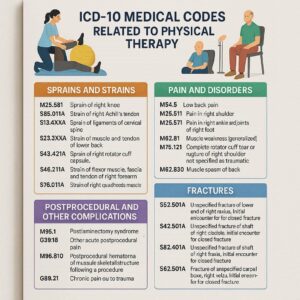
This guide is designed to be your companion. We are going to walk through the world of ICD 10 codes for physical therapy together. We will look at the most common codes, the ones that are often confused, and the new updates for 2026. By the end, you will feel confident that you are coding accurately, ethically, and efficiently.
Let’s dive in.
ICD 10 Codes for Physical Therapy
Table of Contents
ToggleWhy Accurate ICD-10 Coding Matters in PT
Before we start listing codes, it is important to understand the “why.” This isn’t just about getting paid (though that is a big part of it). It is about communication.
Think of the ICD-10 code as the reason for the visit. It justifies the medical necessity of your skilled treatment.
-
For the Payer: Insurance companies use the code to determine if the treatment is covered. A code for “low back pain” might be covered, but a code for “general muscle soreness” might not be.
-
For Outcomes: Clinics often track outcomes based on diagnosis. If you use the wrong code, your data becomes skewed. You might think your treatment for rotator cuff injuries is failing, when in reality, you were treating frozen shoulder but coding it wrong.
-
For Audits: If your clinic is audited, the auditors will look at the diagnosis code and your documentation. They will ask: “Does this note justify this code?” If the answer is no, you could face fines or be required to pay back the insurance company.
Important Note: Specificity is everything in ICD-10. The days of using a general code like
M54.9(Dorsalgia, unspecified) for every back pain patient are gone. Insurers want to know the specific region of the spine, the laterality (left, right, bilateral), and the cause of the issue whenever possible.
Breaking Down the ICD-10 Structure for PTs
ICD-10 codes are alphanumeric. They can be 3 to 7 characters long. The longer the code, the more specific the diagnosis.
-
The First Character: Always a letter. This letter denotes the category of the disease. For us, the most common letters are:
-
M: Diseases of the musculoskeletal system and connective tissue. (e.g., M25.511 – Pain in right shoulder).
-
S: Injuries, poisoning, and certain other consequences of external causes. (e.g., S83.52A – Sprain of anterior cruciate ligament of knee, initial encounter).
-
Z: Factors influencing health status and contact with health services. (e.g., Z47.89 – Encounter for other orthopedic aftercare).
-
G: Diseases of the nervous system. (e.g., G81.91 – Hemiplegia, unspecified affecting right dominant side).
-
-
The 7th Character: For injury codes (the S-section codes), you must include a 7th character. This is called the “extension” and it denotes the stage of healing or type of encounter.
-
A: Initial Encounter (Active treatment). Use this while the patient is actively receiving treatment for the injury.
-
D: Subsequent Encounter (Routine healing). This is the one PTs use most often. It indicates the patient is recovering.
-
S: Sequela (Late effects). This is for problems or conditions that arise as a result of a previous injury, like scar pain or limping after an old fracture.
-
The Most Common ICD-10 Codes in Outpatient Physical Therapy
To make this guide practical, we have broken down the codes by body region and condition type. These are the codes you will use daily.
General and Multi-Region Pain Codes
Sometimes, the diagnosis is simply pain. You might not have imaging. The patient might have a systemic issue. Here are the most common “catch-all” codes.
| Condition Description | ICD-10 Code | Specificity & Usage Notes |
|---|---|---|
| Generalized Pain | M79.7 |
Fibromyalgia. Use this for widespread, chronic pain. |
| Pain in Limb | M79.60 – M79.66 |
This is broken down by limb. (e.g., M79.62 Pain in left arm, M79.64 Pain in right hand). Very useful when the joint is not specified. |
| Myalgia | M79.1 |
Muscle pain. Use this when the pain is clearly muscular but not tied to a specific injury like a strain. |
| Neuralgia/Neuritis | M79.2 |
Nerve pain. Use this for radiating pain, tingling, or numbness not otherwise specified. |
| Other Soft Tissue Disorders | M79.89 |
A great “other” code for things like hip snapping, or generalized soft tissue tenderness. |
The Spine: Cervical, Thoracic, and Lumbar
Back and neck pain are the bread and butter of many PT clinics. Coding them correctly requires precision regarding the region and the presence of radiculopathy.
Cervical Spine (Neck)
| Condition Description | ICD-10 Code | Specificity & Usage Notes |
|---|---|---|
| Cervicalgia | M54.2 |
Neck pain. This is your standard neck pain without radiation. |
| Cervicocranial Syndrome | M53.0 |
Neck pain associated with headaches. Very useful for cervicogenic headaches. |
| Cervicobrachial Syndrome | M53.1 |
Neck pain that radiates down into the arm, but is not yet classified as a radiculopathy. |
| Cervical Radiculopathy | M54.12 |
Pinched nerve in the neck. This code implies specific nerve root involvement with motor or sensory loss. |
| Spinal Instability | M53.2 |
Used for conditions like cervical spondylolisthesis or general ligamentous laxity in the spine. |
Thoracic Spine (Mid Back)
| Condition Description | ICD-10 Code | Specificity & Usage Notes |
|---|---|---|
| Thoracic Back Pain | M54.6 |
Pain in the thoracic spine. This is the standard code. |
| Radiculopathy, Thoracic Region | M54.14 |
Much less common than cervical or lumbar, but use this when a nerve is compressed in the mid-back. |
Lumbar Spine (Low Back)
This is the most common area for PT referrals. Pay close attention to the radiculopathy codes here.
| Condition Description | ICD-10 Code | Specificity & Usage Notes |
|---|---|---|
| Low Back Pain | M54.5 |
The classic “LBP” code. Use this for mechanical low back pain without radiation. |
| Sciatica | M54.3 |
Pain along the sciatic nerve. Note: This is different from radiculopathy. Use this when the pain is in the nerve distribution but the specific root is unclear. |
| Lumbago with Sciatica | M54.4 |
Low back pain that also goes down the leg. |
| Lumbar Radiculopathy | M54.16 |
This is a specific diagnosis for a pinched nerve root in the low back, often confirmed by MRI or specific clinical tests (e.g., positive SLR with myotomal weakness). |
The Shoulder Complex
The shoulder is a complex joint, and the codes reflect that. You need to know if the issue is inflammatory, mechanical, or traumatic.
| Condition Description | ICD-10 Code | Specificity & Usage Notes |
|---|---|---|
| Rotator Cuff Tendinitis | M75.12 |
Inflammation of the rotator cuff. *Note: The last digit denotes laterality. .12 = right, .11 = left, .10 = unspecified.* |
| Rotator Cuff Tear | M75.12x? |
Careful: A tear is different from tendinitis. For a tear, you actually use the same code family but with a different extension. Use M75.12x is not correct. You need to specify:• M75.121 – Complete rotator cuff tear/rupture of right shoulder, not specified as traumatic.• M75.122 – Complete rotator cuff tear/rupture of left shoulder. |
| Adhesive Capsulitis | M75.01 |
Frozen shoulder. |
| Impingement Syndrome | M75.42 |
Shoulder impingement. |
| Bursitis of Shoulder | M75.52 |
Inflammation of the bursa. |
| Glenoid Labrum Tear | S43.43 (or M24.11) |
For traumatic tears, use the S-code (S43.431A for initial). For chronic/degenerative tears, use the M-code (M24.111 for right shoulder). |
The Knee
The knee is highly specific. You must differentiate between sprains (ligaments), strains (muscles/tendons), and internal derangements (meniscus).
| Condition Description | ICD-10 Code | Specificity & Usage Notes |
|---|---|---|
| Pain in Knee | M25.56 |
Generalized knee pain. Use when no specific structure is identified. |
| Osteoarthritis of Knee | M17.0 – M17.9 |
Very specific. M17.0 is bilateral primary OA. M17.11 is unilateral, right knee. |
| Sprain of ACL | S83.50 – S83.51 |
Use the S-codes here. S83.511A (right knee, initial) or S83.511D (right knee, subsequent). |
| Sprain of MCL | S83.41 |
Medial collateral ligament sprain. |
| Meniscal Tear | S83.20 – S83.27 |
S83.241 is a complex tear of the medial meniscus, right knee. |
| Patellofemoral Syndrome | M22.2 |
Patellofemoral disorders. This is the code for anterior knee pain related to the patella. |
| Chondromalacia Patella | M22.4 |
Softening of the cartilage on the back of the kneecap. |
The Hip and Pelvis
Hip pain can be tricky because it often refers from the lumbar spine. Make sure the diagnosis matches your findings.
| Condition Description | ICD-10 Code | Specificity & Usage Notes |
|---|---|---|
| Pain in Hip | M25.55 |
Unspecified hip pain. |
| Osteoarthritis of Hip | M16.1 – M16.9 |
M16.11 for right hip, M16.12 for left. |
| Trochanteric Bursitis | M70.62 |
Lateral hip pain. |
| Hip Labral Tear | S73.11 (or M24.85) |
Traumatic (S-code) vs. degenerative (M-code). S73.111 for right hip. |
| Piriformis Syndrome | M76.1 |
Entrapment of the sciatic nerve by the piriformis muscle in the buttock. |
The Ankle and Foot
| Condition Description | ICD-10 Code | Specificity & Usage Notes |
|---|---|---|
| Ankle Sprain | S93.40 |
Sprain of ankle. The full code requires laterality and encounter. S93.401A for right ankle, initial. |
| Plantar Fasciitis | M72.2 |
Heel pain. |
| Achilles Tendinitis | M76.60 |
Inflammation of the Achilles. M76.61 for right, M76.62 for left. |
| Achilles Tendon Rupture | S86.01 |
Traumatic rupture. Needs laterality and encounter digit. |
Neurological and Post-Surgical Codes
Physical therapy isn’t just for orthopedic injuries. We also treat neurological conditions and post-operative patients.
| Condition Description | ICD-10 Code | Specificity & Usage Notes |
|---|---|---|
| Cerebral Palsy | G80 series |
G80.9 for unspecified. Be specific if you know the type. |
| Hemiplegia | G81.91 |
Weakness on one side of the body affecting the dominant side. |
| Paraplegia | G82.20 |
Paralysis of lower limbs. |
| Parkinson’s Disease | G20 |
Primary Parkinsonism. |
| Generalized Weakness | M62.81 |
Muscle weakness, generalized. Often used for deconditioned patients. |
| Encounter for Orthopedic Aftercare | Z47.89 |
Crucial code. Use this for patients who are post-op and coming in for routine rehab, after the surgical incision has healed and the “injury” phase is over. |
| Encounter for Physical Therapy | Z51.89 |
This is a tricky one. It is not a primary diagnosis. You cannot use this alone. It means the patient is here specifically for PT, but you still need a medical diagnosis code (like M54.2) listed first. |
New ICD-10 Codes for Physical Therapy in 2026
The ICD-10 code set is updated every year on October 1st. For the 2026 fiscal year, there are a few updates that physical therapists should be aware of. While many changes are for rare diseases, a few affect common MSK conditions.
-
Greater Specificity for Tendinopathies: The codes for chronic tendon conditions have been expanded. Previously, many of us used the same code for “tendinitis” regardless of whether it was actually a degenerative tendinosis. New codes now allow for a distinction between acute inflammation (
M77.-with new extensions) and chronic degenerative conditions (M67.-for chronic disorders of synovium/tendon). -
Post-COVID Conditions: The code for post-COVID conditions (often called “Long COVID”) has been refined.
U09.9(Post COVID-19 condition, unspecified) remains, but new subcategories are available for specific manifestations like post-viral fatigue and musculoskeletal pain directly related to a previous COVID infection. -
Coding for Gait Abnormalities: New codes under
R26(Abnormalities of gait and mobility) have been added to better describe specific gait patterns like “antalgic gait” and “spastic gait” with greater laterality.
Important Note on Updates: Always ensure your practice management software is updated with the latest ICD-10 codes every October. Using an outdated code is a surefire way to get a claim denied.
ICD-10 Coding Strategies for Common Scenarios
Knowing the code is one thing. Knowing how to apply it in a real clinical note is another. Let’s look at a few scenarios.
Scenario 1: The Post-Op Total Knee Replacement
-
The Patient: A 68-year-old female, 4 weeks post right total knee arthroplasty. She is here for gait training, ROM exercises, and strengthening.
-
The Codes:
-
Primary Diagnosis:
Z47.1(Aftercare following joint replacement surgery). This is actually more specific than Z47.89. It tells the payer exactly why she is here. -
Secondary Diagnosis:
Z96.641(Presence of right artificial knee joint). This indicates the hardware is in place. -
Additional Diagnosis (Optional):
M25.561(Pain in right knee). You can list this if pain is a current focus of the treatment, but the aftercare code should be primary.
-
Scenario 2: The Chronic Low Back Patient with a Flare-Up
-
The Patient: A 45-year-old male with a history of chronic LBP. He had a recent flare-up after moving furniture. He presents with acute pain, but no radiation.
-
The Codes:
-
Primary Diagnosis:
M54.5(Low back pain). -
How to document the acuity: ICD-10 does not have a “chronic vs. acute” flag for M54.5. This information must live in your written narrative. Your note should say: “Patient with history of chronic LBP, now presenting with acute exacerbation.” The insurance adjuster reads the note, not just the code.
-
Scenario 3: The Patient with Multiple Comorbidities
-
The Patient: A 72-year-old with Parkinson’s Disease who fell and sprained his left ankle. He is now afraid to walk.
-
The Codes (Hierarchy Matters!):
-
Primary Diagnosis:
S93.402D(Sprain of left ankle, subsequent encounter). The injury is the reason for this specific episode of care. -
Secondary Diagnosis:
G20(Parkinson’s Disease). This is relevant because it affects his balance and rehab potential. -
Tertiary Diagnosis:
Z91.81(History of falling). This supports the need for balance training.
-
Common Coding Mistakes to Avoid
Even experienced therapists make these errors. Here is what to watch out for.
-
Using “Unspecified” Codes: Avoid codes ending in .9 (like M54.9) unless you absolutely have no other information. These are “unspecified” codes, and payers view them as a lack of medical necessity. If you can point to a specific lumbar level, do it. If you know it’s the right shoulder, don’t code it as “unspecified shoulder.”
-
Mixing Up Sprains and Strains: This is a classic.
-
Sprain = Ligament (bone to bone). Codes start with
S93,S83,S43. -
Strain = Muscle or Tendon (muscle to bone). Codes often start with
S16(neck),S39(trunk), orS86(lower leg).
-
-
Forgetting the 7th Character: For injury codes, if you forget the “A, D, or S” extension, the computer will reject the claim. Set up your EMR to prompt you for this.
-
Coding the Symptom Instead of the Diagnosis: If the patient has a known rotator cuff tear, do not code “shoulder pain” (M25.51). Code the tear (M75.121). The tear is the cause of the pain. Always code the highest level of specificity known.
The Relationship Between ICD-10 and CPT Codes
Your ICD-10 code (the diagnosis) must support your CPT code (the treatment).
If you bill for Therapeutic Exercise (97110) , your diagnosis should indicate a condition that requires strengthening or range of motion (e.g., rotator cuff tear, post-op knee).
If you bill for Neuromuscular Re-education (97112) , your diagnosis should support the need for balance, coordination, or proprioception training (e.g., s/p CVA, ankle sprain, Parkinson’s).
If you bill for Manual Therapy (97140) , your diagnosis should mention stiffness, adhesions, or joint restriction (e.g., adhesive capsulitis, frozen shoulder, lumbar facet hypomobility).
Golden Rule: If the diagnosis code doesn’t match the treatment code, the payer will deny the claim. For example, billing gait training (97116) for a patient with a simple diagnosis of “elbow tendinitis” is a red flag.
FAQs: ICD-10 Codes for Physical Therapy
Q: Can I use a code from a previous visit if the patient’s condition hasn’t changed?
A: Yes, you can use the same code for as long as the diagnosis is accurate. However, if the patient’s condition evolves (e.g., a sprain is healing but now they have developed secondary stiffness), you may need to update the code to reflect the new primary problem.
Q: What if the patient has a diagnosis from their doctor that I disagree with?
A: You are a licensed professional. You must code for what you find. If the referral says “Lumbar Strain” but your evaluation clearly points to “Facet Syndrome,” you should use the code that matches your clinical findings (M47.812 for Spondylosis without myelopathy or radiculopathy, lumbar region). It is good practice to communicate this with the referring physician.
Q: My patient has Medicare. Do I need to code differently?
A: Medicare follows the same ICD-10 guidelines. However, Medicare is very strict about the “chronic vs. acute” distinction and the “medical necessity” of the code. Always choose the most specific code possible for Medicare patients.
Q: What is the difference between M54.5 and M54.16?
A: M54.5 is general low back pain. M54.16 is lumbar radiculopathy, which implies the pain is caused by nerve root irritation and usually involves pain that travels past the knee, often with associated numbness or weakness.
Q: How do I code for a patient who is “at risk” for falling?
A: You should code Z91.81 (History of falling). You can also code R26.81 (Unsteadiness on feet) if that is a current symptom. Combine this with the primary diagnosis (e.g., Parkinson’s, post-stroke, deconditioning) to justify balance training.
Additional Resources for ICD-10 Coding
Staying up to date is a challenge. Here are a few reliable resources to keep on hand:
-
The CDC’s National Center for Health Statistics: They provide the official ICD-10-CM files and updates.
-
The APTA: The American Physical Therapy Association often provides coding resources and cheat sheets for members.
-
Your State Practice Act: Always check if your state has specific documentation requirements regarding coding.
Conclusion
Navigating the world of ICD 10 codes for physical therapy doesn’t have to be a source of stress. By understanding the structure of the codes, focusing on specificity, and matching your diagnosis to your treatment plan, you can ensure clean claims and fair reimbursement. Remember, the code is the medical justification for your skilled care.
A Final Note on This Guide
The information provided in this article is for general informational purposes only and is current as of February 13, 2026. Coding guidelines and payer policies change frequently. While every effort has been made to ensure accuracy, this information should not replace your professional judgment or the official coding manuals. Always verify codes with the latest ICD-10-CM official guidelines and your specific payer contracts before submitting claims.
Disclaimer: This article is intended for educational and informational purposes only and does not constitute legal or billing advice. You should consult with a qualified healthcare attorney or billing specialist for advice regarding your specific situation.
Author: [Your Name/PT Specialist]
Date: FEBRUARY 13, 2026