If you work in healthcare—whether as a medical coder, a physician, or a billing specialist—you know that precision is everything. One small misstep in coding can lead to claim denials, audits, or a frustratingly incomplete medical record. When it comes to patients who have undergone weight loss surgery, getting the code right is just as important as the surgery itself.
You might be searching for the “icd 10 code for bariatric surgery status” because you have a patient sitting in front of you who had gastric bypass five years ago, and you need to document that history. Or perhaps you are reviewing charts and notice that the code is consistently missing, leaving a gap in the patient’s story.
Let’s clear up the confusion. The code you are looking for is Z98.84. But as with most things in medicine, there is a bit more to the story than just slapping a code on a claim. This guide will walk you through everything you need to know about this specific status code, from its clinical application to the nuances of payer policies.
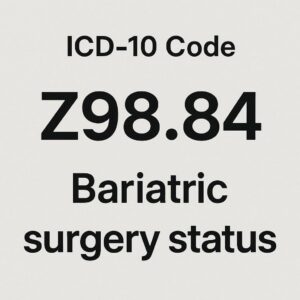
ICD-10 Code for Bariatric Surgery Status
What is the ICD-10 Code for Bariatric Surgery Status?
In the vast library of the International Classification of Diseases, 10th Revision (ICD-10), the specific code used to indicate that a patient has a history of weight loss surgery is:
Z98.84 – Bariatric Surgery Status
This code falls under the category of “Persons with potential health hazards related to family and personal history and certain conditions influencing health status” (Z77-Z99). More specifically, it resides in the “Other postprocedural states” (Z98) block.
What this code means: It tells the story that the patient is not acutely ill from the surgery, but the surgery has happened. It is a piece of history that influences their current and future healthcare needs. Think of it as a flag in the chart that says, “Remember, this patient’s digestive system has been surgically altered.”
Why Accurate Coding Matters Here
You might wonder why we need a specific code for this. Why can’t we just use a general history of surgery code?
-
Nutritional Monitoring: Patients post-bariatric surgery are at risk for specific vitamin deficiencies (B12, iron, calcium). Seeing Z98.84 prompts a physician to check these levels.
-
Anatomical Changes: If a patient needs an endoscopy or a different abdominal surgery later in life, the medical team needs to know about the altered anatomy immediately.
-
Billing Certain Services: Some insurance plans cover specific nutritional counseling or follow-up care specifically for post-bariatric patients. The diagnosis code justifies the medical necessity.
Clinical Context: Understanding the “Status” Code
To use Z98.84 effectively, you need to understand the philosophy behind “status” codes in ICD-10. These are not diagnosis codes that describe an illness. They describe a condition that is not in itself a current illness or injury but may affect future care.
For example, if a patient comes in with a cold, you would code the cold (J00) and also code Z98.84 to indicate their bariatric history. The cold is the reason for the visit, but the bariatric status is relevant background information.
Types of Bariatric Procedures Included
Z98.84 is a blanket code for the status of any weight loss procedure. This includes, but is not limited to:
-
Roux-en-Y Gastric Bypass: The most common form of bypass surgery.
-
Sleeve Gastrectomy: Removing a large portion of the stomach to create a tube-like sleeve.
-
Adjustable Gastric Band (Lap-Band): Placing a band around the stomach to restrict intake.
-
Biliopancreatic Diversion with Duodenal Switch (BPD/DS): A more complex procedure involving both restriction and malabsorption.
Regardless of which specific procedure was performed, the status code remains Z98.84.
When and How to Use Z98.84
Knowing the code is one thing; knowing how to apply it in a real-world chart is another. Here are the primary scenarios where this code is used.
As a Secondary Diagnosis
In 95% of cases, Z98.84 will be a secondary diagnosis. The primary diagnosis (the reason for the encounter) drives the visit.
Example Scenario:
-
Patient: Sarah, a 45-year-old female, presents for her annual physical.
-
History: She had gastric bypass surgery in 2021.
-
Reason for Visit: Routine check-up.
-
Primary Diagnosis: Z00.00 (Encounter for general adult medical examination without abnormal findings).
-
Secondary Diagnosis: Z98.84 (Bariatric surgery status) .
By including Z98.84, the physician is reminded to order specific lab work (like iron studies) that are relevant to Sarah’s history.
When the Visit is Related to the Surgery
Sometimes, the patient is there specifically because of their post-surgery state. This could be for routine follow-up, or it could be for a complication.
Scenario A: Routine Follow-Up
-
Patient: Mike, 52, comes for his 6-month post-op check-up with the bariatric surgeon.
-
Encounter Focus: Monitoring weight loss progress, nutritional status, and surgical recovery.
-
Primary Diagnosis: Z98.84 (Bariatric surgery status). *Note: Some coders might use Z09 (Follow-up examination after completed treatment for conditions other than malignant neoplasm), but Z98.84 is often more specific for the post-surgical state itself. Always check payer preference and specific circumstances.*
-
Secondary Diagnosis: E66.01 (Morbid (severe) obesity due to excess calories) – to link the reason for the original surgery.
Scenario B: Dealing with a Complication
-
Patient: Linda, 38, comes to the ER with severe nausea and vomiting. She had a gastric sleeve 8 months ago.
-
Encounter Focus: Diagnosing and treating the vomiting.
-
Primary Diagnosis: K91.89 (Other postprocedural complications and disorders of digestive system) or a more specific code if stenosis or obstruction is found.
-
Secondary Diagnosis: Z98.84 (Bariatric surgery status) .
In the complication scenario, Z98.84 supports the “why” behind the primary complication code.
Common Questions and Pitfalls with Z98.84
Even with a straightforward code, there are nuances that can trip up even seasoned coders.
The “History of” vs. “Status” Confusion
You might be tempted to use a “Personal history” code, like Z87.19 (Personal history of other diseases of the digestive system). However, this is incorrect. “History of” codes (Z80-Z87) are typically used for diseases that have resolved (like a history of colon polyps). “Status” codes (Z90-Z99) are used for conditions that are permanent or long-lasting, like the absence of an organ or the presence of an artificial device. Bariatric surgery permanently alters the digestive tract, making it a “status” rather than a “history.”
The Missing Code: A Documentation Gap
One of the biggest issues in medical records is the absence of Z98.84. If a patient with a history of gastric bypass is seen for hypertension, and the coder only bills the hypertension code (I10), the full clinical picture is lost. The physician who sees the chart next month won’t have that immediate visual reminder of the patient’s altered anatomy. Always ensure that a relevant status code is included in the patient’s problem list and carried forward to each encounter note.
Payer Specifics
While Z98.84 is the standard code, some insurance companies have specific policies regarding its use, particularly when it is the primary diagnosis. For instance, some payers may not cover a visit for “bariatric surgery status check” if it’s too soon after a prior covered visit. Always be aware of the medical necessity guidelines for the specific procedure being billed.
The Importance of Z98.84 in Long-Term Patient Care
To truly grasp the value of this code, we have to look beyond the billing sheet and into the exam room. Bariatric surgery is not a cure; it is a tool. It places the patient in a new, permanent physiological state.
Nutritional Implications
After gastric bypass, the body absorbs nutrients differently. Patients are prone to:
-
Anemia: Due to decreased iron and B12 absorption.
-
Osteoporosis: Due to decreased calcium absorption.
-
Neurological issues: Rare, but possible with severe B12 or thiamine deficiency.
When Z98.84 is prominently displayed in the chart, it serves as a clinical trigger. It reminds the provider to ask:
-
“Have you been taking your vitamins?”
-
“When was your last iron panel?”
-
“Any tingling in your hands or feet?”
Without that code, these crucial questions might be missed during a busy visit for an unrelated issue like a sore throat.
Implications for Future Procedures
Imagine a patient needs an upper endoscopy (EGD) five years after a Roux-en-Y gastric bypass. The gastroenterologist walks in, reads the chart, and sees Z98.84. Immediately, they know that the anatomy is not standard. They will need to use a specialized scope and approach to visualize the gastric pouch and the jejunum, rather than the entire stomach. The code is a safety mechanism.
Documentation Tips for Providers
For physicians and clinicians, accurate coding starts with accurate documentation. Here is how you can ensure Z98.84 is used correctly in your practice.
-
Include it in the Social/History Section: When writing a note, don’t just list the surgery in a narrative paragraph. Place it in the “Past Surgical History” section of your electronic health record (EHR) where it can be easily pulled into the encounter.
-
Connect the Dots: If you are seeing a patient for a condition commonly linked to bariatric surgery (like gallstones or nutritional deficiencies), explicitly state the relationship in your note. For example: “Patient presents with right upper quadrant pain. Given her history of rapid weight loss following gastric bypass in 2023 (status Z98.84), she is at high risk for cholelithiasis.”
-
Update the Problem List: Ensure that Z98.84 is an active, non-resolvable item on the patient’s master problem list. This ensures it tags along to every future visit.
Additional Related Codes for Bariatric Patients
While Z98.84 is the star of the show, it often appears alongside other codes to paint a complete picture.
| Code | Description | Common Use Case |
|---|---|---|
| E66.01 | Morbid (severe) obesity due to excess calories | Documenting the original reason for the surgery, especially in follow-ups. |
| Z68.35 – Z68.45 | Body Mass Index (BMI) codes | Tracking progress post-surgery. BMI is a vital sign for these patients. |
| E63.9 | Nutritional deficiency, unspecified | When a patient presents with symptoms of malnutrition post-op. |
| K91.2 | Postsurgical malabsorption, not elsewhere classified | A specific complication of bariatric surgery. |
| K91.84 | Other postprocedural complications and disorders of the digestive system | A catch-all for specific surgical complications. |
Real-World Examples: Putting It All Together
Let’s look at three distinct patient encounters to see how Z98.84 functions in the wild.
Example 1: The Annual Wellness Visit
*A 55-year-old male presents for his Medicare Annual Wellness Visit. He is a successful business owner who had a sleeve gastrectomy four years ago. He has maintained a 100-pound weight loss. He is not currently ill.*
-
Diagnosis 1: Z00.00 (Encounter for general adult medical examination)
-
Diagnosis 2: Z98.84 (Bariatric surgery status)
-
Diagnosis 3: Z68.32 (Body mass index 32.0-32.9, adult)
Example 2: The Emergency Room Visit
*A 29-year-old female comes to the ER with abdominal pain and vomiting. She admits she has not been following her dietary guidelines and ate a large piece of bread. An X-ray shows no obstruction, and she is diagnosed with “dumping syndrome.”*
-
Diagnosis 1: K91.89 (Other postprocedural complications and disorders of digestive system) to capture the dumping syndrome
-
Diagnosis 2: Z98.84 (Bariatric surgery status)
-
Diagnosis 3: R11.2 (Nausea with vomiting, unspecified)
Example 3: The Specialist Referral
*A 62-year-old female is referred to a rheumatologist for joint pain. She is still obese but lost significant weight after gastric bypass 10 years ago. The rheumatologist diagnoses osteoarthritis.*
-
Diagnosis 1: M17.0 (Bilateral primary osteoarthritis of knee)
-
Diagnosis 2: Z98.84 (Bariatric surgery status) — Relevant because her weight loss may have slowed the progression of the arthritis.
-
Diagnosis 3: E66.3 (Overweight)
The Future of Bariatric Coding
As medicine evolves, so does coding. Currently, Z98.84 serves its purpose well. However, with the rise of endoscopic bariatric therapies (like the endoscopic sleeve gastroplasty or the aspiration therapy), we may eventually see more specific codes for these non-surgical interventions. For now, Z98.84 remains the go-to code for any patient who has undergone a procedure to alter their digestive tract for weight loss.
Conclusion
In the intricate world of medical coding, the ICD-10 code for bariatric surgery status—Z98.84—is more than just a number. It is a critical piece of a patient’s health narrative. It signals to every provider who touches the chart that this patient’s anatomy and physiology are unique. It triggers preventative care, ensures patient safety, and justifies the medical necessity of treatments related to the post-surgical state.
Whether you are coding for a routine physical, a complication, or a long-term follow-up, remember that Z98.84 is the key to painting an accurate and complete picture of the patient’s health. By using it correctly, you are not just filing an insurance claim; you are contributing to safer, more informed patient care.
Frequently Asked Questions (FAQ)
1. Is Z98.84 only for patients who had the surgery recently?
No. Z98.84 is a “status” code, meaning it is permanent. It should be used for the rest of the patient’s life, as the anatomical changes are permanent and always relevant to their healthcare.
2. Can I use Z98.84 for a patient who had the surgery reversed?
It depends. If the reversal returned the anatomy to “normal,” you might consider a history code instead. However, many reversals still leave the patient with altered anatomy. In that case, Z98.84 may still be appropriate. If the reversal was due to a complication, you would code the complication first.
3. What is the difference between Z98.84 and a code for a complication?
Z98.84 states the fact that surgery occurred. A complication code (like K91.2 for malabsorption) states the problem resulting from the surgery. If a patient has a problem, you code the problem first and the status second.
4. Do I need to specify the type of bariatric surgery in the code?
No. The ICD-10 code Z98.84 does not differentiate between gastric bypass, sleeve, or lap-band. It is a blanket code for all of them. The specific type of surgery should be documented in the clinical note, but it is not required in the diagnosis code itself.
5. My EHR automatically populates old codes. Do I need to check Z98.84 every time?
Yes. While automation is helpful, you must verify that Z98.84 is still relevant to the current encounter. If the patient’s condition has changed, or if you are seeing them for a truly unrelated acute issue, it is often still relevant as a secondary code. It is best practice to keep it active.
Additional Resource
For the most up-to-date official information on ICD-10 coding conventions and guidelines, please refer to the Centers for Medicare & Medicaid Services (CMS) and the National Center for Health Statistics (NCHS) . You can access the official ICD-10-CM Official Guidelines for Coding and Reporting here:
CMS ICD-10 Website