If you work in eye care—whether as an ophthalmologist, optometrist, coder, or practice manager—you know that clinical expertise is only half the battle. The other half is making sure your diagnoses are accurately translated into the language of insurance companies. That language is ICD-10.
Navigating the world of icd 10 code for ophthalmology can sometimes feel like trying to read a map with no legend. There are thousands of codes, each with specific laterality, severity, and encounter type. But here’s the good news: once you understand the structure and the logic behind the codes, the process becomes much more manageable.
This guide is designed to be your friendly, reliable roadmap. We will walk through the most common categories, discuss the pitfalls to avoid, and give you practical tips to streamline your workflow. Whether you are dealing with a routine case of dry eye or a complex diabetic retinopathy, accurate coding is your ticket to getting paid fairly and staying compliant.
Let’s clear the fog and bring things into focus.
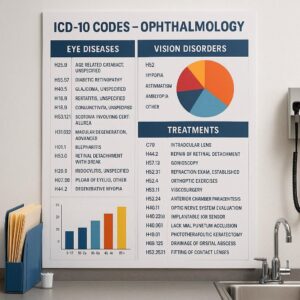
ICD-10 Codes for Ophthalmology
Table of Contents
ToggleWhat is ICD-10? A Quick Refresher
Before we dive into the specifics of ophthalmology, let’s take a step back. ICD-10 stands for the Tenth Revision of the International Statistical Classification of Diseases and Related Health Problems. It is a medical classification list created by the World Health Organization (WHO).
In the United States, we use a clinical modification called ICD-10-CM (Clinical Modification). It is the system healthcare providers use to classify and code all diagnoses, symptoms, and procedures.
Think of it as a giant, structured dictionary for every possible health condition. Instead of writing “the patient has age-related blurry vision in the center of their left eye,” you can summarize it with a precise code like H35.31 (Nonexudative age-related macular degeneration, left eye). This allows for:
-
Standardized Communication: Everyone—from your front desk to the insurance payer—understands the exact condition.
-
Billing and Reimbursement: Codes justify the medical necessity of the procedures you perform.
-
Epidemiological Tracking: Public health officials track disease prevalence and outcomes.
-
Quality of Care Measurement: Data helps identify trends and improve treatment protocols.
The Anatomy of an Ophthalmology ICD-10 Code
Ophthalmology codes primarily live in Chapter 7 of the ICD-10 manual: Diseases of the Eye and Adnexa (H00-H59) . Understanding how these codes are built is the first step to mastering them.
A typical code in this chapter will look like this: H25.12
Let’s break it down:
-
H25: This is the category. It stands for “Age-related cataract.”
-
.1: This is the extension, often indicating the type or morphology. In this case, H25.1 is “Age-related nuclear cataract.”
-
2: This is the laterality or specific detail. .12 means “Age-related nuclear cataract, left eye.”
The Golden Rule of Ophthalmology Coding: Laterality is King.
Most ophthalmic diagnoses require you to specify which eye is affected. You will almost always see codes ending with:
-
1: Right eye
-
2: Left eye
-
3: Bilateral
-
9: Unspecified eye (Use this sparingly, as it suggests a lack of documentation).
Important Note: Insurance payers view “unspecified” codes as a red flag. They imply the provider did not perform a thorough enough exam to determine laterality. Always aim for a specified code unless the documentation truly does not support it.
The Most Common ICD-10 Codes in Ophthalmology
Let’s get into the practical part of our journey. While there are hundreds of codes, a significant portion of a typical practice’s billing will revolve around a core group of diagnoses. Here are the heavy hitters, broken down by category.
Cataract and Associated Disorders
Cataracts are a universal part of aging, making this one of the most frequently billed categories in ophthalmology.
| Condition | ICD-10 Code | Clinical Description |
|---|---|---|
| Age-related Nuclear Cataract | H25.1 (R/L/Bilateral) | Clouding of the central (nuclear) part of the lens. |
| Age-related Cortical Cataract | H25.0 (R/L/Bilateral) | Clouding in the lens cortex, often looking like spokes. |
| Age-related Posterior Subcapsular Cataract | H25.2 (R/L/Bilateral) | Clouding at the back of the lens, often causing glare. |
| Combined Forms of Age-related Cataract | H25.8 (R/L/Bilateral) | More than one type of age-related cataract present. |
| Diabetic Cataract | E08.36, E09.36, E10.36, E11.36 | Cataract secondary to diabetes mellitus. Code first the diabetes. |
| Traumatic Cataract | H26.1 (R/L/Bilateral) | Cataract resulting from an injury to the eye. |
| After-cataract (Secondary Membrane) | H26.4 (R/L/Bilateral) | Opacification of the posterior lens capsule after cataract surgery (PCO). |
| Unspecified Cataract | H26.9 | Use only if the type is not documented. |
Glaucoma: The Silent Thief of Sight
Glaucoma coding is all about specificity. You need to identify the type of glaucoma and the stage.
| Condition | ICD-10 Code | Clinical Description |
|---|---|---|
| Primary Open-Angle Glaucoma (POAG) | H40.11 (R/L/Bilateral) | Chronic, progressive optic nerve damage with open angle. |
| POAG, Stage (Mild, Moderate, Severe, Indeterminate) | Add 1-4 (e.g., H40.11X1) | The “X” is a placeholder, followed by the stage digit. |
| Primary Angle-Closure Glaucoma | H40.21 (R/L/Bilateral) | Glaucoma caused by physical blockage of the drainage angle. |
| Pseudoexfoliation Glaucoma | H40.14 (R/L/Bilateral) | Glaucoma secondary to pseudoexfoliation syndrome. |
| Glaucoma Suspect (Ocular Hypertension) | H40.01 (R/L/Bilateral) | Elevated IOP without evidence of glaucomatous damage. |
| Anatomical Narrow Angle | H40.02 (R/L/Bilateral) | Narrow drainage angle, high risk for angle-closure glaucoma. |
| Low-Tension Glaucoma | H40.12 (R/L/Bilateral) | Typical glaucomatous damage despite statistically normal IOP. |
Understanding Glaucoma Staging:
For POAG, you will use a 5th digit to indicate the stage.
-
0: Stage unspecified
-
1: Mild stage
-
2: Moderate stage
-
3: Severe stage
-
4: Indeterminate stage (when it is not possible to classify based on available data).
Disorders of the Retina
The retina is a complex landscape, and its codes reflect that. Diabetic eye disease is the most prominent here.
| Condition | ICD-10 Code | Clinical Description |
|---|---|---|
| Non-Proliferative Diabetic Retinopathy (NPDR) | E08.31, E09.31, E10.31, E11.31 | Background retinopathy with microaneurysms, hemorrhages, etc. |
| NPDR with Macular Edema | Add .33 to the diabetes code (e.g., E11.33) | NPDR accompanied by swelling in the macula. |
| Proliferative Diabetic Retinopathy (PDR) | E08.32, E09.32, E10.32, E11.32 | More advanced stage with abnormal new blood vessel growth. |
| PDR with Macular Edema | Add .35 to the diabetes code (e.g., E11.35) | PDR accompanied by swelling in the macula. |
| Age-Related Macular Degeneration (AMD) | H35.3 (R/L/Bilateral) | Dry (nonexudative) or Wet (exudative) form. |
| Central Retinal Vein Occlusion (CRVO) | H34.81 (R/L/Bilateral) | Blockage of the main retinal vein. |
| Branch Retinal Vein Occlusion (BRVO) | H34.83 (R/L/Bilateral) | Blockage of a smaller branch of the retinal vein. |
| Retinal Detachment with Retinal Break | H33.0 (R/L/Bilateral) | Rhegmatogenous retinal detachment. |
| Lattice Degeneration | H35.41 (R/L/Bilateral) | Peripheral retinal thinning predisposing to breaks. |
Important Note on Diabetes Coding: When coding diabetic retinopathy, the ICD-10 guidelines require a “code first” approach. You must list the specific diabetes code first (e.g., E11.9 for Type 2 diabetes without complications), followed by the retinopathy code. The diabetes code indicates the cause, and the retinopathy code describes the manifestation.
Neuro-Ophthalmology and Other Common Conditions
| Condition | ICD-10 Code | Clinical Description |
|---|---|---|
| Dry Eye Syndrome | H04.12 (R/L/Bilateral) | Keratoconjunctivitis sicca. |
| Blepharitis | H01.0 (R/L/Bilateral) | Inflammation of the eyelid margins. |
| Allergic Conjunctivitis | H10.45 (R/L/Bilateral) | Eye allergy. |
| Viral Conjunctivitis | B30 (e.g., B30.9) | Adenoviral conjunctivitis. |
| Presbyopia | H52.4 (R/L/Bilateral) | Age-related difficulty focusing on near objects. |
| Myopia (Nearsightedness) | H52.1 (R/L/Bilateral) | Difficulty seeing distant objects clearly. |
| Astigmatism | H52.2 (R/L/Bilateral) | Blurred vision due to irregular corneal shape. |
| Amblyopia (Lazy Eye) | H53.0 (R/L/Bilateral) | Decreased vision in one eye due to abnormal visual development. |
| Floaters and Vitreous Opacities | H43.3 (R/L/Bilateral) | Specks that drift through the field of vision. |
| Migraine Variants | G43. (e.g., G43.B) | Migraine with aura or retinal migraine. |
Common Coding Challenges and How to Avoid Them
Even seasoned coders can trip up. Here are the most common pitfalls in ophthalmology coding and how to navigate them.
The “Rule Out” Trap
You see a patient with high pressure and a suspicious nerve. You write in your note: “Rule out glaucoma.” In ICD-10, you cannot code a condition as if it exists simply because you are testing for it. You must code the diagnosis that is supported by the documentation at that visit.
-
Correct: Code the signs and symptoms, such as H40.01 (Ocular Hypertension) or H40.02 (Anatomical Narrow Angle) .
-
Incorrect: Coding H40.11X1 (Primary Open-Angle Glaucoma, Mild Stage) before you have definitive visual field loss and optic nerve damage documented.
Laterality Neglect
This is the most common error. A superbill that only says “Cataract” is insufficient. The chart note must clearly state “right eye,” “left eye,” or “both eyes.” If it is bilateral, the code must reflect that (ending in 3). If the documentation is ambiguous, it must be sent back to the provider for clarification.
The “Unspecified” Crutch
It is tempting to use the unspecified code when you are in a hurry. But as mentioned earlier, this can lead to claim denials. For example, instead of using H35.9 (Retinal disorder, unspecified) , dig deeper. Is it a retinal hemorrhage H35.6? Or background retinopathy H35.01? Specifying the diagnosis paints a clearer picture of the patient’s health and justifies the exam level.
Sequencing Diabetes and Eye Conditions
This is a major compliance area. When a diabetic patient presents for a diabetic eye exam, the diabetes is the primary (first-listed) diagnosis, and the eye condition is secondary. This tells the payer that the eye exam is directly related to managing the patient’s chronic systemic disease.
Post-Operative Coding Confusion
After cataract surgery, the patient comes in for a routine follow-up. The diagnosis is no longer “Cataract” (since the lens has been removed). You should code Z98.890 (Personal history of surgery to the organs of special sense) or the appropriate “after-cataract” code if they have PCO. For a standard post-op visit, you may also use a code for the status of the artificial lens, such as Z96.1 (Presence of intraocular lens) .
A Practical Guide to the Eye Exam (E/M) Coding and ICD-10
The link between the E/M service (the exam) and the ICD-10 code (the diagnosis) is the concept of Medical Necessity. The diagnosis code must justify why the exam was performed and at what level.
-
A new patient comprehensive exam: This is easily justified by a new diagnosis like H52.1 (Myopia) or a condition requiring a full workup like H40.11 (POAG) .
-
A detailed follow-up exam: This is justified by an established, chronic condition that requires monitoring, such as H35.31 (Dry AMD) or E11.31 (NPDR) .
-
A problem-focused exam: This is appropriate for a minor, acute issue like H10.45 (Allergic Conjunctivitis) .
Think of it as telling a story. The ICD-10 code tells the payer why the patient was there. The CPT code tells them what you did about it. These two must always align.
The Future: ICD-11 on the Horizon
While ICD-10 is the current standard, the medical world is already looking toward ICD-11. The WHO adopted it in 2019, and it will eventually be implemented in the US. ICD-11 is fully digital and more detailed. For ophthalmology, it promises even greater specificity, particularly in areas like genetics and personalized medicine. For now, mastering ICD-10 is the priority, but keeping an eye on future updates is a hallmark of a true professional.
Top Tips for a Cleaner, More Profitable Coding Workflow
-
Update Your Superbill Regularly: Your superbill is your front-line tool. Review it every six months to ensure it includes the most common codes and removes any outdated ones.
-
Invest in Training: Make sure your coders and providers attend regular coding webinars. The rules can change annually, and a small update can make a big difference.
-
Use Encounter Templates: Design your electronic health record (EHR) templates to force specificity. For example, make laterality (right/left/both) a mandatory field before the note can be signed.
-
Double-Check Your Work: Create a simple checklist for coders before claims are submitted. Does the diagnosis match the procedure? Is laterality specified? Is the diabetes code sequenced first?
-
Communicate with Providers: Coders should feel comfortable asking doctors for clarification. Likewise, doctors should explain their clinical reasoning clearly in the notes to support the chosen code.
Helpful Checklist for Daily Coding
-
Is the patient’s chief complaint clearly stated?
-
Does the diagnosis code match the assessment in the note?
-
Is laterality documented and correctly coded (right, left, bilateral)?
-
If the patient has diabetes, is the diabetes code listed first?
-
Have I avoided “unspecified” codes where possible?
-
Is the stage of glaucoma included in the code, if applicable?
-
Does the diagnosis code support the level of the E/M service billed?
Additional Resources
For the most up-to-date information and official guidelines, you should always refer to the Centers for Medicare & Medicaid Services (CMS) and the American Academy of Ophthalmology (AAO).
-
Centers for Medicare & Medicaid Services (CMS): [Link to CMS ICD-10 Website]
-
American Academy of Ophthalmology (AAO): [Link to AAO Coding Resources]
*Please note: While this guide provides a comprehensive overview, coding rules and guidelines are subject to change. Always verify codes with the current ICD-10-CM manual and payer policies before submitting claims.*
Frequently Asked Questions (FAQ)
1. What is the difference between ICD-10 and CPT codes?
Think of it this way: ICD-10 codes explain the reason for the visit (the diagnosis, like “Dry Eye”). CPT codes describe the service performed (the procedure, like “Eye Exam” or “Laser Surgery”). You need both on a claim form.
2. Why is my claim getting denied for an “unspecified” eye code?
Payers view unspecified codes (like H35.9 for retinal disorder) as a lack of medical necessity. They assume that if the diagnosis was truly specific enough to warrant an exam, you would know which eye was affected and the nature of the condition. Always try to use a more specific code.
3. How do I code for a patient who has had an eye removed (enucleation)?
You would code the reason for the absence, such as Z90.01 (Acquired absence of right eye and orbit) . If the absence was due to a past trauma or malignancy, you may also code the historical condition with a “history of” code.
4. Can I use the same ICD-10 code for an initial and a follow-up visit?
Absolutely. For a chronic condition like glaucoma or AMD, you will use the same specific code (e.g., H40.11X2 for moderate POAG) for every follow-up visit related to managing that disease. The code describes the condition, not the visit number.
5. What does the “X” in some ICD-10 codes mean?
The “X” is a placeholder character. It is used in some codes to allow for future expansion or to hold the spot for a laterality or severity digit. When entering the code, you include the “X” as part of the string (e.g., H40.11X2).
6. My patient has cataracts in both eyes but is only having surgery on the right eye today. What code do I use?
For the surgery and the immediate pre-op and post-op visits related to the surgery, you code the diagnosis for the eye being treated. In this case, you would code H25.11 (Age-related nuclear cataract, right eye) , even though the left eye also has a cataract. The left eye cataract would be a separate, inactive diagnosis.
Conclusion
Mastering the icd 10 code for ophthalmology is a journey, not a destination. It requires a commitment to detail, a love for specificity, and constant communication between the clinical and administrative sides of your practice. By understanding the structure of the codes, focusing on laterality, and avoiding common traps like the “rule-out” fallacy, you can ensure your claims are accurate, your practice is compliant, and your reimbursements are timely.
Remember, every code is a piece of a larger story—the story of your patient’s vision and health. Telling that story accurately is the ultimate goal.
Disclaimer: This article is for informational purposes only and does not constitute legal or billing advice. Medical coding regulations and guidelines are complex and subject to change. Always consult with a qualified professional and refer to the latest official coding manuals and payer policies.