If you work in vascular surgery, interventional radiology, or cardiology, you already know that keeping up with CPT code changes is like trying to hit a moving target. Every year, the American Medical Association (AMA) releases updates, and 2026 is no exception.
This year brings a fresh set of new vascular CPT codes for 2026 that aim to simplify reporting for modern procedures. But let’s be honest—new codes also bring confusion, claim denials, and headaches if you aren’t prepared.
Don’t worry. We’ve done the heavy lifting for you.
In this guide, we’ll walk through every relevant change for 2026. You’ll learn what codes are new, which ones are deleted, and how to document correctly. We’ll keep the language simple, the examples practical, and the advice actionable.
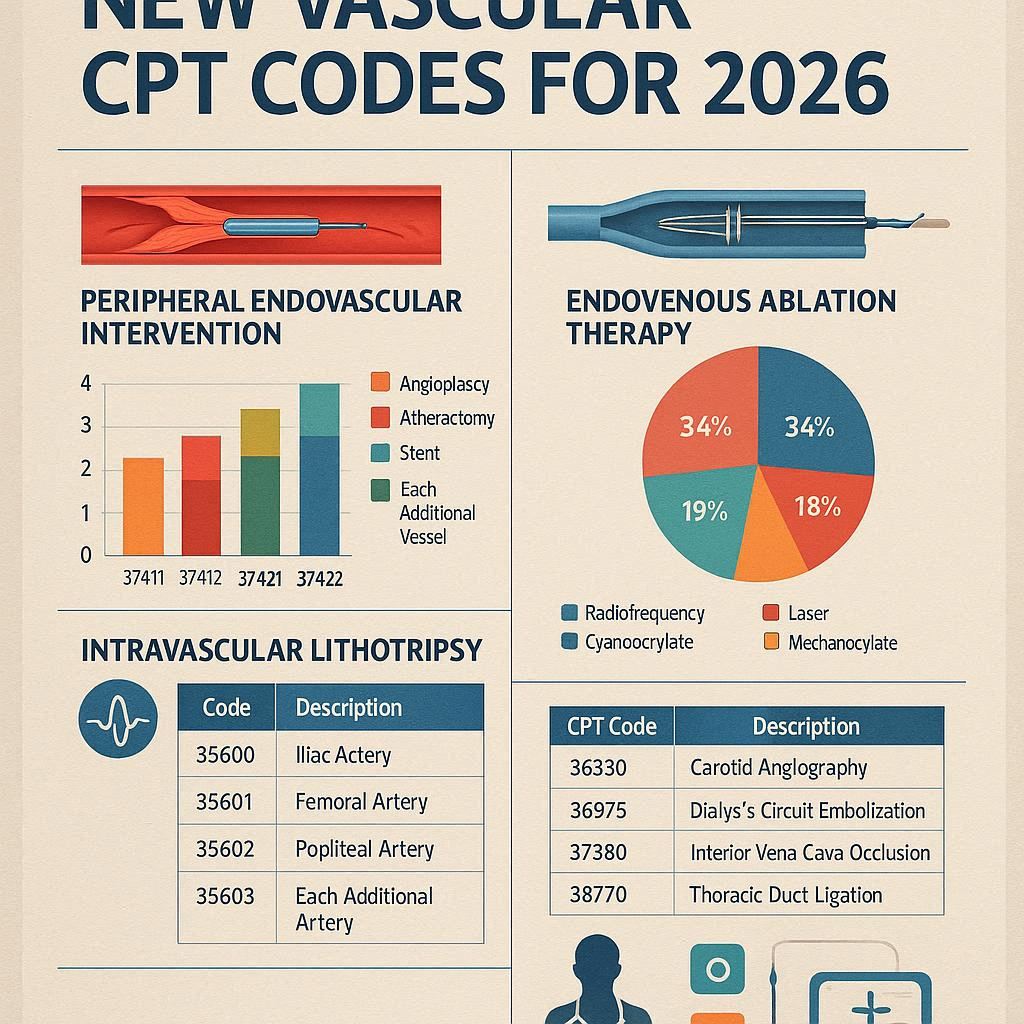
Why the Vascular CPT Codes Are Changing in 2026
Before we look at the specific codes, it helps to understand the “why.” The AMA’s CPT Editorial Panel reviews codes every year based on feedback from physicians, coders, and payers.
For 2026, the main drivers for vascular code changes include:
- Advances in endovascular techniques – Older codes didn’t accurately describe new hybrid procedures.
- Reducing administrative burden – Many old codes required too many modifiers or add-on codes.
- Better alignment with modern imaging – Ultrasound and fluoroscopy guidance are now standard, so some bundled services have been separated.
The goal isn’t to make your life harder. Actually, it’s the opposite. These changes should make coding more logical. But as always, there will be a learning curve.
Important note: The changes described here are based on the final 2026 CPT code set released by the AMA. Always verify with your local payer policies, as some commercial insurers may delay implementation.
Overview of Major Changes for 2026
Let’s start with a high-level summary. In 2026, the vascular section of CPT will see:
- 7 new codes for endovascular repair of complex aortic aneurysms.
- 4 revised codes for lower extremity revascularization.
- 2 deleted codes that have been consolidated into broader descriptors.
- New guidelines for reporting catheter-directed thrombolysis.
We’ll break each category down in the sections below.
But first, here’s a quick reference table.
| Category | 2025 Status | 2026 Status | Action Needed |
|---|---|---|---|
| Endovascular AAA repair | 3 codes (34800-34805) | 5 new codes | Learn new descriptors |
| Lower extremity revasc | 7 codes | 4 revised, 3 unchanged | Review documentation rules |
| Catheter-directed therapy | 2 add-on codes | New primary code introduced | Update charge entry |
| Dialysis access interventions | No specific code | 1 new specific code | Train staff on new option |
New Vascular CPT Codes for 2026: The Complete List
Let’s get specific. Below are the brand-new codes you’ll need to add to your system. Remember, these are effective for dates of service on or after January 1, 2026.
Category I: Endovascular Repair of Abdominal Aortic Aneurysm (AAA)
These codes replace the outdated “open exposure” family.
- 34812 – Endovascular repair of infrarenal abdominal aortic aneurysm, with placement of bifurcated endoprosthesis; including all imaging guidance, vessel access, and closure.
Use this for straightforward, uncomplicated cases. - 34813 – …with concomitant renal or mesenteric artery stent placement.
This is a bundled code. No separate stent code is required. - 34814 – …with extension to one iliac artery using an iliac limb extension.
This covers common anatomy variations. - 34815 – …with extension to both iliac arteries using bilateral iliac limb extensions.
More complex cases go here. - 34816 – …with fenestrated endoprosthesis (two or more fenestrations).
This is a major addition for 2026. Previously, you had to use unlisted codes.
Why this matters: In the past, coding fenestrated AAA repairs was a nightmare. The new codes recognize that this is now a standard, not experimental, procedure.
New Code for Arteriovenous (AV) Access Interventions
Dialysis patients will benefit from this change.
- 36912 – Percutaneous transluminal balloon angioplasty of arteriovenous dialysis access (fistula or graft), including all imaging guidance and radiological supervision.
*Unlike the old codes (36902-36903), this new code bundles the angioplasty without requiring a separate diagnostic code first.*
What this means for you: No more “imaging only” denials. If the plan is angioplasty from the start, use 36912 directly.
Revised Catheter-Directed Thrombolysis Codes
The old add-on codes (37211 and 37212) are gone. In their place:
- 37215 – Catheter-directed thrombolysis, first vessel (arterial or venous), including initial catheter placement, contrast injection, and imaging supervision.
- +37216 – Catheter-directed thrombolysis, each additional vessel (list separately in addition to code for primary procedure).
The biggest change? You no longer need a separate diagnostic arteriogram code before starting thrombolysis. The new codes bundle the initial imaging work.
Deleted and Consolidated Codes for 2026
Not every code survives. Here’s what’s being removed and how to replace it.
| Deleted Code (2025) | Old Descriptor | Replacement for 2026 |
|---|---|---|
| 34800 | Open femoral exposure for endovascular AAA repair | 34812 (bundled into primary repair) |
| 34805 | Open iliac exposure | 34812 or 34814 depending on anatomy |
| 37211 | Catheter-directed thrombolysis, arterial, add-on | 37215 (now a primary code) |
| 37212 | Catheter-directed thrombolysis, venous, add-on | 37215 (now a primary code) |
Critical reminder: Do not use deleted codes after December 31, 2025. Payment will be automatically rejected. If your software hasn’t updated, manually remove them from your favorites list.
How to Document for the New Codes: A Checklist
You can use the right code, but without proper documentation, you’ll still get denials. Here’s a simple checklist for your providers.
For AAA Endovascular Repairs (34812-34816)
- Size of aneurysm (maximum diameter in cm)
- Anatomy description (infrarenal, juxtarenal, or suprarenal)
- Specific device used (manufacturer and type)
- Number of fenestrations (if applicable)
- Any concomitant stents (renal, mesenteric, iliac)
- Access sites (femoral, brachial, or both)
- Closure method (surgical cutdown vs. percutaneous)
For AV Access Angioplasty (36912)
- Type of access (native fistula vs. PTFE graft)
- Pre-procedure stenosis percentage
- Balloon size and inflation pressure
- Post-angioplasty residual stenosis
- Presence of thrombus (if any)
- Any additional interventions (thrombectomy, stent)
For Thrombolysis (37215, 37216)
- Vessel name and side (e.g., “right popliteal artery”)
- Symptom onset time
- Lytic agent name and total dose
- Infusion duration (hours)
- Follow-up imaging intervals
- Reason for stopping infusion (complete lysis, bleeding, etc.)
Pro tip: Create a template in your EHR for each code family. Providers are busy. If you make it easy, they’ll give you the details you need.
Comparative Table: Old vs. New Coding for Common Scenarios
Let’s put this into practice. Below are three realistic patient scenarios. Compare how you would have coded in 2025 versus how you will code in 2026.
Scenario 1: Uncomplicated Infrarenal AAA Repair
- Patient: 72-year-old male, 5.8cm AAA, standard bifurcated endograft.
- 2025 coding: 34800 (open exposure) + 34812 (main repair) + 34820 (imaging). Three codes.
- 2026 coding: 34812 (one code). Everything bundled.
Result: Cleaner claim. Less risk of missing an add-on code.
Scenario 2: Dialysis Fistula Angioplasty
- Patient: 58-year-old female with 80% stenosis in left forearm fistula.
- 2025 coding: 36902 (diagnostic fistulagram) + 36903 (angioplasty). Two codes.
- 2026 coding: 36912 (angioplasty with imaging bundled). One code.
Result: No more denials for “missing diagnostic study” when the angioplasty was planned all along.
Scenario 3: Acute Lower Limb Ischemia – Thrombolysis
- Patient: 65-year-old male, acute onset right leg pain, thrombosed popliteal artery aneurysm.
- 2025 coding: 75710 (diagnostic runoff) + 37211 (thrombolysis add-on) + 75898 (follow-up imaging). Three codes.
- 2026 coding: 37215 (diagnostic and lytic together) + 75898 if repeat imaging is done. Two codes.
Result: The diagnostic component is no longer separate. That means fewer line items and faster prior authorization.
Common Pitfalls to Avoid in 2026
Even experienced coders make mistakes during transition years. Here are the most frequent errors we see with new vascular CPT codes.
1. Using Old Codes After the Deadline
It sounds obvious, but you’d be surprised. Some billing software doesn’t auto-update. Set a calendar reminder for January 1, 2026 to review your code lists.
2. Double-Bundling Imaging Guidance
The new codes for AAA repair (34812-34816) include fluoroscopy, angiography, and closure. Do not add 75952-75954. They are no longer valid with these codes.
3. Misusing the Fenestrated Code (34816)
This code requires a device with two or more fenestrations. If you use a single fenestration or a scalloped device, you must still use unlisted code 34900. Check your operative note carefully.
4. Forgetting the Additional Vessel Code for Thrombolysis
If a patient has bilateral clots, you report 37215 for the first side and +37216 for the second. But if the clots are in two different segments of the same artery (e.g., superficial femoral and popliteal), that’s still one vessel. Only count anatomic vessels (aorta, iliac, femoral, popliteal, tibial).
5. Not Updating Your Superbills
Your paper superbills or EHR favorites will have obsolete codes. Schedule a half-day session in December 2025 to scrub every template.
How Payers Are Responding to the 2026 Changes
Medicare has already announced that it will adopt all new vascular CPT codes for 2026 without delay. However, relative value units (RVUs) are still being finalized as of this writing.
Here’s what we know so far based on the AMA/Specialty Society RVS Update Committee (RUC) recommendations:
- 34812 (uncomplicated AAA) – Expected RVUs: 24.50 (similar to old 34800 + 34812 combined).
- 36912 (AV angioplasty) – Expected RVUs: 6.25 (slightly higher than old 36902 + 36903 due to bundled imaging).
- 37215 (thrombolysis) – Expected RVUs: 12.30 (a 15% increase over the old two-code combination).
Commercial payers: Expect a 3-6 month lag for some smaller insurers. Have a contingency plan. If a code is denied as “invalid,” appeal with a copy of the 2026 CPT manual page showing the new code.
Realistic advice: Keep using the old codes for a few weeks in January only if your payer explicitly tells you they haven’t updated their systems. Most major insurers (UnitedHealthcare, Cigna, Aetna, Humana) will be ready on day one.
Tips for a Smooth Transition to the 2026 Codes
You don’t have to dread January. Here’s a practical timeline.
December 2025 – Preparation Month
- Download the full 2026 CPT book (digital version is fine).
- Highlight all vascular changes.
- Run a report of your top 20 vascular codes from the past year.
- Map each old code to its 2026 equivalent.
- Update your EHR pick lists.
- Hold a 1-hour staff training session.
January 2026 – Go-Live Month
- Audit the first 10 vascular claims of the year.
- Track denial reasons in a shared spreadsheet.
- Hold a 15-minute daily huddle for the first week.
- Have a quick-reference card printed at every coder’s desk.
February 2026 – Optimization Month
- Review denial trends.
- Compare reimbursement rates to 2025.
- Adjust documentation templates based on real-world denials.
- Send a one-page summary to your billing team.
Frequently Asked Questions (FAQ)
Q1: Do I need to use modifiers with the new codes?
Yes, in some cases. For example, if you perform bilateral iliac artery interventions during an AAA repair (34815 is already bilateral), no modifier is needed. But if you do a staged procedure, append modifier -58. Always check the CPT manual’s parenthetical notes.
Q2: What happens if I accidentally use a 2025 code in January 2026?
The claim will reject with CO-4 (Procedure code is inconsistent with the modifier used or the code is invalid). You must void and resubmit with the correct 2026 code. Do not appeal. Just correct and rebill.
Q3: Are there any new coding options for venous disease in 2026?
Yes, but indirectly. The thrombolysis code 37215 applies to both arteries and veins. However, there is no new dedicated code for venous stenting. Use 37238 (iliac vein) or unlisted 37799 for other veins.
Q4: How do I report diagnostic angiography before an intervention with the new codes?
If the angiography is performed and a decision is made to intervene, the new codes bundle the diagnostic portion. If no intervention occurs, use the standalone diagnostic codes (75710 for extremity, 75716 for bilateral). Document clearly: “Diagnostic study only, no intervention performed.”
Q5: Will Medicare reimburse the fenestrated code 34816 without prior authorization?
Most Medicare Administrative Contractors (MACs) will require prior authorization for 34816. Check your local MAC’s LCD. Do not assume it’s automatically covered. Start the prior auth process at least two weeks before the scheduled procedure.
Q6: My EHR doesn’t have the 2026 codes yet. What do I do?
Contact your EHR vendor immediately. Most major systems (Epic, Cerner, athenahealth, NextGen) release updates in mid-December. Ask for the exact release date. In the meantime, use a paper superbill or a manual claim form for vascular cases.
Q7: Are the new codes higher paying?
For most, yes. The AMA’s goal was budget neutrality overall, but specific codes moved up. Thrombolysis and fenestrated AAA repair saw increases. Simple AV angioplasty stayed roughly the same. Don’t expect a huge revenue boost, but also don’t expect a cut.
Additional Resources to Master 2026 Vascular Coding
You don’t have to memorize everything. Bookmark these resources.
- AMA CPT 2026 Professional Edition – The official source. Buy the print or digital version. Do not rely on free online summaries.
[Link: www.ama-assn.org/2026-cpt] - SIR (Society of Interventional Radiology) Coding Resources – SIR publishes a yearly crosswalk of old to new codes. Free for members.
[Link: www.sirweb.org/practice-resources/coding] - CMS Medicare Physician Fee Schedule Look-Up Tool – Search by CPT code to see your local payment rate.
[Link: www.cms.gov/medicare/physician-fee-schedule/search] - ACP (American College of Surgeons) Vascular Coding Webinar – Usually offered in February. Costs around $99. Highly practical.
[Link: www.facs.org/education/coding-workshops] - Your Local MAC’s LCD Database – Some MACs publish specific guidance for fenestrated endografts. Search “your state + MAC LCD.”
[Link: search.medicare.gov/lcds]
Final Thoughts: Embrace the Change
New codes always feel uncomfortable at first. You might miss an old favorite. You might get a few extra denials in January. That’s normal.
But here’s the good news: the new vascular CPT codes for 2026 are genuinely better than what they replace. They reflect how you actually practice. They reduce the number of line items per case. And they close dangerous gray areas that led to audits.
Take it one week at a time. Update your templates. Train your team. And when in doubt, remember the golden rule of coding: If it isn’t documented, it wasn’t done.
You’ve got this.
Conclusion (Three Lines Recap)
The 2026 vascular CPT code updates simplify reporting for endovascular AAA repair, AV access angioplasty, and catheter-directed thrombolysis. Seven new codes replace outdated families, while four deleted codes are now bundled into more comprehensive descriptors. Prepare now by updating your EHR, retraining staff, and auditing early claims to avoid denials.
Disclaimer:
This article is for educational and informational purposes only. It does not constitute legal or medical advice. Coding and billing regulations vary by payer and jurisdiction. Always verify code changes with the official AMA CPT manual and your local Medicare Administrative Contractor (MAC) before submitting claims. The author and publisher assume no liability for any errors or omissions or for any outcomes related to the use of this information.