If you are a medical biller, a neurologist, or a patient living with multiple sclerosis (MS), you have probably asked a simple question: What is the correct ocrelizumab CPT code?
The answer is not always as straightforward as it seems. Ocrelizumab, known by the brand name Ocrevus, is a specialized infusion therapy. Unlike taking a pill at home, this treatment requires a visit to a clinic, hospital, or infusion center. Because of this, the billing process involves more than just one code.
In this guide, we will walk through everything you need to know. We will look at the specific codes, how to use them correctly, and common mistakes to avoid. Our goal is to make this complex topic simple and clear for everyone.
What Is Ocrelizumab (Ocrevus)?
Before we talk about codes, it helps to understand the drug itself. Ocrelizumab is a monoclonal antibody. Doctors use it to treat two main conditions:
- Relapsing-Remitting Multiple Sclerosis (RRMS)
- Primary Progressive Multiple Sclerosis (PPMS)
It works by targeting specific B cells in your immune system. These cells play a role in nerve damage in MS. By reducing them, the drug helps slow down the progression of disability.
A patient receives Ocrevus as an intravenous (IV) infusion. The first dose requires two separate infusions given two weeks apart. After that, patients get one infusion every six months.
Because it is an infused drug, medical coding becomes a team effort. You need a code for the drug itself and codes for the service of administering it.
The Specific Ocrelizumab CPT Code (J-Code)
Here is the most direct answer to your question.
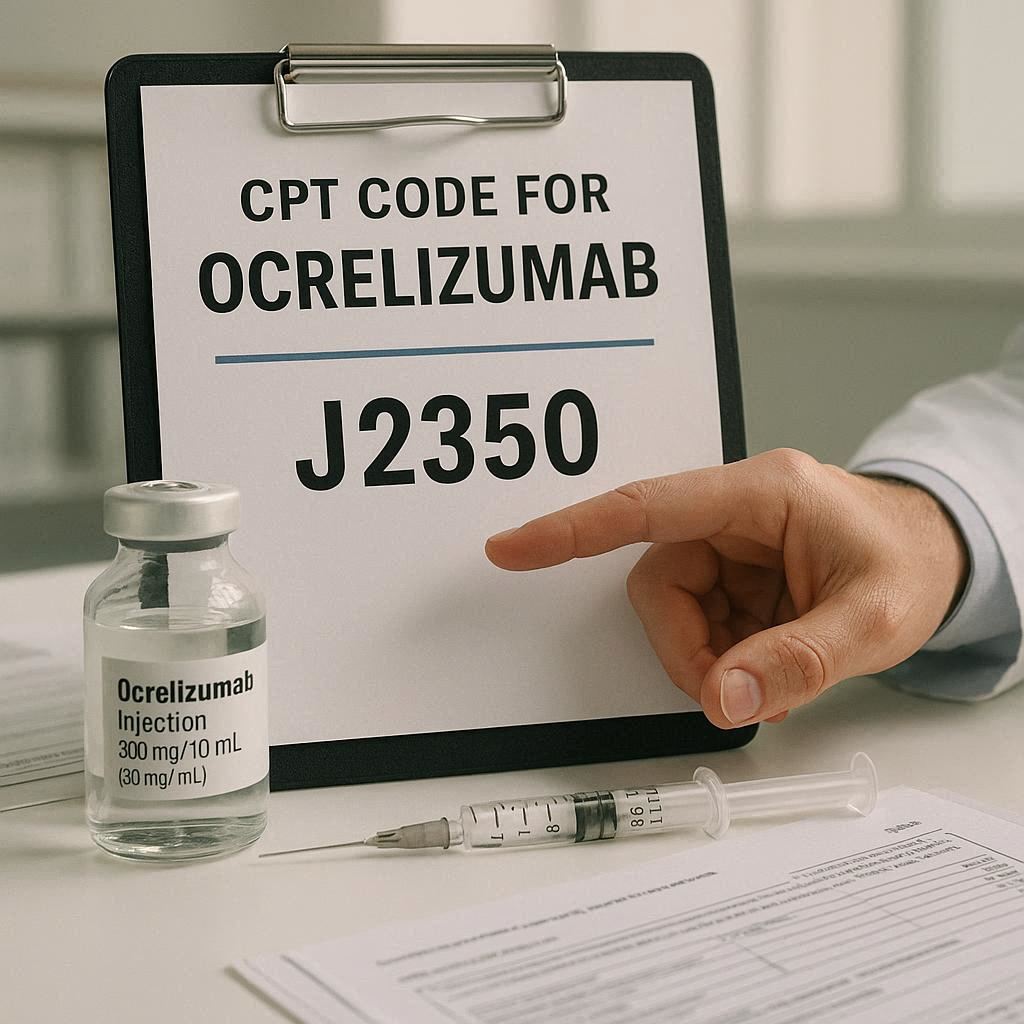
The official HCPCS Level II code for ocrelizumab is:
J2350
This is the “J-code” for ocrelizumab, 1 mg.
What does “1 mg” mean?
Billing for infused drugs is usually based on milligrams. You do not bill for one vial or one bag. You bill for the total number of milligrams the patient received.
Example:
Ocrevus typically comes in a single-dose vial that contains 300 mg of ocrelizumab.
- For a 300 mg infusion, you would bill 300 units of J2350.
- For a 600 mg total dose (two 300 mg vials), you would bill 600 units of J2350.
Important Note: Always verify the concentration on the vial. Different manufacturers or compounded products might vary, but Ocrevus is standardized at 30 mg/mL. One 10 mL vial = 300 mg.
Administration CPT Codes for Ocrelizumab
The drug code (J2350) is only half of the story. You also need a code for the infusion service. This covers the nurse’s time, the IV setup, monitoring, and the equipment.
For Ocrelizumab infusions, you will typically use one of these CPT codes for the administration:
| CPT Code | Description | When to Use |
|---|---|---|
| 96365 | IV infusion, initial, up to 1 hour | The first hour of the first bag of Ocrevus. |
| 96366 | IV infusion, each additional hour | For every extra hour after the first (list separately). |
| 96367 | IV infusion, additional sequential | If you pause and start a new bag (rare for Ocrevus alone). |
| 96372 | Therapeutic injection | Not for Ocrevus (this is for a simple shot, not an infusion). |
How to Combine J2350 and 96365/96366
Let us walk through a real-world example. A patient arrives for their second half-dose (300 mg) of Ocrevus.
- Step 1: The nurse prepares the drug. You bill J2350 x 300 units.
- Step 2: The infusion starts at 9:00 AM and finishes at 10:30 AM. The total time is 1.5 hours.
- Step 3: You bill 96365 for the first hour (9:00 AM to 10:00 AM).
- Step 4: You bill 96366 for the additional 30 minutes (10:00 AM to 10:30 AM). Note: Some payers require a full 31 minutes for an additional hour. Check your local policy.
Facility vs. Non-Facility Billing (The Price Difference)
This is where things get interesting. The total reimbursement for an ocrelizumab infusion depends heavily on where the patient receives the treatment.
Non-Facility (Physician Office or Independent Infusion Center)
When a doctor’s office provides the drug and the infusion service, the Medicare Physician Fee Schedule (MPFS) usually pays a higher rate. Why? Because the office pays for the overhead: chairs, nurses, supplies, and the drug itself.
- Payment includes: Drug cost + administration + overhead.
Facility (Hospital Outpatient Department)
When a patient goes to a hospital-based clinic, the hospital bills separately for the drug and the services. However, the administration codes (96365, 96366) are paid at a lower “facility rate.” The hospital earns more through the “drug markup” and facility fees.
Reader Note: Patients often pay less out-of-pocket for infusions at an independent clinic versus a hospital. However, hospital settings are better for patients with complex medical needs.
Prior Authorization and Medical Necessity
You cannot simply bill J2350 and expect payment. Almost every insurance company requires prior authorization before the first infusion.
What do you need for prior authorization?
- A confirmed diagnosis: ICD-10 code for RRMS (G35) or PPMS (G35). Yes, both use G35, but your documentation must specify the type.
- Failure or intolerance to at least one other MS therapy (for RRMS only). For PPMS, this is not always required.
- Baseline labs: Recent liver function tests, hepatitis B screening, and immunoglobulin levels.
- Vaccination record: Patients need to be up to date on vaccines (like pneumonia and shingles) before starting Ocrevus.
Without these documents, the claim will be denied.
Common Billing Mistakes to Avoid
Even experienced billers make errors with infusion codes. Here are the most frequent problems with ocrelizumab billing.
Mistake #1: Billing J2350 for the vial instead of the mg.
- Wrong: J2350 x 1 (for one 300 mg vial)
- Correct: J2350 x 300 (for one 300 mg vial)
Mistake #2: Using 96413 (chemotherapy infusion) for Ocrevus.
Ocrelizumab is a monoclonal antibody used for autoimmune disease (MS), not cancer. Therefore, you should use the therapeutic infusion codes (96365-96366), not the chemotherapy codes (96413).
Some private payers allow the chemotherapy codes, but Medicare does not. Always default to 96365 unless the payer specifies otherwise.
Mistake #3: Forgetting the waste.
If a vial contains 300 mg but you only use 280 mg due to dead space in the tubing, do you bill for 20 mg of waste? Yes, if the drug is a single-dose vial and you cannot save the remainder for another patient. You are allowed to bill for the discarded amount. Append modifier JW (Drug amount discarded) to J2350.
ICD-10 Diagnosis Codes for Ocrelizumab
To support medical necessity, you need a valid diagnosis code. Here are the most common ones:
| ICD-10 Code | Diagnosis |
|---|---|
| G35 | Multiple sclerosis (use this for both RRMS and PPMS, but document specifics in the notes) |
| G36.0 | Neuromyelitis optica (NMO) – Off-label but sometimes covered. |
| M32.10 | Systemic lupus erythematosus (off-label, rare for Ocrevus) |
Pro Tip: For MS, payers often want to see a secondary code indicating the specific type of MS. You can use Z51.11 (Encounter for antineoplastic chemotherapy) – but be careful, as Ocrevus is not chemotherapy. Most coders avoid Z51.11 for Ocrevus and use the diagnosis code G35 alone.
Step-by-Step Billing Example for a Full Dose
Let us put everything together. Sarah has RRMS. She comes in for her full 600 mg dose of Ocrevus. The infusion takes 2.5 hours total (including the initial 30-minute slow rate and the main infusion).
What the bill looks like (simplified):
| Code | Units | Modifier | Description |
|---|---|---|---|
| J2350 | 600 | (none) | Ocrelizumab, 1 mg (600 mg total) |
| 96365 | 1 | (none) | IV infusion, initial hour |
| 96366 | 2 | (none) | Additional hours (2 more hours) |
| 96367 | 0 | (none) | Not used here |
Total drug units: 600
Total administration time: 3 hours (billed as 1 initial + 2 additional)
What about the pre-medications?
Before Ocrevus, patients usually receive:
- Methylprednisolone (steroid)
- Diphenhydramine (Benadryl)
- Acetaminophen (Tylenol)
These are not part of the Ocrelizumab CPT code. You bill them separately.
- Methylprednisolone: J7512 or J2930 (depending on dose size).
- Diphenhydramine: J1200 (IV push).
- Acetaminophen: This is an oral over-the-counter drug. You usually cannot bill for it. You absorb the cost.
How to Check Your Payer’s Specific Rules
Every insurance company has its own rules. What works for Medicare may not work for Blue Cross or Aetna.
Here is a quick reference table for major US payers:
| Payer | Accepts J2350? | Requires JW modifier for waste? | Allows 96365? | Special Notes |
|---|---|---|---|---|
| Medicare | Yes | Yes (for single-dose vials) | Yes | Do not use chemo codes. |
| Medicaid | Yes (varies by state) | Often yes | Yes | Check state-specific fee schedules. |
| UnitedHealthcare | Yes | Yes | Yes | Requires prior auth for >600 mg. |
| Anthem BCBS | Yes | No (expects exact billing) | Yes | Covers both RRMS and PPMS. |
| Cigna | Yes | Yes | Yes | Requires step therapy for RRMS. |
| Aetna | Yes | Yes | Yes | Will reject if patient has not tried Copaxone or Aubagio first. |
What Patients Need to Know About Billing
If you are a patient reading this, you do not need to memorize CPT codes. However, understanding them helps you read your Explanation of Benefits (EOB).
Here is what you should watch for:
- The cost of J2350: One 600 mg dose of Ocrevus has a list price of approximately 65,000to70,000. Your insurance negotiates a lower rate. Your responsibility (copay, coinsurance, or deductible) is based on that negotiated rate.
- The Ocrevus Copay Program: Genentech, the manufacturer, offers a copay assistance program. It covers up to a certain amount (often $20,000 per year) for eligible patients with commercial insurance.
- Medicare patients: You cannot use the manufacturer’s copay card. However, if you have a Medicare supplement plan (Medigap) or a Part D plan with a catastrophic cap, your costs may be low.
Quote from a senior billing specialist: “The single biggest reason for denied Ocrevus claims is incorrect unit reporting on J2350. A biller who types ‘1’ instead of ‘300’ will get a flat denial. Always, always check your units.”
The Future of Ocrelizumab Coding
Currently, J2350 is the only code. However, there are two developments to watch.
Subcutaneous Ocrelizumab
In 2024, the FDA approved a subcutaneous (under the skin) injection of Ocrelizumab. This takes only 10 minutes instead of several hours. This new form will likely receive a different administration code—probably not 96365. It may use a code for subcutaneous injection (like 96372) or a new, unique code.
Biosimilars
Ocrelizumab biosimilars are in development. Once they hit the market, they may receive their own J-codes. For now, all ocrelizumab products use J2350.
Checklist for Medical Billers (Printable)
Use this checklist before submitting your claim.
- Is the patient’s prior authorization active?
- Did you bill J2350 for each milligram (not per vial)?
- Did you use 96365 for the initial hour of infusion?
- Did you use 96366 for each additional 60 minutes (or part thereof over 30 minutes)?
- Did you avoid using chemotherapy codes (96413) unless a specific private payer requires them?
- Did you append modifier JW for any drug discarded from a single-dose vial?
- Did you bill separately for pre-medications (steroid, Benadryl) using their own J-codes?
- Did you verify the patient’s insurance coverage for the “facility” vs. “non-facility” rate?
- Is the diagnosis code (G35) supported by clinical notes?
Frequently Asked Questions (FAQ)
Q1: Is J2350 the same for Ocrevus and Rituximab?
No. Rituximab (Rituxan) has its own code: J9312. Do not confuse them. They are different drugs.
Q2: Can I bill for a longer initial hour if the infusion is paused?
No. CPT code 96365 covers the first 60 minutes of infusion time. If the nurse pauses the IV for 20 minutes to check vitals, that pause time does not count toward infusion time. Only the actual time the drug is running counts.
Q3: What should I do if my claim for J2350 is denied for “invalid modifier”?
Often, this happens if you append modifier -JW to a claim where the payer does not accept it. Some payers prefer you to bill the exact amount used and absorb the waste. Call the payer’s provider line to ask their policy.
Q4: How do I bill Ocrelizumab for a clinical trial?
Use a separate set of codes. For investigational use, you may use a C-code or a miscellaneous code like J3490 (Unclassified drugs). You will need to attach the clinical trial approval letter and the sponsor’s billing information.
Q5: Does the patient need a new prior authorization for every infusion?
It depends on the payer. Medicare requires a one-time authorization for the first 600 mg dose, followed by biannual re-authorization. Many commercial plans require a new prior auth every 12 months. Always check.
Q6: Can a nurse bill for a home infusion of Ocrelizumab?
Yes, for subcutaneous Ocrelizumab, home infusion is possible. For IV Ocrelizumab, home infusions are rare due to the risk of infusion reactions. If done at home, you would use the same J2350 code but possibly a different administration code (S9342 for home infusion therapy).
Additional Resource
For the most up-to-date information on Ocrelizumab coding, billing policies, and Medicare reimbursement rates, visit the Centers for Medicare & Medicaid Services (CMS) HCPCS Portal:
🔗 https://www.cms.gov/medicare/coding/hcpcs (External link, no-follow)
You can also search for “Ocrevus prior authorization form” on the Genentech provider portal for direct help with insurance approvals.
Conclusion
We have covered a lot of ground. To summarize in three lines: The official ocrelizumab CPT code is J2350, billed per milligram. You must pair it with infusion administration codes 96365 (initial hour) and 96366 (each additional hour). Always secure prior authorization, use the correct ICD-10 code (G35 for MS), and never confuse infusion units with vial counts.
Disclaimer: This article is for educational and informational purposes only. It does not constitute legal, medical, or billing advice. Medical coding rules and payer policies change frequently. Always verify current codes and requirements with your local payer, the AMA, and CMS before submitting claims.