If you work in mental health, you have likely seen the code 90837 on a billing sheet or in an electronic health record. But what does it actually mean? And when should you use it?
This guide gives you a clear, honest definition of CPT code 90837. You will learn how it works, when to bill it, and what pitfalls to avoid. No confusing jargon. No false claims. Just practical knowledge you can use.
What Is CPT Code 90837? A Straightforward Definition
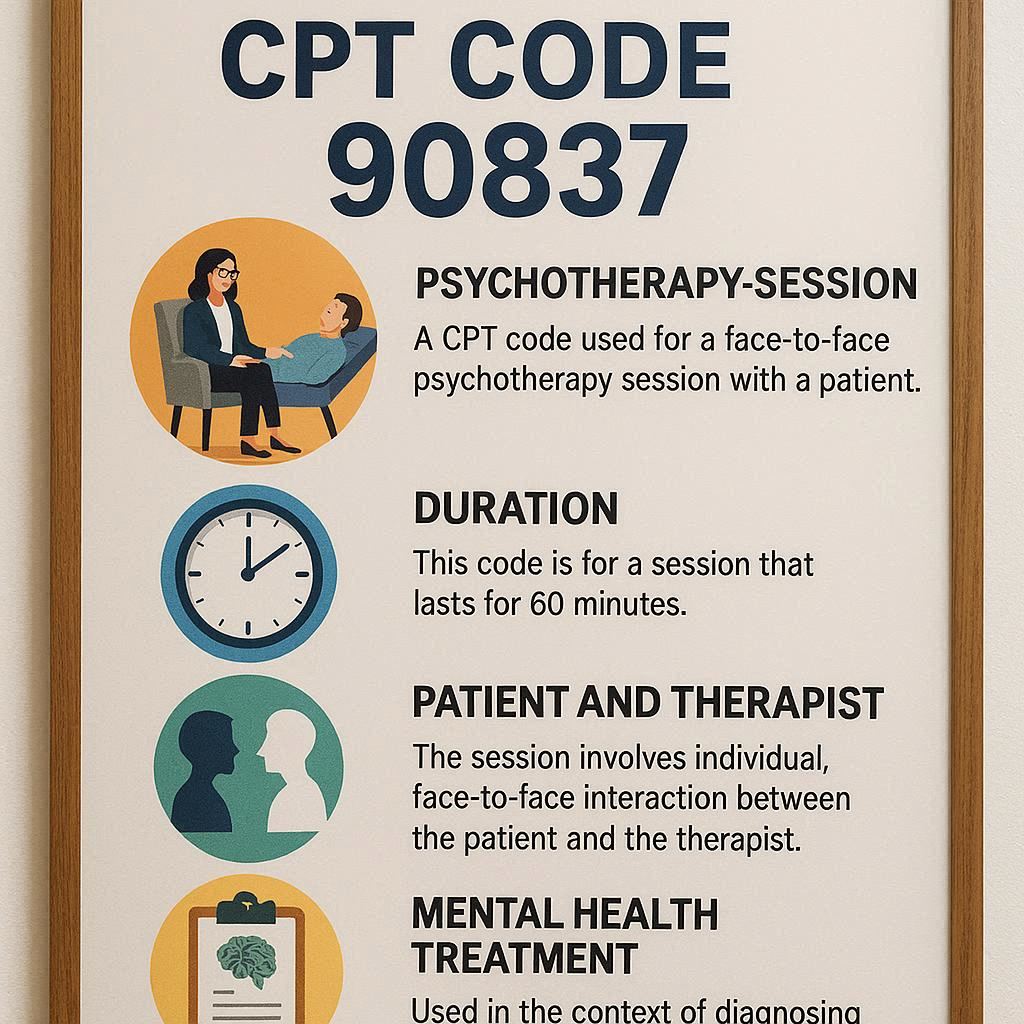
CPT code 90837 describes psychotherapy for 60 minutes with a patient. This is a face-to-face session between a licensed mental health professional and one patient. The time is the key factor.
According to the American Medical Association (AMA), which manages the CPT code set, 90837 applies to outpatient or inpatient settings. The session lasts at least 53 minutes and up to 68 minutes. Yes, the 60-minute label is an average. You can bill 90837 for a session that runs between 53 and 68 minutes total.
This code covers individual psychotherapy. That means one patient, one clinician. The therapy can use different approaches, such as cognitive behavioral therapy, psychodynamic therapy, or supportive counseling.
Important note for readers: The 53-minute minimum is not a suggestion. If you finish after 52 minutes, you cannot bill 90837. You must use a different code.
Why Understanding This Code Matters
Billing mistakes hurt your practice and your patients. Using 90837 incorrectly can lead to denied claims, audits, or even accusations of fraud. On the other hand, using it correctly helps you get paid fairly for longer, complex sessions.
Patients also benefit. When you document correctly, insurance companies understand the level of care provided. That can support future authorizations and treatment plans.
How 90837 Compares to Other Psychotherapy Codes
To really define 90837, you need to see it next to related codes. The table below shows the most common psychotherapy codes for outpatient services.
| CPT Code | Session Length | Typical Use |
|---|---|---|
| 90832 | 30 minutes (16–37 minutes) | Brief check-ins, focused follow-ups |
| 90834 | 45 minutes (38–52 minutes) | Standard therapy session |
| 90837 | 60 minutes (53–68 minutes) | Complex cases, deeper work |
| 90846 | Family therapy without patient present | Family sessions (50 minutes) |
| 90847 | Family therapy with patient present | Family sessions (50 minutes) |
As you can see, 90837 is the longest individual therapy code. It is not for every session. Use it when the clinical need matches the time.
When to Use CPT Code 90837 (Real-World Examples)
You do not use 90837 just because you have extra time. The session must be medically necessary. That means the patient’s condition requires a longer visit.
Here are common situations where 90837 is appropriate:
- A patient with complex trauma needs time to establish safety before processing memories.
- Someone with severe depression cannot slow down their thoughts. You need 60 minutes to complete a safety plan and review coping skills.
- A patient with borderline personality disorder requires de-escalation and structured problem-solving that takes over 50 minutes.
- You are conducting an initial diagnostic assessment that cannot be split into two visits.
Quote from a billing specialist: “I see therapists lose money because they under-code. They do 55 minutes of intense trauma work and bill 90834. That is not wrong, but it is unfair to you and the patient who needed the time.”
The 53-Minute Rule: What Every Clinician Must Know
Let me repeat this for emphasis. To bill 90837, the total time of the session must be at least 53 minutes. This includes all direct face-to-face time with the patient.
If you spend 52 minutes with the patient and 8 minutes on notes, you do not count the notes. Only face-to-face time counts.
If you go over 68 minutes, 90837 is no longer correct. You may need to use an add-on code or bill for prolonged services. But in most outpatient settings, sessions beyond 68 minutes are rare unless pre-approved.
Time-Based Billing vs. Medical Necessity
Here is a truth that many articles skip. Time alone does not justify 90837. You must also prove that the extra time was clinically necessary.
Insurance reviewers look for two things:
- Did the session last at least 53 minutes?
- Does the documentation explain why a shorter session would be inadequate?
If your note only says “patient needed more time,” that may not be enough. You should describe the specific clinical factors. For example: “Due to active suicidal ideation with plan, a full 60 minutes were required to assess safety, develop a crisis plan, and coordinate with family.”
Documentation Requirements for 90837
Good documentation protects you. Poor documentation invites audits. Follow these rules every time you bill 90837.
What Your Note Must Include
- Start and end time of the face-to-face session (e.g., 2:05 PM – 3:02 PM)
- Total time in minutes (57 minutes in this example)
- Therapy modality (CBT, DBT, psychodynamic, interpersonal, etc.)
- Clinical focus (e.g., processing grief, exposure work for PTSD, relapse prevention)
- Medical necessity statement – Why was 60 minutes needed?
- Interventions used – specific techniques (e.g., cognitive restructuring, grounding exercises)
- Patient response – how the patient engaged and any changes in status
- Plan – next session or follow-up steps
Example of a Strong 90837 Note
*Session time: 3:00 PM – 3:58 PM (58 minutes face-to-face). Patient presented with increased anxiety and reports of intrusive thoughts lasting two hours daily. Due to the severity of symptoms and patient’s difficulty tolerating distress, a longer session was required to complete a chain analysis, teach two grounding techniques, and practice them in session. Patient successfully demonstrated diaphragmatic breathing and the 5-4-3-2-1 grounding method. Safety plan updated. Next session scheduled in 5 days.*
Common Mistakes When Using 90837
Even experienced clinicians make errors. Avoid these frequent pitfalls.
Mistake #1: Billing 90837 for Every Session
Using 90837 for every patient, every week, is a red flag. Most payers expect a mix of 90834 and 90837 sessions. If your average session length is 58 minutes for all patients, expect an audit.
Mistake #2: Rounding Up Time
If you started at 2:00 PM and ended at 2:52 PM, that is 52 minutes. You cannot bill 90837. Use 90834 instead.
Mistake #3: Including Non-Face-to-Face Time
Time spent writing notes, calling pharmacies, or reviewing records does not count toward 90837. Only direct patient contact.
Mistake #4: No Medical Necessity Statement
A note with times and interventions but no “why” is incomplete. Always explain the need for the longer session.
Payer Policies: Not All Insurers Treat 90837 Equally
Here is a realistic warning. Some insurance companies have specific rules about 90837. They may limit how often you can bill it. Others may require prior authorization for sessions beyond a certain number per year.
Medicare and CPT 90837
Medicare covers 90837 for individual psychotherapy. However, Medicare requires that the service is medically necessary and properly documented. Medicare Administrative Contractors (MACs) may have local coverage determinations. Always check your local MAC.
Commercial Insurers
UnitedHealthcare, Cigna, Aetna, and Blue Cross plans vary widely. Some quietly audit high users of 90837. Others have internal guidelines that expect 90834 as the standard for most sessions.
Pro tip: Request a copy of each insurer’s psychotherapy billing policy. Many are available online. Save them in a folder for reference.
When You Cannot Bill 90837 (Even With 60 Minutes)
There are situations where 90837 is the wrong choice, even if you have a 60-minute session.
- Group therapy – Use 90853 for group.
- Family therapy – Use 90846 or 90847.
- Interactive complexity – If you have a special add-on code (90785), you can use it with 90837, but not instead of it.
- Crisis services – For a 60-minute crisis intervention, use 90839 (first 60 minutes).
- Testing or assessments – Psychological testing has its own codes (96130, etc.).
How to Decide: 90834 vs. 90837
Many clinicians struggle with this choice. The table below helps you decide.
| Factor | Use 90834 (45 min) | Use 90837 (60 min) |
|---|---|---|
| Session length | 38–52 minutes | 53–68 minutes |
| Patient acuity | Stable, routine follow-up | High distress, crisis, complex trauma |
| Clinical work | Check-in, supportive listening, skill review | Active processing, exposure, chain analysis, safety planning |
| Payer expectation | Most sessions | Some sessions, not all |
| Documentation | Standard note | Stronger medical necessity required |
The Role of Medical Necessity in 90837
Let’s go deeper on medical necessity because it is the most misunderstood part of 90837.
Medical necessity means the service is:
- Reasonable and necessary for the patient’s condition
- Consistent with the standard of care
- Not primarily for the convenience of the patient or clinician
For 90837, you must show that a shorter session would be clinically inadequate. That is a high bar.
Examples of Strong Medical Necessity Statements
- “Due to active command hallucinations instructing self-harm, a 60-minute session was required to complete a safety assessment, notify the crisis team, and establish a 24-hour support plan.”
- “Patient experienced a recent sexual assault and had dissociative symptoms during the first 30 minutes. Remaining time was needed for grounding, reporting options, and distress tolerance planning.”
Weak Medical Necessity Statements to Avoid
- “Patient needed more time to talk.”
- “We always do 60 minutes.”
- “Patient prefers longer sessions.”
CPT Code 90837 and Telehealth
Yes, you can use 90837 for telehealth sessions in most cases. The same time rules apply. The same documentation rules apply.
However, check payer policies for telehealth modifiers. Many require the telehealth modifier (95) or a place of service code (02) for telemedicine. Some payers have temporarily or permanently adopted telehealth for 90837.
Important note: If you provide therapy by phone only (audio-only), some payers require a different code or modifier. Always verify.
How to Avoid Audits for 90837
Therapists are audited more often than many other provider types. Here is how to stay safe.
Red Flags for Payers
- Billing 90837 for 100% of sessions
- Session times that always end at 59 or 60 minutes exactly (too perfect)
- Notes that are identical except for dates
- No variation in medical necessity statements
Green Flags for Payers
- A mix of 90834 and 90837
- Session times that vary (54, 61, 57, 63 minutes)
- Detailed, unique notes for each session
- Clear justification for longer sessions
A Step-by-Step Checklist Before Billing 90837
Use this checklist before you submit a claim for 90837.
- Did the face-to-face session last between 53 and 68 minutes?
- Is this individual psychotherapy (not family or group)?
- Is there a clear medical necessity reason for the longer time?
- Does your note include start and end times?
- Did you describe specific interventions?
- Is the patient’s response documented?
- Does your plan match the session length?
- Have you checked the payer’s policy on 90837?
- Are you using the correct place of service and modifiers?
- Is this session within your scope of practice and license?
If you answered yes to all, you are ready to bill.
Frequently Asked Questions (FAQ)
Can I bill 90837 for a 50-minute session?
No. 50 minutes is under the 53-minute minimum. You should bill 90834 instead.
Does 90837 require a specific therapy type?
No. Any evidence-based therapy approach can be used. The code is based on time, not modality.
Can I bill 90837 twice in one day for the same patient?
Almost never. Payers generally do not cover two individual therapy sessions on the same day. If you need more than 68 minutes, use prolonged services codes or split across two days.
Is 90837 covered by all insurance plans?
Most plans cover it, but some limit frequency or require prior authorization. Always verify benefits.
What happens if an audit finds I used 90837 incorrectly?
You may have to repay the money. In severe cases, you could face fines or exclusion from payer networks. That is why correct use matters.
Can students or interns bill 90837?
Only if the service is performed incident-to a qualified provider and all billing rules are followed. Generally, the supervising clinician bills under their own NPI.
Additional Resources
For more detailed guidance, visit the American Psychological Association’s practice page on psychotherapy codes.
🔗 Link: https://www.apaservices.org/practice/reimbursement/health-codes/evaluation-management
This resource includes payer comparison charts and sample documentation templates.
Conclusion
CPT code 90837 defines a 60-minute individual psychotherapy session lasting 53 to 68 minutes. Use it only when clinical necessity supports the longer time and documentation is complete. Avoid billing it for every session, and always check payer policies.
Disclaimer: This article is for educational purposes only and does not constitute legal, billing, or medical advice. Coding and payer policies change frequently. Always consult official sources and your legal counsel before making billing decisions.