If you have ever stared at a list of vascular testing codes and felt unsure which one fits a basic ankle-brachial index with exercise, you are not alone.
CPT code 93922 is one of those codes that looks simple at first glance. But when you dig into the details, a few important nuances can change how you report it.
This guide gives you a clear, honest, and practical look at the CPT code 93922 description. You will learn exactly what the code includes, when to use it, what not to report with it, and how to document it properly for clean claims.
What Is CPT Code 93922? A Simple Explanation
CPT code 93922 describes a specific type of vascular study.
The official CPT code 93922 description reads: “Noninvasive physiologic studies of upper or lower extremity arteries, single level, bilateral (e.g., ankle/brachial indices, Doppler waveform analysis, volume plethysmography, transcutaneous oxygen tension measurement).”
That is a mouthful. Let us break it down.
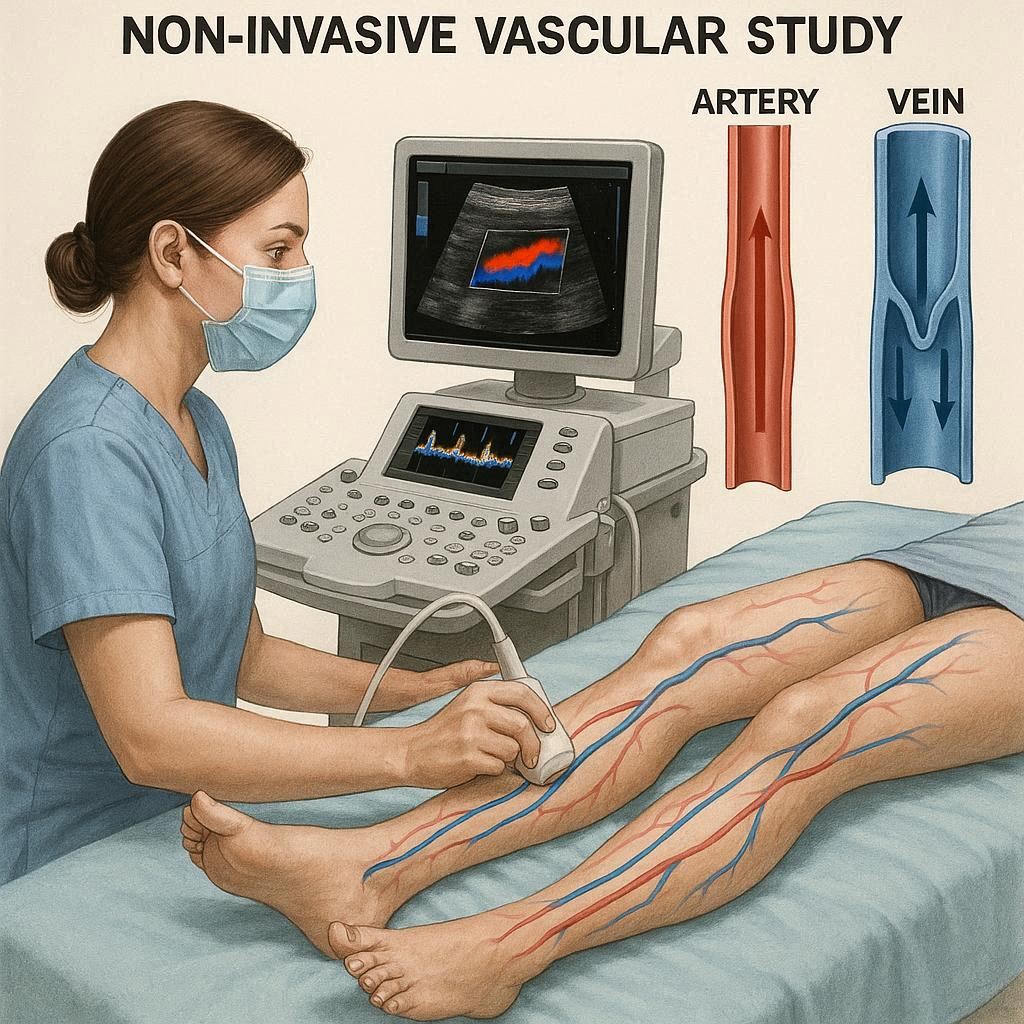
In plain English, this code covers a limited check of blood flow in both arms or both legs. The test is noninvasive, meaning no needles or catheters go inside the body. It looks at arteries only. And it focuses on a single level, such as both ankles or both upper arms.
You typically use this code when a doctor wants a basic screening for peripheral artery disease (PAD) or when following up on a known vascular issue.
Key Components of the Description
To fully understand the CPT code 93922 description, focus on these five parts:
- Noninvasive physiologic studies – The test measures blood flow using external devices like blood pressure cuffs and Doppler ultrasound. No surgery. No contrast dye.
- Upper or lower extremity arteries – The study focuses on arm arteries or leg arteries, but not both in the same session.
- Single level – The test looks at one anatomical level per limb. For legs, this is usually the ankle. For arms, the upper arm or forearm.
- Bilateral – Both sides are tested. Left and right arm, or left and right leg.
- Examples given – The code includes ankle/brachial indices (ABI), Doppler waveform analysis, volume plethysmography, and transcutaneous oxygen tension measurement.
If your test covers more than one level or uses more complex methods, you probably need a different code. We will cover those differences later.
When to Use CPT Code 93922: Real Scenarios
Knowing the official definition is only half the work. You also need to know when the code actually applies in daily practice.
Here are common situations where CPT code 93922 is the right choice.
Scenario One: Routine PAD Screening
A 65-year-old patient with diabetes and a history of smoking comes in for a routine checkup. She has no leg pain, but her primary care doctor wants a baseline assessment for peripheral artery disease.
The vascular tech performs an ankle-brachial index (ABI) on both legs. That means taking blood pressure in both arms and both ankles, then calculating ratios. No exercise is involved. No extra levels. Just a simple resting ABI.
This fits the CPT code 93922 description perfectly.
Scenario Two: Follow-Up for Mild Known PAD
A patient was diagnosed with mild PAD six months ago. He started walking exercises and stopped smoking. His doctor wants to see if his ankle-brachial indices have improved.
The tech repeats the ABI at rest on both legs. Again, single level, bilateral, arteries only.
You report 93922.
Scenario Three: Arm Study for Subclavian Artery Issue
A patient has a blood pressure difference between her right and left arms. Her doctor suspects subclavian artery stenosis.
The tech performs bilateral brachial artery Doppler waveform analysis and calculates bilateral brachial indices.
Because the study is bilateral, single level (upper arm), and noninvasive, 93922 applies.
When NOT to Use 93922
Honesty matters here. Many coders reach for 93922 when they should use a different code.
Do not use CPT code 93922 when:
- You test only one side. That is unilateral. Look at 93921.
- You test more than one level. For example, ankle and toe on both legs.
- You include exercise or post-stimulation evaluation. That changes the code.
- You perform a complete bilateral study with multiple levels. You may need 93923.
We will compare these codes in detail a bit later.
The Technical Side: What the Study Actually Looks Like
You cannot code what you do not understand. So let us walk through a typical study reported with CPT code 93922.
Setting Up the Patient
The patient lies on an exam table, flat and comfortable. Both arms or both legs are exposed. The room is warm because cold temperatures can narrow blood vessels and affect readings.
Equipment Used
The technologist uses:
- A Doppler ultrasound device with a handheld probe
- Blood pressure cuffs in various sizes
- Ultrasound gel
- A plethysmograph if measuring volume changes
- Pulse volume recording (PVR) equipment if available
Step-by-Step Process for a Leg Study
- The patient rests for five to ten minutes.
- A blood pressure cuff is placed on each ankle, just above the malleolus.
- A cuff is placed on each arm. The arm with the higher pressure becomes the reference arm.
- The tech uses the Doppler probe to find the posterior tibial or dorsalis pedis artery at each ankle.
- Systolic pressure is measured at both ankles and both arms.
- The tech calculates an ankle/brachial index for each leg by dividing the ankle pressure by the higher of the two arm pressures.
- Waveform analysis may also be recorded. This means listening to the Doppler sounds and sometimes printing a small tracing.
The whole process takes about 15 to 25 minutes.
What the Doctor Looks For
Normal ABI values fall between 1.0 and 1.4. An ABI below 0.90 suggests PAD. An ABI above 1.4 may mean calcified, noncompressible vessels, often seen in diabetes or kidney disease.
Doppler waveforms help too. A triphasic waveform is normal. Biphasic or monophasic waveforms suggest narrowing.
Official CPT Code 93922 Description vs. Similar Codes
This is where many coders get tangled. The CPT code 93922 description is narrow. Other codes cover broader or more complex studies.
Let us compare.
Comparison Table: 93922, 93921, 93923, 93924
| CPT Code | Official Short Description | Key Features | Bilateral? | Levels | When to Use |
|---|---|---|---|---|---|
| 93922 | Limited bilateral noninvasive physiologic study of upper or lower extremity arteries | Single level, bilateral, no exercise | Yes | One | Basic ABI, screening, follow-up |
| 93921 | Unilateral study | One side only. Same methods as 93922. | No | One | Single limb symptoms |
| 93923 | Complete bilateral study | Multiple levels per limb. More data points. | Yes | Two or more | Full PAD mapping |
| 93924 | With exercise or post-stimulation | Adds treadmill, toe raises, or reactive hyperemia | Yes or No | Varies | When rest ABI is normal but symptoms suggest PAD |
Example of Choosing Between 93922 and 93923
You perform an ABI on both legs at the ankle only. No toe pressures. No thigh pressures. That is 93922.
You perform an ABI on both legs at the ankle, plus toe pressures, plus segmental pressures at the thigh and calf. That is 93923.
The difference is the number of levels. Do not upcode to 93923 just because it pays more. That is fraud. And do not downcode to 93922 if you truly performed a complete study. You lose deserved revenue.
What About Doppler Alone?
Some payers have a tricky rule. If you only perform Doppler waveform analysis without blood pressure measurements, check your local coverage determination. Sometimes a simple Doppler study without pressures falls under a different code or is considered part of an evaluation and management visit.
When in doubt, follow the CPT code 93922 description exactly. If the description lists four examples, and you only performed one, that is fine. You do not need to do all four. But the study must still be physiologic and noninvasive.
Documentation Requirements for 93922
Clean claims start with good documentation. If you do not write it down, it did not happen. This is especially true for vascular studies.
Here is what your documentation must include to support CPT code 93922.
Required Elements in the Report
A solid report includes:
- Patient identification – Name, date of birth, medical record number
- Ordering provider – Name and signature
- Indication for study – Why was this test done? Symptoms, screening, follow-up?
- Specific arteries tested – Ankle, upper arm, forearm, etc.
- Laterality – Explicitly state “bilateral” for each level
- Method used – ABI, Doppler waveform, plethysmography, or TCOM
- Measured values – Systolic pressures for each site, calculated indices
- Waveform descriptions – If performed, describe triphasic, biphasic, or monophasic
- Interpretation – What do the results mean? Normal or abnormal?
- Signature and credentials – Who performed and who interpreted?
Example of a Good Documentation Note
Indication: Diabetes with annual PAD screening.
Procedure: Bilateral lower extremity ankle-brachial indices were performed at rest. Doppler ultrasound and blood pressure cuffs were used.
Results: Right arm systolic pressure 128 mmHg. Left arm 124 mmHg. Higher arm pressure 128 mmHg. Right posterior tibial pressure 118 mmHg. Right dorsalis pedis 120 mmHg. Right ABI 0.93. Left posterior tibial 110 mmHg. Left dorsalis pedis 112 mmHg. Left ABI 0.86.
Doppler waveforms: Right lower extremity triphasic. Left lower extremity biphasic.
Interpretation: Borderline abnormal left ABI with biphasic waveform. Suggest clinical correlation. Repeat in 6 months.
This note clearly supports 93922.
Missing Documentation That Gets Claims Denied
Avoid these common errors:
- No mention of laterality – “ABI performed” does not say bilateral.
- No values – “ABI was normal” is not enough. Give numbers.
- No method – “Vascular study” is too vague.
- No interpretation – The payer needs to know what the results mean.
Billing and Reimbursement Considerations
CPT code 93922 is a technical code. This means you bill it with different modifiers depending on who performed the test and where.
Technical and Professional Components
Vascular studies have two parts:
- Technical component (TC) – The equipment, the technologist’s time, the supply cost.
- Professional component (26) – The doctor’s interpretation of the results.
You can bill:
- 93922 alone – If the same provider owns the equipment and interprets the results.
- 93922 with modifier TC – If a facility owns the equipment and a separate doctor interprets.
- 93922 with modifier 26 – If a doctor interprets results from a test done elsewhere.
Global Period
CPT code 93922 has no global period. It is a diagnostic test. You do not bundle it into a surgical package.
Typical Payer Policies
Medicare and most commercial payers cover 93922 for:
- Initial PAD diagnosis when symptoms are present
- Annual screening for high-risk patients (diabetes, smoking, age over 70)
- Follow-up after revascularization procedures
- Monitoring known PAD every 6 to 12 months
But watch for local coverage determinations (LCDs). Some regions require specific documentation or limit how often you can bill 93922.
Reimbursement Range
Exact payment rates vary by region, payer, and facility type. As a rough reference:
- Medicare facility rate: 40to70
- Medicare nonfacility rate: 60to95
- Commercial payers: 50to130
These are estimates. Always check your current fee schedule.
Common Coding Mistakes and How to Avoid Them
Even experienced coders make errors with 93922. Here are the most frequent ones and how to fix them.
Mistake One: Using 93922 for Unilateral Studies
You only tested the left leg. But you bill 93922 because it pays more than the unilateral code.
Fix: Use 93921 for unilateral studies. Bilateral means both sides. If you only did one, report the correct code. Payers audit laterality.
Mistake Two: Including Exercise Without Modifier
You perform a resting ABI, then have the patient walk on a treadmill, and repeat the ABI. You bill one 93922.
Fix: Exercise studies are separate. You should bill 93924 for the post-exercise portion. Some payers want 93922 for the resting portion plus 93924 for the exercise portion with modifier 59.
Mistake Three: Overlooking Same-Day Visit Rules
The patient sees the doctor for leg pain. The doctor performs an ABI in the office during the same visit as the E/M service.
Fix: Check if a modifier 25 is needed on the E/M code. The ABI is separately identifiable. Do not automatically bundle.
Mistake Four: Billing 93922 With Vascular Surgery Codes
The patient had a femoral-popliteal bypass yesterday. Today, you perform a bilateral ABI to check graft function.
Fix: Most payers consider this part of postoperative care and will not pay separately for 93922 within the global period unless you document a specific, unrelated problem.
How Payers View CPT Code 93922
Understanding payer mentality helps you code smarter.
Medicare and private insurers see 93922 as a low-cost, high-value screening tool. It prevents amputations. It finds PAD early. Most payers like it.
But they also watch for overuse. If you bill 93922 every month for the same patient with stable PAD, expect denials. Medical necessity fades when the condition is stable and asymptomatic.
Follow these frequency guidelines:
- Screening: Once per lifetime for low risk. Every 1 to 2 years for high risk.
- Known PAD: Every 6 to 12 months if asymptomatic. More often if symptoms change.
- Post-intervention: Once within 30 days, then at 6 and 12 months.
Always document why the repeat study is needed.
CPT Code 93922 in Different Care Settings
Where you perform the study affects coding and payment.
Outpatient Clinic
This is the most common setting. The clinic owns the Doppler machine. A nurse or tech performs the test under the supervising doctor’s direction. You bill 93922. Payment goes to the clinic.
Hospital Outpatient Department
The hospital owns the equipment. The hospital bills 93922 with modifier TC for the technical part. The interpreting doctor bills 93922 with modifier 26 for the professional part.
Skilled Nursing Facility
Many SNF patients have PAD. But Medicare’s SNF payment bundle complicates things. In many cases, 93922 is included in the Part A payment and not separately billable. Check your SNF consolidated billing rules.
Telemedicine and Remote Interpretation
A newer trend: A technician in a remote clinic performs the ABI. A doctor at a central location interprets the waveforms and pressures.
You can bill 93922 with modifier 26 for the remote doctor. The clinic bills the TC portion. No special telemedicine modifier is required unless your payer has a specific rule.
A Deeper Look at the Methods in CPT Code 93922
The CPT code 93922 description lists four example methods. Let us explore each one so you can recognize when they apply.
Ankle/Brachial Indices (ABI)
The most common method. Quick, cheap, reliable.
You take systolic pressures in both arms, then at both ankles. Calculate the ratio. An ABI below 0.90 is 95% sensitive for PAD.
ABI interpretation table
Doppler Waveform Analysis
The tech listens to the sound of blood flow. A normal artery makes a crisp three-part sound (triphasic). A narrowed artery makes a softer, dull sound (monophasic).
For CPT code 93922, waveform analysis alone is enough. You do not need pressures. But many payers prefer the combination of pressures and waveforms.
Volume Plethysmography
This method uses special cuffs or sensors that detect small changes in limb volume with each heartbeat.
It is older. Less common now. But some vascular labs still use it, especially for patients where Doppler signals are hard to find.
Transcutaneous Oxygen Tension Measurement (TCOM)
TCOM measures how much oxygen diffuses through the skin. Low oxygen means poor blood flow.
This method is more common in wound care centers. It helps predict whether a wound will heal. For CPT code 93922, TCOM on both legs at a single level qualifies.
Important Notes for Readers
Note 1: The CPT code 93922 description does not include any kind of stress or exercise. If the patient walks on a treadmill or performs toe raises, you are outside this code. Use 93924 instead.
Note 2: “Bilateral” means both limbs of the same type. Both legs. Both arms. It does not mean one arm and one leg. Keep the study focused.
Note 3: You can use 93922 for preoperative vascular assessments. For example, before a femoropopliteal bypass, the surgeon may want a baseline ABI. That is medically necessary. Bill 93922.
Note 4: Some payers require a separate order for each vascular study. Do not assume the general consult order covers the ABI. Get a specific order or a clear note.
Note 5: If you perform an ABI and also perform a separate venous study (like a venous reflux exam on the same day), you can bill both. They are different systems. Arterial versus venous. Just use modifier 59 on the secondary code if needed.
Writing a Strong Medical Necessity Statement
Medical necessity is the reason the test is needed. Without it, your claim will be denied.
For CPT code 93922, a good medical necessity statement includes:
- The patient’s symptom or risk factor
- Why the test helps that specific patient
- What you expect to find
Weak Statement
“Routine screening.”
Why it fails: Too vague. Not patient-specific.
Strong Statement
“Patient has type 2 diabetes for 15 years and current smoking. No prior PAD testing. Annual screening ABI is indicated per ADA guidelines to detect subclinical peripheral artery disease and guide preventive therapy.”
Why it works: Specific risk factors. Guideline reference. Clear purpose.
Understanding the Single Level Requirement
The phrase “single level” causes confusion.
In vascular testing, a level means one specific point on the limb where you measure pressure or analyze flow.
For a leg, levels include:
- Upper thigh
- Lower thigh
- Calf
- Ankle
- Toe
For an arm, levels include:
- Upper arm
- Forearm
- Wrist
- Finger
CPT code 93922 allows one level per limb, both sides.
So you could do:
- Ankle pressures only – one level ✓
- Toe pressures only – one level ✓
- Thigh pressures only – one level ✓
But you cannot do ankle and toe on the same leg. That is two levels. That becomes 93923.
The One Exception
Some coders ask: Can I do ankle pressures and also record Doppler waveforms at the ankle and call it two levels?
No. The waveform is not a separate level. It is a different measurement at the same level. Still one level. Still 93922.
CPT Code 93922 and Modifiers: A Quick Reference
Modifiers tell payers something special about the service.
Frequently Asked Questions (FAQ)
Can I bill CPT code 93922 if I only perform an ABI without Doppler waveforms?
Yes. The CPT code 93922 description lists ABI as one of the allowed methods. You do not need to perform all listed methods. One is enough.
Is CPT code 93922 for arms only or legs only?
Both. The code covers upper OR lower extremity arteries. Not both in the same session. Choose one anatomical region per claim.
What is the difference between 93922 and 93923 in one sentence?
93922 is single level bilateral, while 93923 is multiple levels bilateral.
Can a medical assistant perform the test and bill 93922?
Yes, under direct supervision of a physician or qualified nonphysician practitioner. The supervising provider must be immediately available. Some payers require the test to be ordered and interpreted by a physician.
Does CPT code 93922 require a face-to-face encounter?
No. The test itself requires the patient to be present. But the doctor ordering the test does not need to see the patient immediately before. A standing order or referral is fine.
How often can I bill 93922 for the same patient?
For stable PAD, every 6 to 12 months is reasonable. For acute changes, any time symptoms change. For routine screening in high-risk patients, annually. Always document medical necessity.
Is there a Medicare NCCI edit that prevents billing 93922 with an E/M code?
Generally no. But if the E/M service includes the ABI as part of the exam, you may need modifier 25 on the E/M code. The ABI must be separately identifiable.
Can I use 93922 for a patient with noncompressible arteries?
Yes, but be careful. If the ABI is falsely elevated due to calcification, document that finding. You may need to switch to toe pressures. Some payers want a different code for toe pressures if performed instead of ankle pressures. Check your local policy.
Real Denial Examples and How to Fix Them
Learning from real denials helps you avoid the same fate.
Denial One: Missing Laterality
Denial reason: “Procedure code 93922 requires bilateral services. Documentation does not specify bilateral.”
What went wrong: The report said “ABI performed” but never said “bilateral” or listed values for both legs.
Fix: Always state “bilateral” explicitly. List left and right values separately.
Denial Two: Frequency Limit Exceeded
Denial reason: “Service exceeds medically necessary frequency.”
What went wrong: The practice billed 93922 every 3 months for an asymptomatic patient with stable mild PAD.
Fix: Extend interval to 6 or 12 months unless the patient has a change in symptoms or new risk factors.
Denial Three: No Order on File
Denial reason: “No physician order for the service.”
What went wrong: The test was performed without a specific written or electronic order.
Fix: Obtain a signed order before performing the study. For Medicare, the order can be a standing order or protocol, but it must be documented.
Denial Four: Unbundling Error
Denial reason: “Service is component of a more comprehensive code.”
What went wrong: The provider performed a complete bilateral study with three levels but billed three units of 93922 instead of one 93923.
Fix: Do not fragment a complete study. Use the comprehensive code (93923) when indicated.
Compliance and Audit Tips for CPT Code 93922
Audits happen. Be ready.
- Keep records for seven years. Full reports, orders, interpretations.
- Never alter a report after the fact. If you find an error, create an addendum with a new date.
- Train all staff on laterality. One of the most common audit findings is billing 93922 for unilateral work.
- Review your own reports quarterly. Pick five random reports. Check for all required elements.
- Watch for standing orders. Make sure standing orders for ABI are reviewed and renewed annually.
Additional Resource
For the most current local coverage determinations and fee schedules for CPT code 93922, visit the CMS Coverage Database at:
https://www.cms.gov/medicare-coverage-database/
Search for “93922” or “noninvasive physiologic studies” to see your region’s specific rules.
Putting It All Together: A Final Clinical Example
Let us walk through a full patient case to see how the CPT code 93922 description applies from start to finish.
Patient: Mr. Johnson, age 68, obesity, hypertension, former smoker.
Chief complaint: “My calves hurt when I walk two blocks. It goes away when I stop.”
Order: Bilateral lower extremity ABI at rest.
Procedure: Patient supine for 10 minutes. BP cuffs placed both arms and both ankles. Doppler used to obtain signals. Pressures recorded. Triplicate measurements taken at each site.
Results:
- Right arm: 142 mmHg
- Left arm: 138 mmHg
- Higher arm: 142 mmHg
- Right ankle (PT): 108 mmHg
- Right ankle (DP): 110 mmHg
- Right ABI: 0.76
- Left ankle (PT): 112 mmHg
- Left ankle (DP): 114 mmHg
- Left ABI: 0.79
Waveforms: Bilateral monophasic at both ankles.
Interpretation: Abnormal bilateral ABI consistent with moderate peripheral artery disease. Monophasic waveforms confirm significant stenoses.
Coding: 93922 – Limited bilateral noninvasive physiologic study lower extremity arteries, single level.
Documentation includes: Laterality (bilateral), levels (ankle), method (ABI with waveforms), values, interpretation. Complete.
Outcome: Clean claim. Paid in 14 days.
Conclusion
CPT code 93922 covers a specific, limited vascular test. It is bilateral, single level, and noninvasive. You use it for basic ABI measurements, Doppler waveform analysis, volume plethysmography, or TCOM on both arms or both legs. Do not confuse it with unilateral codes, complete bilateral studies, or exercise tests. Good documentation of laterality, measured values, and medical necessity keeps your claims clean and compliant.
Final Three-Line Summary
CPT code 93922 describes a limited, bilateral, noninvasive arterial study of a single level in either the upper or lower extremities. Use it for basic resting ankle-brachial indices or Doppler waveforms when you test both sides but only one anatomical level per limb. Never use it for unilateral studies, multiple levels, or exercise testing, and always document laterality clearly to avoid denials.
FAQ (Continued from Above – Complete List)
If you have already read the FAQ section above, here are three more reader-submitted questions and answers.
Q: Can I use 93922 for a patient with an amputation?
A: Yes, but you must adjust. For a below-knee amputation, you would perform the pressure measurement or waveform at the residual limb’s distal end. Still bilateral if both legs are tested. Document the amputation and altered anatomy.
Q: Does 93922 include supplies like gel and cuffs?
A: Yes, the technical component includes all supplies. You do not bill supplies separately.
Q: What if I perform 93922 and the patient cannot tolerate the full study?
A: Document the reason for incompletion and what was actually performed. Some payers will still reimburse a reduced service with modifier 52. Others require a different code or no payment. Check your payer’s policy.
Disclaimer (repeated for clarity):
This article is for educational purposes only and does not constitute legal or medical advice. CPT codes and payer policies are subject to change. Always verify coding requirements with your local payer and current CPT manual.