If you work in a medical office, clinic, or hospital outpatient department, you have probably seen the 99211 CPT code on many superbills. But what exactly does this code mean? And when can you use it without breaking the rules?
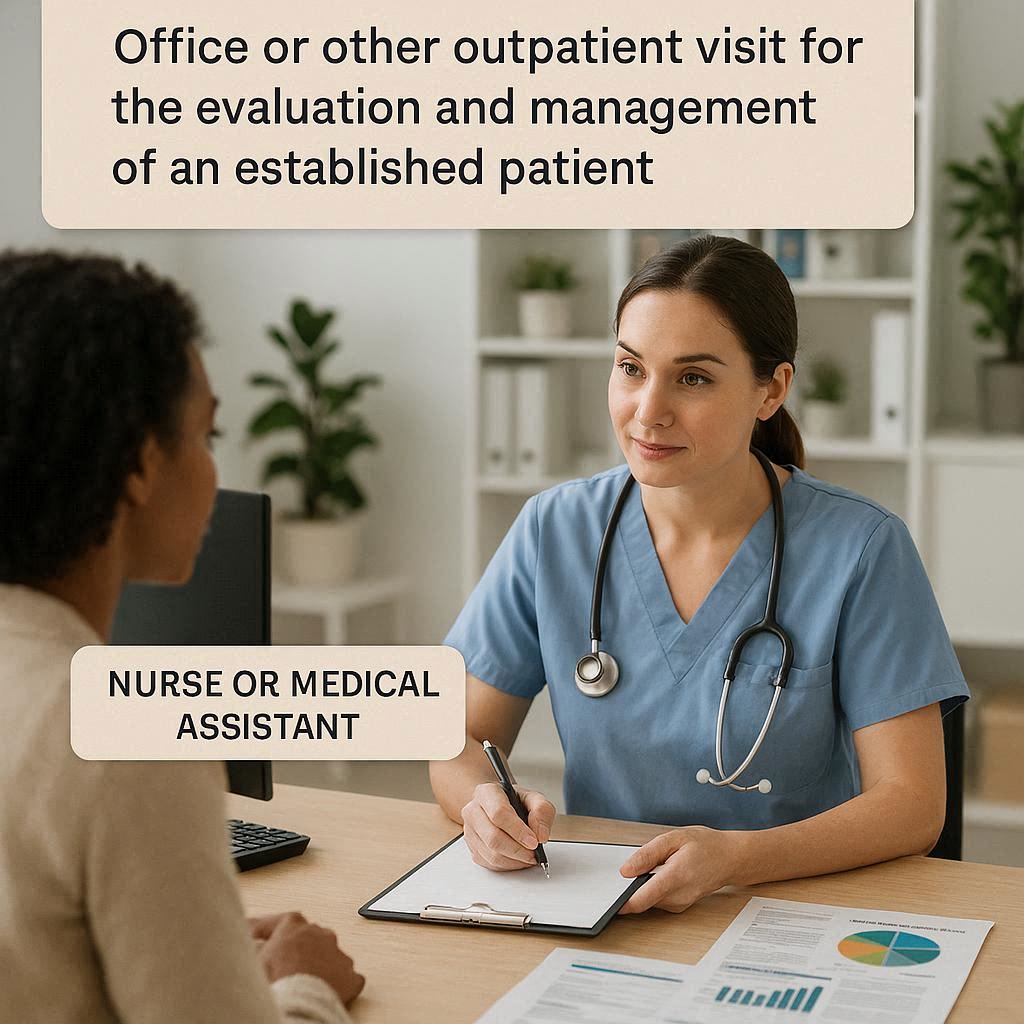
The 99211 CPT code represents an office or other outpatient visit for an established patient. In this visit, the presence of a physician or other qualified health care professional may not be required. The key point is that the service itself must be face-to-face with a clinical staff member.
In simple terms, 99211 is the lowest level of Evaluation and Management (E/M) service for established patients. You use it for brief, straightforward encounters that need a clinical touch but do not demand a doctor’s direct involvement.
Let us break this down into clear, practical pieces. By the end of this guide, you will know exactly when to use 99211, how to document it, and how to avoid common billing mistakes.
What Is the 99211 CPT Code? A Clear Definition
The official CPT codebook defines 99211 as:
“Office or other outpatient visit for the evaluation and management of an established patient, that may not require the presence of a physician or other qualified health care professional. Usually, the presenting problem(s) are minimal. Typically, 5 minutes are spent performing or supervising these services.”
Let us highlight the three most important parts of this definition:
- Established patient only – You cannot use 99211 for a new patient.
- No physician presence required – A clinical staff member (medical assistant, nurse, or technician) can provide the service.
- Minimal presenting problem – The patient’s issue is very simple and needs little time (around 5 minutes).
This code is unique because it does not require the three key components that most E/M codes need: history, examination, and medical decision making (MDM). Instead, a physician only needs to supervise the service, even without being in the room.
Important note for readers: Do not confuse 99211 with a non-billable task. Even though the problem is minimal, the service must still be medically necessary.
Key Requirements for Billing 99211
Before you add 99211 to a claim, check these five conditions. You must meet all of them to bill this code correctly.
1. The Patient Must Be Established
An established patient is someone who has received professional services from the physician or another physician of the same specialty in the same group practice within the last three years.
If the patient has never visited your practice, or if it has been more than three years, you cannot use 99211. You will need a new patient code (99201–99205, though 99201 is now deleted).
2. The Service Must Be Face-to-Face
The encounter must happen in person. You cannot bill 99211 for telephone calls, patient portal messages, or video visits unless specific telehealth rules apply (and most payers do not allow 99211 for telehealth).
The face-to-face time is typically around 5 minutes, but the CPT code does not set a strict time minimum. The key is that the service is brief and requires minimal clinical skill.
3. A Physician Must Supervise the Service
Even if the physician does not see the patient, they must provide general supervision. This means the physician is available (on-site or immediately accessible by phone) while the clinical staff member performs the service.
For example:
- A medical assistant checks a patient’s blood pressure per doctor’s orders.
- A nurse gives a simple injection the doctor prescribed earlier.
The physician does not need to be in the same room, but the service must happen under the practice’s normal supervision policies.
4. The Service Must Be Medically Necessary
This is the most common reason for denied claims. You cannot bill 99211 just because a patient walked in to pick up a prescription or drop off a urine sample. The service must involve some clinical interaction.
Realistic example of medical necessity: A patient comes in for a previously ordered blood pressure check. The medical assistant takes the reading, records it, and reports it to the supervising doctor. That is medically necessary.
Example without medical necessity: The patient drops off a form at the front desk. The receptionist hands it to a nurse. No clinical service occurs. You cannot bill 99211.
5. The Staff Member Must Be Qualified Clinical Personnel
Front desk staff or administrative personnel cannot bill 99211. Only clinical staff — medical assistants (MAs), licensed practical nurses (LPNs), registered nurses (RNs), or certified technicians — may provide the service.
The staff member must act under the physician’s supervision and follow the practice’s scope of practice rules.
When to Use 99211: Real-Life Scenarios
The best way to understand 99211 is to see it in action. Below are common, appropriate uses for this code.
| Scenario | Appropriate to bill 99211? | Why? |
|---|---|---|
| Patient returns for a blood pressure recheck as ordered by the physician. Nurse takes BP and records it. | Yes | Clinical service under supervision. Medical necessity exists. |
| Patient comes to the office for a simple injection (vitamin B12, allergy shot). MA administers the shot per standing orders. | Yes | Face-to-face clinical service. Minimal problem. |
| Patient needs a urine dipstick test ordered by the doctor. Lab technician performs the test and documents results. | Yes | Clinical test performed under supervision. |
| Patient stops by to pick up a work note. Front desk gives the note. | No | No clinical service. No face-to-face with clinical staff. |
| Patient calls to ask about medication side effects. Nurse talks for 4 minutes. | No (unless specific payer rules exist) | Not face-to-face. Most payers do not accept 99211 for telephone calls. |
| Patient drops off a stool sample at the front desk. Receptionist accepts it. | No | No clinical interaction. No documented service. |
How 99211 Differs from Other E/M Codes
Many billers mix up 99211 with 99212 or other codes. Let us clarify the differences with a clear table.
| CPT Code | Patient Type | Physician Presence Required? | Typical Time | Key Components Required | Level of Complexity |
|---|---|---|---|---|---|
| 99211 | Established | No (clinical staff only) | ~5 minutes | None (supervision only) | Minimal |
| 99212 | Established | Yes | ~10 minutes | Problem-focused history, exam, straightforward MDM | Straightforward |
| 99213 | Established | Yes | ~15 minutes | Expanded problem-focused history, exam, low MDM | Low |
| 99214 | Established | Yes | ~25 minutes | Detailed history, exam, moderate MDM | Moderate |
| 99215 | Established | Yes | ~40 minutes | Comprehensive history, exam, high MDM | High |
Notice the pattern. Once the physician sees the patient directly, you move away from 99211 and into 99212–99215. The 99211 code is unique because it allows billing for clinical staff work without the physician’s face-to-face time.
Documentation Rules for 99211: Keep It Simple but Complete
Poor documentation is the number one reason for 99211 denials. Many practices assume that because the service is minimal, they do not need to write anything down. That is a mistake.
Here is what your documentation must include to support a 99211 charge:
Required Elements
- Date of service – The exact day the face-to-face encounter happened.
- Patient name and ID – Clearly identify the patient.
- Reason for visit – A brief note about the minimal problem (e.g., “BP recheck per Dr. Smith’s order from 10/01”).
- Service performed – Exactly what the clinical staff did (e.g., “MA took right arm BP: 128/82”).
- Staff member’s name and title – Who performed the service? (e.g., “Jane Doe, CMA”).
- Supervising physician – The doctor who ordered the service or was available for supervision.
- Time spent – While not required, noting “~5 minutes” helps justify the code.
- Signature and credentials – The clinical staff person signs the note.
Sample Documentation for 99211
Date: 10/15/2025
Patient: John Miller, DOB 05/12/1965
Reason for visit: Follow-up BP check per Dr. Lee’s order from 10/12/2025.
Service: Medical assistant performed manual blood pressure in right arm after patient rested for 5 minutes. Result: 132/84 mmHg. No complaints of dizziness or headache.
Time: 6 minutes face-to-face.
Staff: Sarah Johnson, CMA (Certified Medical Assistant)
Supervising physician: Dr. Emily Lee (on-site)
Signature: Sarah Johnson, CMA
This note is short but complete. It proves the service happened, was clinical, and was supervised.
Common Billing Mistakes with 99211 (And How to Avoid Them)
Even experienced billers make errors with 99211. Here are the most frequent problems and simple solutions.
Mistake #1: Billing 99211 for Non-Face-to-Face Work
Some practices try to bill 99211 for telephone calls, refill requests, or result messages. Unless a specific payer has a temporary telehealth policy (rare for 99211), this is incorrect.
Solution: Use telephone codes (99441–99443) or online digital codes (98970–98972) instead. If the work is administrative, do not bill any E/M code.
Mistake #2: Using 99211 for New Patients
The CPT code clearly states “established patient.” If you use 99211 for a new patient, the claim will deny.
Solution: Verify patient status in your EHR before billing. If the patient has not been seen in over three years or has never visited, use new patient codes (99202–99205).
Mistake #3: No Documentation of Medical Necessity
A claim without a clear reason for the visit is a red flag. Payers will audit these.
Solution: Always write one sentence explaining why the patient needed the service. Link it to a physician’s order or a standing protocol.
Mistake #4: Billing 99211 on the Same Day as Another E/M Service
If a physician sees the patient later the same day for a separate problem, you cannot bill 99211 for the earlier staff visit. The 99211 is considered part of the same encounter.
Solution: Bill only the higher-level E/M code (e.g., 99213) for the physician visit. Do not add 99211.
Mistake #5: Using 99211 for Point-of-Care Tests Without Clinical Judgment
Running a glucose test or a strep test may justify 99211 only if the staff member exercises clinical judgment. If the test is performed automatically without any assessment, it is not an E/M service.
Solution: Document any evaluation or decision made by the staff member (e.g., “Reviewed glucose result of 110 mg/dL with patient, instructed to follow diet plan per Dr. Lee’s order”).
Billing Guidelines and Payer Policies for 99211
Medicare, Medicaid, and private insurers all accept 99211, but each has specific rules. Let us review the most important guidelines.
Medicare (CMS)
Medicare covers 99211 for established patients in outpatient settings. However, CMS has strict rules about incident-to billing when 99211 is used in non-physician settings.
Key Medicare rules for 99211:
- The service must be performed under the direct supervision of a physician or qualified NPP (nurse practitioner, physician assistant).
- The physician must have initiated the plan of care.
- The service must be an integral part of the patient’s treatment.
- You cannot bill 99211 for a separate service on the same day as a major procedure (e.g., surgery) unless it is truly distinct.
Medicaid (State-dependent)
Most state Medicaid programs follow CMS guidelines for 99211. Check your state’s fee schedule. Some states require prior authorization for frequent 99211 visits (more than once per week).
Private Payers (UnitedHealthcare, Cigna, Aetna, BCBS)
Private insurers generally accept 99211, but many have started auditing this code heavily. Why? Because practices overuse it for non-clinical tasks.
Helpful tip: Some payers require that the clinical staff member be an employee of the practice, not a contractor. Also, a few payers will not reimburse 99211 at all. Always verify with each contract.
When NOT to Bill 99211: A Clear List
To keep your claims clean, remember these situations where 99211 does NOT apply.
- The patient is new. Use new patient codes.
- The physician sees the patient on the same day for the same problem. Bill the physician’s E/M code only.
- No clinical service occurs. Picking up forms, dropping off specimens, or scheduling appointments are not billable.
- Only administrative staff are involved. The front desk cannot bill 99211.
- The service takes 10 minutes or more and needs physician judgment. Move to 99212 or higher.
- The payer specifically excludes 99211. Some Medicare Advantage plans do not reimburse it.
How to Train Your Staff to Use 99211 Correctly
Training is the best prevention against billing errors. Use these steps to build a strong 99211 workflow in your practice.
Step 1: Create a Written Policy
Draft a one-page guide that lists:
- What 99211 is and is not.
- Which staff members may perform the service.
- Documentation requirements (template included).
- Supervision rules.
Step 2: Role-Play Real Scenarios
Hold a 15-minute team meeting. Give examples and ask your staff to say “bill” or “do not bill.”
Examples for role-play:
- A patient arrives for a scheduled INR check. MA performs fingerstick and gives result. (Bill)
- A patient asks the front desk for a prescription refill. Staff gives the paper to the nurse. Nurse calls the patient later. (Do not bill – no face-to-face)
- A patient wants to discuss lab results. The doctor is busy, so the nurse spends 5 minutes explaining normal findings and reassuring the patient. (Bill – clinical judgment used)
Step 3: Build Documentation Templates in Your EHR
Create a quick “99211 Note” template that includes:
- Reason for visit (dropdown: BP check, injection, wound check, etc.)
- Service performed (free text)
- Staff name and title (auto-populated)
- Supervising physician (dropdown)
- Time (auto-calculated or manual entry)
Make it so easy that staff cannot forget to document.
Step 4: Audit 20 Claims Per Month
Pick 20 random 99211 claims each month. Review the documentation. If you find errors, retrain the staff member involved.
Reimbursement Rates for 99211 in 2024 and 2025
Reimbursement for 99211 varies by payer, location, and setting. However, we can give you realistic estimates.
| Payer | Average Reimbursement (Facility) | Average Reimbursement (Non-Facility) |
|---|---|---|
| Medicare (national average) | 12.50–16.00 | 21.00–25.00 |
| Medicaid (varies by state) | 8.00–14.00 | 12.00–18.00 |
| UnitedHealthcare | 15.00–22.00 | 22.00–28.00 |
| Cigna | 14.00–20.00 | 20.00–26.00 |
| Aetna | 13.00–19.00 | 19.00–25.00 |
| BCBS (varies by state) | 12.00–23.00 | 18.00–30.00 |
Important note: These numbers are estimates. Actual payment depends on your contract, geographical location, and facility status. Always check your fee schedule.
Non-facility rates (private practice) are higher because they include practice expense. Facility rates (hospital outpatient departments) are lower because the facility bills separately for overhead.
Modifiers and 99211: Do You Need Them?
In most cases, you do not use modifiers with 99211. However, there are two exceptions.
| Modifier | When to Use with 99211 | Example |
|---|---|---|
| Modifier 25 (Significant, separately identifiable service) | If a physician performs a procedure on the same day as a 99211 visit for a different problem. The 99211 must be distinct. | Patient comes for a BP check (99211 by MA). Later the same day, the physician removes a wart on the hand (17110). Append modifier 25 to 99211. |
| Modifier 59 (Distinct procedural service) | Rare. Only if no other modifier applies and the service is clearly separate. | Most payers prefer 25. Avoid 59 unless instructed. |
Do not use modifiers 24, 57, or 80 with 99211. They do not apply.
Frequently Asked Questions (FAQ) About 99211
1. Can a medical assistant bill 99211?
No. The medical assistant cannot bill. The practice bills under the supervising physician’s NPI. The MA performs the service, but the physician’s name goes on the claim.
2. How many minutes is 99211?
The CPT codebook says typically 5 minutes are spent. However, there is no strict time requirement. The key is that the problem is minimal and the service is brief. If you spend 10 minutes, consider whether 99212 is more appropriate.
3. Can I bill 99211 for a telephone call?
Generally, no. Medicare does not allow 99211 for telephone calls. Some private payers have made exceptions during public health emergencies, but that is rare now. Use telephone E/M codes (99441–99443) or patient portal codes instead.
4. Does 99211 require medical decision making (MDM)?
No. That is what makes 99211 unique. You do not need to document history, exam, or MDM. You only need a brief note describing the clinical service under physician supervision.
5. Can I use 99211 for a patient who only wants a prescription refill?
It depends. If the patient comes to the office and a clinical staff member assesses the need for the refill (e.g., checks blood pressure for a hypertension refill), then yes. If the patient simply picks up a signed prescription at the front desk, no.
6. What happens if I bill 99211 without documentation?
The claim may initially pay, but an audit will deny it. You will have to refund the money. Worse, repeated errors can trigger a full practice audit. Always document.
7. Can I bill 99211 on the same day as a preventive medicine visit (99381–99397)?
Yes, if the 99211 service is for a separate, acute problem. For example, a patient comes for an annual physical (99396) and also asks the MA to check a minor rash per the doctor’s order. Document both. Append modifier 25 to the preventive code, not to 99211.
8. Is 99211 only for office settings?
No. The code says “office or other outpatient setting.” You can use it in hospital outpatient departments, clinic-based settings, and some skilled nursing facilities (if the patient is established and the service is outpatient in nature). Do not use it for inpatient hospital visits.
Additional Resources for 99211 Billing
For more official and up-to-date information, refer to these trusted sources:
- CMS E/M Services Guide
https://www.cms.gov/outreach-and-education/medicare-learning-network-mln/mlnproducts/mlnpubs
Search for “Evaluation and Management Services Guide” – the official Medicare reference. - American Medical Association (AMA) CPT Codebook
Purchase the current year’s CPT Professional Edition. The AMA is the authoritative source for all CPT codes, including 99211. - Local Coverage Determinations (LCDs)
Visit your Medicare Administrative Contractor’s (MAC) website. Search for “99211 LCD” to see if your region has specific coverage rules.
Final Thoughts and Best Practices
The 99211 CPT code is a useful tool for practices that want to bill for brief, staff-performed clinical services. When used correctly, it captures revenue for work that was previously uncompensated. When used incorrectly, it invites denials, audits, and repayment demands.
Here are three best practices to carry with you:
- Document before you bill. If you cannot write a one-sentence note describing the clinical service, do not bill 99211.
- Train your team quarterly. Staff turnover and forgetfulness cause errors. A short refresher every three months saves money.
- When in doubt, choose a different code or do not bill. Billing a 99211 without clear medical necessity is not worth the audit risk. The reimbursement is low, but the compliance cost is high.
Conclusion
The 99211 CPT code allows billing for brief, face-to-face clinical services provided by staff to established patients under physician supervision, without requiring direct physician involvement. You must document medical necessity, use qualified clinical staff, and avoid common errors like billing for phone calls or administrative tasks. Used honestly and correctly, 99211 fairly compensates your practice for minimal but valuable patient encounters.
Disclaimer: This article is for educational purposes only and does not constitute legal or medical billing advice. Coding rules and payer policies change frequently. Always consult your current CPT manual, payer contracts, and compliance officer before billing.