If you or a loved one has been scheduled for a lung cancer screening, you have likely heard the words “low-dose CT scan.” But what happens when the bill arrives?
Understanding medical codes can feel like learning a new language. You might see strange numbers like G0296 or 71271 on your paperwork. Do not worry. You are not alone.
This guide will walk you through everything you need to know about the lung cancer screening CT CPT code. We will keep it simple, clear, and honest. No confusing medical jargon. No unrealistic promises.
By the end of this article, you will know exactly which codes to look for, how to avoid billing errors, and what to expect from your insurance company.
What is a Lung Cancer Screening CT?
First, let us clarify what we are talking about.
A lung cancer screening is not the same as a diagnostic CT scan. A screening is for people who have no symptoms of lung cancer. It is a preventive measure, similar to a mammogram for breast cancer or a colonoscopy for colon cancer.
During the test, you lie on a table that slides through a large, donut-shaped machine. The machine takes detailed pictures of your lungs. The whole process takes less than a minute. It does not hurt.
The goal is to find lung cancer early, when it is easier to treat.
Who qualifies for a lung cancer screening?
You cannot just walk in and ask for this test. Doctors follow strict rules to decide who should get screened.
You typically qualify if you meet all three of these criteria:
- You are between 50 and 80 years old.
- You have a “30 pack-year” history of smoking. (We will explain this below.)
- You currently smoke or have quit within the last 15 years.
What is a pack-year?
A pack-year means you smoked an average of one pack per day for one year.
Here are a few examples:
- 1 pack per day for 30 years = 30 pack-years
- 2 packs per day for 15 years = 30 pack-years
- Half a pack per day for 60 years = 30 pack-years
If you meet these criteria, talk to your doctor about whether screening is right for you.
Why Does the CPT Code Matter?
You might be wondering, “Why should I care about a code?”
Here is the honest truth: Insurance companies do not read your doctor’s notes word for word. They read codes.
A CPT code (Current Procedural Terminology) tells the insurance company exactly what service you received. If the wrong code is used, your claim will be denied. You could end up paying hundreds of dollars out of pocket for a test that should be free.
For lung cancer screening, there are two main codes you need to know about. One is for the screening service itself. The other is for the interpretation of the images.
Let us break them down.
The Primary Lung Cancer Screening CT CPT Code: G0296
The most important code for patients and providers is G0296.
This is a HCPCS Level II code (pronounced “hicks-picks”). It is used specifically for a low-dose CT scan for lung cancer screening.
What does G0296 cover?
When a doctor bills using G0296, they are telling the insurance company:
“We performed a low-dose CT scan on a patient who meets the national screening criteria. This patient has no signs or symptoms of lung cancer.”
This code is tied to a specific set of rules. It cannot be used for any old CT scan.
When is G0296 used?
G0296 is used during the annual screening exam.
If a patient has a nodule or spot on their lung that needs follow-up, the doctor will use a different code for the next scan. That follow-up scan is considered “diagnostic,” not “screening.”
Important Note: G0296 is not a standard CPT code. It is a HCPCS code created by Medicare. However, many private insurance companies also accept and recognize G0296 for lung cancer screening.
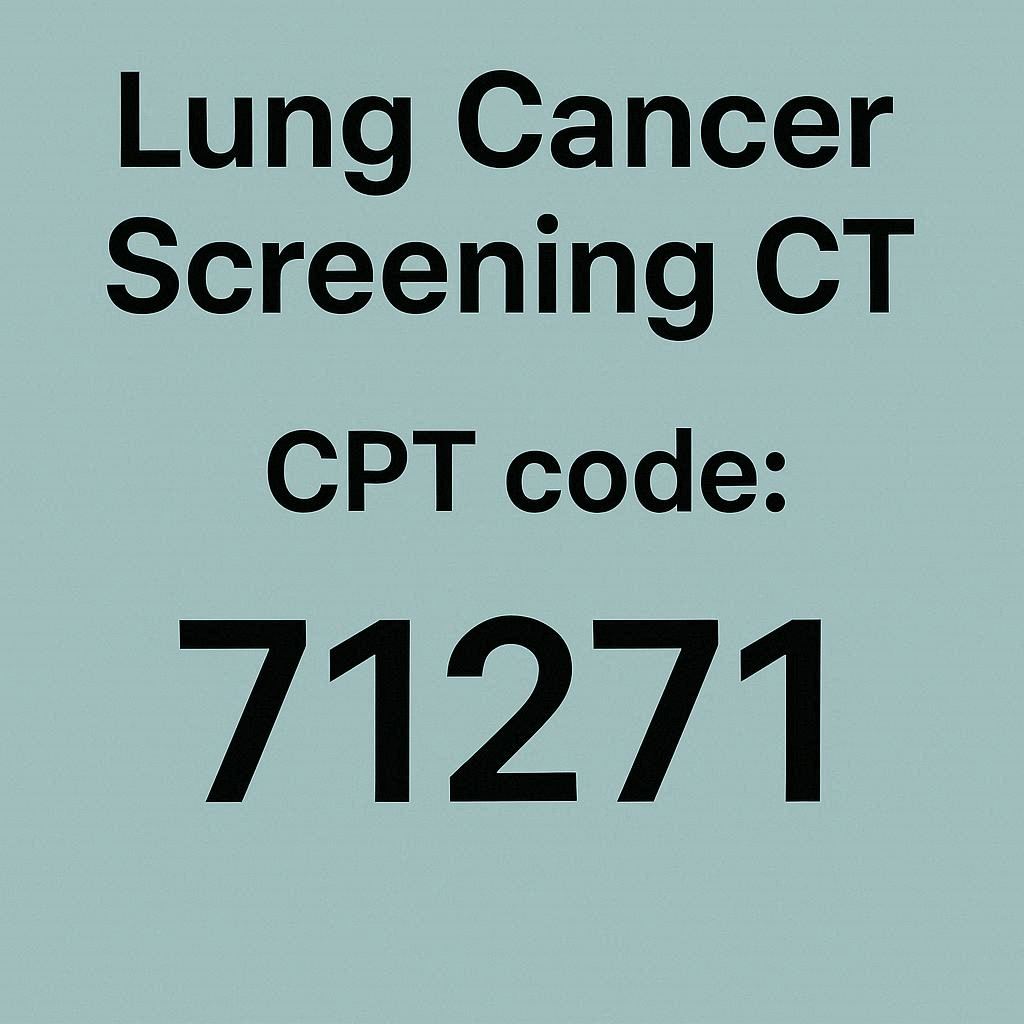
The CPT Code 71271
In recent years, the American Medical Association (AMA) created a new CPT code specifically for lung cancer screening.
This code is 71271.
What is the difference between G0296 and 71271?
This is where things get a little tricky. Let us look at the table below.
| Feature | G0296 | 71271 |
|---|---|---|
| Code Type | HCPCS Level II | CPT (Current Procedural Terminology) |
| Used By | Primarily Medicare | Private insurers, some Medicare plans |
| Description | Lung cancer screening; low-dose CT scan | Computed tomography, thorax, low dose for lung cancer screening |
| Patient Criteria | Must meet shared decision-making visit | Must meet USPSTF criteria |
| Separate Interpretation | Usually included | Usually included |
So, which one is right?
It depends on your insurance. Medicare prefers G0296. Many private insurance companies prefer 71271. Some will accept either.
Do not worry about choosing the code yourself. Your doctor’s billing office will know which code to use based on your specific insurance plan.
Your job is simply to verify that one of these two codes appears on your bill. If you see a different code (like 71250 or 71260), call your provider immediately. Those are for diagnostic CT scans, not screenings.
The Shared Decision Making Visit: G0296 (or 0438T, 0439T)
Before you can get the CT scan, you need a separate appointment. This is called a shared decision making (SDM) visit.
During this visit, you and your doctor will sit down and discuss:
- The benefits of finding lung cancer early.
- The risks of screening (false positives, radiation exposure).
- Your personal risk factors.
- What happens if the scan finds something abnormal.
Medicare requires this visit. Many private insurers do too.
Codes for the shared decision making visit
There are two codes for the SDM visit:
- G0296 (for the SDM visit only) : This is used when the SDM visit happens on a different day than the CT scan.
- 0438T or 0439T: These are newer codes used when the SDM visit happens immediately before the CT scan.
If your doctor bills for the SDM visit, you may have a small copay. But the CT scan itself (code G0296 or 71271) should have zero cost sharing for most eligible patients under the Affordable Care Act.
Quote from a billing specialist: “I see denials every day because the doctor forgot to document the shared decision making visit. If that note is missing, the insurance company will reject the claim. Always ask your doctor to confirm they have completed the SDM paperwork.”
How Much Does a Lung Cancer Screening CT Cost?
This is the question everyone wants to answer.
Under the Affordable Care Act (ACA), preventive services like lung cancer screening should be covered at no cost to you. That means no copay, no coinsurance, and no deductible.
But there are catches.
When is the screening truly free?
You pay $0 for the CT scan if:
- You meet all the screening criteria (age, smoking history, no symptoms).
- Your insurance plan is ACA-compliant.
- Your provider uses the correct CPT code (G0296 or 71271).
- The scan is done by an in-network provider.
When will you have to pay?
Here are the most common reasons patients receive a bill:
| Situation | Likely Cost |
|---|---|
| You do not meet the screening criteria | Full price (300−600) |
| The doctor uses a diagnostic code (71250) by mistake | Full price (300−600) |
| The SDM visit was not documented | Full price |
| Your insurance plan is grandfathered (older plans) | Varies (copay or deductible) |
| The radiologist is out-of-network | Balance billing possible |
What is balance billing? This happens when the hospital is in-network, but the radiologist who reads your scan is not. The radiologist can bill you for the difference between what insurance paid and their full fee.
Always ask before your scan: “Is the radiologist in-network?”
Diagnostic CT vs. Screening CT: A Critical Difference
One of the biggest billing mistakes happens when a screening becomes a diagnostic test.
Let us use a real example.
Scenario A (Screening):
Jane is 55 years old. She smoked a pack a day for 35 years. She feels great. No cough. No chest pain. She goes for her annual low-dose CT scan. The scan is normal.
Correct code: G0296 or 71271. Jane pays: $0.
Scenario B (Diagnostic):
John is 60 years old. He smoked for 40 years. He has a persistent cough that will not go away. His doctor orders a CT scan to find out why he is coughing.
Correct code: 71250 (CT chest without contrast). John pays: His standard copay or deductible (often 100−500).
Scenario C (Screening becomes diagnostic):
Maria is 58 years old. She meets all screening criteria. She gets a screening CT. The scan finds a small nodule. Her doctor orders a follow-up CT scan in six months to watch the nodule.
First scan code: G0296. Maria pays: $0.
Second scan code: 71250 (diagnostic). Maria pays: Her standard copay.
Once a nodule is found, all future scans for that nodule are considered diagnostic, not screening. This is a frustrating rule, but it is the current standard.
Understanding the Radiology Report and Coding
The radiologist is the doctor who reads your CT images. They write a report that describes everything they see.
This report directly affects the codes used for billing.
Common findings and what they mean
| Finding | What it means | Next step |
|---|---|---|
| No nodules | Normal scan | Return to annual screening in 12 months |
| Small nodule (<6 mm) | Probably benign | Repeat scan in 12 months (screening code still applies sometimes) |
| Larger nodule (6-8 mm) | Needs closer watch | Repeat scan in 6-12 months (often becomes diagnostic coding) |
| Nodule >8 mm | Suspicious | Referral to pulmonologist; possible biopsy |
| Other finding (enlarged lymph nodes, etc.) | Could be infection or other issue | Further testing |
If the radiologist recommends a follow-up scan in less than 12 months, that follow-up will almost certainly use a diagnostic code (71250, 71260, or 71270).
Step-by-Step Guide to Avoiding Billing Problems
You do not need to be a coding expert. But you do need to be an advocate for yourself.
Follow these steps before and after your scan.
Step 1: Verify your eligibility
Call your insurance company. Ask these four questions:
- “Is lung cancer screening with a low-dose CT scan a covered preventive service under my plan?”
- “Do I need a prior authorization?”
- “Which CPT code do you prefer: G0296 or 71271?”
- “Is the imaging center and the radiologist in-network?”
Write down the answers. Get the representative’s name and ID number.
Step 2: Confirm the SDM visit
Ask your doctor’s office: “Has the shared decision making visit been completed and documented in my chart?”
If the answer is no, schedule that visit before your CT scan.
Step 3: At the imaging center
When you check in for your CT scan, politely ask the front desk:
“Can you confirm that this test will be billed using the screening code G0296 or 71271? I have no symptoms. This is a preventive screening.”
This simple question saves thousands of patients from billing errors every year.
Step 4: After the scan
When you receive your Explanation of Benefits (EOB) from your insurance company, look for two things:
- Patient responsibility: $0 (for the screening itself).
- CPT code: G0296 or 71271.
If you see a different code, do not pay the bill yet. Call your provider’s billing office immediately.
Step 5: If you receive a bill
Do not panic. Do not ignore it.
Call the billing office and say:
“I received a bill for a lung cancer screening CT. This should be covered as a preventive service with no cost sharing. Can you verify that the correct CPT code (G0296 or 71271) was used and that my shared decision making visit is documented?”
In most cases, this resolves the issue. The billing office will correct the code and resubmit the claim.
Private Insurance vs. Medicare vs. Medicaid
Different payers have different rules. Let us break it down.
Medicare (Part B)
- Covers: Annual LDCT for eligible beneficiaries (ages 50-77 for Medicare).
- SDM visit required: Yes.
- CPT code: G0296.
- Patient cost: $0 for the scan (if all criteria met). You may pay 20% of the SDM visit.
- Frequency: Once per year.
Private Insurance (ACA-compliant plans)
- Covers: Annual LDCT for eligible adults (ages 50-80).
- SDM visit required: Usually yes.
- CPT code: 71271 (increasingly common) or G0296.
- Patient cost: $0 for the scan.
- Frequency: Once per year.
Medicaid
Coverage varies significantly by state. Some states cover lung cancer screening. Others do not.
Check with your specific state Medicaid office. If coverage is available, the rules often mirror Medicare’s guidelines.
Medicare Advantage (Part C)
These are private plans that replace Original Medicare. They must cover the same services as Medicare, but they can have different rules for prior authorization and in-network providers.
Always call your Medicare Advantage plan before scheduling a lung cancer screening CT.
What To Do If Your Claim Is Denied
Denials happen. It is frustrating, but it is not the end of the road.
Here are the most common denial reasons and how to fix them.
| Denial Reason | Why it happens | Solution |
|---|---|---|
| “Not medically necessary” | Patient does not meet age/smoking criteria. | Review eligibility criteria with your doctor. If you qualify, ask for a letter of medical necessity. |
| “Missing documentation” | No shared decision making visit on file. | Ask your doctor to submit the SDM note to the insurance company. |
| “Wrong code used” | Provider billed 71250 (diagnostic) instead of G0296. | Call provider. Ask them to resubmit with correct screening code. |
| “Screening too frequent” | Patient had a scan within the last 11 months. | Wait until 12 months have passed since the last screening. |
| “No prior authorization” | Provider forgot to get approval before the scan. | This is the provider’s error. Ask them to write off the charge. |
How to appeal a denial
If the insurance company denies your claim after you have tried everything, file an appeal.
- Call your insurance company. Ask for the appeals department.
- Request a written explanation of the denial.
- Gather your documents: Your doctor’s order, SDM visit note, and the radiology report.
- Write a simple appeal letter. State: “I am requesting an appeal for claim number [X]. I met all USPSTF criteria for lung cancer screening. The correct CPT code was used. Please reverse the denial.”
- Send the letter via certified mail so you have proof of delivery.
Most appeals are successful when the patient clearly qualified for the screening.
Frequently Asked Questions (FAQ)
1. Can I get a lung cancer screening CT without a doctor’s order?
No. You need a written order from a physician or qualified non-physician practitioner (like a nurse practitioner or physician assistant). The order must state that the scan is for lung cancer screening.
2. How often can I get a screening CT?
Once every 12 months. If you have a scan in September 2024, you cannot have another screening until September 2025.
3. What if my scan finds something other than lung cancer?
CT scans often find other issues, such as:
- Enlarged thyroid
- Kidney masses
- Liver lesions
- Coronary artery calcification
Your doctor will tell you if any of these findings need follow-up. That follow-up will be billed separately, often with a diagnostic code.
4. Does insurance cover the follow-up scan if something is found?
Yes, but it will be covered as a diagnostic test, not a preventive screening. You will likely have a copay or deductible.
5. Is there any radiation risk with a low-dose CT scan?
Yes, but the dose is very low. A low-dose chest CT uses about the same amount of radiation as 10-20 chest X-rays. For people at high risk of lung cancer, the benefit of early detection far outweighs the small radiation risk.
6. What happens if I do not meet the smoking criteria but I want the scan?
You can still get a CT scan. But it will be considered a diagnostic test (or a self-pay screening). Your insurance will likely not cover it. The cash price is usually between 200and600.
7. Does the code G0296 expire?
No. G0296 is an active HCPCS code as of this writing. However, codes do change over time. Always verify current codes with your provider and insurance company.
8. Can a hospital bill me separately for the facility fee and the radiologist?
Yes. You may receive two bills: one from the hospital (facility fee) and one from the radiologist (professional fee). Both bills should show $0 patient responsibility if the screening is properly coded and covered.
If either bill shows an amount due, call that billing department immediately.
Comparison Table: Screening vs. Diagnostic CT Chest
| Feature | Screening CT | Diagnostic CT |
|---|---|---|
| Patient has symptoms? | No | Yes |
| CPT / HCPCS Code | G0296 or 71271 | 71250, 71260, 71270 |
| Requires SDM visit | Yes | No |
| Insurance coverage | 100% (no cost sharing) for eligible patients | Subject to copay/deductible |
| Typical out-of-pocket cost | $0 (if criteria met) | 100−1,000+ |
| Follow-up for nodules | No (screening stops if nodule found) | Yes |
| Radiation dose | Low (approx. 1-2 mSv) | Standard (approx. 5-8 mSv) |
Additional Resources
For more reliable information, visit these official sources:
- US Preventive Services Task Force (USPSTF): Final recommendation statement for lung cancer screening.
- Centers for Medicare & Medicaid Services (CMS): National Coverage Determination (NCD) for Lung Cancer Screening with Low Dose Computed Tomography.
- American Lung Association: Patient guide to lung cancer screening and shared decision making.
Link to resource: https://www.cms.gov/medicare-coverage-database/view/ncd.aspx?NCDId=364 (CMS official page)
Key Takeaways for Patients
Let us summarize what you really need to remember.
- The codes you need to know: G0296 (Medicare) and 71271 (private insurance).
- You must qualify: Age 50-80, 30 pack-year smoking history, no symptoms.
- You need a shared decision making visit before the scan.
- Your cost should be $0 for the scan itself if all rules are followed.
- If you receive a bill, do not pay it immediately. Call the billing office and check the code.
Lung cancer screening saves lives. But only if you can access it without financial stress. Understanding these codes gives you power. It protects your wallet and your health.
Do not let confusing medical billing stop you from getting this important test.
Conclusion
Understanding the lung cancer screening CT CPT code does not have to be overwhelming. Remember the two main codes: G0296 for Medicare and 71271 for most private insurers. Always confirm you meet the screening criteria, complete a shared decision making visit with your doctor, and verify the correct code before your scan. If you receive a bill for a preventive screening, do not pay it—contact the billing office to correct the coding error first.
Final Checklist Before Your Lung Cancer Screening
Use this checklist to ensure a smooth billing experience.
☐ I am between 50 and 80 years old.
☐ I have a 30+ pack-year smoking history.
☐ I have no current symptoms of lung cancer.
☐ I have completed a shared decision making visit with my doctor.
☐ My doctor has documented the SDM visit in my chart.
☐ I have a written order for a low-dose CT scan for lung cancer screening.
☐ I have called my insurance to verify coverage and prior authorization requirements.
☐ I have confirmed the imaging center and radiologist are in-network.
☐ I will ask the front desk to confirm the screening code (G0296 or 71271) at check-in.
☐ I will review my EOB for a $0 patient responsibility.