If you work in a medical office, you have probably seen CPT code 99211 listed on a fee schedule or in your billing software. At first glance, it looks simple. It is often called the “nurse visit code” or the “brief established patient code.” But here is the truth: few codes cause more confusion, denied claims, and compliance headaches.
This guide gives you a real-world, honest definition of CPT code 99211. You will learn exactly when to use it, when to avoid it, and how to document it correctly. No fluff. No fake rules. Just practical knowledge you can use today.
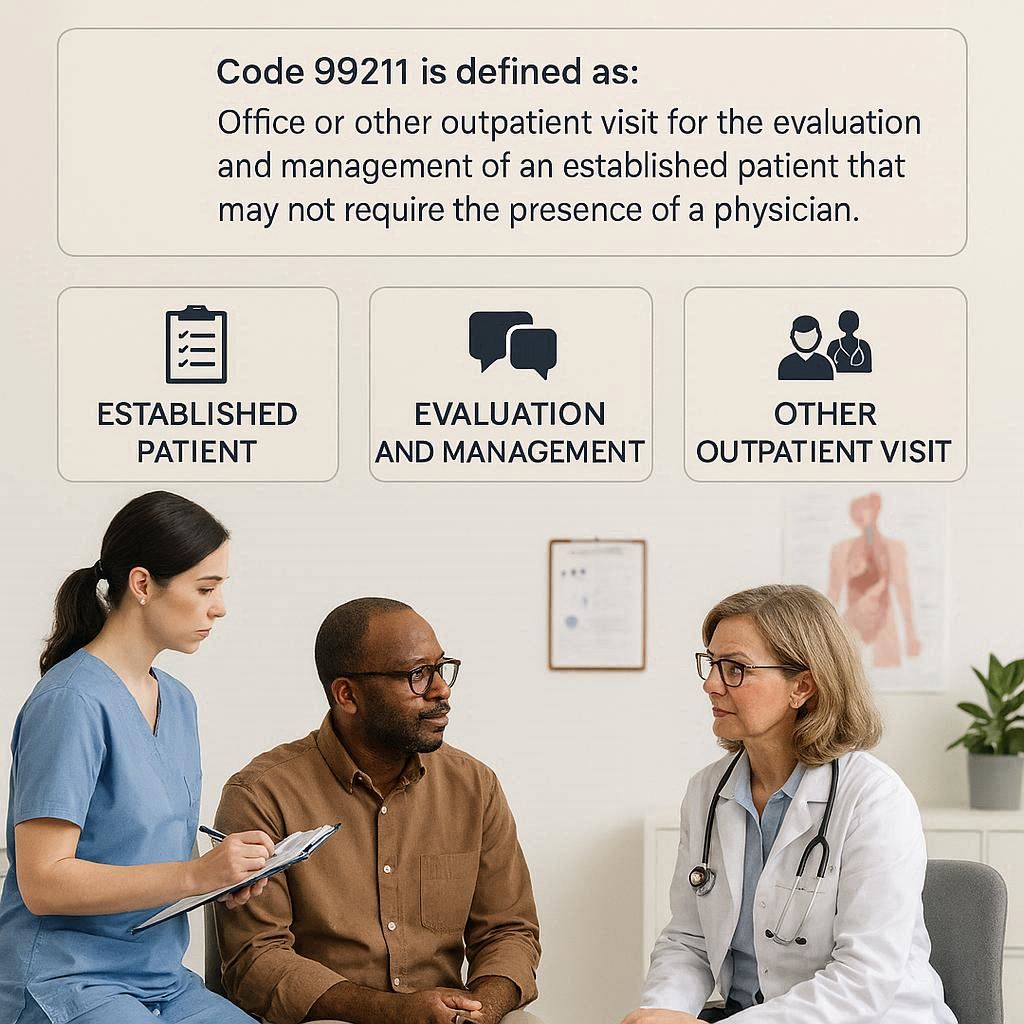
What Is CPT Code 99211? A Straightforward Definition
Let us start with the official definition. Then we will translate it into plain English.
Official CPT definition for 99211:
Office or other outpatient visit for the evaluation and management of an established patient. The visit requires no physician or other qualified health care professional (QHP) to be present. Usually, the presenting problem(s) are minimal. Typically, 5 minutes are spent performing or supervising the service.
Now, here is what that actually means for you and your team.
CPT code 99211 describes a very short, low-complexity visit for an established patient. The key difference from every other E/M code is this: no physician or QHP (nurse practitioner, physician assistant, etc.) needs to be in the room. A licensed staff member—like an RN, LPN, medical assistant (MA), or even a receptionist with specific training—can provide the service under the physician’s general supervision.
The visit is minimal. Think: a blood pressure check, a medication injection the patient gets regularly, or a quick urine dipstick test. The doctor does not need to see the patient face-to-face. The staff member handles it, and the doctor later reviews anything necessary.
Key Words to Remember
- Established patient only. You cannot use 99211 for a new patient.
- No physician or QHP present. The service is furnished by clinical staff.
- Minimal problem. Usually one stable issue.
- 5 minutes typical time. Time is not the only factor, but it is a helpful guide.
Important note: CPT code 99211 does not require the patient to see a physician. That is its superpower. But that also makes it a red flag for auditors if you use it carelessly.
How 99211 Differs from Other E/M Codes (Comparison Table)
Many people mix up 99211 with 99212, 99213, or even preventive visit codes. Let us clear that up right now.
| Feature | 99211 | 99212 | 99213 | 99214 |
|---|---|---|---|---|
| New or established patient | Established only | Either | Either | Either |
| Physician/QHP presence required | No | Yes | Yes | Yes |
| Typical time | 5 minutes | 10 minutes | 15 minutes | 25 minutes |
| Medical decision making | Minimal (straightforward) | Straightforward | Low | Moderate |
| Presenting problem | Minimal (e.g., check BP) | Self-limited (e.g., cold) | Low severity (e.g., ear infection) | Moderate severity (e.g., high BP with med change) |
| Face-to-face requirement | Staff with patient | Physician with patient | Physician with patient | Physician with patient |
As you can see, 99211 stands alone. No other E/M code allows a zero-physician-face-to-face visit.
Why This Matters for Your Revenue
Many practices think: “We can bill 99211 for every nurse task.” That is a dangerous belief. Payers—especially Medicare and commercial insurers—have strict rules. They expect that 99211 is the exception, not the routine.
Use it too often, and you invite an audit. Use it incorrectly, and you will owe money back. But when used correctly, 99211 can capture legitimate, billable staff work that otherwise would be lost revenue.
Real-World Scenarios: When to Use CPT Code 99211
Let us walk through situations where 99211 is the right choice. These examples come from real clinics.
Scenario 1: The Blood Pressure Recheck
A 58-year-old established patient with hypertension comes in for a blood pressure check. The doctor asked the patient to return in one week. The patient feels fine. The medical assistant takes the BP, records it, and sends the reading to the doctor. The doctor reviews it later and says no change is needed.
Can you bill 99211? Yes. The staff performed the service. The problem is minimal. No physician face-to-face visit occurred.
Scenario 2: The Routine Injection
An established patient with vitamin B12 deficiency comes to the office for their monthly B12 shot. The LPN gives the injection. The patient leaves. The doctor does not see the patient because the injection is part of an existing treatment plan.
Can you bill 99211? Yes, but check the payer’s policy. Some payers bundle injection administration into the drug code. Others allow 99211 separately. When allowed, 99211 is correct.
Scenario 3: The Urine Dipstick for UTI Follow-Up
A patient with a history of recurrent UTIs was treated two weeks ago. The doctor asked the patient to return for a repeat urinalysis to confirm the infection is gone. The medical assistant collects the urine, runs a dipstick, and documents “negative nitrites, negative leukocytes.” The doctor reviews the result and signs off.
Can you bill 99211? Yes. The staff performed the test under the doctor’s order. The visit was minimal.
Scenario 4: The Medication Refill Request Without an Exam
A patient calls the office and asks for a refill of their metformin. The receptionist checks the chart, confirms the patient is due for a refill, and sends the request to the doctor. The doctor approves it. No in-person visit occurs.
Can you bill 99211? No. This is a common mistake. 99211 requires a face-to-face encounter with a staff member. A telephone call alone does not qualify. You would use a telephone visit code (such as 99441–99443) if appropriate, but those have their own rules.
When NOT to Use CPT Code 99211 (Critical List)
Avoid using 99211 in these situations. Each one is a real audit finding I have seen in practice reviews.
- New patients. Never. Use 99201–99205 (but note 99201 is deleted) or 99202–99205.
- When a physician or QHP sees the patient. If the doctor enters the room, you must use a higher code (99212–99215) if appropriate.
- For telephone calls or portal messages. No face-to-face = no 99211.
- For services bundled into a global period. For example, a post-op wound check within 90 days of surgery. The surgical package includes that visit.
- For routine vitals without a medical necessity. If a patient walks in just to say hello and you take their BP for fun, that is not billable.
- When the staff member is not under physician supervision. Medicare requires general supervision for 99211. That means the physician must be immediately available (not necessarily in the same room) but in the office suite.
- For annual wellness visits or preventive visits. Those have separate codes (G0438, G0439, 99381–99397).
Pro tip: If a payer denies 99211 and you think you used it correctly, check your documentation first. Then check the payer’s medical policy. Many commercial plans follow Medicare’s lead, but not all.
Documentation Requirements for 99211 (What Auditors Want)
Here is where most practices fail. They think: “It is only a 5-minute code. We do not need much documentation.” That is a mistake.
Medicare and other payers require meaningful documentation even for 99211. You do not need a full SOAP note like a physician visit. But you do need the following:
Minimum Documentation Elements for 99211
- Date of service – Obvious but sometimes missing.
- Patient name and identifier – Match the chart.
- Chief complaint or reason for visit – “Patient here for BP recheck per Dr. Smith’s request.”
- Service performed – “MA took manual BP in right arm, seated. Result 128/82.”
- Who performed the service – Signature and credentials (e.g., “Jane Doe, CMA”).
- Physician review and sign-off – The doctor must review and sign the note. This proves general supervision.
- Time (optional but helpful) – “Total face-to-face time 4 minutes.”
Example of a Strong 99211 Note
*Date: 5/15/2026*
*Patient: John Miller, DOB 3/10/1965*
*Reason: Follow-up BP check per Dr. Patel’s request from 5/8 visit.*
*Service: Manual blood pressure taken in left arm, seated after 5 minutes rest. Result 132/84.*
No new symptoms reported. Patient denies headache, chest pain, or vision changes.
Staff: Sarah Johnson, LPN
*Time: 5 minutes face-to-face*
*Reviewed by: Dr. A. Patel, 5/15/2026. No medication change needed. Plan: recheck in 4 weeks.*
This note is simple but complete. An auditor can see the medical necessity, the staff role, the physician oversight, and the minimal problem.
What Does NOT Work
- “BP check” alone – No medical necessity.
- “Nurse visit” – No detail.
- No physician signature – No supervision proof.
- No date – Invalid.
Payer-Specific Rules for 99211 (Medicare, Medicaid, Commercial)
Not all payers treat 99211 the same way. You must know your contracts.
Medicare’s Rules for 99211
Medicare allows 99211. But they audit it frequently. Key points:
- The service must be medically necessary. A screening BP with no reason is not covered.
- The physician must be physically present in the office suite (general supervision).
- You cannot bill 99211 on the same day as another E/M service for the same patient by the same physician.
- Medicare pays a low fee. In 2024–2025, the national average is roughly 23–26. Check your local fee schedule.
Commercial Payers (UnitedHealthcare, Cigna, Aetna, BCBS)
Policies vary widely.
- UnitedHealthcare: Allows 99211 but requires documentation of the staff’s encounter and physician review.
- Cigna: Often denies 99211 for medication injections if you also bill the administration code. Check your contract.
- Aetna: Generally follows Medicare guidelines but may require a higher level of documentation for non-Medicare plans.
- Blue Cross Blue Shield (varies by state): Some BCBS plans do not cover 99211 at all for certain office settings (e.g., standalone injection clinics). Verify before billing.
Medicaid
State by state. Some Medicaid plans do not recognize 99211. Others pay a very low rate. Many require prior authorization for frequent use.
Best practice: Create a payer cheat sheet for your front desk and billing team. List which payers accept 99211 and any special requirements.
Common Billing Mistakes and How to Avoid Them
I have reviewed hundreds of denied claims for 99211. These are the top five errors I see.
Mistake 1: Billing 99211 for Telephone Calls
What happens: A patient calls for a prescription refill. The receptionist takes the message. The office bills 99211.
Why it is wrong: No face-to-face encounter. Use prolonged telephone codes (99441–99443) or bill nothing if the call is brief and not separately payable.
How to fix: Train staff that “face-to-face” means in the same room, physically.
Mistake 2: Using 99211 When the Physician Walks In
What happens: The MA starts the visit. The doctor walks in for 30 seconds to say hello. The practice bills 99211.
Why it is wrong: Once a physician (or QHP) is present and performs any E/M component, you cannot use 99211. You must use 99212 or higher if medical necessity supports it.
How to fix: Only bill 99211 when the physician truly does not see the patient face-to-face. If the doctor steps in, choose the correct code based on MDM or time.
Mistake 3: No Physician Oversight Documentation
What happens: The MA writes a note. No physician cosignature. The practice bills 99211.
Why it is wrong: Medicare requires “general supervision.” The note must show the physician reviewed and agreed with the service.
How to fix: Require physician electronic signature on all 99211 notes before billing. Do not batch sign at the end of the month.
Mistake 4: Billing 99211 for Routine, Non-Medically Necessary Services
What happens: A patient wants their blood pressure checked “just because.” The office bills 99211.
Why it is wrong: No medical necessity. The patient has no complaint, no known condition, no doctor’s order.
How to fix: Only bill 99211 when the service is linked to a specific, documented medical need (e.g., “monitoring hypertension” or “follow-up of abnormal lab”).
Mistake 5: Using 99211 for New Patients
What happens: A new patient comes in for a brief nurse visit to get a flu shot. The office bills 99211.
Why it is wrong: CPT clearly states “established patient” only. A new patient has not received professional services from the physician or QHP in the past 3 years.
How to fix: For new patient preventive or E/M services, use the correct new patient code (99202–99205). For a standalone vaccine without E/M, use the vaccine administration code (90471, etc.) without 99211.
Time and Medical Decision Making for 99211
Many coders ask: “How do I choose 99211 versus 99212?” The answer lies in who is present and the complexity.
Time-Based Criteria
CPT says typical time for 99211 is 5 minutes. That is face-to-face time with the staff member. But time alone does not justify the code. You must also have:
- No physician presence
- Minimal presenting problem
If your staff spends 15 minutes with a patient but the problem remains minimal and no doctor is present, can you still use 99211? Yes, technically. But payers may question why a doctor was not involved for a longer visit. Use clinical judgment.
Medical Decision Making (MDM) for 99211
The official CPT MDM table for 99211 is not complex because the code does not require MDM. The physician is not making decisions in real time. Instead, the staff follows a standing order or protocol.
That said, the patient’s problem must be minimal. Examples:
- Stable chronic condition (hypertension, diabetes on stable meds)
- Minor, self-limited symptom (mild itching without rash)
- Follow-up for a known issue (check INR for warfarin patient)
If the patient presents with chest pain, shortness of breath, or any moderate-to-high severity symptom, 99211 is inappropriate. The doctor must see that patient.
CPT Code 99211 and Incident-To Billing Rules
Here is an advanced topic that affects many primary care practices. 99211 often ties to incident-to billing rules for non-physician practitioners.
What Is Incident-To?
“Incident-to” is a Medicare concept. It allows a non-physician provider (like a nurse or PA) to bill under the physician’s National Provider Identifier (NPI) at 100% of the physician fee schedule, rather than 85% for a PA/NP billing independently.
For 99211, incident-to rules require:
- The patient is established.
- The service is furnished under the physician’s supervision (general supervision is fine).
- The service is an integral part of the patient’s ongoing treatment plan.
- The physician initiated the treatment plan and sees the patient at a frequency that demonstrates active involvement.
If you violate incident-to rules, Medicare may recoup payments. You also risk fraud and abuse liability.
Simple Rule for Incident-To and 99211
If your physician has not seen the patient for the same condition within the past 6–12 months, do not bill 99211 incident-to. Instead, have the physician see the patient first.
Quote from an auditor: “Incident-to violations for 99211 are the number one reason small practices lose their Medicare billing privileges. It looks small, but it adds up fast.”
How to Train Your Staff on 99211
Your medical assistants, LPNs, and front desk staff need clear rules. Create a one-page training sheet.
Sample Staff Training Card for 99211
You MAY bill 99211 when:
- Patient is established (seen here within 3 years)
- Physician is in the office suite (general supervision)
- You see the patient face-to-face
- Service is medically necessary (has a reason)
- You document: reason, what you did, time, your name
- Physician reviews and signs the note
You MAY NOT bill 99211 when:
- Patient is new
- You only talk on the phone
- Patient has no complaint or doctor’s order
- Physician enters the room (use 99212+)
- The visit is within a global surgical period
What to say to a patient if you cannot bill 99211:
“Mrs. Jones, I can check your blood pressure today, but your insurance may not cover it as a billable visit because you do not have a specific medical need. Would you like to proceed, or would you prefer to schedule a visit with Dr. Smith?”
Transparency saves headaches later.
The Financial Reality of 99211
Let us talk about money. 99211 pays poorly compared to other E/M codes. But it pays better than zero.
Average Reimbursement Rates (2025 estimates, U.S.)
| Payer | Average Payment for 99211 |
|---|---|
| Medicare (national average) | $24.00 |
| Medicaid (sample state) | 12.00–18.00 |
| Commercial (average) | 28.00–45.00 |
| High-value commercial plan | Up to $55.00 |
These are not huge numbers. But if you perform 20 legitimate 99211 visits per week, that is roughly 480–960 per week, or 25,000–50,000 per year in additional revenue.
However, if you use 99211 incorrectly and get audited, the clawbacks and fines can wipe out years of revenue.
Opportunity Cost
Every time staff spends 10 minutes on a 99211 visit, they could be doing something else. If your medical assistant is highly skilled, consider whether that time is better spent on higher-value tasks. Sometimes, billing 99211 is not worth the documentation burden.
Legal and Compliance Risks
I want to be direct with you. Improper use of 99211 has led to:
- Medicare recoupment demands (tens of thousands of dollars)
- Corporate integrity agreements
- Exclusion from federal health programs (rare but possible)
Real Audit Example
A family practice in Florida billed 99211 for every “nurse visit” over two years. They had no documentation of medical necessity, no physician oversight notes, and used 99211 for telephone calls. Medicare audited. The practice repaid $147,000 plus penalties. They also had to hire a compliance consultant for three years.
Do not let this be you.
Seven Compliance Safeguards for 99211
- Create a written policy for 99211 use.
- Train all clinical staff annually.
- Review 10 random 99211 charts every month (internal audit).
- Do not bill 99211 for any service you cannot link to a specific medical need in the note.
- Require physician sign-off within 24–48 hours.
- Check payer policies quarterly – they change.
- When in doubt, do not bill. A small loss is better than an audit.
Frequently Asked Questions (FAQ)
1. Can a medical assistant bill 99211?
No. A medical assistant cannot bill anything. The practice bills 99211 under the supervising physician’s NPI. The MA performs the service. The physician must supervise and sign the note.
2. Does 99211 require face-to-face time?
Yes. The patient must be physically present. Telephone, telehealth (video), and portal messages do not qualify for 99211.
3. Can I use 99211 for a telehealth visit?
Generally, no. Medicare and most commercial plans have separate telehealth codes. For a brief, audio-video visit with a staff member (not a physician), check payer guidance. Many do not allow 99211 via telehealth.
4. What is the difference between 99211 and G0463?
G0463 is a code for federally qualified health centers (FQHCs) and rural health clinics (RHCs). Do not use 99211 in an FQHC/RHC unless you know their specific encounter rules. G0463 is for “visit” payments. Ask your biller.
5. Can I bill 99211 and an injection code together?
Yes, in many cases. For example, 99211 (nurse visit for B12 deficiency) plus 96372 (therapeutic injection administration). But check the payer’s bundling rules. Some payers consider the injection administration inclusive to 99211.
6. How many times can I bill 99211 for the same patient?
As many times as medically necessary. But if you bill 99211 weekly for months without a physician visit, an auditor will ask why. Schedule periodic physician visits to maintain incident-to eligibility.
7. What happens if I accidentally bill 99211 instead of 99212?
You will likely be underpaid. That is better than overbilling. But you can correct it by submitting an adjusted claim with the correct code.
8. Does Medicare require the 5 minutes to be documented for 99211?
Medicare does not require time to be documented for 99211, but it is strongly recommended. If audited, time helps prove the visit was more than trivial.
Additional Resources for CPT Code 99211
For further reading and official guidance, here are trustworthy sources:
- American Medical Association (AMA) CPT® Professional Edition – The official code book. Always check the latest version.
- Medicare Claims Processing Manual, Chapter 12 (Section 30.6.1) – Incident-to and 99211 rules.
- CMS E/M Services Guide – Search for “99211” on CMS.gov for official FAQs.
- Your local MAC (Medicare Administrative Contractor) – Each MAC publishes local coverage determinations (LCDs). For example, Novitas, Palmetto GBA, Noridian.
Link to CMS E/M quick reference:
https://www.cms.gov/Outreach-and-Education/Medicare-Learning-Network-MLN/MLNProducts/Downloads/eval-mgmt-serv-guide-ICN006764.pdf
(Copy and paste into your browser. Always verify you have the most current version.)
Conclusion (Three-Line Summary)
CPT code 99211 represents a minimal, staff-performed visit for established patients under physician supervision without the doctor’s face-to-face presence. Correct use requires strict documentation of medical necessity, face-to-face staff interaction, and physician review to avoid costly audits and denials. When used properly, 99211 captures legitimate revenue for brief services like BP checks, follow-up urinalysis, or routine injections—but always check payer-specific rules first.
Disclaimer: This article is for educational purposes only and does not constitute legal, coding, or billing advice. Medical coding rules change frequently. Always verify with your payer contracts, your compliance officer, and the current CPT and CMS manuals before billing any code. The author and publisher assume no liability for any adverse outcomes resulting from the use of this information.