If you are reading this, you probably have a denial letter in one hand and a billing manual in the other. Do not worry. You are not alone.
Intravenous Immune Globulin (IVIG) therapy is a lifesaving treatment for patients with immunodeficiencies, neuropathies, and autoimmune conditions. But for the medical biller or coder? It can feel like a maze.
The good news is that finding the correct CPT code for IVIG therapy is simpler than it looks once you break it down into two parts: the drug itself and the infusion service.
Let us walk through this together. No jargon bombs. No unrealistic promises. Just honest, practical guidance to help you get paid correctly.
Understanding the Basics: Drug vs. Administration
Before we talk numbers, we need to understand a golden rule in medical coding: The drug is not the service.
Think of it this way. If a patient goes to a coffee shop, they pay for the coffee (the product) and they pay for the barista’s time (the service). IVIG works the same way.
- The Product: The immunoglobulin liquid inside the bag.
- The Service: The nurse setting up the IV, monitoring the patient, and adjusting the flow rate.
You will need to bill two different sets of codes for every single IVIG session. Mixing these up is the number one reason claims get rejected.
The Primary CPT Code for IVIG Therapy (The Drug)
Here is where most people get stuck. There is not just one code. There are many. Why? Because different brands of IVIG have different HCPCS codes.
The most common codes you will use for the drug itself fall under the J-code series.
The Heavy Hitters: J1559 vs. J1561
Let us look at the two codes you will likely use every day.
| HCPCS Code | Drug Name (Brand) | Standard Concentration | Key Note |
|---|---|---|---|
| J1559 | Gammaplex, Xembify | 10% | Most common for primary immune deficiency. |
| J1561 | Gamunex-C, Gammaked | 10% | Widely used for neurology (CIDP). |
| J1566 | Immune Globulin (IGIV) | 5% or 10% | General/Unspecified (Avoid if possible). |
| J1599 | Immune Globulin (Non-lyophilized) | Various | Used for products without a specific J-code. |
Important Note: Do not just pick J1599 because it is easier. If the manufacturer has a specific code (like J1559), you must use that specific code. Payers will deny J1599 if a specific code exists.
How to Bill the Units (The Math)
This is where we need to do a little math. Do not skip this section.
You do not bill “per bag.” You bill per gram.
Most IVIG products are a 10% solution. This means 10 grams of protein per 100 mL of liquid.
The Formula:
- Look at the vial or bag. Find the total grams (e.g., 30 grams).
- Look at the HCPCS code descriptor. (Usually, 1 unit = 1 gram).
- Bill the total number of grams.
Example:
A nurse infuses 30 grams of Gamunex-C.
- CPT Code: J1561
- Units: 30
*If you bill 1 unit for a 30-gram bag, you are losing 97% of your revenue. Do not do this.*
The Administration Codes (How the Drug is Given)
You have the drug ready. Now, how is the patient receiving it?
IVIG is almost always a “therapeutic infusion.” You will rarely use “push” codes (like 96374) for immunoglobulins because IVIG takes hours.
Here is your go-to list for administration:
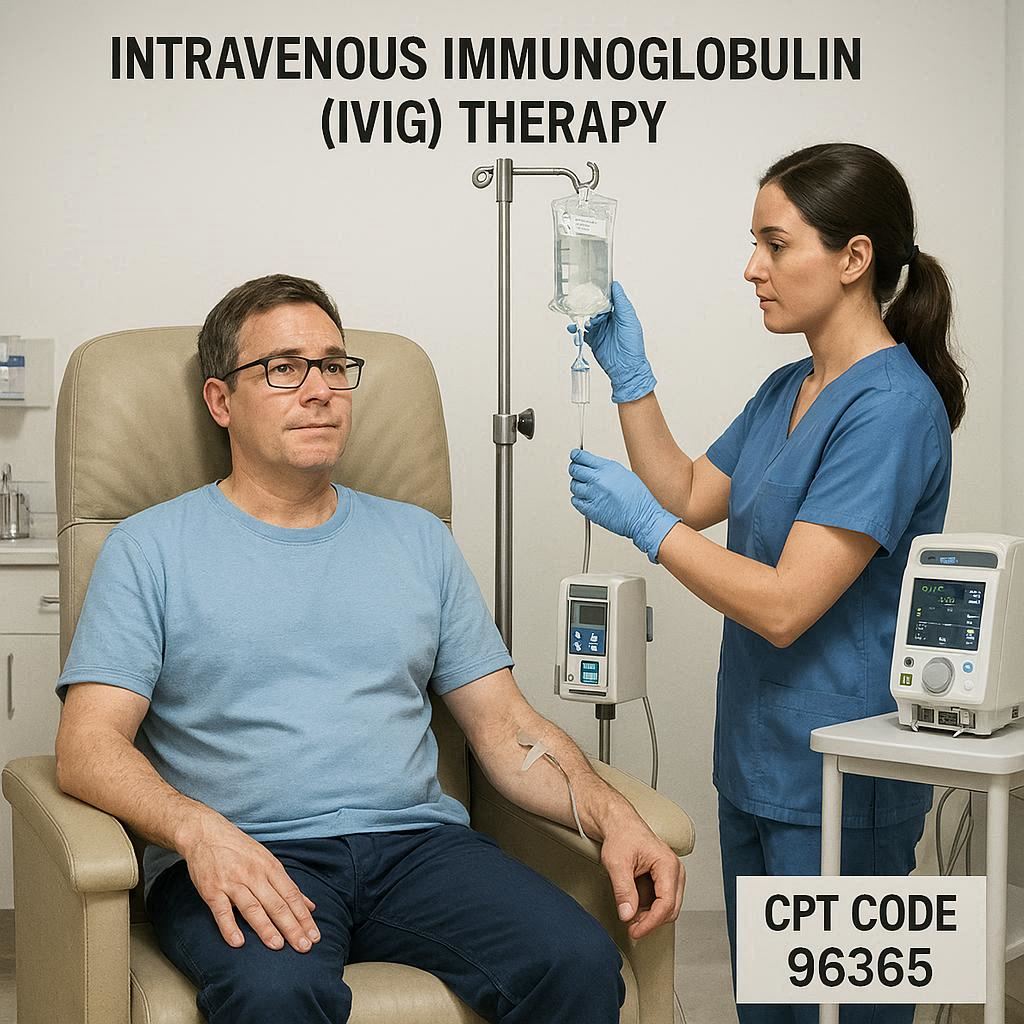
Code 96365 (The Starter Code)
96365: IV infusion, for therapy, prophylaxis, or diagnosis (specify substance or drug); initial, up to 1 hour.
- When to use: The first hour of the infusion.
- Note: You can only bill this once per encounter, regardless of how many bags you hang.
Code 96366 (The Add-On Code)
96366: each additional hour.
- When to use: For every hour after the first 60 minutes.
- Crucial Rule: You can only bill this if the total infusion time is more than 30 minutes past the first hour. (Most payers follow the “31-minute rule”).
Example of Time Calculation:
- Infusion starts at 9:00 AM. Ends at 2:00 PM. (Total 5 hours).
- Bill 96365 (First hour).
- Bill 96366 x 4 (Hours 2, 3, 4, and 5).
Code 96367 (Simultaneous Infusion)
96367: Sequential IV infusion of a different substance.
- When to use: This is rare for pure IVIG. You would use this if you infuse IVIG, then immediately run a different drug (like an antihistamine or diuretic) through the same line after the IVIG finishes.
The “Hydration” Trap: Do Not Use 96360
A very common mistake is using hydration codes (96360, 96361) for the saline flush before or after IVIG.
Do not do this.
Hydration codes are for hydration therapy (treating dehydration). The saline used to flush an IV line or dilute IVIG is part of the infusion service. It is not separate.
- Wrong: 96365 + 96361 (Hydration)
- Right: 96365 + 96366 (Infusion)
Step-by-Step: Building Your Claim
Let us build a real-world claim together. This helps to see the whole picture.
Patient Scenario:
Sarah has Common Variable Immunodeficiency (CVID). She comes to the infusion clinic.
- Drug: 40 grams of Gammaplex (J1559).
- Start time: 10:00 AM
- End time: 2:00 PM (4 hours total)
- Nurse monitoring: Yes, vitals every 30 minutes.
Your Claim Form (CMS-1500) should look like this:
| Line | Code | Modifier | Units | Description |
|---|---|---|---|---|
| 1 | J1559 | JW (if waste) | 40 | IVIG Drug (40 grams) |
| 2 | 96365 | – | 1 | Initial hour of infusion |
| 3 | 96366 | – | 3 | Additional hours (Hours 2,3,4) |
Total Reimbursement: Drug cost + ~200−400 for nursing time (depending on your location).
Modifiers: When to Add a “Flag”
Sometimes a simple code is not enough. You need a modifier to tell the insurance company why you did something.
Modifier JW (Drug Waste)
This is vital for IVIG because vials are expensive.
- What it is: The amount of drug you had to throw away because the vial was larger than the patient’s dose.
- Example: The patient needs 35 grams. You open a 40-gram vial. You waste 5 grams.
- How to bill:
- Line 1: J1559 – 35 units (Administered)
- Line 2: J1559 – JW – 5 units (Waste)
Note: If you use a multi-dose vial for multiple patients, you cannot bill waste.
Modifier JZ (No Waste)
Effective for 2024/2025, many payers require JZ if there is zero waste.
- What it is: You used the entire vial perfectly. Nothing left to throw away.
- Example: Patient needs 40 grams. You open a 40-gram vial. Use it all.
- How to bill: J1559 – JZ – 40 units.
Modifier 59 (Distinct Procedural Service)
Use this sparingly. You might need 96368 (IV infusion with concurrent hydration) in rare cases, but for standard IVIG? You likely do not need modifier 59. If you are infusing IVIG and a separate chemotherapy drug at the exact same time (very rare), you would use this.
Payer Differences (Commercial vs. Medicare)
Here is where things get tricky. Not all payers follow the same rules.
Medicare (Part B)
- Drug Reimbursement: Medicare pays 106% of the Average Sales Price (ASP). You cannot markup the drug excessively.
- Site of Service: They pay less for office infusions than hospital outpatient infusions.
- JW Modifier: Required for waste.
- Advance Beneficiary Notice (ABN): If you think Medicare might deny IVIG for a specific diagnosis, you must give the patient an ABN before infusion. Otherwise, you cannot bill the patient.
Commercial Payers (Blue Cross, Aetna, United)
- Reimbursement: Usually based on a fee schedule (e.g., $X per hour + drug cost + 10%).
- Time Rules: Some payers use “mid-point” rounding. Others use “whole hours.” Check your contract.
- Prior Authorization: 90% of commercial plans require prior auth for IVIG. If you skip this, they will deny 100% of the claim.
“I have seen clinics lose $50,000 in a single month simply because they billed 96366 for the 2nd hour but the payer wanted 96367. Always check the local coverage determination (LCD).” — Anonymous Infusion Billing Manager
The Top 5 Reasons IVIG Claims Get Denied
Let us fix your rejections before they happen.
1. Missing Prior Authorization
- Problem: You infused the drug and then asked for approval.
- Fix: Get written authorization before the nurse mixes the vial. IVIG is expensive. Payers will not pay without a number.
2. Incorrect Units (Billing by mL instead of grams)
- Problem: You billed 300 units for 300mL of a 10% solution (which is 30 grams).
- Fix: Convert mL to grams. Grams = mL x Concentration (0.1 for 10%).
3. Using an Unlisted Code (J1599) lazily
- Problem: You did not want to look up the brand.
- Fix: Create a cheat sheet for your top 5 brands. J1559, J1561, J1566, J1575, J1599.
4. Not including the diagnosis code
- Problem: You billed the drug but no diagnosis.
- Fix: IVIG requires a specific ICD-10 code. D80.1 (CVID) works. G61.81 (CIDP) works. Z51.11 (Encounter for antineoplastic chemo) is often wrong.
5. Infusion time miscalculation
- Problem: You billed 96365 + 96366 when the infusion was only 61 minutes total.
- Fix: If total time is 61 minutes, you get 96365 (first 60 min) + 0 additional hours. The extra 1 minute is “included” in the first code.
A Complete Billing Checklist for Clinics
Print this out. Tape it to your billing desk.
- Verify Benefits: Does the patient have IVIG coverage? Is it a medical benefit (Part B) or pharmacy benefit (Part D)? (Part D usually excludes infusion services).
- Get Prior Authorization: Document the authorization number on the patient’s chart.
- Check the NDC: The National Drug Code (NDC) on the vial must match the J-code you bill.
- Calculate Waste: Weigh the vial before and after if possible. Document the waste.
- Document Start/Stop Times: The nurse must write down the exact minute the fluid started and stopped.
- Apply Modifiers: Add JW or JZ.
- Submit Claim: Use 96365 for the first hour, 96366 for each additional hour.
Diagnosis Codes That Support Medical Necessity
You cannot just bill IVIG for “fatigue” or “weakness.” Payers have strict lists.
Commonly Covered Diagnoses:
- D80.0 – D80.9: Immunodeficiency disorders (CVID, Selective IgA deficiency).
- G61.81: Chronic Inflammatory Demyelinating Polyneuropathy (CIDP).
- G35: Multiple Sclerosis (specific relapsing forms only).
- M33.20 – M33.29: Dermatomyositis (adult).
- D69.3: Immune Thrombocytopenic Purpura (ITP).
- I63.9 (Specific stroke types for neonates) – Rare.
Diagnoses That Will Likely Be Denied:
- Chronic fatigue syndrome (without immune deficiency).
- Autism spectrum disorder (lack of evidence).
- General “weakness.”
Crucial Note: Always check the payer’s medical policy. If your diagnosis is not on their “approved” list, do not waste your time billing. You will lose.
The Future of IVIG Coding (2026 and Beyond)
We are seeing two major trends.
First: More payers are moving toward “site-neutral” payments. They want to pay the same price for IVIG whether you are in a hospital or a private clinic. This hurts independent clinics.
Second: Biosimilars and subcutaneous IG (SCIG) are growing. SCIG has different codes (e.g., J1558 for Cuvitru). If you see a patient switching from IV to SubQ, learn the J1558 and C9095 families.
Third: Artificial intelligence is starting to audit infusion times. If your documentation says “infused over 4 hours” but the pump log says “3.5 hours,” the AI will flag you. Be precise.
FAQ: Your Burning Questions Answered
Q: Can I bill for the nurse’s time to mix the IVIG?
A: No. Preparation time (mixing, pulling vials from the fridge) is bundled into the infusion code (96365). You cannot bill it separately.
Q: What if the patient has a reaction and we stop the infusion?
A: Bill for the actual time infused. If you stopped at 45 minutes, you only bill 96365. You do not bill a “partial” 96366. If you infused for 1 hour and 35 minutes, bill 96365 + 96366.
Q: Is there a different code for Subcutaneous IG (SCIG)?
A: Yes. For SubQ infusions (using a pump), you usually use 96369 (initial subcutaneous infusion) and 96370 (each additional hour). Do not use 96365 for SubQ.
Q: My patient is in the hospital. Does this change?
A: Yes. Hospitals use CPT codes slightly differently (sometimes with revenue codes). For a hospital outpatient department, you still use 96365/96366, but you must add a revenue code (usually 0260 for IV therapy).
Q: Do I need a modifier if I use a vial for two patients?
A: Yes. Do not bill waste. Split the units. Bill Patient A for the exact grams they received. Bill Patient B for the exact grams they received. No JW modifier is needed because there was no waste (you used the whole vial).
Additional Resources
For the most up-to-date fee schedules and local coverage determinations, always check the CMS (Centers for Medicare & Medicaid Services) official database.
Recommended Resource Link:
CMS HCPCS Quarterly Update (Official Government Site) – Bookmark this page. You can download the latest J-code list for free. Do not trust third-party blogs for code values; go straight to the source.
Conclusion
Navigating the CPT code for IVIG therapy does not have to be a headache. Remember the three pillars: bill the specific J-code for the brand (like J1559 or J1561) by the gram, use administration codes 96365 (first hour) and 96366 (each additional hour), and always document your infusion start and stop times meticulously. Avoid the hydration code trap, master the JW waste modifier, and never skip prior authorization. By following these honest, realistic guidelines, you will reduce denials, improve cash flow, and spend less time fighting with insurance companies.
Disclaimer: This article is for educational purposes only and does not constitute legal or medical billing advice. Coding rules, reimbursement rates, and payer policies change frequently. Always consult your local payer contract and a certified medical coder for specific patient scenarios. The author is not responsible for claim denials based on this general information.