If you have ever stared at a list of CPT codes for psychological or neuropsychological testing, you know how confusing things can get. One code looks almost like the next. The numbers blur together. And the official descriptions? They often feel like they were written for lawyers, not for busy professionals.
That is exactly why we created this guide.
Let’s talk about CPT code 96133. By the time you finish reading, you will understand exactly what this code covers, when to use it, how to bill it correctly, and—just as important—when to avoid it.
We will keep things simple, practical, and completely honest. No fluff. No copy-pasted jargon. Just useful information you can put to work today.
What Is CPT Code 96133? A Straightforward Definition
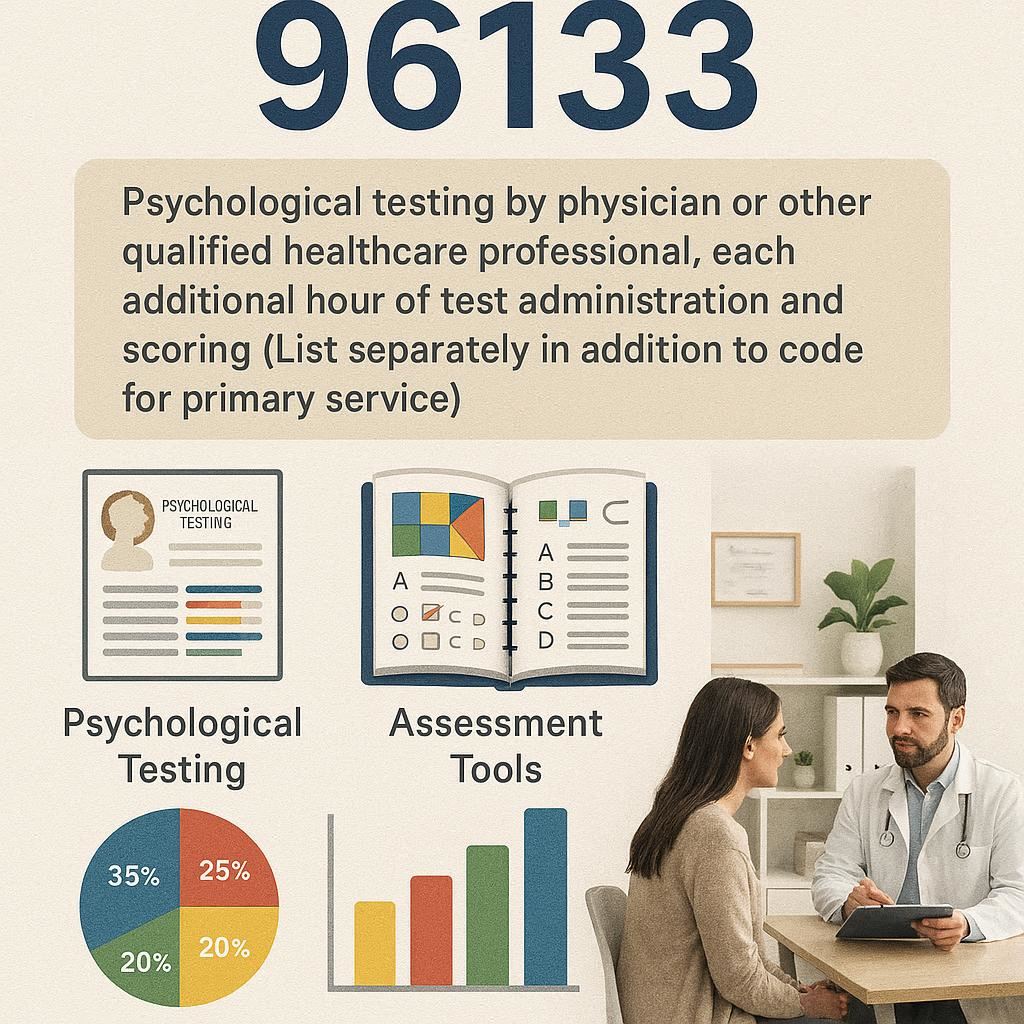
CPT code 96133 is used to report neuropsychological testing evaluation services performed by a qualified health professional. More specifically, this code applies to each additional hour of testing time after the first hour.
Here is the official short descriptor (as published by the American Medical Association):
“Psychological or neuropsychological test administration and scoring by a physician or other qualified health professional, each additional hour.”
But let us break that down into plain English.
When a patient needs complex testing of their memory, attention, problem-solving, language, or visual-spatial skills, a specialist (like a clinical neuropsychologist) often administers and scores those tests. The first hour of this work is billed using a different code (96132). Every additional hour after that gets billed with 96133.
Think of it this way:
- 96132 = the first hour of neuropsychological testing evaluation services
- 96133 = each additional hour (per hour)
You cannot bill 96133 by itself. It always follows 96132 on the same claim.
Who Performs These Services?
The code explicitly mentions “by a physician or other qualified health professional.” In real-world practice, that typically means:
- Clinical neuropsychologists (PhD or PsyD)
- Psychologists with specialized training in neuropsychology
- In some settings, psychiatrists or neurologists with advanced training in testing
The key word is “qualified.” The professional must have the education, training, and credentials required by their state and payer to perform neuropsychological testing independently.
How 96133 Fits Into the Bigger Picture of Testing Codes
Many people confuse neuropsychological testing codes with simpler psychological testing codes. They are not the same.
To understand 96133, you need to see where it lives in the CPT code family.
| CPT Code | Description | Typical Use |
|---|---|---|
| 96130 | Psychological testing evaluation (first hour) | Personality, emotional, or behavioral testing |
| 96131 | Psychological testing evaluation (each additional hour) | Continued emotional/behavioral testing |
| 96132 | Neuropsychological testing evaluation (first hour) | Cognitive, memory, executive function testing |
| 96133 | Neuropsychological testing evaluation (each additional hour) | Continued cognitive testing |
| 96136 | Psychological or neuropsychological test administration (first 30 minutes) | Technician or computer-based test administration |
| 96137 | Psychological or neuropsychological test administration (each additional 30 minutes) | Continued test administration |
As you can see, 96133 is specifically for the evaluation component of neuropsychological testing—not just administration. That is a critical distinction.
Important note: The evaluation component includes interpretation of test data, integration with clinical history, formulation of conclusions, and report writing. It is not simply handing a patient a pencil and a booklet.
Detailed Breakdown: What Does the 96133 Service Include?
Let us get specific. When a clinician bills 96133, what exactly are they doing during that “additional hour”?
According to CPT guidelines and payer policies, the service includes:
1. Continued Test Administration and Scoring
The clinician directly administers additional neuropsychological tests to the patient. This could include:
- Memory tests (e.g., list learning, story recall)
- Attention and working memory tasks
- Executive function measures (e.g., sorting, fluency, inhibition)
- Language and naming tests
- Visual-spatial and construction tasks
- Processing speed measures
Scoring of these tests is also included. The clinician calculates raw scores, converts them to standardized scores (if applicable), and checks for scoring errors.
2. Behavioral Observations
During the additional testing hour, the clinician notes the patient’s:
- Effort and motivation
- Fatigue level
- Frustration tolerance
- Problem-solving strategies
- Emotional reactions to difficult tasks
These observations are clinically meaningful and feed into the final interpretation.
3. Clinical Integration (Ongoing)
Even during test administration, the clinician is thinking. They compare the patient’s performance to normative data. They adjust the test battery based on emerging findings. This is not passive work.
4. Report Writing (Partially)
Some of the report writing may occur during the billed time if it is performed face-to-face or immediately after testing while the information is fresh. However, extensive report writing often falls under the evaluation code’s time rather than separate unbilled work. (More on this in the documentation section.)
What Is NOT Included in 96133?
- Simple test administration by a technician (use 96136/96137)
- Automated computer testing without clinician interaction
- Time spent on non-testing activities (scheduling, billing, cleaning equipment)
- Separate psychotherapy or counseling services
If a clinician provides psychotherapy during the same visit, that should be billed separately with an add-on modifier (such as 90785 or other applicable codes) depending on payer guidelines.
Time Rules: How to Count Hours for 96133
Time-based coding is one of the most common sources of errors. Let us make it simple.
The Basic Rule
- 96132 = first 60 minutes of neuropsychological testing evaluation services
- 96133 = each additional 60 minutes
You bill one unit of 96133 for every full 60 minutes beyond the first hour.
Partial Hours: What Happens?
If the total time is not an exact multiple of 60 minutes, you follow these guidelines:
| Total Evaluation Time | How to Bill |
|---|---|
| 61 to 90 minutes | 96132 (first hour) + 96133 (one additional hour) |
| 91 to 120 minutes | 96132 + 2 units of 96133 (but note: some payers expect one 96133 for the second hour; the third hour would be an additional 96133) |
| 121 to 150 minutes | 96132 + 2 units of 96133 (since 121–150 = two full additional hours after the first) |
| 151 to 180 minutes | 96132 + 3 units of 96133 |
Let us clarify with an example.
Example:
Dr. Chen performs neuropsychological testing evaluation with a patient. The total face-to-face time for test administration, scoring, and ongoing interpretation is 2 hours and 15 minutes (135 minutes).
- First 60 minutes → 96132
- Remaining 75 minutes → That covers one full additional hour (60 minutes) plus 15 minutes into the next hour. For the second additional hour, you bill one unit of 96133 (the first 60 minutes of the second additional hour). The extra 15 minutes do not yet justify a second 96133 unit.
So total billing: 96132 + 96133 (1 unit).
If the total time were 3 hours and 5 minutes (185 minutes):
- First 60 min → 96132
- Next 60 min → 96133 (first additional hour)
- Next 60 min → 96133 (second additional hour)
- Remaining 5 min → Not billable as a separate unit (since a full 60 minutes is required for each 96133)
Important: Medicare and many commercial payers require the full 60 minutes to bill each unit of 96133. Rounding up is not allowed. If you have 59 minutes, you cannot bill a unit.
Does the Time Have to Be Continuous?
Not necessarily. The total cumulative time spent on evaluation services during a single calendar day counts. However, if testing occurs over multiple days, you typically bill each day’s first hour as 96132 and additional hours on that same day as 96133. You cannot carry over time from one day to the next to “build” an hour.
Check with individual payers. Some expect daily sessions to be billed separately with their own 96132 each day. Others allow 96133 across days as long as the total time is met. When in doubt, follow the “each day has its own first hour” rule.
When to Use 96133 (Real Clinical Scenarios)
Let us move from theory to practice. Here are real-world examples of when you would correctly use CPT code 96133.
Scenario 1: Moderate Traumatic Brain Injury (TBI)
A 45-year-old patient suffered a moderate TBI in a car accident six months ago. They complain of memory lapses, difficulty multitasking at work, and slow thinking. A neuropsychologist schedules a comprehensive evaluation.
- First hour (96132): Clinical interview, review of medical records, selection of tests, and beginning of test administration (e.g., attention and processing speed measures).
- Second hour (96133): Continued administration of memory tests, executive function tasks, and language screening. The clinician also scores the first set of tests during natural breaks.
- Third hour (96133): Completion of testing, behavioral observations, preliminary interpretation, and dictation of initial report findings.
Billing: 96132 + 2 units of 96133
Scenario 2: Suspected Dementia in an Older Adult
An 78-year-old patient with gradual memory decline over two years. Family members report personality changes. The neurologist refers for neuropsychological testing to differentiate Alzheimer’s disease from frontotemporal dementia.
- First hour (96132): History taking, mental status exam, selection of dementia-sensitive tests (e.g., CERAD battery, clock drawing, verbal fluency).
- Second hour (96133): Administration of delayed recall tasks, visuoconstructional tests, and mood questionnaires.
- Third hour (96133): Scoring, comparison to normative data, formulation of diagnostic impressions, and report writing.
Billing: 96132 + 2 units of 96133
Scenario 3: Pediatric ADHD and Learning Disorder
A 10-year-old child with suspected ADHD and reading difficulty. The school requested testing to guide an IEP.
- First hour (96132): Parent interview, review of school records, child interview, selection of intellectual, attention, and achievement tests.
- Second hour (96133): IQ testing administration (e.g., WISC-V) and continuous performance test.
- Third hour (96133): Academic achievement testing and memory testing.
- Fourth hour (additional 96133): Final scoring, interpretation, and integration with teacher ratings.
Billing: 96132 + 3 units of 96133
In each scenario, the clinician is actively engaged in evaluation services. They are not passively watching the patient fill out forms.
When NOT to Use 96133 (Common Mistakes to Avoid)
Even experienced billers sometimes reach for the wrong code. Here is when you should avoid using 96133.
1. Technician-Administered Testing
If a psychometrist or technician administers the tests while the neuropsychologist scores and interprets later, you generally cannot bill 96133 for the technician’s time. Instead, you use 96136 and 96137.
- The neuropsychologist’s time for face-to-face evaluation (if any) might be 96132, but the technician’s time is separate.
- Do not combine them.
2. Unsupervised Computer Testing
The patient sits alone in a room and clicks through a computerized battery (e.g., CNS Vital Signs, Cogstate). No clinician is present. The computer scores automatically. This does not meet the definition of 96133 because there is no real-time evaluation or clinician interaction.
Use an appropriate E/M code or, in some cases, unlisted code, depending on the payer.
3. Brief Repeat Testing (Less Than 30 Minutes)
A patient returns for a brief follow-up test to monitor medication effects. Total time with the clinician is 20 minutes. This is not a full hour of evaluation. It also is not a full additional hour after a first hour.
Many payers expect you to use 96130/96131 for psychological testing or an E/M code for brief follow-ups, not 96133.
4. Scoring Already Completed Tests
You have already administered all tests. Now, after the patient leaves, you spend an hour just scoring answer sheets. That is not 96133. Scoring alone, without concurrent administration or face-to-face time, is generally considered part of the evaluation service’s “non-face-to-face” work. It is bundled.
5. Report Writing Without Testing
You saw the patient yesterday. Today, you write a six-page report. That time does not count toward 96133 because there is no direct patient contact and no test administration. Report writing is an inherent part of 96132/96133 during the evaluation day, but not as a standalone, next-day service.
Documentation Requirements for 96133
Good documentation protects you during audits and ensures you get paid. Payers want to see that the time billed matches the work done.
Essential Elements for Each Unit of 96133
Your medical record should include:
- Total time spent on evaluation services (face-to-face, plus any immediate scoring and interpretation during that time).
- Breakdown of time per hour (e.g., “8:00 AM – 9:00 AM: Test administration and scoring”).
- Specific tests administered during each hour.
- Clinical observations made during testing (e.g., “Patient became fatigued in hour two, required frequent encouragement”).
- Scoring results (raw scores or notes that scoring was completed).
- Signature and credentials of the qualified professional who performed the service.
Sample Documentation Note
*“9:00 AM – 10:00 AM (first additional hour – 96133): Continued neuropsychological testing. Administered California Verbal Learning Test (CVLT-3), Trail Making Test Parts A & B, and Controlled Oral Word Association (COWA). Scored CVLT-3 and Trail Making tests in real time. Patient showed impaired learning curve but good retention after delay. Mild difficulty with set-shifting on Trails B. No significant fatigue noted.”*
Do not write novels, but do not be vague either. If an auditor cannot tell what you did for that hour, you risk a denial or clawback.
Common Documentation Errors
- Listing only “continued testing” without test names.
- Forgetting to document the start and stop times.
- Claiming 96133 on a day with no face-to-face contact.
- Double-billing the same time with another service (e.g., 90837 for psychotherapy during the same hour).
Note: Some payers require the use of a modifier (like 59 or XU) when billing 96133 on the same day as other timed services. Always check your specific payer’s policy.
Reimbursement Rates for 96133 (What Can You Expect?)
Let us talk money. Reimbursement for 96133 varies widely based on:
- Payer (Medicare, Medicaid, commercial insurance)
- Geographic location (local Medicare rates)
- Place of service (office, outpatient hospital, tele-health)
- Clinician credentials
Medicare Facility vs. Non-Facility Rates
Medicare publishes the Physician Fee Schedule annually. As of the most recent data (and remember that rates change yearly), here are approximate ranges. Always verify current rates.
| Setting | Approximate 96133 Reimbursement |
|---|---|
| Non-facility (private office) | 60–90 per unit |
| Facility (hospital outpatient) | 30–50 per unit |
Why the big difference? In a facility setting, Medicare pays the hospital a separate facility fee. The professional component (your work) is lower.
Commercial Payer Rates
Commercial rates vary enormously. A typical contracted rate might fall between 70and120 per unit of 96133. Out-of-network rates could be higher but come with patient balance billing restrictions depending on state laws.
Factors That Influence Payment
- Geographic Practice Cost Index (GPCI): High-cost areas (e.g., NYC, San Francisco) pay more.
- Modifiers: If you bill 96133 with modifier 95 (telehealth), some payers reimburse the same as in-person; others reduce payment.
- Multiple units: Payers expect a discount on the second and third units of 96133 (multiple procedure payment reduction). Medicare typically reduces the practice expense portion of the second and subsequent units.
Important note: Never bill 96133 without supporting documentation. If an audit finds insufficient records, you may have to repay the entire amount plus penalties.
Modifiers and 96133: A Quick Reference
Modifiers tell payers something special about the service. Here are the most relevant modifiers for 96133.
| Modifier | When to Use | Example |
|---|---|---|
| 95 | Telehealth (synchronous audio-video) | You perform neuropsychological testing via a secure video platform |
| 59 | Distinct procedural service | You provide 96133 and another timed service that is truly separate (use only if no more specific modifier applies) |
| XU | Unusual non-overlapping service | Similar to 59, but more specific for services that do not overlap |
| 52 | Reduced services | You started the additional hour but had to stop early due to patient distress (rare for 96133) |
| 76 | Repeat procedure by same physician | You repeat a full additional hour of testing on a later date for the same condition (uncommon) |
Telehealth and 96133
Many payers temporarily expanded telehealth for neuropsychological testing during public health emergencies. Check current policies. When allowed, you typically:
- Use modifier 95
- Document that the patient has the necessary technology (camera, stable internet)
- Confirm that testing is valid via telehealth (some tests are not validated for remote administration)
96133 vs. Other Common Codes: A Side-by-Side Comparison
This table helps you quickly decide which code to use.
| Service Provided | Correct Code | Why Not 96133? |
|---|---|---|
| First hour of neuropsychological testing | 96132 | 96133 is only for additional hours |
| One hour of psychological (not neuropsychological) testing evaluation | 96131 (add-on to 96130) | Wrong domain (personality/emotional vs. cognitive) |
| Technician administers tests for 60 minutes | 96136 (first 30 min) + 96137 (second 30 min) | No qualified professional direct service |
| 90 minutes of neuropsychological testing total | 96132 + 96133 | Correct, because second hour falls into 96133 |
| Scoring tests after patient left (no face-to-face) | No separate code (bundled) | Not a billable timed service |
| 15 minutes of brief cognitive testing (e.g., MoCA) | E/M code (e.g., 99213 with prolonged service, if applicable) | Not a full hour; not comprehensive evaluation |
| Full neuropsychological battery over 4 hours (same day) | 96132 + 3 units of 96133 | Correct if all hours are qualified professional time |
Real Talk: Challenges and Pitfalls with 96133
Let us be honest. Billing 96133 is not always straightforward. Here are common frustrations and how to handle them.
Challenge 1: Auditors Questioning Your Time
Some payers argue that a qualified professional cannot spend multiple hours face-to-face with one patient doing testing. They might downcode 96133 to 96137 (lower reimbursement) or deny it as “not medically necessary.”
Solution: Document aggressively. Show why a technician could not perform the testing (e.g., complex patient behavior, need for real-time clinical judgment, adapting tests on the fly). Explain the medical necessity of the qualified professional’s presence.
Challenge 2: Payer-Specific Rules
UnitedHealthcare, Aetna, Cigna, and Blue Cross plans all have their own neuropsychological testing policies. Some limit the number of 96133 units per date of service (e.g., maximum 2 units). Others require prior authorization beyond a certain number of hours.
Solution: Always check the specific policy before scheduling long batteries. Build a relationships with payer reps if possible.
Challenge 3: Time Documentation Disputes
You document 3 hours (96132 + 2 units of 96133). The payer’s algorithm sees only 2 hours and pays for 96132 + 1 unit.
Solution: Appeal with your time logs. Show start and stop times. If you use an electronic health record (EHR) with time stamps, even better.
Challenge 4: Mixing Testing and Therapy
You spend 20 minutes of the hour on psychotherapy (e.g., helping the patient cope with frustration) and 40 minutes on testing. Can you bill 96133 for the full hour? Generally, no. The predominant service should guide coding. If therapy is significant, consider billing a therapy add-on code (90785 for interactive complexity) or separate E/M.
State and Payer Variations: What You Need to Know
No national guide can cover every payer’s quirks. But here are common variations to watch for.
Medicare
- Follows the 60-minute rule strictly.
- Does not allow “rounding up.”
- Requires that the qualified professional personally performs the service (incident-to rules do not apply for 96133 because it requires direct supervision by the billing professional—in practice, the neuropsychologist must be present).
Medicaid
Varies by state. Some states:
- Reimburse 96133 at rates similar to Medicare.
- Require prior authorization for more than 2 units per day.
- Exclude telehealth for neuropsychological testing.
Commercial Payers
- Some bundle 96133 into a flat fee per battery (e.g., $400 for up to 4 hours). Do not bill per unit.
- Others require use of specific modifiers for multiple units.
- Many require that the testing be “medically necessary” with clear diagnostic questions.
Action step: Create a cheat sheet for your top five payers. Update it every January.
Billing 96133 with Other Services on the Same Day
Can you bill 96133 and an office visit (E/M code) on the same day? Yes, but with conditions.
Same Day E/M + 96133
If the patient comes for a separate, medically necessary office visit (e.g., medication management or psychotherapy) and neuropsychological testing on the same day, you can bill both if:
- The services are distinct (different time blocks, different foci).
- You use modifier 25 on the E/M code.
- You do not double-count time. If you spent 20 minutes of the E/M discussing medications and 60 minutes on testing, the 60 minutes cannot be split between both codes.
Example:
- 9:00–9:20 AM: Medication management and brief check-in (E/M 99213 with modifier 25)
- 9:20–10:20 AM: Neuropsychological testing (first hour → 96132)
- 10:20–11:20 AM: Continued testing (96133)
Document clearly which time belongs to which service.
Same Day Psychotherapy + 96133
If you provide psychotherapy during the same encounter, consider add-on code 90785 (interactive complexity) if the patient has communication or behavioral difficulties. Do not bill 90833 (psychotherapy add-on) with 96133 unless time is completely separate and distinct. Payers often bundle them.
Documentation Examples: Right vs. Wrong
Let us look at two examples. One will get you paid. The other will get you audited.
Poor Documentation (Red Flag)
“Continued testing. Patient did well. One hour.”
Why this fails: No test names. No start/stop times. No observations. No scoring mention. No link to medical necessity.
Good Documentation (Green Light)
*“10:15 AM – 11:15 AM (96133 – unit 1 of 2). Administered: DKEFS Trail Making Test (Condition 4), Wechsler Memory Scale-IV (Logical Memory I & II), and Boston Naming Test (short form). Scored all administered tests during session: Trail Making T-score = 32 (mild impairment), Logical Memory I raw = 28 (low average), Logical Memory II raw = 12 (significant drop). Patient became tearful during delayed recall but redirected to task. Effort good. No signs of malingering.”*
Why this succeeds: Specifics. Times. Test names. Scores. Observations. Professional judgment.
Frequently Asked Questions (FAQ)
1. Can a technician bill 96133?
No. Only a qualified physician or other qualified health professional can bill 96133. Technicians use 96136/96137.
2. How many units of 96133 can I bill per day?
There is no absolute national limit, but most payers expect 1–4 units per day depending on patient need. Beyond 4 hours (96132 + 3 units of 96133), you should justify medical necessity carefully.
3. Does 96133 include report writing?
It includes report writing that occurs during or immediately after the face-to-face testing while the clinician is still engaged in evaluation. Extensive separate report writing on another day is not billed separately.
4. Can I bill 96133 for telehealth?
Yes, if the payer allows telehealth for neuropsychological testing and you follow their requirements (e.g., modifier 95, real-time video).
5. What is the difference between 96133 and 96137?
96133 is for qualified professional evaluation time (interpretation, integration). 96137 is for test administration only (often by a technician or computer).
6. Do I need a prior authorization for 96133?
Many payers require prior authorization for neuropsychological testing beyond a certain number of hours (e.g., >2 hours total). Always check.
7. Can I bill 96133 if the patient left early?
Only if you completed a full 60 minutes of evaluation services. If the patient left after 45 minutes into the additional hour, you cannot bill 96133 for that partial hour.
8. Is 96133 used for children?
Yes, frequently for pediatric neuropsychological evaluations (e.g., ADHD, autism, learning disorders, traumatic brain injury).
9. What happens if I accidentally bill 96133 without 96132?
The claim will likely deny because 96133 is an add-on code. It must be billed with 96132 on the same date of service.
10. Does Medicare cover 96133?
Yes, Medicare covers medically necessary neuropsychological testing. However, coverage may be limited to specific diagnostic categories (e.g., dementia, TBI, stroke). Check your local MAC policy.
Additional Resources
For deeper guidance, refer to these trusted sources:
- American Academy of Clinical Neuropsychology (AACN) – Billing and Coding Resources
Link: https://www.theaacn.org/practice-resources/billing-and-coding/
Why it helps: Offers specialty-specific advice, sample documentation templates, and updates on payer issues.
Conclusion
CPT code 96133 is a vital tool for billing the additional hours of neuropsychological testing evaluation services. It applies only after the first hour (96132) and requires a qualified health professional’s direct, face-to-face time. Proper use demands accurate time tracking, detailed documentation, and awareness of payer-specific rules. When used correctly, 96133 fairly compensates clinicians for the complex, skilled work of understanding how a patient’s brain functions.
Disclaimer: This article is for educational purposes only and does not constitute legal, billing, or medical advice. CPT codes, payer policies, and reimbursement rates change frequently. Always verify current guidelines with your local payer, the AMA, and your compliance officer before submitting claims.