If you manage patients with one serious, high-risk chronic condition, you have likely heard about Principal Care Management (PCM). But let us be honest. The billing rules, time tracking, and code selection can feel overwhelming.
You are not alone. Many healthcare providers confuse PCM with Chronic Care Management (CCM). Others worry about using the wrong code and facing an audit.
This guide walks you through everything you need to know. We will cover each PCM CPT code in plain English. You will learn who qualifies, how to track time correctly, and how to avoid common mistakes.
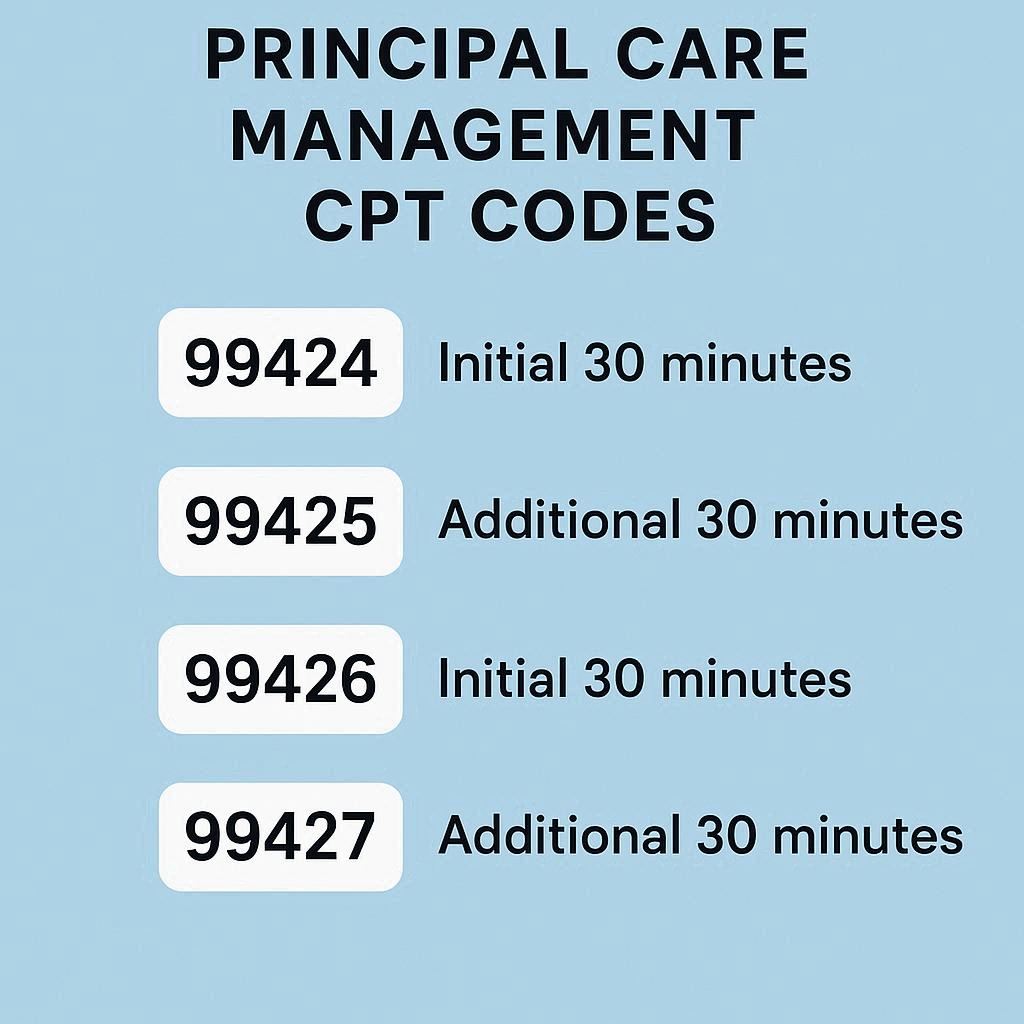
What Is Principal Care Management (PCM)?
Principal Care Management is a Medicare care management service. It focuses on patients who have one single, high-risk chronic condition.
Think of a patient with severe congestive heart failure. Or a patient with metastatic cancer. Or someone with advanced Parkinson’s disease.
These patients do not have multiple chronic conditions. They have one main, dominant condition that drives all their healthcare needs. That is the “principal” condition.
PCM helps coordinate care for that condition. The goal is to prevent hospitalizations, reduce symptoms, and improve quality of life.
How Is PCM Different from CCM?
This is where many people get stuck. Chronic Care Management (CCM) is for patients with two or more chronic conditions. PCM is for patients with one serious chronic condition.
| Feature | CCM | PCM |
|---|---|---|
| Number of conditions | Two or more chronic conditions | One single high-risk chronic condition |
| Time requirement (monthly) | At least 20 minutes | At least 30 minutes for first 30 days, then 30 minutes monthly |
| Who can bill | Physicians, NPs, PAs, clinical staff under general supervision | Same as CCM |
| Patient consent | Required | Required |
| Typical patients | Diabetes + hypertension + arthritis | Stage IV cancer, severe heart failure, ALS |
Important note: A patient cannot receive both PCM and CCM in the same calendar month. You must choose the service that best fits the patient’s clinical needs.
Who Qualifies for Principal Care Management?
Before you look at codes, you need to check if your patient qualifies. Medicare defines a “principal care management” patient very strictly.
The patient must meet all three of these criteria:
1. One Single High-Risk Chronic Condition
The patient has exactly one chronic condition that is expected to last at least 12 months. This condition must place the patient at significant risk of:
- Death
- Acute exacerbation
- Decompensation
- Functional decline
Examples include:
- Stage 3 or 4 chronic kidney disease (not on dialysis)
- Single ventricle cardiac dysfunction
- Metastatic solid tumor cancer
- Amyotrophic lateral sclerosis (ALS)
- Progressive Parkinson’s disease with mobility issues
2. No Other Significant Chronic Conditions
The patient cannot have a second chronic condition that requires separate, ongoing care management. Minor or stable conditions are fine. For example, a patient with controlled hypertension who does not need active management is still eligible.
But if the patient has COPD and requires regular monitoring for that condition, they likely need CCM instead.
3. The Condition Drives 80% or More of Healthcare Utilization
This is the “principal” part. The single condition must be the main reason for most office visits, tests, medications, and specialist referrals.
Principal Care Management CPT Codes: Complete List
Here are the current PCM CPT codes you will use. These codes are covered by Medicare and many commercial payers.
| CPT/HCPCS Code | Description | Time Requirement | Typical Use |
|---|---|---|---|
| G0511 | General care management for patients with one chronic condition (often used by FQHCs and RHCs) | 30 minutes minimum | Federally Qualified Health Centers and Rural Health Clinics |
| G2059 | PCM – first 30 days of service | 30 minutes (initial month) | Setup, care plan creation, initial coordination |
| G2060 | PCM – subsequent 30-day period | 30 minutes monthly | Ongoing care management |
| G2061 | PCM – each additional 30 minutes beyond first 30 minutes (first month) | Additional 30 minutes | Complex patients needing extra time in month 1 |
| G2062 | PCM – each additional 30 minutes beyond first 30 minutes (subsequent months) | Additional 30 minutes | Complex patients needing extra time after month 1 |
| G2063 | PCM – 60 minutes or more in a calendar month (first month) | 60+ minutes | Very high-need patients at initiation |
| G2064 | PCM – 60 minutes or more in a calendar month (subsequent months) | 60+ minutes | Ongoing high-complexity management |
Let us break these down by real-world use.
G2059: The Initial Month Code
You use G2059 for the very first month you provide PCM to a patient. This code requires at least 30 minutes of clinical staff time directed by a physician or other qualified healthcare professional.
What counts toward the 30 minutes?
- Creating and updating the care plan
- Coordinating with other providers (specialists, home health, labs)
- Medication management review
- Speaking with the patient or caregiver by phone
- Reviewing test results and following up
- Arranging referrals
- Documenting the care in the electronic health record
What does not count?
- Time spent face-to-face in an office visit (bill that separately)
- Travel time
- Administrative work like scheduling appointments
G2060: Subsequent Months
After the first month, you switch to G2060. The time requirement stays the same: at least 30 minutes per calendar month.
The work changes slightly. In subsequent months, you focus on:
- Monthly care plan updates
- Ongoing coordination
- Checking in with the patient or caregiver
- Monitoring for changes in the principal condition
G2061, G2062, G2063, G2064: Additional Time
Some patients need more than 30 minutes in a month. That is when you add these codes.
Think of them as “add-on” codes. You bill them in addition to the base code (G2059 or G2060).
For example:
- A patient in the first month needs 80 minutes of PCM work. You bill G2059 (30 minutes) plus G2061 (30 minutes) plus G2061 again (last 20 minutes does not count because you need full 30-minute increments).
- A patient in month three needs 70 minutes. You bill G2060 (30 minutes) plus G2062 (30 minutes). The extra 10 minutes is not billable.
Pro tip: You can only bill additional time in 30-minute increments. If you have 45 minutes of work, you bill one base code and one add-on (60 minutes total). You lose the leftover 15 minutes.
Billing Rules You Cannot Ignore
Medicare has strict rules for PCM billing. Break these rules, and you risk denied claims or audits.
Rule 1: Obtain Patient Consent Every Year
You must get verbal or written consent from the patient (or their caregiver) before starting PCM. Document the consent in the medical record.
The consent must include:
- The patient’s agreement to receive PCM
- Permission to share information with other providers
- A clear explanation that the patient can stop PCM at any time
Renew consent annually.
Rule 2: Do Not Double Bill
You cannot bill PCM on the same day as:
- Transitional Care Management (TCM) (CPT 99495, 99496)
- Chronic Care Management (CCM) (CPT 99490, 99491, etc.)
- Complex Chronic Care Management (CCCM) (CPT 99487, 99489)
- Certain remote patient monitoring codes for the same condition
You can bill PCM on the same day as a standard office visit (E/M code like 99214). Just make sure the work is distinct. Do not count the same time for both services.
Rule 3: Track Time Meticulously
Your documentation must show the total time spent on PCM each month. Break it down by date and activity.
Example documentation:
*“03/10/2026: 15 minutes – Called patient’s cardiologist to coordinate diuretic adjustment. 03/12/2026: 10 minutes – Reviewed home blood pressure logs and called patient. 03/15/2026: 10 minutes – Updated care plan and ordered lab tests. Total PCM time for March = 35 minutes. Billing G2060.”*
Rule 4: Use Qualified Staff
PCM can be provided by:
- Physicians
- Nurse practitioners (NPs)
- Physician assistants (PAs)
- Clinical staff (RNs, LPNs, medical assistants) under general supervision
General supervision means the physician is available but not necessarily present.
Step-by-Step Guide to Billing PCM
Let us walk through a real example.
Patient: Margaret, 72 years old, has single-ventricle cardiac dysfunction (one principal condition). She has well-controlled hypertension but requires no active management for it. She lives alone.
Month 1:
- March 1: Obtain verbal consent. Document it. (5 minutes)
- March 3: Create a comprehensive care plan. Coordinate with home health aide. (20 minutes)
- March 10: Call patient to check symptoms. Adjust one medication. (10 minutes)
- March 15: Send care plan to cardiologist. (5 minutes)
Total time: 40 minutes. Bill G2059 (first 30 minutes) + G2061 (additional 30 minutes). You have 10 minutes of un-billed time.
Month 2:
- April 5: Update care plan. (10 minutes)
- April 12: Review weekly vitals sent by patient’s daughter. Call with feedback. (15 minutes)
- April 20: Coordinate refill of cardiac medication with pharmacy. (5 minutes)
Total time: 30 minutes. Bill G2060.
Month 3:
- May 2: Patient calls with shortness of breath. Spend 25 minutes assessing, coordinating with cardiologist, and adjusting plan.
- May 15: Routine follow-up call. (10 minutes)
Total time: 35 minutes. Bill G2060 only (first 30 minutes). The extra 5 minutes is not billable.
How PCM Codes Compare to Other Care Management Services
Many practices offer multiple care management programs. Here is how PCM fits alongside others.
| Service | Number of Conditions | Time (Monthly) | Code Examples |
|---|---|---|---|
| Principal Care Management (PCM) | 1 high-risk chronic condition | 30+ minutes | G2059, G2060, G2061-2064 |
| Chronic Care Management (CCM) | 2+ chronic conditions | 20+ minutes | 99490, 99491, 99437 |
| Complex CCM (CCCM) | 2+ chronic conditions with complex needs | 60+ minutes | 99487, 99489 |
| Transitional Care Management (TCM) | Post-discharge (30 days) | Interactive contact within 2 days | 99495, 99496 |
| Remote Patient Monitoring (RPM) | Any (device-based) | 20+ minutes device setup and data review | 99453, 99454, 99457 |
Important note: Some commercial payers use different codes. Always verify with each insurance plan. Medicare Advantage plans may follow Medicare rules but not always.
Documentation Requirements for PCM
Your documentation is your best friend during an audit. Do not take shortcuts.
What to Document Each Month
- Consent form (signed or verbal consent noted)
- Care plan (updated monthly)
- Time log (total time, date, activity, who performed the work)
- Clinical summary (changes in condition, medications, coordination done)
- Patient or caregiver communication (date, method, outcome)
Sample Documentation Template
*“Principal Care Management – Patient consent on file (verbal consent 01/15/2026). Principal condition: Stage IV pancreatic cancer. No other chronic conditions requiring active management.*
February 2026 PCM time:
- *02/03: 10 min – Reviewed pain log, called patient, adjusted pain meds.*
- *02/10: 10 min – Coordinated with oncology for new nausea symptoms.*
- *02/17: 10 min – Updated care plan, sent to home health nurse.*
- *02/24: 5 min – Called patient to check weight and appetite.*
Total time: 35 minutes. Billing G2060.
*Care plan updated 02/17/2026. No changes to principal diagnosis. No face-to-face visit on same day as PCM time.*”
Common Mistakes to Avoid
Even experienced billers make mistakes with PCM. Here are the most common ones.
Mistake 1: Billing PCM for the Wrong Patient
If a patient has two active chronic conditions requiring management, they need CCM, not PCM. For example, a patient with heart failure and COPD that requires regular monitoring is a CCM patient.
Fix: Review the patient’s active problem list before starting PCM.
Mistake 2: Counting Face-to-Face Visit Time
You cannot count time spent in a regular office visit toward PCM. That time belongs to the E/M code. The only exception is if you spend additional time after the visit on PCM activities (like updating the care plan based on the visit).
Fix: Keep separate time logs for PCM and for face-to-face visits.
Mistake 3: Forgetting to Update the Care Plan
The care plan is not a one-time document. You must update it each month you bill PCM. The update can be small, but it must happen.
Fix: Set a monthly calendar reminder to review and update each PCM patient’s care plan.
Mistake 4: Billing PCM and CCM in the Same Month
Medicare does not allow this. If you bill PCM, you cannot bill any CCM codes for that same patient in that same calendar month.
Fix: Choose one service per patient per month. If the patient’s needs change, switch services the following month.
Reimbursement Rates for PCM Codes (2026 Estimates)
Reimbursement varies by location and payer. These are approximate Medicare rates. Always check your local Medicare Administrative Contractor (MAC) for exact rates.
| Code | Approximate Medicare Reimbursement |
|---|---|
| G2059 (initial 30 min) | 65–80 |
| G2060 (subsequent 30 min) | 60–75 |
| G2061 (add-on, first month) | 50–65 |
| G2062 (add-on, subsequent) | 45–60 |
| G2063 (60+ min, first month) | 120–150 |
| G2064 (60+ min, subsequent) | 110–140 |
Note: These rates change annually. Use them as rough estimates only.
PCM for FQHCs and RHCs: Code G0511
If you work in a Federally Qualified Health Center (FQHC) or Rural Health Clinic (RHC), you use a different code. Code G0511 is your general care management code for patients with one chronic condition.
The rules are similar:
- Minimum 30 minutes per month
- Patient must have one high-risk chronic condition
- Consent required
- Cannot bill G0511 with CCM codes in the same month
The main difference is payment. FQHCs and RHCs receive a bundled payment. Consult your specific MAC for FQHC/RHC rates.
How to Start a PCM Program in Your Practice
Adding PCM to your services does not have to be hard. Follow these steps.
Step 1: Identify Eligible Patients
Run a report of your active patients. Look for those with:
- One dominant chronic condition
- Frequent hospitalizations or ED visits
- Complex medication regimens
- High specialist utilization
Step 2: Train Your Staff
Everyone involved needs to understand:
- What PCM is (and what it is not)
- How to track time accurately
- How to document correctly
- How to obtain consent
Step 3: Create Templates
Build EHR templates for:
- PCM consent form
- Monthly care plan
- Time log
- Monthly progress note
Step 4: Pilot the Program
Start with 10-15 patients. Run PCM for them for three months. Track your time, document everything, and bill correctly. Then audit your own work.
Step 5: Scale Up
Once your pilot works smoothly, add more patients. Consider assigning one nurse or care coordinator to manage your PCM panel.
Real-World FAQ: Your PCM Questions Answered
Q: Can I bill PCM for a patient with dementia?
A: Only if dementia is the single principal condition and no other chronic condition requires active separate management. If the patient also has diabetes requiring active management, use CCM instead.
Q: What if the patient travels or is in the hospital for part of the month?
A: You can still bill PCM if you provide at least 30 minutes of non-face-to-face care management during days the patient is not hospitalized. Time spent while the patient is in the hospital does not count toward PCM.
Q: Do I need a separate care plan for PCM?
A: No. You can integrate the PCM care plan into the patient’s overall medical record. But it must be distinct and updated monthly.
Q: Can the patient’s family member give consent?
A: Yes, if the family member is the legal guardian or has medical power of attorney. For a patient without capacity, document that you attempted to obtain consent from the patient and instead obtained it from the authorized representative.
Q: Can I bill PCM for a patient who died during the month?
A: No. Do not bill PCM for the month of death unless you provided a full month of service before the date of death. Most practices choose not to bill for partial months.
Q: Do commercial insurance plans cover PCM?
A: Some do. Check each plan. Many follow Medicare’s lead. Others have their own codes. UnitedHealthcare and Aetna may cover PCM under specific plans. Always verify benefits.
The Future of Principal Care Management Codes
Care management codes have expanded rapidly since 2015. PCM is relatively new compared to CCM. Expect continued growth.
What might change in the next few years?
- More payers adopting PCM, including Medicare Advantage plans
- Higher reimbursement for complex care management as value-based care grows
- Integration with remote patient monitoring (RPM) and other digital health tools
- Potential code consolidation as CMS simplifies care management billing
Stay updated through your MAC and specialty societies.
Additional Resource
For the most current official information on PCM codes, billing guidelines, and Medicare updates, visit the CMS Care Management Services webpage:
https://www.cms.gov/outreach-and-education/medicare-learning-network-mln/mlnproducts/downloads/chroniccaremanagement.pdf
Note: CMS updates this document periodically. Always check for the most recent version.
Conclusion
Principal Care Management CPT codes help you get paid for managing patients with one serious chronic condition. Use G2059 for the first month and G2060 for subsequent months. Add G2061 or G2062 for extra time in 30-minute blocks. Document time carefully, obtain consent every year, and never bill PCM with CCM in the same month. Start small, train your team, and build a sustainable PCM program that improves patient outcomes and practice revenue.
Frequently Asked Questions (FAQ)
1. What is the minimum time for Principal Care Management?
30 minutes per calendar month. The first month uses G2059. Subsequent months use G2060.
2. Can I bill PCM and CCM for the same patient in the same month?
No. Medicare does not allow it. Choose one service per month based on the patient’s condition count.
3. Does PCM require face-to-face contact?
No. PCM is a non-face-to-face service. You can provide all PCM work by phone, secure message, or through coordination with other providers.
4. Can a medical assistant provide PCM under supervision?
Yes. Clinical staff (including MAs, LPNs, RNs) can provide PCM under general supervision of a physician or qualified practitioner.
5. What if my patient has one principal condition but also stable, managed hypertension?
They may still qualify for PCM if the hypertension requires no active, separate care management. Use clinical judgment. When in doubt, choose CCM.
6. Do I need a new care plan each month for PCM?
You need to update the existing care plan each month. The update can be small, such as noting a medication change or a new goal.
7. What happens if I accidentally bill PCM for an ineligible patient?
You may have to refund the payment and face an audit risk. Train staff to verify eligibility before the first PCM month.
8. Is there a PCM code for 60 minutes in the first month?
Yes. Use G2063 for 60 minutes or more in the first month. This replaces G2059 plus add-ons in some billing systems.
Disclaimer: This article is for educational purposes only. Coding, billing, and reimbursement rules change frequently. Always consult your local Medicare Administrative Contractor (MAC), payer policies, and a qualified coding specialist before billing any service.