If you have ever looked down at your arms or legs during a dry winter month and noticed fine cracks, rough patches, or a dull, ashy appearance, you have likely experienced xerosis cutis. In simple terms, this is the medical name for abnormally dry skin.
But when a doctor documents this condition on a medical record or an insurance claim, they do not write “very dry skin.” They use a specific alphanumeric code. That code is L85.3.
This guide walks you through everything you need to know about the ICD 10 code for xerosis cutis. We will cover what the code means, when to use it, what other codes to avoid, and how to document this condition correctly. Whether you are a medical coder, a billing specialist, a nursing student, or a curious patient, this article gives you a reliable, practical reference.
What Is Xerosis Cutis? A Quick Overview
Before we dive into codes, let us briefly talk about the condition itself. Xerosis cutis refers to dehydrated skin that lacks adequate oil and moisture. It is not a life-threatening issue, but it can cause significant discomfort.
Common signs of xerosis cutis include:
- Rough, scaly texture
- Fine white flakes
- Tightness, especially after bathing
- Redness or mild irritation (in more advanced cases)
- Itching that worsens at night
Who gets it?
Anyone can develop xerosis cutis, but it is more common in:
- Older adults (due to natural oil gland reduction)
- People living in cold, dry climates
- Individuals who take frequent hot showers or baths
- Patients with certain underlying conditions (like hypothyroidism or diabetes)
Important note for coders: Xerosis cutis is different from ichthyosis (a genetic disorder) and from eczema with active inflammation. Do not mix these up in your documentation.
The Correct ICD 10 Code for Xerosis Cutis
Let us go straight to the point.
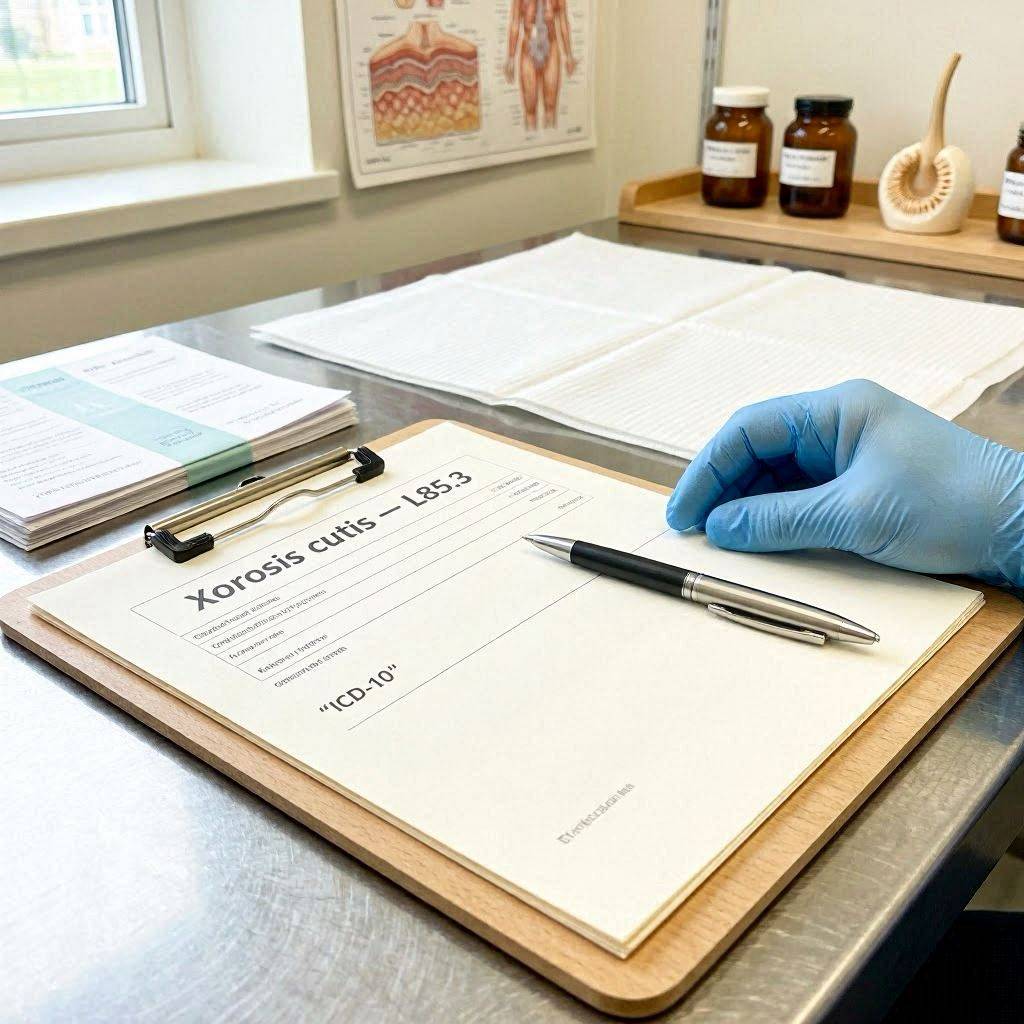
The ICD 10 code for xerosis cutis is L85.3.
Code classification:
- Category: L00–L99 (Diseases of the skin and subcutaneous tissue)
- Subcategory: L85 (Other epidermal thickening)
- Specific code: L85.3 (Xerosis cutis)
What this code includes:
- Dry skin as a primary diagnosis
- Asteatosis (lack of sebum) without another cause
- Winter itch (when documented as xerosis cutis)
What this code does not include:
- Dehydration of the skin due to fluid loss (that is a different category)
- Dermatitis (use L20–L30 codes instead)
- Ichthyosis vulgaris (Q80.0)
Here is a simple reference table to help you distinguish L85.3 from similar conditions.
| Condition | ICD 10 Code | Key Difference from Xerosis Cutis |
|---|---|---|
| Xerosis cutis | L85.3 | Dry, rough skin without inflammation |
| Atopic dermatitis | L20.89 | Itchy, red, swollen, often weeping |
| Ichthyosis vulgaris | Q80.0 | Genetic, fish-like scales from birth |
| Simple dehydration (skin) | E86.0 | Related to body fluid deficit, not oil |
| Contact dermatitis | L25.9 | Reaction to an external allergen |
As you can see, L85.3 is very specific. Use it only when the skin is dry and scaly but not actively inflamed, infected, or part of a genetic syndrome.
When to Use L85.3: Clinical Scenarios
Let us look at realistic examples. This will help you decide if xerosis cutis is the correct choice for your patient or medical record.
Scenario 1: The elderly patient in winter
An 82-year-old woman comes in with complaints of itchy, tight skin on both lower legs. Examination shows fine scaling and superficial cracks. No redness, no blisters. She uses moisturizer occasionally but forgets.
Correct code: L85.3 (xerosis cutis)
Scenario 2: Post-accutane use
A 24-year-old man finished isotretinoin (Accutane) three months ago. His face and arms remain unusually dry and flaky, even with lotion. No active acne lesions.
Correct code: L85.3
Scenario 3: Dry skin with mild erythema
A 55-year-old woman has dry patches on her shins that are slightly pink and itchy. The doctor notes “xerotic dermatitis with minimal inflammation.”
Correct code: You may need two codes. L85.3 for the dry skin, plus L24.9 (unspecified irritant contact dermatitis) or L30.9 (dermatitis unspecified), depending on documentation. Some coders prefer L30.9 for xerotic eczema. Always follow your doctor’s specific diagnosis.
Scenario 4: Diabetic patient with dry feet
A 67-year-old with type 2 diabetes has severely dry heels with cracks but no infection. The skin is not red or swollen.
Correct code: L85.3 (primary) + E11.9 (type 2 diabetes without complications, as a secondary code if relevant for management).
Clinical note: Xerosis cutis is often a secondary diagnosis. It rarely stands alone as a reason for hospitalization, but it matters for outpatient care and quality of life.
Billing and Documentation Best Practices
Medical coding is not only about picking the right number. You also need to support that code with clear documentation. Payers (insurance companies) deny claims when the documentation does not match the code.
What your clinical note should include for L85.3:
- Location of the dry skin (e.g., “bilateral lower extremities”)
- Absence of signs of infection (no pus, no heat)
- Absence of active inflammation (no deep redness or weeping)
- Any contributing factors (winter season, frequent bathing, medications)
- Treatment plan (emollients, humidifier, soap changes)
Common denial reasons:
- The physician wrote “dry skin” but the coder used L85.3. That is actually acceptable, but some payers prefer “xerosis.” When in doubt, add “xerosis cutis” to the note.
- The code was used for a patient with obvious eczema. That is incorrect and will trigger audits.
- Missing laterality. While L85.3 does not require laterality (it is a general code), your note should mention if it is localized or generalized.
Example of a well-documented note:
“Patient presents with bilateral shin dryness, fine scaling, and itching for three weeks. No erythema, no vesicles, no weeping. Skin is not infected. Likely xerosis cutis aggravated by indoor heating and hot showers. Plan: recommend ceramide-based moisturizer twice daily and cool showers.”
That note easily supports L85.3.
Differential Diagnosis: Do Not Confuse These
Even experienced coders occasionally hesitate. Below is a more detailed comparison table. Use it as a quick reference when the diagnosis is not entirely clear.
| Diagnosis | Typical Appearance | Common Location | ICD 10 Code |
|---|---|---|---|
| Xerosis cutis | Dry, rough, fine scales, no inflammation | Shins, forearms, hands | L85.3 |
| Asteatotic eczema (eczema craquelé) | Cracked, dry skin with “dried riverbed” look, mild redness | Lower legs, elderly patients | L30.8 or L30.9 |
| Seborrheic dermatitis | Greasy, yellow scales, redness | Scalp, eyebrows, nasolabial folds | L21.9 |
| Psoriasis vulgaris | Thick, silvery scales, well-defined plaques | Elbows, knees, scalp | L40.0 |
| Contact dermatitis | Itchy, red, blisters or dry patches depending on irritant | Hands, face, areas exposed to allergen | L23.9 (allergic) or L24.9 (irritant) |
If the patient has deep cracks that bleed or ooze, do not default to L85.3. That suggests eczema or another inflammatory process.
Frequently Asked Questions (FAQ)
1. Is L85.3 the same for xerosis cutis of the hands and feet?
Yes. ICD 10 code L85.3 does not specify body location. You do not need a different code for hands versus feet. However, your clinical note should mention the site.
2. Can I use L85.3 for a baby with dry skin?
Yes, if the baby truly has xerosis cutis (dry, non-inflamed skin). However, many infants have transient dry skin that resolves on its own. Also, rule out ichthyosis (Q80 codes) before using L85.3 in newborns.
3. What is the difference between L85.3 and L85.0?
Great question. L85.0 is “acquired ichthyosis.” That condition appears later in life but looks like fish-like scales. It is much more severe than common dry skin. Xerosis cutis (L85.3) is milder and does not have true scale plates.
4. Does Medicare cover treatment for xerosis cutis under L85.3?
Medicare typically does not cover over-the-counter moisturizers. However, if the xerosis leads to complications (fissures, infection, cellulitis), then treatment of those complications is covered. L85.3 alone usually does not qualify for prescription drug coverage unless the patient fails standard OTC therapy.
5. Can xerosis cutis be a sign of an internal disease?
Yes, rarely. Severe, generalized xerosis can be associated with hypothyroidism, lymphoma, or chronic kidney disease. If a patient presents with unexplained whole-body xerosis, consider screening for underlying conditions. In that case, you would code L85.3 plus the underlying disease code.
6. How do I code xerosis cutis with an infection?
If the dry skin becomes infected (e.g., cellulitis due to scratching), L85.3 is still relevant as a secondary code. The primary code would be the infection (L03.115 for lower leg cellulitis, for example). Do not delete L85.3; it explains why the skin barrier failed.
Practical Tips for Medical Coders
Let us get practical. You have a chart in front of you. Here is a step-by-step checklist before you assign L85.3.
✔️ Does the documentation say “xerosis,” “asteatosis,” “dry skin,” or “winter itch”?
✔️ Is there any mention of “eczema,” “dermatitis,” “atopic,” or “weeping”? If yes, do not use L85.3.
✔️ Is the condition generalized or localized? Both are fine for L85.3.
✔️ Has the doctor ruled out contact irritants? Not strictly required, but helpful.
✔️ Is this an elderly patient on diuretics? That still qualifies for L85.3. Diuretics do not change the code.
Common coding errors to avoid:
- Coding xerosis cutis as E86.0 (dehydration). E86.0 is for low body fluid, not skin surface dryness.
- Using L98.8 (other specified disorders of skin) for xerosis. L98.8 is a catch-all, but L85.3 is more accurate.
- Coding two dry skin codes. Only one code is needed for xerosis cutis.
Treatment Overview (For Context)
As a coder or patient, you do not need to prescribe treatment. But understanding treatment helps you see why L85.3 matters. Proper documentation supports medical necessity.
Standard treatments for xerosis cutis include:
- Emollients and humectants (creams with urea, lactic acid, or ceramides)
- Avoiding hot water and harsh soaps
- Using a humidifier in dry environments
- Short, lukewarm baths (5-10 minutes)
If a doctor prescribes a topical steroid for xerosis, that suggests there is inflammation. In that case, the correct code may shift from L85.3 to L30.9 (xerotic eczema). Do not assume L85.3 if the therapy includes steroids unless the note clearly says “no inflammation.”
Quote from a dermatology coding guideline: “Xerosis cutis (L85.3) is a dry skin condition without inflammation. If a patient requires corticosteroids, the condition is no longer pure xerosis.”
Additional Resource for Coders and Clinicians
For the most up-to-date official ICD-10-CM guidelines, always refer to the Centers for Medicare & Medicaid Services (CMS) ICD-10 website. You can find the complete 2025 coding manual and quarterly updates there.
📘 Recommended external link:
CMS 2025 ICD-10-CM Official Guidelines for Coding and Reporting (Open this link to access free, authoritative code updates and chapter-specific rules for skin diseases.)
Bookmark that page. It saves you from using outdated codes.
Summary Table: Quick Reference Guide
| Element | Details |
|---|---|
| Condition | Xerosis cutis (abnormally dry skin) |
| ICD 10 Code | L85.3 |
| Chapter | Diseases of the skin and subcutaneous tissue (L00–L99) |
| Includes | Asteatosis, winter itch (as dry skin), senile xerosis |
| Excludes1 | Ichthyosis (Q80.-) |
| Excludes2 | Dermatitis (L20–L30), eczema (L20–L30) |
| Documentation needs | Location, absence of inflammation, triggers |
| Typical patient | Elderly, winter season, post-accutane, diabetic |
| Billing tips | Use as secondary code often; avoid with infection as primary |
Conclusion
In three lines:
Xerosis cutis is simple dry skin without inflammation, and its correct ICD 10 code is L85.3. Use this code when documentation shows scaling, roughness, and tightness but no redness, weeping, or infection. Always support the code with a clear clinical description to avoid denials and ensure accurate patient records.
*Disclaimer: This article is for informational and educational purposes only. It does not constitute legal, medical, or billing advice. Coding guidelines change periodically. Always consult the latest official ICD-10-CM manual and your organization’s compliance team before submitting claims.*