Dry skin is more than just a winter annoyance. For millions of people, it is a persistent medical condition known as xerosis. You might have seen this term on a doctor’s note or an insurance claim and wondered what it really means.
If you work in medical billing, nursing, or simply want to understand your own health records, learning about the ICD-10 code for xerosis is essential. This code helps healthcare providers communicate clearly, ensures proper treatment, and makes sure insurance claims go through without issues.
In this guide, we will walk you through everything you need to know. We will keep the language simple, avoid confusing medical jargon, and give you practical advice you can use today.
What Is Xerosis? A Simple Explanation
Xerosis is the medical term for abnormally dry skin. Unlike the mild dryness you might feel after washing your hands too often, xerosis involves a rough, scaly, and sometimes itchy skin surface. In severe cases, the skin can crack and bleed.
Your skin has a natural protective barrier made of oils and water. When this barrier breaks down, moisture escapes, and the skin loses its flexibility. This condition becomes more common as we age, but it can affect anyone.
Common signs of xerosis include:
- A feeling of tightness, especially after bathing.
- Visible white or gray scales.
- Redness or irritation.
- Fine cracks on the hands, lower legs, or abdomen.
Xerosis itself is not contagious, but it can lead to complications like infections if the cracks allow bacteria to enter.
Why Does Xerosis Need a Medical Code?
You might wonder why something as common as dry skin needs a special code. The answer lies in how modern healthcare works.
Medical codes are the language of insurance, hospitals, and clinics. When a doctor diagnoses you with xerosis, they must translate that diagnosis into a standardized alphanumeric code. This code tells the insurance company exactly what condition was treated.
Without the correct code, claims can be denied. Patients may receive unexpected bills. Researchers cannot track how many people suffer from xerosis. In short, the code is not just bureaucracy. It is a tool for better care and fair payment.
The Primary ICD-10 Code for Xerosis: L85.3
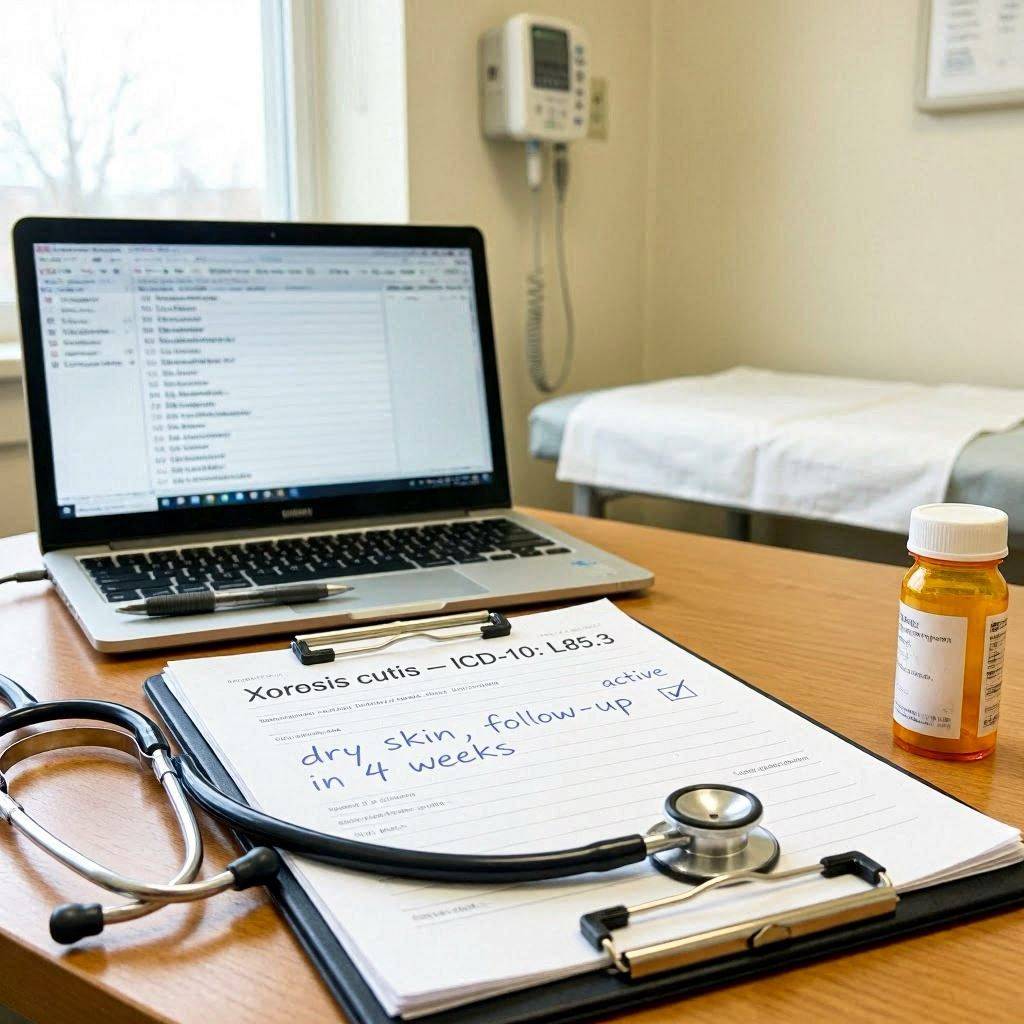
Let us answer the main question directly. The specific ICD-10 code for xerosis is L85.3.
This code falls under the category “Other epidermal thickening.” More precisely, the official descriptor is “Xerosis cutis.” You will find this code in the chapter covering diseases of the skin and subcutaneous tissue (L00-L99).
Breaking Down the Code L85.3
| Code Component | Meaning |
|---|---|
| L | Diseases of the skin and subcutaneous tissue |
| 85 | Other epidermal thickening |
| .3 | Xerosis cutis |
When a doctor enters L85.3 into a medical record or billing system, they confirm that the patient has abnormal dryness of the skin that requires medical attention. This code works for both initial visits and follow-up appointments.
When to Use L85.3
You should use L85.3 when:
- The patient presents with generalized dry skin without an underlying disease causing it.
- The dryness is severe enough to cause symptoms like itching, flaking, or cracking.
- The treatment focuses on moisturizing, lifestyle changes, or topical medications.
Here is a practical example. A 65-year-old woman comes to the clinic with scaly legs and arms. She has no rash, no infection, and no other skin condition. The doctor prescribes a thick emollient cream. The correct code for this visit is L85.3.
Other ICD-10 Codes Related to Dry Skin
Not every case of dry skin uses L85.3. Sometimes, the dryness is a symptom of another condition. Medical coders must look at the root cause.
Here is a comparison table to help you choose the right code.
| Condition | ICD-10 Code | When to Use |
|---|---|---|
| Xerosis cutis (simple dry skin) | L85.3 | The dryness is the main diagnosis |
| Atopic dermatitis with dry skin | L20.89 | Patient has eczema or allergies |
| Ichthyosis vulgaris | Q80.0 | Inherited condition causing fish-like scales |
| Dry skin due to diabetes | E11.620 | Diabetes is the primary diagnosis |
| Drug-induced dry skin | L24.89 | A medication (like retinoids) causes the dryness |
| Senile xerosis | L85.3 | Dry skin in elderly patients (same code) |
Important note for coders: Always check the documentation. If the physician writes “xerosis due to chronic kidney disease,” you may need to code the kidney disease first. Dry skin is a common complication of many systemic illnesses.
Documentation Requirements for Xerosis
Insurance companies and auditors love clear documentation. If you are a provider or a coder, you must ensure the medical record answers three questions.
1. Is the diagnosis confirmed?
The record must state “xerosis,” “xerosis cutis,” or “dry skin requiring medical treatment.” Vague terms like “skin dryness” without context may cause problems.
2. Is it a primary or secondary diagnosis?
If xerosis is the main reason for the visit, L85.3 goes in the primary position. If the patient comes for diabetes management and mentions dry skin as an aside, the code moves to a secondary spot.
3. Are there any complications?
Cracked, bleeding, or infected skin changes the coding. For infected xerosis, you may need to add a code for cellulitis (L03) or a skin infection code.
How Physicians Diagnose Xerosis
You do not need a biopsy or blood test for xerosis in most cases. Doctors rely on a physical exam and a conversation about your symptoms.
During the visit, the doctor will look for:
- Dry, rough patches on the shins, hands, or trunk.
- Fine scales that look like cracked riverbeds.
- Redness from scratching.
- Absence of blisters or oozing (which would suggest another condition).
They will also ask about your bathing habits, the weather, your age, and any medications you take. This information helps rule out more serious disorders.
A friendly reminder: Do not self-diagnose serious conditions. If your dry skin does not improve with over-the-counter lotions after two weeks, see a healthcare professional.
Common Treatments for Xerosis (And How They Relate to Coding)
Treatment for xerosis is usually simple. However, the type of treatment can affect medical coding and billing.
Over-the-Counter (OTC) Products
Most mild xerosis responds to OTC moisturizers containing:
- Urea.
- Lactic acid.
- Ceramides.
- Petrolatum.
If a patient only uses OTC products and does not see a doctor, no medical code is used. The visit to the doctor creates the need for a code.
Prescription Treatments
When OTC products fail, doctors may prescribe:
- High-concentration urea cream (20% to 40%).
- Topical corticosteroids for itching (e.g., hydrocortisone 2.5%).
- Antibiotics if cracks become infected.
The prescription of these medications justifies medical coding. For example, a prescription for a strong steroid cream confirms that the xerosis is clinically significant.
Lifestyle Advice
Doctors often recommend:
- Shorter, cooler showers.
- Humidifiers in dry climates.
- Gentle, fragrance-free soaps.
This advice is part of the medical visit. Coders can still use L85.3 even if the only “treatment” is education.
Xerosis in Different Age Groups
Xerosis does not look the same in a toddler, an adult, and a grandparent. Let us explore how age affects coding.
Xerosis in Infants and Children
Babies have delicate skin. Cold weather or frequent bathing can trigger xerosis. In children, the condition often appears on the cheeks, arms, and legs.
The code remains L85.3 unless the child has an underlying disorder like atopic dermatitis. Many children outgrow mild xerosis.
Xerosis in Adults
Adults between 20 and 60 years old typically develop xerosis on the lower legs and hands. Occupations that require frequent handwashing (healthcare, food service) are common causes.
Again, use L85.3 unless another condition is present.
Xerosis in the Elderly (Senile Xerosis)
As we age, our skin produces fewer natural oils. Senile xerosis affects over 75% of people older than 70. The lower legs, forearms, and trunk are most affected.
The code is still L85.3. There is no separate code for senile xerosis. However, you may see the term “senile xerosis” in the documentation. This is fine. The code remains the same.
Billing and Reimbursement Considerations
You have the correct code, but will the insurance company pay? Let us talk about real-world billing.
Medicare and Xerosis
Medicare covers medically necessary treatment for xerosis. If the dry skin causes cracking, bleeding, or infection, treatment is covered. Routine dryness that only needs OTC lotion may not be covered.
Medicare Advantage plans vary, so always check individual policies.
Private Insurance
Most private insurers cover visits for xerosis diagnosis and treatment. However, some may deny claims if the documentation does not show medical necessity. For example, “patient requests lotion for dry skin” may not be enough. “Patient has painful cracking and bleeding due to xerosis” is much stronger.
Denial Prevention Checklist
To avoid claim denials, ensure your medical record includes:
- A clear diagnosis of xerosis cutis.
- Physical findings (roughness, scaling, fissures).
- Symptoms (itching, pain, bleeding).
- A treatment plan (prescription, follow-up, or referral).
Differences Between Xerosis and Other Skin Conditions
New coders often confuse xerosis with other skin disorders. This table will help you tell them apart.
| Condition | Key Features | Correct Code |
|---|---|---|
| Xerosis | Dry, rough, scaly, no inflammation | L85.3 |
| Eczema (atopic dermatitis) | Itchy, red, inflamed, sometimes oozing | L20.89 |
| Psoriasis | Thick, silvery scales on red plaques | L40.5 |
| Ichthyosis | Large, dark, fish-like scales (genetic) | Q80.- |
| Contact dermatitis | Rash after touching an irritant | L24.9 |
A helpful tip: If the skin looks red and angry, it is probably not simple xerosis. Look for inflammation to choose a different code.
Step-by-Step Coding Example
Let us walk through two real patient scenarios.
Scenario 1: Simple Xerosis
A 45-year-old man visits his family doctor in January. He says, “My legs are so dry they look like alligator skin. They itch at night.” On exam, the doctor sees fine white scales on both shins. No redness. No cracks.
The doctor recommends a humidifier and a thick moisturizer.
Coding: L85.3 (xerosis cutis) as primary diagnosis.
Scenario 2: Xerosis with Infection
A 72-year-old woman with a history of diabetes comes to the clinic. She has dry, scaly skin on both lower legs. One area is red, warm, and oozing yellow fluid. The doctor diagnoses xerosis with secondary cellulitis.
Coding:
- Primary: L03.116 (cellulitis of left lower leg)
- Secondary: L85.3 (xerosis cutis)
- Additional: E11.9 (type 2 diabetes without complications)
Notice how the infection becomes the primary code because it poses a more immediate health risk.
Frequently Asked Questions (FAQ)
1. Is L85.3 the same for all types of dry skin?
No. L85.3 covers simple, non-inflammatory dry skin. If inflammation, infection, or an underlying disease is present, you need additional or different codes.
2. Can I use L85.3 for dry skin caused by cancer treatment?
Yes, but you must code the cancer and the treatment effect. For radiation-induced dry skin, use L58.9 (radiation dermatitis, unspecified) plus the cancer code. For chemotherapy-induced dryness, use the adverse effect codes.
3. Does insurance always cover a visit coded with L85.3?
Not always. Insurance expects medical necessity. If the notes only say “dry skin” with no symptoms or treatment, the claim may be denied.
4. Is xerosis the same as dehydration?
No. Dehydration affects your whole body and requires fluids. Xerosis only affects the skin. You can be well-hydrated and still have xerosis.
5. How often can I bill for xerosis?
There is no set limit. However, if a patient comes every week for the same stable xerosis without new problems, insurers may question the frequency. Most follow-ups are scheduled every 3 to 6 months.
6. What is the difference between L85.3 and L85.9?
L85.9 is “Epidermal thickening, unspecified.” Use L85.9 only if the doctor cannot tell if it is xerosis or another thickening disorder. L85.3 is more specific and preferred.
Additional Resources for Coders and Patients
You do not have to memorize every code. Use these reliable resources to stay accurate.
- AAPC (American Academy of Professional Coders) – Offers code lookup tools and training.
- CMS (Centers for Medicare & Medicaid Services) – Publishes official ICD-10 guidelines for free.
- AAD (American Academy of Dermatology) – Provides patient-friendly information on xerosis.
For patients, the National Eczema Association has excellent guides on dry skin management, even though xerosis is different from eczema.
Practical Tips for Preventing Xerosis
Prevention is always better than treatment. Here are simple, proven ways to keep your skin healthy.
Adjust Your Bathing Habits
- Take one 5 to 10-minute shower per day.
- Use warm, not hot, water.
- Apply cleanser only to armpits, groin, and feet. Let water run over the rest.
Moisturize Correctly
- Apply cream within 3 minutes of toweling off.
- Choose ointments or creams over lotions. Lotions contain alcohol that can dry skin further.
- Look for ingredients like ceramides, shea butter, or petrolatum.
Change Your Environment
- Run a humidifier in your bedroom during winter.
- Avoid direct heat from fireplaces or space heaters.
- Wear soft, breathable fabrics like cotton. Avoid wool directly on the skin.
These steps not only prevent xerosis but also reduce the need for medical visits. That is good for your health and your wallet.
What Patients Should Know About Their Medical Records
You have the right to understand your own medical records. If you see the code L85.3 on an explanation of benefits (EOB) or a bill, do not panic. It simply means your provider diagnosed dry skin.
If you disagree with the code, you can:
- Ask your doctor for clarification.
- Request a medical record amendment if the diagnosis is wrong.
- Contact your insurance company to discuss coverage.
Mistakes happen. A 2022 study found that up to 20% of medical codes contain some error, though most are minor. Double-check your records, especially before a surgery or major procedure.
The Future of ICD-10 Coding for Xerosis
The ICD-10 system is not permanent. ICD-11 launched in 2022, though most countries still use ICD-10. The new system includes more specific codes for skin conditions.
In ICD-11, xerosis falls under “Primary dry skin” with code ED51. However, the United States has not yet fully transitioned. For now, L85.3 remains the standard.
Keep an eye on announcements from the CDC and CMS. When the switch happens, you will need new training. But do not worry—the basic principles will remain the same. You will still document the diagnosis, look for causes, and choose the most specific code.
A Note on Medical Ethics and Honest Coding
This guide would not be complete without a word on integrity. Never change a diagnosis to get a higher reimbursement. Never code xerosis if the patient only has normal winter dryness without symptoms.
Upcoding (billing for a more severe condition than present) is fraud. It can lead to fines, exclusion from insurance programs, and even criminal charges. Always code what you see and document what you do.
If you are a patient, be honest about your symptoms. Do not exaggerate to get a prescription cream. Do not minimize your symptoms to avoid a “disease label.” Accurate information helps everyone.
Conclusion
Xerosis, or abnormally dry skin, uses the ICD-10 code L85.3 when it is a primary diagnosis without underlying disease. Proper documentation of symptoms like cracking, itching, and bleeding ensures accurate coding and insurance reimbursement. Always distinguish simple xerosis from eczema, psoriasis, or infection-related dryness to choose the correct code.
Disclaimer: This article provides general educational information and does not constitute medical or legal advice. Medical coding guidelines vary by payer and region. Always consult official ICD-10 manuals and a certified medical coder for specific cases.