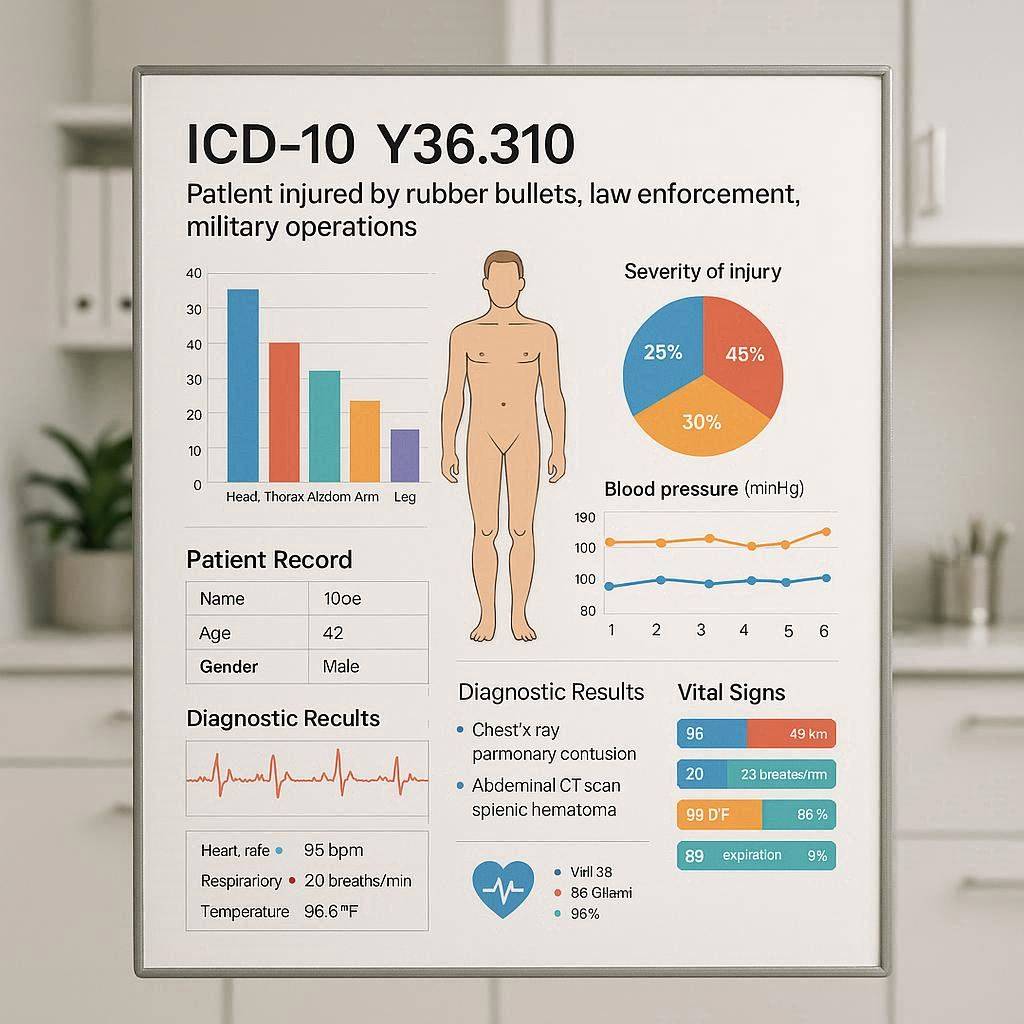
If you have ever scrolled through the external causes of morbidity section in the ICD-10 manual, you know it can feel like a maze. Codes like Y36.310 often raise more questions than answers. What does it actually represent? When is it appropriate to use it? And perhaps most importantly, how do you keep your documentation accurate without crossing into guesswork?
Let’s clear up the confusion together.
This guide focuses entirely on ICD-10 code Y36.310. We will walk through its official definition, its clinical context, common scenarios where it applies, and what you absolutely should avoid. Whether you work in a veteran’s hospital, a trauma center, or a private billing office, this article aims to give you honest, practical knowledge you can trust.
Important Note: This article is for educational and professional reference purposes only. Always verify codes with the latest ICD-10-CM official guidelines for the current year. Medical coding rules evolve, and payer policies vary.
ICD-10-CM code Y36.310 is categorized under the section External causes of morbidity (V00-Y99). More specifically, it falls within Legal intervention, operations of war, military operations, and terrorism (Y35-Y38).
The full label for Y36.310 is:
“War operations involving fire, conflagration and hot substances, military personnel, initial encounter”
In plain language, this code is used when a member of the military is injured for the first time due to fire, large-scale burning (configration), or exposure to hot substances during war operations. The “initial encounter” part is critical. It tells the insurance company and public health databases that this is the first time the patient is receiving active treatment for this specific injury event.
Breaking Down the Code Structure
To really understand Y36.310, you have to look at each segment. Here is a simple breakdown:
Code Segment
Meaning
Y36
War operations involving military personnel
.310
Specifics: fire, conflagration, hot substances, initial encounter
7th character
Required: A = initial encounter, D = subsequent, S = sequela
The code always needs a seventh character. Without it, your claim will likely reject. For Y36.310, the valid seventh characters are:
A – Initial encounter (active treatment)
D – Subsequent encounter (routine healing or aftercare)
So in practice, you may see Y36.310A, Y36.310D, or Y36.310S.
When to Use Y36.310: Realistic Clinical Scenarios
Abstract definitions only help so much. Let’s put this code into real-world situations. Remember: we are talking about war operations. That means active armed conflict, not training accidents or domestic incidents.
Scenario 1: Direct Combat Burn Injury
A soldier is on patrol in an active combat zone. An explosive device ignites a fuel storage area. The soldier suffers second-degree burns on the arms and face from the resulting fireball. This is the first time they receive medical care at a field hospital.
Correct code: Y36.310A (initial encounter for war op involving fire)
Scenario 2: Exposure to a Hot Substance (Not Fire)
Imagine a military vehicle is hit by an incendiary round. A service member is not directly burned by flames but is injured by molten metal or superheated steam from damaged equipment. This still qualifies as “hot substances.”
Correct code: Y36.310A
Scenario 3: Follow-Up Visit for the Same Burn
The same soldier is seen three weeks later at a military clinic for wound debridement and skin graft check. The burn is healing, but active treatment continues.
Correct code: Y36.310D (subsequent encounter)
Scenario 4: Scarring Years After the Event
Five years after discharge, the same veteran seeks care for severe burn scars that restrict mobility in the hands. The burn occurred during the same war operation.
Correct code: Y36.310S (sequela)
A Note on “Initial Encounter”
The word “initial” does not only mean the very first hour of care. According to ICD-10 guidelines, the initial encounter includes the entire period of active treatment for the condition. That can include surgery, intensive care, and initial rehabilitation. Once the patient enters routine recovery or healing phase, you switch to subsequent.
What Y36.310 Does NOT Include (Critical Exclusions)
Honest coding means knowing what a code is not for. Misusing Y36.310 can lead to audits, denials, or even allegations of fraud. Let’s be very clear.
Do Not Use Y36.310 For:
Training accidents – If a soldier is burned during a live-fire exercise on a domestic base during peacetime, that is not war operations. Look at codes in Y37 (Military operations, not during war).
Terrorism – If the event is classified as terrorism by official authorities, you would use Y38 codes.
Civilian injuries – This code is for military personnel only. A civilian contractor or a family member does not qualify.
Legal intervention – Injuries from police or military acting as law enforcement (e.g., riot control) go under Y35, not Y36.
Fire from a cigarette or cooking accident – Even if the person is in the military, a routine fire in a barracks kitchen is a home-type accident. Use X00-X09 series.
Quick Comparison Table
Type of Incident
Correct ICD-10 Code Range
Burn during active war operation, military personnel
Y36.310
Burn during military training exercise (no war)
Y37.3-
Burn from terrorist attack
Y38.0-
Burn from legal intervention (e.g., tear gas fire)
Y35.1-
Burn from accidental house fire on base (peacetime)
X00-X09
Pro tip: Always check the activity and place of occurrence codes (Y92, Y93) to support your external cause code. They add context and reduce confusion.
Documentation Requirements for Y36.310
Proper medical coding starts with proper documentation. As a coder, you cannot guess. If the provider’s note is unclear, you must query them. Here is what a compliant medical record should contain before you assign Y36.310:
Essential Elements:
Military personnel status – The note must clearly state the patient is active duty, reserve on active orders, or National Guard in federal service.
War operations context – The injury occurred during armed conflict, not peacetime activity.
Mechanism – Fire, conflagration (large uncontrolled fire), or hot substance (molten material, steam, heated liquids, or gases).
Encounter type – Initial, subsequent, or sequela. This should match the patient’s treatment phase.
Specific injury code – Y36.310 is an external cause code. You must also code the actual injury (e.g., T20.32XA for burn of face).
*”Patient is an active-duty Army specialist. On 03/15/2025, while engaged in combat operations in a declared war zone, an improvised explosive device ignited a nearby fuel cache. The patient sustained full-thickness burns to both hands from the fire. This is the initial evaluation at our burn unit.”*
From that note, you can confidently assign:
T23.30XA (Burn of hand, unspecified degree)
Y36.310A
Example of Poor Documentation:
“Burn injury, military patient.”
You cannot code from this. You do not know if it was war, training, or an accident. Always query.
Common Coding Mistakes and How to Avoid Them
Even experienced coders sometimes stumble on Y36.310. Let’s look at frequent errors and how to sidestep them.
Mistake #1: Missing the Seventh Character
This is the most common error. Y36.310 without A, D, or S is incomplete. Most encoder software will flag this, but if you are coding manually, double-check.
Fix: Always append A, D, or S based on the encounter type.
Mistake #2: Confusing “Initial” with “First Visit Only”
Some coders switch to subsequent too quickly. If the patient is still in active treatment (e.g., inpatient burn ward, multiple surgeries), it remains initial.
If a soldier is burned by a fire pit at a base picnic during peacetime, that is not war operations. Believe it or not, this error happens.
Fix: Ask one question: Was the fire directly caused by enemy action or active war operations? If no, use X00-X09 or Y37.
Mistake #4: Forgetting the Injury Code
External cause codes like Y36.310 are almost never standalone. Payers expect a primary diagnosis (the burn itself).
Fix: Always pair Y36.310 with a code from Chapter 19 (Injury, poisoning, and certain other consequences of external causes).
How Y36.310 Fits Into the Bigger Picture of External Cause Codes
External cause codes are often misunderstood. Some coders think they are optional. They are not. The ICD-10-CM official guidelines state that external cause codes should be used for each encounter for which an injury or external cause is being recorded.
Why does this matter for Y36.310 specifically?
Public health surveillance – The military and the VA track combat injuries. Accurate use of Y36.310 helps allocate resources for burn treatment research.
Veterans’ benefits – A proper external cause code can support a service-connected disability claim.
Insurance reimbursement – Some workers’ compensation and TRICARE policies require precise external cause coding for war-related injuries.
In other words, this code is not bureaucratic noise. It has real impact on patient care and benefits.
Code Hierarchy for War Operations
Understanding where Y36.310 sits in the larger Y36 category helps you choose correctly.
Y36.0 – War operations involving explosion of marine weapons
Y36.1 – War operations involving destruction of aircraft
Y36.2 – War operations involving other explosions and fragments
Y36.3 – War operations involving fire, conflagration and hot substances (this is where you find Y36.310)
Y36.4 – War operations involving firearm discharge
Y36.5 – War operations involving nuclear weapons
Y36.8 – Other war operations
Within Y36.3, the fourth and fifth digits specify:
Y36.31 – Military personnel (this includes Y36.310)
Y36.32 – Civilian
So if you ever have a civilian injured by fire during war operations (a rare but real scenario), you would use Y36.320, not Y36.310.
A Step-by-Step Guide to Assigning Y36.310
Let’s walk through a realistic case from start to finish. This is the kind of scenario you might see in a military hospital or VA facility.
Case File:
Patient: 24-year-old active duty Marine History: Stationed in a combat zone. An enemy mortar strike ignites a supply depot. Patient is 20 feet away. Sustains hot tar splashes on the left leg and smoke inhalation. Treatment: Debridement, IV fluids, oxygen therapy. First time receiving care for this injury.
T27.0XXA – Burn of larynx and trachea, initial encounter
T24.191A – Burn of lower leg, hot tar, initial encounter
Step 2: Identify the external cause.
War operations, fire or hot substance, military personnel, initial encounter.
Y36.310A
Step 3: Identify any place or activity codes (optional but helpful).
Y92.29 – Other specified battlefield as the place of occurrence
Y93.G – Activity, military activity
Step 4: Sequence the codes correctly.
List the injury codes first. Then the external cause code. Do not list Y36.310 as the primary diagnosis.
Final coding:
T27.0XXA
T24.191A
Y36.310A
Y92.29 (if your facility requires it)
Y93.G (if required)
Important Reader Notes (Do Not Skip)
Before you start using Y36.310 in production, keep these practical reminders in mind.
Note 1: Always check your payer’s specific guidelines. TRICARE, VA, and commercial insurers may have unique rules about external cause codes. Some prefer Y36.310, others may want a different hierarchy.
Note 2: Do not assume that “military personnel” means any service member. Reservists and National Guard members are only considered military personnel for Y36 codes when they are on federal active duty in a war zone. Weekend drill injuries use different codes.
Note 3: The term “conflagration” means a large, destructive fire that spreads widely. A small campfire that gets out of control usually does not qualify. If in doubt, query the provider for the scale of the fire.
Note 4: Sequelae (Y36.310S) require a separate injury code that specifies the late effect. For example, if a burn scar causes contracture, you would code the contracture (e.g., M95.2) and then Y36.310S.
Note 5: Never use Y36.310 for mental health conditions resulting from war operations. For PTSD, anxiety, or depression related to combat burn events, use F codes plus Y36.890 (other war operations) or the appropriate Y36.3 code as a secondary external cause for context.
Frequently Asked Questions (FAQ)
Q1: Can I use Y36.310 for a burn that happened during a war but the patient is now a veteran treated at a civilian hospital?
Yes. The code does not require the patient to still be active duty. The external cause is historical. As long as the original event was war operations involving fire/hot substances for military personnel, Y36.310 remains correct. Use the appropriate seventh character (D or S) based on current encounter type.
Q2: What if the provider only writes “combat burn” with no further details?
You cannot assume fire or hot substance. “Combat burn” could be from an explosion (Y36.2), a chemical agent (Y36.8), or direct flame (Y36.3). You must query the provider for the specific mechanism.
Q3: Is Y36.310 only for active war zones declared by Congress?
No. ICD-10 does not require a formal declaration of war. It uses “war operations” broadly to include any armed conflict between military forces of opposing nations or factions. Peacekeeping missions under fire may also qualify. When in doubt, refer to official military records or the provider’s description.
Q4: Do I need to code Y36.310 for every burn visit?
No. Only for encounters directly related to that external cause. If a veteran comes in for a routine physical and mentions an old combat burn, but there is no active treatment or sequelae for that burn, you do not need to code Y36.310. Code only what is treated or evaluated during that encounter.
Q5: What is the difference between Y36.310A and Y37.310A?
Y37 codes are for military operations not during war. Y36 codes are for war operations. Y37.310A would be a burn from a training fire or peacetime military exercise. Be careful: the numbers look similar, but the meaning is completely different.
Q6: Can I use Y36.310 with a burn code that has a different seventh character?
Yes. The injury code’s seventh character (A, D, S) does not have to match the external cause code’s seventh character. For example, you may have a healing burn (subsequent injury code) but the external cause is still initial if you are only now documenting the event. However, to avoid confusion, most coders match them. Match when possible.
Additional Resources for Accurate Coding
No single article can cover every nuance. For ongoing learning and verification, use these trusted resources:
ICD-10-CM Official Guidelines for Coding and Reporting – Published annually by CMS and NCHS. This is your primary source. Pay special attention to Section IV, External Cause of Morbidity Codes.
AHA Coding Clinic for ICD-10-CM – The official resource for coding advice. Search for “war operations” or “Y36” to see real case examples.
TRICARE Policy Manual – If you bill for military health benefits, this manual outlines specific documentation and coding requirements for combat-related injuries.
VHA Directive 1130 (Coding and Documentation) – For VA coders, this directive clarifies how to handle service-connected conditions and external cause codes.
External link recommendation: For the most up-to-date official ICD-10-CM code set and guidelines, visit the CMS ICD-10 webpage (www.cms.gov/medicare/coding-billing/icd-10-codes). Always verify code validity for the current calendar year.
Conclusion: Your Next Steps with Y36.310
Understanding ICD-10 code Y36.310 comes down to three key points. First, always confirm the patient is military personnel injured by fire, conflagration, or hot substances during active war operations. Second, never forget the seventh character—A for initial, D for subsequent, S for sequela. Third, pair it with a specific injury code and document clearly to support accurate coding, billing, and veteran care.
Final friendly reminder: When in doubt, query the provider. A five-minute conversation saves hours of claim denials. You have the knowledge now. Use it wisely.
*Disclaimer: This content is for informational purposes only and does not constitute legal, medical, or billing advice. ICD-10 codes and guidelines change. Always consult the official ICD-10-CM manual and your compliance officer before submitting claims.*