Medical coding can sometimes feel like learning a new language. With thousands of codes available, finding the right one for a specific situation requires patience and precision. One code that often raises questions is Y83.8. You might have seen it in your coding books or software and wondered exactly when to use it.
This guide is here to help. We will walk through everything you need to know about this code, from its official definition to real-world examples. Whether you are a medical coder, a billing specialist, a nursing student, or a healthcare provider, this article will give you the clarity you need. Let us break it down together in simple, clear terms.
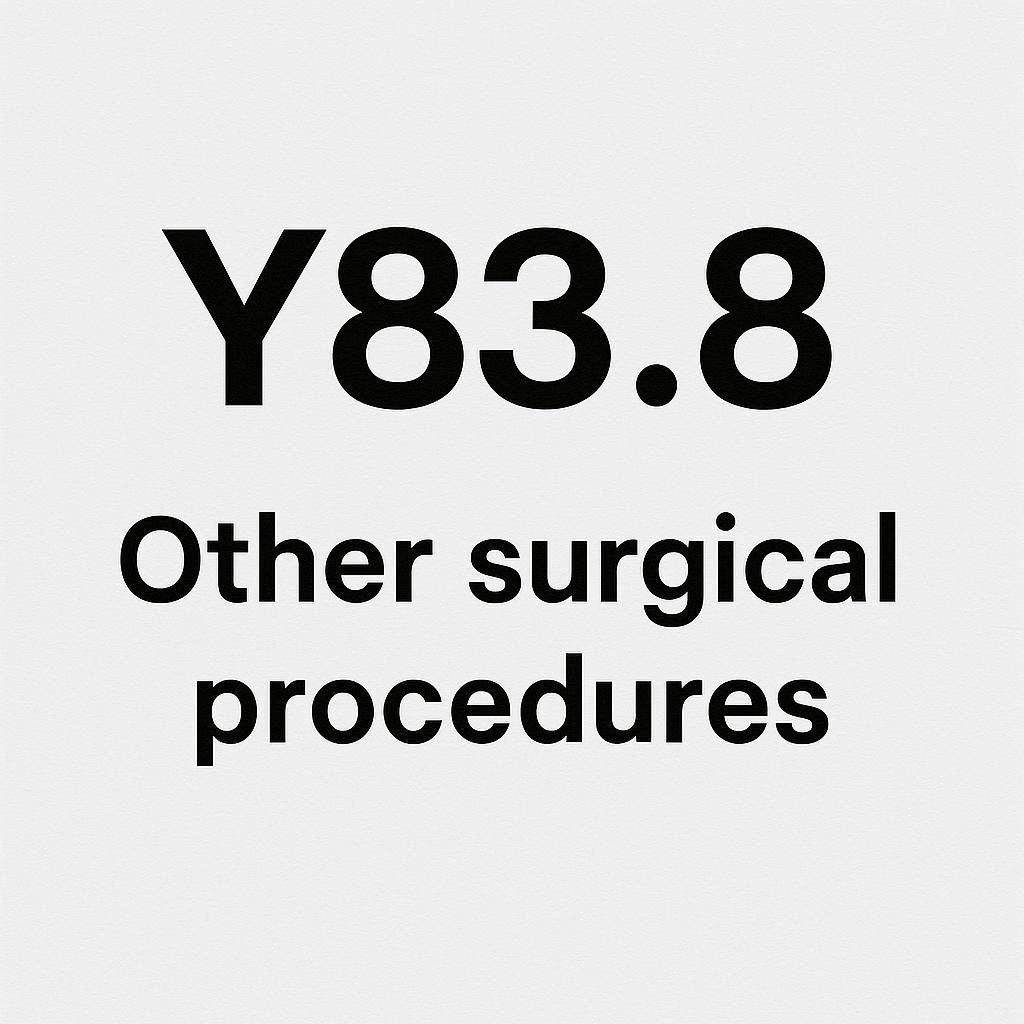
What Exactly Is ICD-10 Code Y83.8?
ICD-10 code Y83.8 falls under a specific category known as “External causes of morbidity.” More precisely, it belongs to the block for surgical and other medical procedures as the cause of abnormal reaction or later complication, without mention of misadventure at the time of the procedure.
The full official title of the code is: Y83.8 – Other specified surgical and other medical procedures.
This code is used when a patient experiences an abnormal reaction or a later complication from a medical or surgical procedure, but the problem is not due to an error during the procedure itself. The complication arises as a known risk of that specific type of procedure, which is not listed under a more specific Y83 code.
Important Note for Readers: Code Y83.8 is never a primary or first-listed diagnosis. It is always a secondary code. You use it to provide additional information about the cause of the patient’s current condition.
Where Does This Code Fit in the ICD-10 Structure?
To understand Y83.8, it helps to see its place in the ICD-10 hierarchy. The “Y83” category specifically covers procedures that lead to abnormal patient reactions. Here is a simple breakdown:
| Code | Description |
|---|---|
| Y83.0 | Surgical operation with transplant of whole organ |
| Y83.1 | Surgical operation with implant of artificial internal device |
| Y83.2 | Surgical operation with anastomosis, bypass, or graft |
| Y83.3 | Surgical operation with formation of external stoma |
| Y83.4 | Other reconstructive surgery |
| Y83.5 | Amputation of limb(s) |
| Y83.6 | Removal of organ (partial) (total) |
| Y83.8 | Other specified surgical and other medical procedures |
| Y83.9 | Unspecified surgical and other medical procedures |
As you can see, Y83.8 is the catch-all category for procedures that do not fit neatly into Y83.0 through Y83.7 (note that Y83.7 is not listed above as it is reserved for other specified procedures, but Y83.8 is the broader “other”).
When Should You Use Y83.8? (Real Clinical Scenarios)
This is where many coders get stuck. The key is understanding that Y83.8 applies to specified procedures that are not already covered by more precise codes. Let us look at concrete examples.
Scenario 1: A Reaction to a Specialized Diagnostic Procedure
Imagine a patient undergoes a complex cardiac electrophysiology study (EPS) with mapping. This is not a common surgery like a transplant (Y83.0) or a bypass (Y83.2). A few days later, the patient develops an abnormal reaction—such as a persistent arrhythmia or vascular spasm—directly linked to the study itself. The procedure was performed correctly, with no misadventure or error.
In this case, you would code:
- Primary code: The arrhythmia or complication (e.g., I47.2 for ventricular tachycardia).
- Secondary code: Y83.8 (Other specified surgical and other medical procedures – the EPS).
Scenario 2: Complications from a Non-Surgical Medical Procedure
The Y83 category includes “other medical procedures,” not just surgery. Consider a patient receiving repetitive transcranial magnetic stimulation (rTMS) for depression. This is a non-invasive procedure. The patient suffers a prolonged seizure as a known but rare complication. No equipment failure or operator error occurred.
You would use:
- Primary code: The seizure (e.g., G40.909).
- Secondary code: Y83.8 because rTMS is a specified medical procedure not listed elsewhere.
Scenario 3: A Modern or Rare Surgical Technique
New surgical techniques emerge all the time. Suppose a patient has a laparoscopic gastric plication (a type of bariatric surgery different from a bypass or stoma formation). Weeks later, they develop a gastric leak due to tissue reaction, not surgical error. The specific procedure (gastric plication) is not represented by Y83.0-Y83.7.
The correct secondary code is Y83.8, as it is another specified surgical procedure.
What This Code Is NOT For
It is equally important to know when to avoid Y83.8. Here is a quick list of situations where this code is inappropriate:
- Misadventure during procedure: If a retained sponge, wrong patient, or equipment failure caused the issue, use Y62-Y69 codes (e.g., Y65.8 for other specified misadventures).
- Drug or biological reaction: If the reaction is to an anesthetic or medication given during the procedure, use Y40-Y59 codes.
- Procedures with a specific Y83 code: Do not use Y83.8 for transplants, implants, bypasses, stomas, reconstructive surgery, amputations, or organ removals. Use the specific subcode.
- Unspecified procedure: If the medical record does not specify the procedure, use Y83.9 instead.
Official Coding Guidelines for Y83.8
To use this code with confidence, you must respect the official ICD-10-CM guidelines. Here are the most relevant rules, explained in plain English.
1. The “No Misadventure” Rule
Code Y83.8 explicitly excludes misadventures. The official description includes the phrase “without mention of misadventure at the time of the procedure.” This is critical. If the chart clearly states “laparotomy sponge left in abdomen,” you are in the wrong category. You must move to the Y62-Y69 series (misadventures to patients during surgical and medical care).
2. It Is Always a Secondary Code
You will never list Y83.8 as the principal diagnosis. The primary code always describes the nature of the complication (e.g., infection, hemorrhage, organ failure). Y83.8 explains why that complication occurred (the procedure). Think of it as telling the full story.
3. Use It with Procedure Codes
When reporting Y83.8, the medical record should clearly document the specific procedure performed. For inpatient settings, you will also report the corresponding ICD-10-PCS procedure code. For outpatient and physician office coding, the documentation must name the procedure (e.g., “laser interstitial thermal therapy”).
4. The “Specified” Requirement
The “8” in Y83.8 stands for “other specified.” This means the medical record must name the exact procedure. If the documentation is vague—e.g., “patient had a procedure” or “underwent surgery”—you cannot use Y83.8. You would have to use Y83.9 (unspecified), which is less precise and often less useful for data analysis.
Pro Tip for Coders: When in doubt, query the provider. A simple question like, “Please specify the exact surgical or medical procedure performed prior to this complication,” can justify using the accurate Y83.8 code instead of a generic code.
Common Mistakes and How to Avoid Them
Even experienced coders occasionally stumble with external cause codes. Here are the most frequent errors with Y83.8, along with simple fixes.
Mistake #1: Using Y83.8 for Expected Post-Op Issues
Not every post-procedure condition is a complication. A patient will have pain after a biopsy. That is expected. Using Y83.8 for routine, expected recovery issues is incorrect. Only use it for abnormal reactions or later complications that are outside the typical healing process.
Correct approach: Does the condition require additional treatment, prolong hospitalization, or cause lasting harm? If yes, it may be a complication. If it is a normal part of recovery, do not code Y83.8.
Mistake #2: Confusing Y83.8 with Y84.8
Code Y84.8 covers “Other medical procedures” as the cause of abnormal reaction, but note the category difference. Y84 is for other medical care, not surgical procedures. A simple rule:
- Y83 = Surgical and other medical procedures (invasive, operative).
- Y84 = Other medical procedures (e.g., diagnostic imaging, blood draw, dialysis, therapeutic massage).
If the procedure required a scalpel, scope, or incision, think Y83.8 (if not elsewhere classified). If it was a non-invasive treatment or test, consider Y84.8.
Mistake #3: Forgetting to Code the Manifestation
Y83.8 alone is incomplete. It tells you what caused the problem (the procedure) but not what the problem is. Always pair it with a code that describes the complication itself. For example:
- Y83.8 + T81.32XA (disruption of external operation wound, initial encounter)
- Y83.8 + J95.4 (Mendelson’s syndrome due to procedure)
Never report Y83.8 as a standalone code on a claim.
Documentation Tips for Physicians and Clinicians
For healthcare providers, good documentation is the foundation of accurate coding. If you are a surgeon, anesthesiologist, or proceduralist, these tips will help your coding team use Y83.8 correctly.
What to Include in the Medical Record
Your note should answer these four questions:
- What exact procedure was performed? Use specific names. “Endoscopic ultrasound-guided fine-needle aspiration” is better than “biopsy.”
- Was the procedure completed as intended? Note any deviations, but also clarify if there was no misadventure.
- What specific complication occurred? Describe the abnormal reaction (e.g., “post-procedural pancreatitis” or “delayed gastric emptying”).
- What is the clinical link? State the connection: “The patient’s fever is a known complication of the cryoablation procedure performed yesterday.”
Example of Strong Documentation
“On 10/15/2025, the patient underwent percutaneous cryoablation of a renal tumor under CT guidance. The procedure was performed without technical error or misadventure. On post-procedure day two, the patient developed a large perinephric hematoma requiring transfusion. This is a known but uncommon complication of renal cryoablation.”
From this note, a coder can confidently assign:
- Primary: N28.89 (other specified disorders of kidney and ureter – for the hematoma)
- Secondary: Y83.8 (other specified surgical procedure – cryoablation)
The Importance of External Cause Codes Like Y83.8
Some coders wonder: “Why bother with external cause codes? They do not affect DRG reimbursement in many cases.” While it is true that some payers do not require them, these codes are far from useless. Here is why they matter.
Public Health and Research
Agencies like the CDC and WHO use external cause codes to track complication rates across different procedures. If every hospital uses Y83.8 consistently for a new procedure like transcaval embolization, researchers can identify safety signals early. This leads to better patient safety guidelines.
Risk Management and Quality Improvement
Hospitals use these codes internally. If a specific surgical technique coded to Y83.8 shows a high rate of a particular complication, the quality department can investigate. Is it a training issue? A patient selection issue? Without accurate coding, that data is invisible.
Legal and Insurance Contexts
In medical liability cases or disability claims, the specificity of Y83.8 strengthens the record. It shows precisely which procedure led to the complication, distinguishing it from other potential causes. This clarity benefits both the patient and the provider.
Step-by-Step Decision Tree for Using Y83.8
If you are still unsure, follow this simple algorithm. It will guide you to the right decision in four questions.
Question 1: Is the patient’s current condition an abnormal reaction or later complication of a procedure?
- No → Do not use Y83.8. Stop here.
- Yes → Proceed to Question 2.
Question 2: Was the complication caused by a misadventure (error, accident, equipment failure) during the procedure?
- Yes → Use Y62-Y69 (misadventure codes). Do not use Y83.8.
- No → Proceed to Question 3.
Question 3: Is the complication a known reaction to a drug or biological agent given during the procedure?
- Yes → Use Y40-Y59 codes.
- No → Proceed to Question 4.
Question 4: Is the procedure specifically listed in Y83.0 through Y83.7?
- Yes → Use that specific code (e.g., Y83.2 for bypass).
- No → Is the procedure clearly specified in the medical record?
- Yes → Use Y83.8.
- No → Use Y83.9 (unspecified).
This tree works for almost every scenario you will encounter in a hospital or clinic setting.
Practical Examples in Table Format
Let us compare correct and incorrect uses of Y83.8 side by side. This table will clarify the boundaries.
| Clinical Scenario | Correct Code(s) | Incorrect Code | Why? |
|---|---|---|---|
| Patient has a vertebroplasty. One week later, develops a pulmonary cement embolism. No error during procedure. | Primary: I26.99 (other pulmonary embolism). Secondary: Y83.8 | Y83.2 (bypass) | Vertebroplasty is not a bypass, transplant, or stoma. It is another specified surgical procedure. |
| Patient has a gastric bypass (Y83.2). Develops an anastomotic leak. No misadventure. | Primary: K91.89 (other postprocedural disorders of digestive system). Secondary: Y83.2 | Y83.8 | Y83.2 specifically covers bypasses. Use the more specific code. |
| Patient has a routine blood draw. Develops a large hematoma and compartment syndrome. No error. | Primary: M79.81 (other hematoma). Secondary: Y84.8 (other medical procedures) | Y83.8 | Blood draw is not a surgical procedure. It falls under Y84.8. |
| Surgeon accidentally cuts a nerve during a correctly indicated appendectomy. No error in technique, but a known risk. | Primary: S34.21XA (injury of nerve root of lumbar spine). Secondary: Y83.8 | Y65.8 (misadventure) | This is not a misadventure. Misadventures imply a preventable error (wrong site, retained object). This is a known surgical risk. |
Reader Note: The difference between a complication and a misadventure is often the subject of audits. When in doubt, remember: misadventure = something went wrong that should not have happened in standard care. Complication (Y83.8) = something went wrong even though care was standard.
Relationship Between Y83.8 and Other Chapters in ICD-10
ICD-10 is a hierarchical system. Y83.8 does not live in isolation. It interacts with other code categories. Understanding these relationships will make you a more versatile coder.
The “T” Codes (Injury, Poisoning, and Certain Other Consequences)
The T81-T88 series covers complications of surgical and medical care, not elsewhere classified. For example, T81.3 is “disruption of operation wound.” These T codes often serve as the primary code for the complication itself. Then, Y83.8 serves as the secondary external cause code. Together, they provide a complete picture:
- T81.31XA (Disruption of external operation wound, initial encounter)
- Y83.8 (Other specified surgical and other medical procedures – e.g., cryoablation)
The “E” Codes (Endocrine, Nutritional, Metabolic)
External cause codes are sometimes mistakenly confused with E codes from ICD-9. In ICD-10, external causes are in V00-Y99. Y83.8 is specifically under “Y83” as we have discussed.
The “Z” Codes (Factors Influencing Health Status)
Z codes describe encounters for reasons other than illness. They are not used with Y83.8 in the same way. For example, Z48.8 (encounter for other specified surgical aftercare) would not be paired with Y83.8 because the aftercare encounter is not the complication itself.
Future-Proofing Your Coding: Why Y83.8 Matters More Now
Medicine evolves rapidly. Five years ago, procedures like irreversible electroporation (IRE) for tumors or pulsed field ablation for cardiac arrhythmias were experimental. Today, they are becoming standard. The ICD-10 code set updates annually. However, new procedures often do not receive their own specific Y83 code for several years. In that gap, Y83.8 is the only correct choice.
By using Y83.8 accurately, you help national and international health agencies track the safety profile of new procedures. This is not just administrative work. It is a contribution to patient safety on a global scale.
A Note on ICD-11
ICD-11 has been released, but most of the world, including the US, still uses ICD-10 for clinical coding. The structure in ICD-11 is different. External causes have their own chapter. However, the principle remains the same: there is a category for complications of procedures without misadventure. For now, mastering Y83.8 in ICD-10 remains a valuable skill for years to come.
Frequently Asked Questions (FAQ)
Q1: Can Y83.8 be the principal diagnosis on a Medicare claim?
No. Medicare and all other payers follow ICD-10-CM guidelines that prohibit external cause codes as principal diagnoses. Always code the specific complication first.
Q2: Is Y83.8 used for outpatient surgery coding?
Yes, absolutely. Outpatient facilities and physician offices use external cause codes when the documentation supports it. However, always verify payer policies, as some do not require external cause codes for ambulatory encounters.
Q3: What is the difference between Y83.8 and Y84.8 in practice?
Y83.8 is for surgical and invasive medical procedures (endoscopy, biopsy, surgery). Y84.8 is for non-invasive or less invasive medical care (X-ray, ultrasound, physical therapy, acupuncture).
Q4: Do I need a seventh character for Y83.8?
No. Unlike injury codes, external cause codes like Y83.8 do not use seventh characters for episode of care (initial, subsequent, sequela). You simply report the 5-character code as is.
Q5: How do I code a complication from a procedure that was performed at another facility?
You still use Y83.8. The external cause code describes the type of procedure, not where it occurred. However, you may add a place of occurrence code (Y92) if known and relevant.
Q6: Is there a specific list of procedures officially included in Y83.8?
No official master list exists because new procedures are always emerging. The rule is: any specified surgical or invasive medical procedure not listed in Y83.0-Y83.7 qualifies for Y83.8.
Additional Resources for Medical Coders
If you want to deepen your understanding of external cause coding, here are two highly reliable sources:
- CDC ICD-10-CM Official Guidelines for Coding and Reporting – This is the definitive rulebook. Read the section on external cause codes carefully. [Link to CDC guidelines page – verify current URL]
- AHA Coding Clinic for ICD-10-CM/PCS – This quarterly publication provides real-world coding advice and case studies. Search their archive for “Y83.8” or “external cause” to see practical examples.
Conclusion
ICD-10 code Y83.8 serves a vital but specific role. It is the secondary code you turn to when a patient suffers an abnormal reaction or later complication from a specified surgical or medical procedure, provided the procedure is not listed elsewhere in the Y83 category and no misadventure occurred. By pairing it correctly with a primary diagnosis code, you complete the clinical story, support public health research, and ensure accurate medical records.
Remember the golden rules: always specify the procedure, never code it alone, and double-check that the complication is truly abnormal. With this guide, you now have the clarity and confidence to use Y83.8 accurately and ethically.
Disclaimer: This article is for educational purposes and does not constitute legal, medical, or billing advice. Coding guidelines and payer policies change. Always refer to the most current ICD-10-CM Official Guidelines for Coding and Reporting and consult with qualified professionals for specific cases.