If you have ever dealt with a persistent, itchy, or uncomfortable yeast infection, you know how frustrating it can be. But when you look at a medical bill or an insurance claim, you might see a strange combination of letters and numbers next to your diagnosis. That string of characters is the ICD 10 code.
For healthcare providers and medical billers, finding the right ICD 10 code for a yeast infection is not just about bureaucracy. It is about accuracy, proper reimbursement, and ensuring that a patient’s medical record tells the correct story.
This guide will walk you through everything you need to know. We will look at the most common codes, the differences between locations of the infection, and even special situations like newborn infections. Let us make sense of this together.
What Exactly Is an ICD 10 Code?
Before we dive into specific numbers, let us take a quick step back. ICD 10 stands for the 10th revision of the International Classification of Diseases. It is a system used worldwide to track diagnoses, symptoms, and procedures.
Every health condition has its own unique code. When your doctor writes down a diagnosis, a medical coder translates that into an ICD 10 code. This code is then sent to your insurance company. The insurance company uses the code to understand why you received treatment and to decide how much to pay.
A yeast infection is medically known as candidiasis. It is caused by an overgrowth of a fungus called Candida, most often Candida albicans. Because this infection can appear in many different places on the body, there is not just one single code. There is a family of codes.
The Primary ICD 10 Code for Yeast Infection (Unspecified)
Let us start with the most common code you will see. When a doctor documents a yeast infection without specifying the exact location or type, or when the location is clear but no further details are available, they often use a general code.
B37.9 – Candidiasis, unspecified
This is the catch-all code for a yeast infection. It means the patient has a diagnosis of candidiasis, but the medical record does not specify the site. You might see this used in urgent care settings or during a preliminary examination before test results come back.
However, many insurance companies and auditors prefer a more specific code. If your documentation says “vaginal yeast infection,” you should not use B37.9. You should use a code that identifies the vagina as the site.
Important Note for Medical Coders: Always use B37.9 only as a last resort. If the location is documented, choose the site-specific code. This improves data quality and reduces the risk of a denied claim.
Yeast Infection of the Skin (Cutaneous Candidiasis)
Yeast infections do not only happen in the vagina or mouth. They can appear on the skin, especially in warm, moist areas like armpits, under the breasts, or in groin folds. This is often called a skin yeast infection or cutaneous candidiasis.
The specific code for this is:
B37.2 – Candidiasis of skin and nail
This code covers yeast infections on the skin (intertrigo caused by candida) and infections of the fingernails or toenails caused by candida (candidal paronychia). It is a frequently used code in dermatology and primary care.
When to use B37.2:
- A red, itchy rash with satellite pustules in skin folds.
- Candida infection under the breasts.
- Candidal infection in the groin area (different from a vaginal infection).
- Candidal paronychia (redness and swelling around the nail bed).
When to avoid B37.2:
- Do not use this for diaper rash (use L22). Although diaper rash can be caused by candida, the specific code for diaper dermatitis is L22.
- Do not use this for a vaginal infection (use N77.1 or B37.3+).
Vaginal Yeast Infection (Vulvovaginal Candidiasis)
This is probably what most people think of when they hear “yeast infection.” It is incredibly common. In fact, three out of four women will have at least one vaginal yeast infection in their lifetime.
The coding for this is slightly more detailed because you have a couple of options. The most accurate code is a combination code.
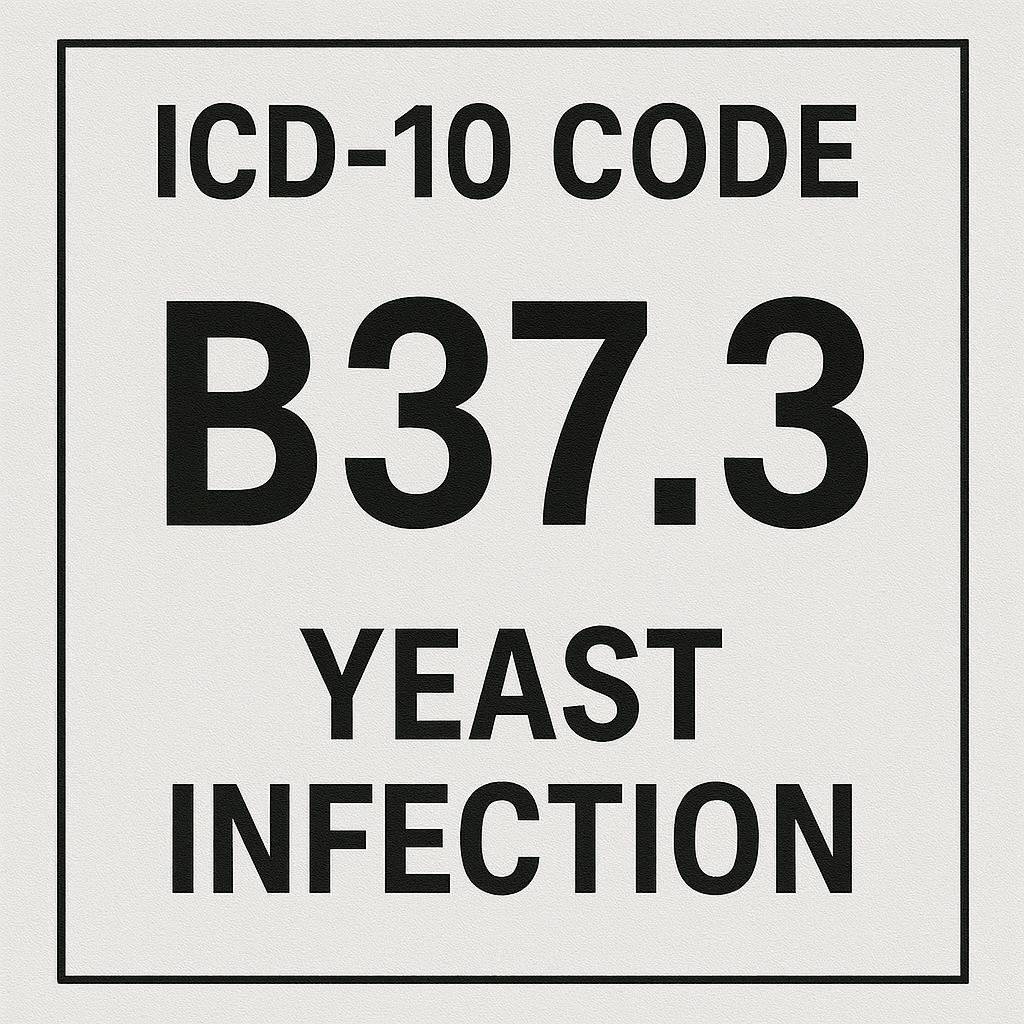
B37.3 – Candidiasis of vulva and vagina
Then, to add even more clinical context, you can use a secondary code:
N77.1 – Vulvovaginal candidiasis
Wait, why two codes? This is a great question. In ICD 10, some conditions are classified by the infection first, and others by the body system. However, the most widely accepted and specific code for a simple vaginal yeast infection is:
B37.3 (Candidiasis of vulva and vagina) – This code stands alone perfectly. It includes both the vulva and the vagina. Many coders and insurance companies accept B37.3 as the complete code for a routine vaginal yeast infection.
The code N77.1 is actually a code that describes “vulvovaginal candidiasis” as a disorder of the female pelvic organs. But N77.1 requires an additional code from B37.- to identify the infection. So, using B37.3 alone is simpler and more common.
Recurrent Vaginal Yeast Infections
A standard vaginal yeast infection is easy to code. But what about a patient who has four or more infections in one year? That is a different clinical scenario. The code changes slightly.
For recurrent vulvovaginal candidiasis, you still use B37.3 as the primary code. However, you should add a code to capture the recurrent nature. You can add Z91.A – Allergy status to drugs, medicaments and biological substances if the recurrence is due to an allergy, but more commonly, you would document the recurrence in the clinical notes. Unfortunately, ICD 10 does not have a perfect standalone code for “recurrent yeast infection” outside of using B37.3 with a supporting note.
For coders: Always look for the word “recurrent” in the documentation. If it is present, you may also need to code any underlying condition, such as diabetes (E08-E13) or immunodeficiency (D84.9).
Oral Yeast Infection (Thrush)
Thrush is a yeast infection that develops inside the mouth and on the tongue. It looks like creamy white lesions, often on the tongue or inner cheeks. It is most common in babies, older adults, and people with weakened immune systems.
The code for oral candidiasis is clear and direct.
B37.0 – Candidal stomatitis
This is the official term for thrush. You might also see it documented as “oral candidiasis” or “candidal thrush.” All of these map to B37.0.
Thrush in Newborns (Neonatal Candidiasis)
Babies can get thrush during birth if the mother has a vaginal yeast infection. This is a specific situation with its own code.
P37.4 – Other congenital candidiasis
This code is for a yeast infection that is present at birth or acquired during the birthing process. It is a neonatal code only. Do not use P37.4 for an adult or an older child.
Doctor’s Note: If a newborn develops thrush after birth from a bottle nipple or pacifier, that is usually coded as B37.0, not P37.4. The P37.4 code is specifically for congenital (present at birth) infections.
Yeast Infections in Other Specific Locations
Candida is a versatile fungus. It can affect almost any part of the body. Here is a quick reference table for less common sites of infection.
| Location of Yeast Infection | ICD 10 Code | Description |
|---|---|---|
| Esophagus (throat tube) | B37.81 | Candidal esophagitis. Often seen in immunocompromised patients. |
| Lungs (respiratory) | B37.1 | Pulmonary candidiasis. Rare, usually in very sick patients. |
| Bloodstream (systemic) | B37.7 | Candidal septicemia. This is a serious, life-threatening condition. |
| Heart valves | B37.6 | Candidal endocarditis. Very serious and rare. |
| Urinary tract (bladder) | B37.49 | Other urogenital candidiasis. For yeast in urine not from vagina. |
| Penis (male yeast infection) | B37.42 | Candidal balanitis. Yeast infection on the head of the penis. |
| Mouth (thrush) | B37.0 | Candidal stomatitis. White patches inside the mouth. |
| Skin and nails | B37.2 | Candidiasis of skin and nail. Rashes in folds or infected nails. |
This table shows you how specific you can get. A systemic yeast infection in the blood is very different from a simple skin rash. The codes reflect that difference in severity.
How to Choose the Right Code: A Simple Flowchart in Words
You do not need a medical degree to understand basic coding logic. Follow these simple questions to find the right ICD 10 code for a yeast infection.
Step 1: Where is the infection?
- If it is in the mouth → B37.0
- If it is on the skin (not genital) → B37.2
- If it is in the vagina or vulva → B37.3
- If it is in the esophagus → B37.81
- If it is in the blood → B37.7
- If it is on the penis → B37.42
Step 2: Is the patient a newborn?
- If yes, and the infection was present at birth → P37.4
Step 3: Is the location unknown or not documented?
- If yes → B37.9 (but try to get more information).
Step 4: Is there an underlying condition?
- If the patient has HIV, diabetes, or is on chemotherapy, code that as a secondary diagnosis. It changes the medical picture.
Common Coding Mistakes to Avoid
Even experienced coders can sometimes get tripped up with yeast infection codes. Here are the most frequent errors.
Mistake 1: Using B37.9 for a vaginal infection.
This is the number one mistake. If the doctor writes “vaginal yeast infection,” you have a site. Use B37.3, not B37.9.
Mistake 2: Confusing diaper rash with candidiasis.
Diaper rash (L22) is often caused by irritation, not yeast. If the doctor specifically says “candidal diaper dermatitis,” you can use B37.2, but many pediatricians prefer L22 with an additional code from B37.2. Always check your payer guidelines.
Mistake 3: Forgetting to code the underlying condition.
A yeast infection is often a sign of something else. If a patient has uncontrolled diabetes and gets recurrent yeast infections, you must code the diabetes (E11.65 for type 2 with other specified complications). If you only code the yeast infection, the insurance company sees only half the story.
Mistake 4: Using a systemic code for a local infection.
B37.7 (candidal septicemia) is a severe, hospital-level diagnosis. Do not use it for a simple vaginal or oral infection. That would be incorrect and could look like fraud.
Real-World Examples of Correct Coding
Sometimes, seeing examples helps more than memorizing rules. Here are three patient scenarios.
Scenario 1: A woman with itching and discharge.
- Doctor’s note: “Patient presents with white, curdy discharge and vulvar pruritus. Wet prep shows pseudohyphae. Diagnosis: Acute vulvovaginal candidiasis.”
- Correct ICD 10 code: B37.3
Scenario 2: A man with redness on the penis.
- Doctor’s note: “Redness and small papules on the glans. Diabetic patient. KOH prep positive for candida. Diagnosis: Candidal balanitis.”
- Correct ICD 10 code: B37.42 (plus E11.9 for type 2 diabetes without complications).
Scenario 3: A 4-month-old baby with white patches in the mouth.
- Doctor’s note: “Infant with poor feeding and white plaques on buccal mucosa that scrape off with bleeding. Diagnosis: Oral thrush.”
- Correct ICD 10 code: B37.0 (This is not a congenital infection, so P37.4 is incorrect).
Why Specificity Matters for Insurance Claims
You might wonder why this level of detail is important. Can’t you just use one code for all yeast infections? The short answer is no.
Insurance companies use these codes to determine medical necessity. For example, a drug like fluconazole (a common oral treatment for yeast infections) is usually covered for B37.3 (vaginal) and B37.0 (oral). But if you use the unspecified code B37.9, the insurance company might delay payment to ask for more details.
Also, public health researchers use this data. If everyone uses B37.9 for everything, no one knows how many people have vaginal infections versus esophageal infections. That data is important for research and drug development.
Pro Tip for Patients: If your insurance denies a claim for a yeast infection treatment, check the code on your explanation of benefits (EOB). If it says B37.9, ask your doctor’s office to amend the code to the specific location. That often solves the problem.
The Link Between Yeast Infections and Other Diseases
A routine yeast infection is not usually a sign of a serious illness. However, recurrent or severe infections can be a red flag. As a coder or a patient, you should be aware of these links.
Diabetes
High blood sugar feeds yeast. Uncontrolled diabetes is a top cause of recurrent yeast infections. If a patient has three or more infections in a year, screening for diabetes is wise. The codes for diabetes with candidiasis are found in the E08-E13 range.
HIV / AIDS
People with advanced HIV often get oral thrush that does not go away. They may also get esophageal candidiasis. Esophageal candidiasis (B37.81) is considered an AIDS-defining condition in some diagnostic criteria.
Antibiotic Use
Taking antibiotics kills good bacteria. This allows yeast to overgrow. While there is no specific code for “yeast infection due to antibiotics,” you can use a code for adverse effect of an antibiotic (Y40.-) as a secondary code. However, most clinics do not add this unless the reaction is severe.
The Future of Yeast Infection Coding (ICD 11)
You should know that ICD 11 has been released, though most of the world still uses ICD 10. In ICD 11, the codes for yeast infections are reorganized. The changes are not massive, but the numbers look different.
For now, focus on ICD 10. The transition to ICD 11 in the United States is not expected for several years. However, the logic remains the same: specify the site, specify the severity when possible, and always document the underlying cause.
A Helpful Checklist for Medical Coders
Before you submit a claim for a yeast infection, run through this quick checklist.
- Is the specific anatomic site documented? (Vagina, mouth, skin, esophagus, etc.)
- If site is documented, did I use a site-specific code (B37.0, B37.2, B37.3, etc.)?
- Did I check for a secondary diagnosis like diabetes or HIV?
- For newborns, did I confirm if the infection was congenital (P37.4) or acquired after birth (B37.0)?
- Did I avoid using B37.9 when a more specific code exists?
- Is the severity (like recurrent) documented and coded appropriately?
What Patients Need to Know About These Codes
If you are a patient reading this, you might feel overwhelmed. You do not need to memorize these numbers. But understanding them helps you be your own advocate.
When you see a medical bill, look for the diagnosis code. If it says “B37.9” but you had a clear vaginal infection, you can ask your doctor’s billing office to correct it. A correction might change your insurance coverage or your out-of-pocket cost.
Also, never assume that an infection is “just yeast.” If you keep getting infections, ask your doctor to check for diabetes or other immune conditions. The code on your chart is a clue to a bigger picture.
Documenting Yeast Infections in Electronic Health Records (EHRs)
Most doctors now use EHR systems like Epic, Cerner, or NextGen. These systems often have built-in coding suggestions. However, these suggestions are only as good as the documentation.
If a doctor types “yeast infection,” the EHR might default to B37.9. That is not ideal. The doctor should type “vaginal candidiasis” or “oral thrush.” This small change in wording produces a better code.
Advice for Physicians: Be specific in your notes. Instead of writing “yeast infection,” write “vulvovaginal candidiasis” or “cutaneous candidiasis of the inframammary fold.” Your coding team will thank you, and your claims will be cleaner.
A Complete Table of All Yeast Infection Related Codes
Here is a complete, easy-to-scan reference for every relevant code.
| ICD 10 Code | Full Medical Term | Common Name |
|---|---|---|
| B37.0 | Candidal stomatitis | Oral thrush |
| B37.1 | Pulmonary candidiasis | Yeast infection in the lung |
| B37.2 | Candidiasis of skin and nail | Skin yeast infection, nail yeast |
| B37.3 | Candidiasis of vulva and vagina | Vaginal yeast infection |
| B37.4 | Candidiasis of other urogenital sites | Includes balanitis (B37.42) |
| B37.41 | Candidal cystitis and urethritis | Yeast in bladder or urethra |
| B37.42 | Candidal balanitis | Yeast infection on the penis |
| B37.49 | Other urogenital candidiasis | Other rare genital sites |
| B37.5 | Candidal meningitis | Yeast infection in brain lining |
| B37.6 | Candidal endocarditis | Yeast infection on heart valve |
| B37.7 | Candidal septicemia | Yeast infection in the blood |
| B37.8 | Candidiasis of other sites | Includes esophagus (B37.81) |
| B37.81 | Candidal esophagitis | Yeast infection in throat tube |
| B37.89 | Other sites | Other rare locations |
| B37.9 | Candidiasis, unspecified | Unspecified yeast infection |
| P37.4 | Other congenital candidiasis | Newborn yeast infection at birth |
| N77.1 | Vulvovaginal candidiasis | Alternate code (use with B37.3) |
How to Prevent Yeast Infections (A Clinical Perspective)
While this article focuses on coding, understanding prevention helps you appreciate the diagnosis. Prevention strategies also inform medical necessity. For example, a doctor might prescribe a prophylactic (preventive) antifungal for a patient on long-term antibiotics.
Prevention methods include:
- Wearing cotton underwear.
- Avoiding douches and scented products.
- Changing out of wet swimsuits or gym clothes quickly.
- Managing blood sugar if diabetic.
- Using probiotics (though evidence is mixed, many patients report benefits).
None of these prevention methods have a direct ICD 10 code, but they are important for patient education. A well-informed patient is less likely to have recurrent infections, which means fewer claims and less work for the billing department.
When to See a Doctor (Symptoms That Require a Code)
From a coding perspective, the symptoms a patient reports lead to the diagnosis. But from a patient perspective, you should know when a yeast infection is actually an emergency.
These symptoms require medical attention:
- Fever over 100.4°F (38°C) along with a yeast infection.
- Severe abdominal pain.
- Back pain that is new or severe.
- Vomiting or nausea.
- Thick, green, or foul-smelling discharge (this might be a different infection).
If you have any of these, go to a doctor. The codes for these symptoms might include R50.9 (fever, unspecified) or R10.9 (abdominal pain, unspecified) alongside a yeast infection code.
The Cost of a Yeast Infection (Without Insurance)
Let us talk about real-world numbers. Understanding costs puts the coding process into perspective. The price of treatment depends on the location and severity.
- Over-the-counter cream (Monistat, etc.): 15to30. No code needed because no insurance claim is filed.
- Prescription oral fluconazole (Diflucan): 20to50 for one pill. The code used is usually B37.3.
- Doctor’s office visit: 100to200. Includes evaluation and management code (like 99213) plus the diagnosis code B37.3.
- Emergency room visit for severe infection: 300to800. The code might be B37.3 or B37.7 if systemic.
If you have insurance, your out-of-pocket cost depends on the codes used. A code for a simple infection usually results in a low copay. A code for systemic infection means higher costs and more tests.
Questions to Ask Your Doctor or Billing Office
If you see a code on your bill that does not look right, you have the right to ask questions. Here are five questions to ask.
- “What specific location code did you use for my yeast infection?”
- “Was the unspecified code B37.9 used? If so, can you change it to a site-specific code?”
- “Did you code any underlying condition like diabetes or a weakened immune system?”
- “Is the code you used covered by my insurance plan for the medication you prescribed?”
- “Can you provide an itemized bill with all diagnosis codes clearly listed?”
These questions protect you from billing errors. And errors happen more often than you might think. Studies suggest that up to 80% of medical bills contain at least one minor error.
Summary of Key Takeaways
We have covered a lot of information. Let us bring it all together in a simple list.
- The primary unspecified code is B37.9, but you should avoid it when possible.
- Vaginal yeast infections use B37.3.
- Oral thrush uses B37.0.
- Skin yeast infections use B37.2.
- Newborn infections present at birth use P37.4.
- Always look for underlying conditions like diabetes.
- Specificity prevents claim denials and improves patient care.
Conclusion
The ICD 10 code for a yeast infection is not one single number. It is a family of codes that reflect the many ways candida can affect the human body. For a routine vaginal infection, B37.3 is your best choice. For thrush, use B37.0. For skin rashes, turn to B37.2.
Remember, good coding tells a complete story. It protects the patient, the provider, and the insurance system. Whether you are a medical coder, a physician, or a curious patient, using the right code ensures everyone is on the same page. Keep this guide handy, stay specific, and always document the full clinical picture.
Frequently Asked Questions (FAQ)
Q1: What is the most common ICD 10 code for a vaginal yeast infection?
A: The most common and accurate code is B37.3 (Candidiasis of vulva and vagina).
Q2: Can I use the same code for a male yeast infection on the penis?
A: No. For a yeast infection on the penis (balanitis), you should use B37.42 (Candidal balanitis).
Q3: What is the difference between B37.9 and B37.3?
A: B37.9 is “Candidiasis, unspecified” (no location given). B37.3 is “Candidiasis of vulva and vagina” (specific location). Always use B37.3 if the vagina is mentioned.
Q4: What code is used for thrush in babies?
A: For a baby who develops thrush after birth, use B37.0. For a newborn who has the infection at birth (congenital), use P37.4.
Q5: Does insurance cover the treatment if I use the wrong code?
A: Possibly not. An unspecified code (B37.9) may lead to a denied claim or a request for more information. Using the correct site-specific code improves approval rates.
Q6: What code do I use for a yeast infection caused by antibiotics?
A: You would use the site-specific code (e.g., B37.3 for vaginal) and you may add a secondary code for the adverse effect of the antibiotic (Y40.-). However, many clinics only code the infection itself.
Q7: Is there a separate code for recurrent yeast infections?
A: ICD 10 does not have a perfect standalone code for “recurrent.” You use the site-specific code (like B37.3) and ensure the word “recurrent” is in the clinical documentation. You may also code any underlying cause.
Q8: What code is used for a yeast infection in the throat (esophagus)?
A: That is B37.81 (Candidal esophagitis). This is a more serious infection often seen in immunocompromised patients.
Additional Resource
For the most up-to-date official ICD 10 coding guidelines, always refer to the Centers for Medicare & Medicaid Services (CMS) ICD 10 website or the World Health Organization (WHO) classification page.
You can also use free lookup tools like ICD10Data.com or Find-A-Code to verify codes in real-time. These resources are updated annually, so bookmark them for future reference.
Disclaimer: This article is for educational and informational purposes only. It is not a substitute for professional medical advice, diagnosis, or treatment. Always seek the advice of your physician or another qualified health provider with any questions you may have regarding a medical condition. Medical coding guidelines change over time; always consult the latest official ICD 10 coding manuals and payer-specific policies before submitting claims.