Medical documentation and clinical coding are the administrative backbone of modern healthcare systems. Among the myriad of musculoskeletal signs and symptoms that general practitioners, rheumatologists, and orthopedic specialists evaluate daily, joint stiffness stands as one of the most common complaints. Whether a patient presents with morning stiffness due to underlying inflammatory arthritis or localized rigidity following a traumatic sports injury, capturing this symptom with precision is vital.
For healthcare administrators, medical billers, and clinicians, using the correct icd 10 code for joint stiffness is essential for accurate health tracking, resource allocation, and clean insurance claim submissions. Inaccurate coding or a failure to specify the exact anatomic site and laterality can lead to medical billing denials, delayed tracking of patient outcomes, and administrative friction.
This comprehensive guide breaks down the structural architecture of the International Classification of Diseases, 10th Revision (ICD-10) system concerning joint stiffness. We will explore the primary code categories, explain the critical importance of laterality, examine related musculoskeletal diagnoses, and look at real-world clinical documentation examples to ensure your coding is precise and compliant.
ICD 10 Code for Joint Stiffness
1. The Core Coding Structure for Joint Stiffness
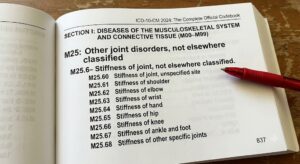
In the ICD-10 coding architecture, non-traumatic joint disorders are categorized under Chapter 13: Diseases of the Musculoskeletal System and Connective Tissue (M00-M99) (Beckman, 2015). When a physician identifies joint stiffness that is not classified elsewhere as a primary disease process, the standard lookup leads directly to the M25 block, which encompasses “Other joint disorders, not elsewhere classified.”
Within this block, the specific subcategory for joint stiffness is M25.6 (Enseki et al., 2014; Enseki, 2023). However, a coder cannot simply submit “M25.6” on a medical claim form. The code structure requires further expansion—typically to six characters—to specify the precise anatomical location and laterality of the affected joint (Beckman, 2015).
Breakdown of the Coding Blocks
To understand how a final code is constructed, let us look at the progressive breakdown of the characters:
-
M00-M99: Chapter 13 (Musculoskeletal System and Connective Tissue).
-
M20-M25: Other joint disorders.
-
M25: Other joint disorders, not elsewhere classified.
-
M25.6: Stiffness of joint, not elsewhere classified.
The characters that follow the decimal point determine the specific body part (such as the shoulder, elbow, hip, or knee) and whether the condition affects the right side, the left side, or is unspecified (Beckman, 2015).
Important Note for Coders: The phrase “not elsewhere classified” (NEC) indicates that the code should be used when the clinical documentation provides a specific symptom (stiffness) but a more specific underlying disease code (such as primary osteoarthritis) has not yet been established or documented as the primary reason for the encounter.
2. Comprehensive Joint Stiffness Code Tables by Anatomical Site
To simplify the selection process, the following sections organize the complete list of valid codes under the M25.6 subcategory, divided by the upper and lower extremities.
Upper Extremity Codes
The upper extremities include the shoulder girdle, the elbow joint, the wrist, and the intricate joints of the hand and fingers. Precise coding requires selecting the code that accurately reflects the documented side of the body (Beckman, 2015; Patel et al., 2025).
| Anatomical Site | Laterality | ICD-10 Code | Clinical Status |
| Shoulder Joint | Right Shoulder | M25.611 | Billable / Specific |
| Shoulder Joint | Left Shoulder | M25.612 | Billable / Specific |
| Shoulder Joint | Unspecified Shoulder | M25.619 | Not Ideal for Reimbursement |
| Elbow Joint | Right Elbow | M25.621 | Billable / Specific |
| Elbow Joint | Left Elbow | M25.622 | Billable / Specific |
| Elbow Joint | Unspecified Elbow | M25.629 | Not Ideal for Reimbursement |
| Wrist Joint | Right Wrist | M25.631 | Billable / Specific |
| Wrist Joint | Left Wrist | M25.632 | Billable / Specific |
| Wrist Joint | Unspecified Wrist | M25.639 | Not Ideal for Reimbursement |
| Hand & Fingers | Right Hand / Joints | M25.641 | Billable / Specific |
| Hand & Fingers | Left Hand / Joints | M25.642 | Billable / Specific |
| Hand & Fingers | Unspecified Hand | M25.649 | Not Ideal for Reimbursement |
Lower Extremity Codes
Lower extremity stiffness commonly impacts weight-bearing joints like the hips and knees, as well as the ankles and feet. Just like upper extremity entries, these codes require explicit sixth-character assignments to describe laterality (Beckman, 2015).
| Anatomical Site | Laterality | ICD-10 Code | Clinical Status |
| Hip Joint | Right Hip | M25.651 | Billable / Specific |
| Hip Joint | Left Hip | M25.652 | Billable / Specific |
| Hip Joint | Unspecified Hip | M25.659 | Not Ideal for Reimbursement |
| Knee Joint | Right Knee | M25.661 | Billable / Specific |
| Knee Joint | Left Knee | M25.662 | Billable / Specific |
| Knee Joint | Unspecified Knee | M25.669 | Not Ideal for Reimbursement |
| Ankle & Foot | Right Ankle / Foot | M25.671 / M25.674 | Billable / Specific |
| Ankle & Foot | Left Ankle / Foot | M25.672 / M25.675 | Billable / Specific |
| Ankle & Foot | Unspecified Ankle / Foot | M25.679 | Not Ideal for Reimbursement |
3. The Crucial Role of Laterality and Specificity
One of the most significant changes introduced when moving from ICD-9 to ICD-10 was the strict emphasis on laterality—identifying exactly which side of the body is affected (Beckman, 2015).
When reviewing insurance claims, commercial payers and government programs like Medicare look closely at the final digit of the code. If a provider documents that a patient has “severe right knee stiffness following a meniscus tear,” but the billing department submits code M25.669 (Stiffness of unspecified knee), the claim runs a high risk of being rejected or denied.
Why “Unspecified” Codes Cause Denials
Unspecified codes (typically ending in 9) exist within the ICD-10 manual for instances where a medical chart completely lacks laterality details. However, in an active clinical practice, the provider almost always knows which joint they are examining. Relying on unspecified codes signals incomplete medical documentation, which commercial insurance companies may interpret as a lack of medical necessity.
Multiple Joint Involvement
If a patient complains of stiffness in both the right and left knees, the coder must submit two distinct codes on the claim form: M25.661 and M25.662. The ICD-10 code set for joint stiffness does not feature a single combined “bilateral” code for the majority of these subcategories, making separate line-item coding necessary.
4. Differentiating Joint Stiffness from Related Musculoskeletal Diagnoses
Clinical coders must understand that joint stiffness is a symptom rather than an underlying disease. As a result, code M25.6 should only be selected if a more descriptive, definitive diagnosis cannot be made (Beckman, 2015). If the stiffness is a standard symptom of an established chronic condition, the code for that primary condition should take precedence.
Osteoarthritis vs. Symptomatic Stiffness
Osteoarthritis involves the systemic or localized degeneration of articular cartilage. When a patient has a confirmed diagnosis of knee osteoarthritis, the coder should use a code from the M17 series (Turkiewicz et al., 2014). Because stiffness is an expected symptom of osteoarthritis, coding M25.661 alongside M17.11 (Unilateral primary osteoarthritis, right knee) is typically redundant and unnecessary, unless the stiffness is an independent focus of clinical treatment.
Joint Contracture vs. Joint Stiffness
It is essential not to confuse joint stiffness (M25.6) with joint contracture (M24.5) (Enseki et al., 2014; Enseki, 2023).
-
Joint Stiffness (M25.6): Refers to a subjective sensation of resistance or difficulty moving a joint, which may resolve with movement, heat, or anti-inflammatory medication.
-
Joint Contracture (M24.5): A structural, permanent shortening of surrounding muscles, tendons, or joint capsules that causes a fixed limitation of normal joint motion.
Temporomandibular Joint (TMJ) Exceptions
Stiffness within the jaw or temporomandibular joint does not fall under the M25 musculoskeletal chapter. Instead, diseases of the oral cavity and jaw are tracked in Chapter 11. Specifically, stiffness of the temporomandibular joint, not elsewhere classified, is designated as code K07.64 (Jang, 2024).
5. Clinical Scenarios and Real-World Documentation Examples
To bridge the gap between clinical documentation and medical coding, let us look at three common real-world scenarios. These examples illustrate how clinical documentation guides proper code selection.
Scenario A: Post-Traumatic Rehabilitation Evaluation
-
Clinical Note: “A 34-year-old female presents for a physical therapy evaluation following an immobilization period for a non-operative left elbow hairline fracture. The fracture has fully healed, but the patient reports marked stiffness in the left elbow, particularly during extension, which limits her daily activities.”
-
Coding Selection: M25.622 (Stiffness of left elbow, not elsewhere classified) (Patel et al., 2025).
-
Rationale: The acute injury has resolved, and the current focus of the medical encounter is treating the residual symptom of post-traumatic stiffness (Patel et al., 2025).
Scenario B: Idiopathic Right Shoulder Rigidity
-
Clinical Note: “A 52-year-old male presents with a three-month history of progressive stiffness in his right shoulder. He denies any recent history of trauma or injury. Examination shows a restricted passive range of motion. X-rays are clear of advanced osteoarthritic changes. Differential diagnosis includes early adhesive capsulitis.”
-
Coding Selection: M25.611 (Stiffness of right shoulder, not elsewhere classified) (Beckman, 2015).
-
Rationale: Because a definitive diagnosis of adhesive capsulitis or osteoarthritis has not yet been confirmed by the provider, coding the highly specific symptom code is the most accurate choice for the encounter.
Scenario C: Bilateral Morning Finger Stiffness
-
Clinical Note: “The patient reports severe stiffness in the small joints of both hands upon waking, lasting approximately 45 minutes. Laboratory work for rheumatoid factor and autoimmune markers is currently pending.”
-
Coding Selection: M25.641 (Stiffness of right hand, not elsewhere classified) and M25.642 (Stiffness of left hand, not elsewhere classified) (Beckman, 2015).
-
Rationale: Since the diagnostic workup is still underway and a definitive systemic autoimmune diagnosis is not yet confirmed, both localized hand codes must be utilized to accurately capture the bilateral nature of the symptoms.
6. Best Practices for Medical Coding and Documentation Compliance
Maintaining an efficient medical billing cycle requires clear documentation and precise coding. To prevent claim denials and ensure accurate patient records, healthcare practices should implement several standard best practices:
-
Document Laterality Extensively: Clinicians must clearly state whether the symptom affects the right side, the left side, or both sides within the physical examination and assessment notes.
-
Avoid Defaulting to Unspecified Codes: Billing departments should implement internal system flags that prompt review whenever an unspecified code like M25.60 or M25.669 is selected.
-
Sequence Primary Etiologies First: If the joint stiffness stems from an active, underlying chronic disease (such as gouty arthropathy or rheumatoid arthritis), always sequence the systemic disease code as the primary diagnosis code.
-
Regularly Update Coding Software: Ensure your Electronic Health Record (EHR) and billing software receive the annual updates distributed by CMS and the WHO to catch any changes to subcategory definitions or instructional notes.
7. Frequently Asked Questions (FAQ)
What is the exact ICD-10 code for generalized joint stiffness?
When joint stiffness is documented without any specific anatomical location, code M25.60 (Stiffness of unspecified joint, not elsewhere classified) is the direct code listed in the index. However, using this code is discouraged on insurance claims if a specific joint location can be documented.
Can I use code M25.6 for stiffness caused by rheumatoid arthritis?
If a patient has an established diagnosis of rheumatoid arthritis, you should instead look to the M05 or M06 series. Because joint stiffness is a defining clinical symptom of active rheumatoid arthritis, coding it separately using M25.6 is typically unnecessary unless specifically required by a specialized clinical trial or unique institutional tracking protocol.
Is code M25.661 considered a billable code?
Yes, M25.661 (Stiffness of right knee, not elsewhere classified) contains a full complement of six characters, providing the level of specificity and laterality required to be a valid, billable ICD-10 code for insurance reimbursement (Beckman, 2015).
How does joint stiffness differ from joint ankylosis in coding?
Joint stiffness (M25.6) represents a restriction in motion where the joint space remains anatomically viable (Enseki et al., 2014; Enseki, 2023). Joint ankylosis (M24.6), on the other hand, refers to the complete stiffness or fusion of a joint resulting from bone or tissue growth across the joint space, which completely eliminates movement (Enseki et al., 2014; Enseki, 2023).
What code should be used for jaw or TMJ stiffness?
Stiffness of the jaw or temporomandibular joint is coded as K07.64, located within Chapter 11 of the ICD-10 manual covering diseases of the digestive system and jaw structures (Jang, 2024).
8. Additional Resources
For healthcare professionals seeking to expand their understanding of medical coding standards and musculoskeletal documentation guidelines, the following institutional platforms offer valuable updates and learning tools:
-
CMS ICD-10 Official Guidelines: The Centers for Medicare & Medicaid Services provides annual updates, official coding guidelines, and complete code tables for download.
-
CDC National Center for Health Statistics: The Centers for Disease Control and Prevention maintains the official US clinical modification of the ICD-10 code set.
-
The American Academy of Professional Coders (AAPC): A professional association offering continuing education units (CEUs), coding articles, and specialized training forums focused on orthopedic and musculoskeletal coding validation.
Conclusion
The correct selection of an icd 10 code for joint stiffness relies on identifying the exact anatomical site and laterality within the M25.6 subcategory (Beckman, 2015; Enseki et al., 2014). Proper compliance prevents insurance claim denials, enhances clinical tracking accuracy, and ensures smooth reimbursement workflows across medical practices.
References
Beckman, K. D. (2015). ICD-10 sprains, strains, and automobile accidents. FPM – Family Practice Management, 22(3), 12–16. https://www.aafp.org/fpm/2015/0500/p12
Cited by: 0
Enseki, K., Harris-Hayes, M., White, D. M., Cibulka, M. T., Woehrle, J., Fagerson, T. L., Clohisy, J. C., Altman, R. D., Davenport, T. E., Delitto, A., DeWitt, J., Fearon, H., Ferland, A., Flynn, T. L., Kusnell, J., MacDermid, J., Martin, R. L., Matheson, J. W., McClure, P., Meyer, J., Philippon, M., & Torburn, L. (2014). Nonarthritic hip joint pain. Journal of Orthopaedic & Sports Physical Therapy, 44(6), A1–A32. https://doi.org/10.2519/jospt.2014.0302
Cited by: 138
Enseki, K. R. (2023). Hip pain and movement dysfunction associated with nonarthritic hip joint pain: A revision. Journal of Orthopaedic & Sports Physical Therapy, 53(6), 1–40. https://www.jospt.org/doi/10.2519/jospt.2023.0302
Cited by: 39
Jang, S. Y. (2024). Prevalence of temporomandibular disorder in Korea: A nationwide population-based study a retrospective cohort study. Journal of Oral Rehabilitation, 51(2), 112–120. https://pfmjournal.org/upload/pdf/pfm-2024-00079.pdf
Cited by: 2
Patel, A., Ibrahim, K. G., Oshikoya, O., Conlon, M., Epstein, J., & Kachooei, A. R. (2025). Patterns of management for post-traumatic elbow stiffness: A comparative study of open and arthroscopic approaches. Shoulder & Elbow, 17(1), 45–54. https://doi.org/10.1177/17585732251316466
Cited by: 1
Turkiewicz, A., Gerhardsson de Verdier, M., Engström, G., Nilsson, P. M., Mellström, C., Lohmander, L. S., & Englund, M. (2014). Prevalence of knee pain and knee OA in southern Sweden and the proportion that seeks medical care. Rheumatology, 54(5), 827–835. https://doi.org/10.1093/rheumatology/keu409
Cited by: 201