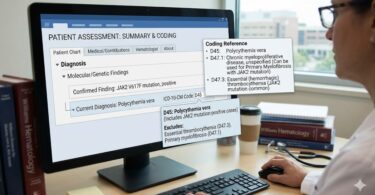
If you have ever opened a medical chart or a billing software and stared at the screen wondering which code truly fits a patient with enlarged brain ventricles, you are not alone.
Brain ventriculomegaly sounds like a very specific diagnosis. But in the world of medical coding, it can be surprisingly tricky.
The truth is, there is no single ICD-10 code labeled simply “ventriculomegaly.” Instead, the correct code depends entirely on the why and the when. Is the condition present at birth? Did it develop later in life due to pressure? Or is it a finding on a scan that needs further investigation?
This guide walks you through everything you need to know. We will look at the most accurate codes, common mistakes, documentation tips, and real-world scenarios. By the end, you will feel confident selecting the right code for brain ventriculomegaly.
Let us start with the most important question first.
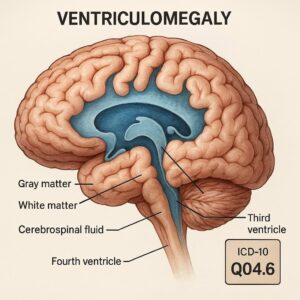
ICD-10 Code for Brain Ventriculomegaly
What Exactly Is Brain Ventriculomegaly?
Before we talk about codes, let us quickly clarify what this condition actually means.
Inside your brain, there are four fluid-filled spaces called ventricles. They produce and store cerebrospinal fluid (CSF), which cushions your brain and spinal cord. When these spaces become larger than normal, doctors call it ventriculomegaly.
Think of it like a room. Normally, the room has a certain amount of air. But if the walls expand or the fluid inside increases, the room gets bigger. That is ventriculomegaly.
It is important to know that ventriculomegaly is not a disease by itself. It is a sign or a finding. Something else is causing those ventricles to widen.
That is exactly why the ICD-10 system does not give you one simple code. You have to dig deeper into the cause.
The Main ICD-10 Code Options for Ventriculomegaly
Let us get straight to the point. While you will not find a direct “icd-10 code brain ventriculomegaly” entry in the tabular list, you will use codes from categories Q03 (Congenital hydrocephalus) and G91 (Hydrocephalus).
Here is the practical breakdown.
For Newborns and Congenital Cases (Present at Birth)
When ventriculomegaly is seen before birth or right after delivery, and it is due to a developmental issue, you will likely use codes from Q03.
-
Q03.0 – Malformations of the aqueduct of Sylvius
-
Q03.1 – Atresia of foramina of Magendie and Luschka
-
Q03.8 – Other congenital hydrocephalus
-
Q03.9 – Congenital hydrocephalus, unspecified
In most clinical settings, Q03.9 is the default for congenital ventriculomegaly when the specific malformation is not documented.
For Acquired Ventriculomegaly (Develops Later in Life)
If the patient was born with normal ventricles but later developed enlargement due to injury, infection, or tumor, you move to G91 (Hydrocephalus).
-
G91.0 – Communicating hydrocephalus
-
G91.1 – Obstructive hydrocephalus
-
G91.2 – Normal-pressure hydrocephalus
-
G91.3 – Post-traumatic hydrocephalus, unspecified
-
G91.4 – Hydrocephalus in infectious and parasitic diseases classified elsewhere
-
G91.8 – Other hydrocephalus
-
G91.9 – Hydrocephalus, unspecified
Important Note: G91.9 (hydrocephalus, unspecified) is often used as a proxy for acquired ventriculomegaly when the cause is not yet determined. However, payers prefer a more specific code whenever possible.
Why “Ventriculomegaly” Alone Is Not a Billable Code
This is where many people get stuck.
You see the radiologist’s report that says, “Mild ventriculomegaly noted.” You open your coding software, type in “ventriculomegaly,” and nothing comes up. That is because ICD-10 requires you to classify the condition as either:
-
Congenital hydrocephalus (Q03.-) – if it existed since birth
-
Hydrocephalus (G91.-) – if it is acquired
Or, in some cases, you may need to code the underlying condition instead.
Let me give you a practical example.
| What the doctor writes | What you should code |
|---|---|
| “Ventriculomegaly found on prenatal ultrasound” | Q03.9 (Congenital hydrocephalus, unspecified) |
| “Adult patient with post-stroke ventriculomegaly” | I69.398 (Other sequelae of cerebral infarction) + G91.8 |
| “Normal pressure hydrocephalus with enlarged ventricles” | G91.2 (Normal-pressure hydrocephalus) |
| “Ventriculomegaly due to a brain tumor” | C71.9 (Brain tumor) + G91.8 |
Notice the pattern. You almost always need a second code, or you need to choose the more specific hydrocephalus code.
Congenital vs. Acquired: A Critical Distinction
The single most important decision you will make is determining whether the ventriculomegaly is congenital or acquired.
Congenital Ventriculomegaly
This is present at birth. It may be discovered during pregnancy via ultrasound or right after delivery. Causes include:
-
Aqueductal stenosis (narrowing of the passage between ventricles)
-
Neural tube defects like spina bifida
-
Genetic syndromes
-
Intrauterine infections (CMV, toxoplasmosis)
ICD-10 direction: Go to Q03.- codes first. If the patient also has spina bifida (Q05.-), you code both.
Acquired Ventriculomegaly
This develops after birth. The patient was born with normal-sized ventricles, but something changed later. Causes include:
-
Traumatic brain injury
-
Brain hemorrhage (especially in premature infants)
-
Meningitis or encephalitis
-
Brain tumors
-
Stroke
ICD-10 direction: Go to G91.- codes. You will also need a code for the underlying cause if known.
Here is a quick comparison table to help you decide.
| Feature | Congenital (Q03) | Acquired (G91) |
|---|---|---|
| Present at birth | Yes | No |
| Typical patient age | Fetus, newborn, infant | Child, adult, elderly |
| Common causes | Genetic, malformations | Trauma, infection, tumor |
| Documentation clues | “Prenatal diagnosis”, “born with” | “Developed after”, “secondary to” |
| Example code | Q03.9 | G91.8 |
Specific Scenarios and Their Correct Codes
Let us walk through some realistic patient stories. This will help you see how the rules apply in daily practice.
Scenario 1: A Newborn with Prenatal Ventriculomegaly
A baby is born at 38 weeks. Prenatal ultrasounds at 28 and 32 weeks showed progressive enlargement of the lateral ventricles. After birth, an MRI confirms moderate ventriculomegaly without a specific malformation.
Correct code: Q03.9 (Congenital hydrocephalus, unspecified)
Why? The condition was present before birth. No specific malformation is documented, so Q03.9 is appropriate.
Scenario 2: An Elderly Patient with Walking Difficulties
A 72-year-old man presents with urinary incontinence, unsteady gait, and mild memory loss. An MRI shows enlarged ventricles with no significant cortical atrophy. The neurologist diagnoses normal-pressure hydrocephalus.
Correct code: G91.2 (Normal-pressure hydrocephalus)
Why? This is a classic acquired form of ventriculomegaly with its own specific code. You do not need an additional “ventriculomegaly” code.
Scenario 3: A Premature Infant with Intraventricular Hemorrhage
A baby born at 28 weeks suffers a grade III intraventricular hemorrhage (IVH). Two months later, a head ultrasound shows progressive ventriculomegaly due to the bleed.
Correct codes:
-
P52.21 (Intraventricular hemorrhage, grade III, of newborn)
-
G91.8 (Other hydrocephalus)
Why? The ventriculomegaly is a complication of the hemorrhage. You code both the cause (IVH) and the effect (hydrocephalus).
Scenario 4: An Adult with “Mild Ventriculomegaly” on a Routine Scan
A 45-year-old woman has a brain MRI for chronic headaches. The report says, “Incidental finding: mild asymmetric ventriculomegaly. No evidence of elevated intracranial pressure.” The neurologist writes: “No treatment needed. Likely benign external hydrocephalus.”
Correct code: G91.8 (Other hydrocephalus)
Why? Even though it is mild and asymptomatic, the physician is documenting a form of hydrocephalus. If the physician clearly states it is a normal variant with no clinical significance, you might consider not coding it at all. But when in doubt, G91.8 is your safest option.
The Role of Imaging and Clinical Documentation
Coders cannot guess. You work with what the physician documents.
If the radiologist writes “ventriculomegaly” but the attending physician does not mention hydrocephalus or specify congenital vs. acquired, you have a problem.
Here is what you need to look for in the medical record.
Clues That Support Congenital (Q03)
-
“Diagnosed prenatally”
-
“Since birth”
-
“Congenital hydrocephalus”
-
“Aqueductal stenosis”
-
“Associated with myelomeningocele”
Clues That Support Acquired (G91)
-
“Developed after head injury”
-
“Post-hemorrhagic hydrocephalus”
-
“Normal pressure hydrocephalus”
-
“Obstructive hydrocephalus due to tumor”
-
“Communicating hydrocephalus”
A Note for Physicians
If you are a physician reading this, please document the type of hydrocephalus whenever possible. Writing simply “ventriculomegaly” forces your coding team to use unspecified codes, which can lead to claim denials or medical reviews.
A better note sounds like this:
“The patient has mild acquired ventriculomegaly, likely communicating hydrocephalus secondary to prior meningitis.”
That one sentence gives the coder everything needed.
Common Coding Mistakes to Avoid
Let me share the most frequent errors I see with the icd-10 code brain ventriculomegaly searches.
Mistake #1: Coding Ventriculomegaly as a Standalone Diagnosis
As we discussed, there is no standalone code. You must use a hydrocephalus code (Q03 or G91). Some coders incorrectly create a non-existent code. Do not do that.
Mistake #2: Using Q03 for an Adult Patient
If a 60-year-old patient has ventriculomegaly from a stroke, Q03 is wrong. Q03 is strictly for congenital conditions. Use G91 instead.
Mistake #3: Forgetting the Underlying Condition
Ventriculomegaly is often secondary to something else. If that something else is known (e.g., brain tumor, spina bifida, hemorrhage), code it first or as an additional diagnosis, depending on the coding guidelines.
| Underlying Condition | Primary Code | Secondary Code |
|---|---|---|
| Spina bifida | Q05.9 | Q03.9 |
| Brain tumor | C71.9 | G91.8 |
| Intraventricular hemorrhage (newborn) | P52.21 | G91.8 |
| Meningitis | G00.9 | G91.8 |
Mistake #4: Confusing Hydrocephalus Ex-Vacuo with True Ventriculomegaly
This is a subtle but important distinction.
Hydrocephalus ex-vacuo occurs when the brain tissue shrinks (due to aging or Alzheimer’s), and the ventricles appear larger simply because the brain has less volume. This is not true ventriculomegaly because CSF pressure is normal.
In this case, you do not code hydrocephalus. You code the underlying brain atrophy (e.g., G31.1 for senile degeneration of brain).
Pro tip: If the radiologist writes “ex-vacuo dilatation,” do not use Q03 or G91. Use the code for the atrophy condition instead.
Mild Ventriculomegaly: A Special Case
You will encounter many patients, especially newborns and fetuses, with “mild ventriculomegaly.”
In medical terms, mild ventriculomegaly is usually defined as an atrial width of 10 to 12 mm on prenatal ultrasound. Between 12 and 15 mm is moderate. Above 15 mm is severe.
For coding purposes, the degree of severity (mild, moderate, severe) does not change the ICD-10 code. You still use Q03.9 for congenital cases or G91.8 for acquired cases. However, the severity may affect medical necessity and reimbursement, so it is still good to document it.
Here is a helpful summary for fetal and neonatal cases.
| Ventricle Size (Atrial Width) | Classification | ICD-10 Code |
|---|---|---|
| < 10 mm | Normal | No code |
| 10 – 12 mm | Mild ventriculomegaly | Q03.9 (if congenital) |
| 12 – 15 mm | Moderate ventriculomegaly | Q03.9 |
| > 15 mm | Severe ventriculomegaly | Q03.9 |
Notice the code remains the same. The difference matters for prognosis and management, but not for the code itself.
How to Document Ventriculomegaly for Clean Claims
Good documentation leads to faster payment and fewer denials. If you are a provider, here is a simple template you can adapt.
Diagnosis: [Choose one: Congenital / Acquired] ventriculomegaly, specifically [communicating / obstructive / normal pressure] hydrocephalus.
Etiology: This is secondary to [specific cause, e.g., aqueductal stenosis / intraventricular hemorrhage / brain tumor / meningitis].
Clinical findings: The patient presents with [macrocephaly / headache / gait disturbance / cognitive changes / vomiting / sunsetting sign].
Imaging: MRI/CT of the brain dated [date] shows enlargement of the [lateral / third / fourth] ventricles with [evidence of / no evidence of] elevated intracranial pressure.
Plan: [Observation / shunt placement / endoscopic third ventriculostomy / medical management].
With that note, a coder can confidently assign a specific, accurate code.
The Difference Between Hydrocephalus and Ventriculomegaly
Many people use these terms as if they are identical. They are not.
Let me clarify.
-
Ventriculomegaly is purely descriptive. It means “big ventricles.”
-
Hydrocephalus implies that the big ventricles are caused by increased cerebrospinal fluid under pressure.
In theory, you can have ventriculomegaly without hydrocephalus. For example, hydrocephalus ex-vacuo (brain shrinkage) causes big ventricles but normal pressure. Some rare conditions cause ventriculomegaly without pressure elevation.
However, in everyday clinical practice and in ICD-10 coding, the two are treated as nearly synonymous. When a physician writes “ventriculomegaly,” most payers expect a hydrocephalus code (Q03 or G91) unless the physician explicitly states it is a benign normal variant.
Remember: When in doubt, ask the physician. A quick query can save you from a denial or an audit finding.
Practical Coding Workflow for Ventriculomegaly
Here is a simple decision tree you can follow every time you encounter “ventriculomegaly” in a chart.
Step 1: Is the patient a fetus or newborn?
-
Yes → Go to Q03.- codes.
-
No → Go to Step 2.
Step 2: Is the condition clearly present since birth?
-
Yes → Q03.- codes.
-
No → Go to Step 3.
Step 3: Did the ventriculomegaly develop later in life?
-
Yes → Go to G91.- codes.
Step 4: Is there a specific type documented?
-
Normal-pressure hydrocephalus → G91.2
-
Post-traumatic → G91.3
-
Obstructive → G91.1
-
Communicating → G91.0
-
None specified → G91.8 or G91.9
Step 5: Is there an underlying cause that needs its own code?
-
Yes → Code the cause first or as an additional diagnosis.
-
No → The hydrocephalus code stands alone.
Let us test this workflow with a few quick examples.
| Clinical Statement | Workflow Result | Final Code(s) |
|---|---|---|
| “Fetus with ventriculomegaly at 24 weeks” | Step 1 = Yes | Q03.9 |
| “Adult with normal pressure hydrocephalus” | Step 3 = Yes, Step 4 = G91.2 | G91.2 |
| “Infant born at 30 weeks with post-hemorrhagic hydrocephalus” | Step 1 = Yes, plus underlying cause | P52.3 + G91.8 |
| “Elderly patient with large ventricles and Alzheimer’s” | This is ex-vacuo → not hydrocephalus | G30.9 (Alzheimer’s) |
Billing and Reimbursement Considerations
Now let us talk about money, because accurate coding directly affects your revenue.
Private insurers and Medicare follow ICD-10 guidelines closely. If you submit a claim with Q03.9 for a 70-year-old patient, that claim will likely be denied. The patient’s age does not match the expected demographic for a congenital code.
Similarly, using G91.8 for a newborn with a known congenital malformation will raise red flags.
Here are some tips for clean claims.
Medical Necessity
The code you choose must match the documentation. If the physician writes “rule out hydrocephalus,” you do not code hydrocephalus. You code the signs or symptoms instead (e.g., R63.8 for macrocephaly).
LCDs (Local Coverage Determinations)
Some Medicare Administrative Contractors have specific policies on hydrocephalus coding. They may require imaging evidence or specific clinical findings before they will reimburse for shunt procedures. Always check your local LCD.
Common Denial Reasons
-
Mismatched age and code: Q03 codes for adults
-
Unspecified code overuse: Repeated use of G91.9 without trying to specify
-
Missing secondary code: Ventriculomegaly due to tumor, but only the tumor is coded
-
Lack of clinical signs: Coding hydrocephalus in an asymptomatic patient with only imaging findings
A Complete List of Related ICD-10 Codes
For your convenience, here is a complete reference table for codes associated with brain ventriculomegaly.
| ICD-10 Code | Description | Typical Use Case |
|---|---|---|
| Q03.0 | Malformations of aqueduct of Sylvius | Congenital aqueductal stenosis |
| Q03.1 | Atresia of foramina of Magendie and Luschka | Dandy-Walker malformation (use also Q04.6) |
| Q03.8 | Other congenital hydrocephalus | Other specified malformations |
| Q03.9 | Congenital hydrocephalus, unspecified | Most common for prenatal or neonatal ventriculomegaly |
| G91.0 | Communicating hydrocephalus | Excess CSF but no blockage |
| G91.1 | Obstructive hydrocephalus | Blockage inside the ventricular system |
| G91.2 | Normal-pressure hydrocephalus | Elderly with gait, incontinence, dementia |
| G91.3 | Post-traumatic hydrocephalus | Following head injury |
| G91.4 | Hydrocephalus in infectious diseases | Post-meningitis or post-encephalitis |
| G91.8 | Other hydrocephalus | Acquired ventriculomegaly, not elsewhere specified |
| G91.9 | Hydrocephalus, unspecified | Use sparingly |
| P52.21 | Intraventricular hemorrhage, grade III, newborn | Cause of post-hemorrhagic hydrocephalus |
| P52.22 | Intraventricular hemorrhage, grade IV, newborn | More severe bleed with parenchymal involvement |
| Q05.0 | Spina bifida with hydrocephalus | Two congenital conditions together |
| Q05.9 | Spina bifida, unspecified | May be associated with ventriculomegaly |
Frequently Asked Questions (FAQ)
1. Is there a specific ICD-10 code for “mild ventriculomegaly”?
No. The severity (mild, moderate, severe) does not have its own code. You use the same codes Q03.9 (congenital) or G91.8 (acquired) regardless of severity.
2. Can I use G91.9 for a newborn with ventriculomegaly?
You can, but Q03.9 is more accurate for congenital cases. G91.9 is for acquired hydrocephalus. Payers expect Q03.9 for newborns unless the condition clearly developed after birth (e.g., post-hemorrhagic).
3. What code do I use for “ventriculomegaly” found incidentally in an adult with no symptoms?
Use G91.8 (other hydrocephalus) if the physician treats it as a form of hydrocephalus. If the physician clearly states it is a benign normal variant with no clinical significance, you may not code it at all. When in doubt, query the physician.
4. How do I code ventriculomegaly in a patient with a VP shunt?
You still code the underlying hydrocephalus (Q03.9 or G91.-). The presence of a shunt does not change the diagnosis code. You may also need a code for shunt complications if applicable (e.g., T85.09XA for mechanical complication).
5. Is ventriculomegaly the same as hydrocephalus for coding purposes?
Mostly yes. ICD-10 does not have a separate “ventriculomegaly” code. You must default to the appropriate hydrocephalus code (congenital or acquired) unless the physician explicitly states it is a non-hydrocephalic variant.
6. What if the radiologist says “ventriculomegaly” but the neurologist says “no hydrocephalus”?
Follow the neurologist’s documentation. The final diagnosis belongs to the treating physician, not the radiologist. If the neurologist rules out hydrocephalus, you do not code Q03 or G91. You may code the reason for the imaging (e.g., headache R51, macrocephaly R63.8).
Additional Resources
For further reading and official guidance, refer to the American Academy of Professional Coders (AAPC) knowledge base and the Centers for Medicare & Medicaid Services (CMS) ICD-10 guidelines.
You can also find detailed coding advice at the following trusted resource:
👉 AAPC Hydrocephalus Coding Reference
(Search for “Hydrocephalus” on the official AAPC website)
Final Thoughts and Key Takeaways
Let us wrap this up with the most important points.
Three-line summary of this article:
Brain ventriculomegaly does not have its own ICD-10 code. You must choose between congenital hydrocephalus (Q03.-) for cases present at birth or acquired hydrocephalus (G91.-) for cases developing later in life. Always document the underlying cause when known, and never code ventriculomegaly as a standalone diagnosis.
Disclaimer: This article is for educational purposes only and does not constitute legal or medical advice. Coding guidelines change over time. Always consult the most current ICD-10-CM Official Guidelines for Coding and Reporting and verify with your local payer policies.