In the vast ecosystem of durable medical equipment (DME), few devices are as deceptively simple—yet as clinically critical—as the humble cane. A single misplaced code can delay a patient’s recovery by weeks, trigger a Medicare audit, or result in thousands of dollars in denied claims. For the billing specialist, physical therapist, orthopedist, or DME supplier, mastering the HCPCS code for a cane is not merely administrative paperwork; it is a clinical and financial responsibility.
Every year, over 11 million Americans use canes to maintain independence, prevent falls, and ambulate safely. Yet, the Centers for Medicare & Medicaid Services (CMS) denies nearly 18% of initial DME claims due to incorrect coding—many of these involving walking assistance devices. This article is your definitive, evidence-based roadmap through the labyrinth of HCPCS Level II codes for canes. We will dissect each code’s nuances, explore medical necessity documentation, compare reimbursement rates, and provide actionable strategies to maximize compliant revenue. By the end, you will not only know which code to use—you will understand why.
Part 1: The Foundation – What is HCPCS and Why Canes Have Their Own Codes
1.1 HCPCS Level II: A Brief Taxonomy
The Healthcare Common Procedure Coding System (HCPCS) is divided into three levels. Level II codes (alphanumeric, e.g., E0100, E0110) describe non-physician services, supplies, and DME. Canes fall under the E0100–E0149 series: “Walking Aids.”
Unlike crutches or walkers, canes are unique because they redistribute weight to the upper extremity while requiring less metabolic energy than a walker. The coding distinctions reflect engineering differences: number of points of contact with the floor, adjustability, and added features (e.g., quad bases, hemi-height variations).
1.2 Why a Cane is NOT a “One-Size-Fits-All” Code
A common billing error is using a single generic “cane” code for all patients. CMS rules are explicit: the code must match the specific device provided. For example:
- A standard adjustable aluminum cane (E0100) cannot be billed as a quad cane (E0110).
- A hemi-cane for unilateral weight-bearing (E0117) is distinct from a hemi-walker.
Miscoding is not just a clerical error—it can be interpreted as fraud under the False Claims Act if patterns show upcoding (e.g., billing a quad cane when a standard cane was delivered).
Part 2: The Complete HCPCS Code Set for Canes (With Table)
2.1 Detailed Code Breakdown
Below is the official CMS-aligned table. Each code is accompanied by its long descriptor, key clinical indication, and reimbursement modifier rules.
| HCPCS Code | Long Descriptor | Typical Patient Indication | Reimbursement Note (2024 CMS Fee Schedule) |
|---|---|---|---|
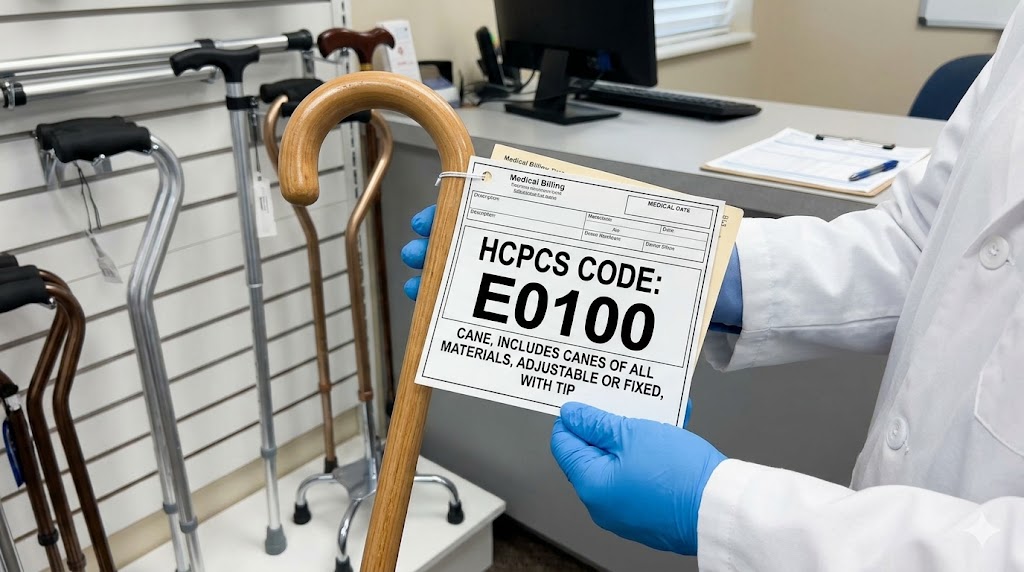
| E0100 | Cane, adjustable (including white canes for visually impaired), any material, any tip, each | Mild balance deficits, unilateral weakness, post-hip fracture (non-weight-bearing to partial weight-bearing) | ~$45–$65; requires KX modifier if patient meets coverage criteria |
| E0105 | Cane, adjustable, quad (four-pronged base), any material, each | Moderate instability, hemiparesis, severe osteoarthritis requiring broader base of support | ~$75–$95; often requires proof of failure of E0100 |
| E0110 | Cane, non-adjustable, standard, any material, each | Patient with fixed height needs (rare in adults; more common in pediatrics or custom use) | ~$30–$45; rarely billed due to adjustability preference |
| E0111 | Cane, non-adjustable, quad, each | Same as E0105 but for patients who cannot manage adjustable locks | ~$65–$85; prior authorization often required |
| E0112 | Cane, adjustable, hemi (hemi-height walker conversion) | Short stature (<4’10”) or pediatric patients; hemi-cane provides extra stability | ~$90–$120; higher reimbursement due to specialized design |
| E0113 | Cane, non-adjustable, hemi, each | Institutional settings (nursing homes) where adjustability is a tampering risk | ~$80–$100 |
| E0114 | Cane, quad, with large diameter tip (≥3 inches) | Severe neuropathy or unstable terrain (rural home environment) | ~$100–$130; add modifier UE if used in unlisted environment |
| E0117 | Hemi-cane (unilateral) with forearm support | Patients with hemiplegia or severe wrist arthritis who cannot grip standard handle | ~$150–$200; requires detailed physician narrative |
| E0118 | Cane, with shock absorber (pneumatic or spring mechanism) | Chronic pain from impact loading (e.g., avascular necrosis, hip impingement) | ~$130–$170; often denied unless specific diagnosis (e.g., M87.07) |
2.2 HCPCS Modifiers That Change Everything
Modifiers are appended to the cane code to indicate special circumstances:
- KX: “Medical necessity criteria have been met.” Required for all initial cane claims to Medicare.
- NU: New equipment (purchase).
- RR: Rental (rare for canes, but used in short-term rehab).
- UE: Used durable medical equipment (resale or loaner).
- GA: Waiver of liability statement on file (advanced beneficiary notice for non-covered items).
Example: E0105 KX NU = New quad cane, medically necessary and compliant.
Part 3: Medical Necessity – The Clinical Justification for Each Cane Code
3.1 The “Face-to-Face” Rule (CMS 1718-R)
Since 2015, a face-to-face encounter between the patient and a treating physician (MD, DO, NP, or PA) is mandatory before prescribing a cane. The documentation must include:
- A detailed description of the patient’s mobility limitation.
- Specific physical exam findings (e.g., “2/5 left hip abductor strength; Timed Up and Go test 28 seconds”).
- Why a cane—not a walker or crutch—is the minimum necessary device.
- Which specific cane features are required (e.g., “quad base due to postural sway >10 degrees”).
3.2 Diagnosis Codes That Support Each Cane HCPCS
Not all ICD-10 codes are equal. High-acceptance diagnoses include:
- M25.561 – Pain in right knee (for E0100)
- I69.351 – Hemiplegia following cerebral infarction affecting right dominant side (for E0117 hemi-cane)
- M17.0 – Bilateral primary osteoarthritis of knee (for E0105 quad cane)
- H54.7 – Unspecified visual impairment (for E0100 white cane)
Low-acceptance diagnoses (often denied): simple aging (R54), “general weakness” (R53.1), or obesity without functional deficit (E66.9).
Part 4: Reimbursement Strategies – From Claim to Cash
4.1 Medicare’s Fee Schedule for Canes (2024)
CMS reimburses canes under the DMEPOS fee schedule. For 2024, the national limiting charge for E0100 is $52.47. However, local coverage determinations (LCDs) vary by DME MAC jurisdiction.
Real-world example – Jurisdiction B (Novitas):
- E0100 allowed amount: $48.12
- Patient coinsurance (20%): $9.62
- Supplier profit margin after cost of goods ($15 cane): $33.12 per unit.
4.2 Avoiding Common Denials
| Denial Reason | Prevention Strategy |
|---|---|
| Missing KX modifier | Auto-add KX in billing software when diagnosis supports it. |
| No face-to-face note | Obtain signed physician note within 6 months prior to delivery. |
| Cane not reasonable/necessary | Ensure functional deficit (e.g., gait speed <0.8 m/s) is quantified. |
| Upcoding (E0105 vs E0100) | Document failed trial of single-point cane. |
4.3 Private Payer Variations
While Medicare is the gold standard, private insurers (UnitedHealthcare, Aetna, Blue Cross) often require:
- Prior authorization for quad or hemi-canes.
- Step therapy: Patient must try a $20 drugstore cane first (and fail) before covering an E0117.
- Rental caps: Some plans cover only 3 months of rental (E0100 RR) before purchase.
Part 5: Clinical Pearls – Choosing the Right Cane for the Right Code
5.1 The Biomechanics of Cane Use
A cane reduces load on the contralateral hip by 25–40%. The correct HCPCS code mirrors the required base of support:
- Single-point (E0100): Minimal stability; best for proprioceptive feedback.
- Quad (E0105/E0110): Increases base of support to 6×6 inches; reduces sway by 40% in hemiparesis.
- Hemi-cane (E0117): Provides forearm trough; offloads wrist and hand completely.
5.2 When to Avoid a Cane (and Use a Different Code)
Do not use a cane code if the patient:
- Requires bilateral support → use walker (E0143) or crutches (E0118 for Lofstrand).
- Has severe cognitive impairment (cannot remember cane placement) → use rolling walker with brakes.
- Weight exceeds 350 lbs → use bariatric cane (E0118 is often off-label; consider custom code K0108).
Part 6: Compliance, Audits, and Documentation Best Practices
6.1 The 7 Key Elements of a Compliant Cane Order
- Patient’s full name and date of birth.
- Order date (must precede delivery date).
- Detailed description of the cane (including HCPCS code if possible).
- Diagnosis (ICD-10) and functional limitation.
- Length of need (e.g., “3 months, then re-evaluate”).
- Signature and credentials of prescribing practitioner.
- Supplier’s NPI and DMEPOS accreditation number.
6.2 Targeted Probe and Educate (TPE) Risk
CMS’s TPE program currently scrutinizes E0105 and E0117 claims. In 2023, the medical review denial rate for quad canes was 22.3% nationally. The top reason: “Insufficient documentation of failed trial with standard cane.”
Action step: For every E0105 claim, attach a progress note showing:
- Date of standard cane trial.
- Specific adverse event (e.g., “patient fell twice while using single-point cane”).
- Timed gait speed improvement with quad cane (e.g., “TUG decreased from 32s to 19s”).
Conclusion
Mastering HCPCS codes for canes transforms a mundane billing task into a powerful clinical-financial tool that ensures patients receive the correct mobility aid while protecting your revenue cycle from audits. From the adjustable standard cane (E0100) to the specialized hemi-cane (E0117), each code carries distinct medical necessity requirements, reimbursement rates, and documentation traps. By following the evidence-based strategies in this guide—including proper modifier use, ICD-10 pairing, and TPE defense—you will achieve both compliant coding and optimal patient outcomes.
Frequently Asked Questions (FAQs)
Q1: Can I bill Medicare for a cane that the patient bought from a drugstore without a prescription?
A: No. Medicare requires a written order (prescription) from a treating practitioner before delivery. A patient’s self-purchased cane is not reimbursable.
Q2: What is the difference between E0105 and E0111?
A: E0105 is an adjustable quad cane; E0111 is non-adjustable. Most adults need E0105. Non-adjustable is reserved for institutional use or when locking mechanisms pose a risk.
Q3: How often can a patient get a new cane under Medicare?
A: Medicare covers a new cane every 5 years unless there is a significant change in medical condition (e.g., 50-lb weight gain, new stroke). For lost or damaged canes, a new prescription and a narrative letter of explanation are required.
Q4: Is a white cane for the blind coded differently?
A: No. E0100 includes “including white canes for visually impaired.” Do not use a separate code.
Q5: My patient needs a bariatric cane (500-lb capacity). Which code should I use?
A: No standard HCPCS code exists. Use K0108 (miscellaneous DME) and attach a detailed invoice and letter of medical necessity.
Q6: Can a physical therapist prescribe a cane under Medicare?
A: No. Only MD, DO, NP, PA, or clinical nurse specialist can prescribe. PTs can recommend but the final order must come from a Medicare-approved practitioner.
Q7: What happens if I accidentally use E0100 instead of E0105?
A: You will be reimbursed the lower amount (~$48 vs ~$85). You cannot resubmit with a corrected code unless you refund the initial payment. To avoid, double-check the cane’s base before billing.
Q8: Are canes subject to competitive bidding?
A: In most areas, standard canes (E0100) are part of the DMEPOS Competitive Bidding Program. Only contract suppliers can bill Medicare. Quad canes (E0105) are often non-bid items but check your local MAC.
Additional Resources
- CMS Local Coverage Determination (LCD) Database – Search “Walking Aids” – cms.gov/medicare-coverage-database
- DMEPOS Fee Schedule Lookup Tool – cms.gov/apps/physician-fee-schedule
- American Physical Therapy Association (APTA) – Gait Aid Selection Guide – apta.org/clinical-resources
- HCPCS Level II Expert 2024 (Optum360) – The gold standard coding manual.
- Medicare’s “Mobility Assistive Equipment” Fact Sheet – Publication #11045.
- Noridian DME MAC – Cane Medical Necessity Template – Free downloadable PDF template for physicians.
- KX Modifier Self-Audit Checklist – Available from the AAHomecare (American Association for Homecare).