If you have ever needed to bill for a blood pressure cuff, you probably asked yourself one question: What is the right HCPCS code for a blood pressure cuff?
You are not alone. Many medical suppliers, billing specialists, and even patients managing home care find this confusing.
The short answer is that there is not just one single code. Instead, several HCPCS Level II codes apply, depending on whether the cuff is manual or digital, reusable or disposable, and part of a kit or sold alone.
This guide walks you through everything you need to know. No medical coding degree required. Just clear, honest, and practical information.
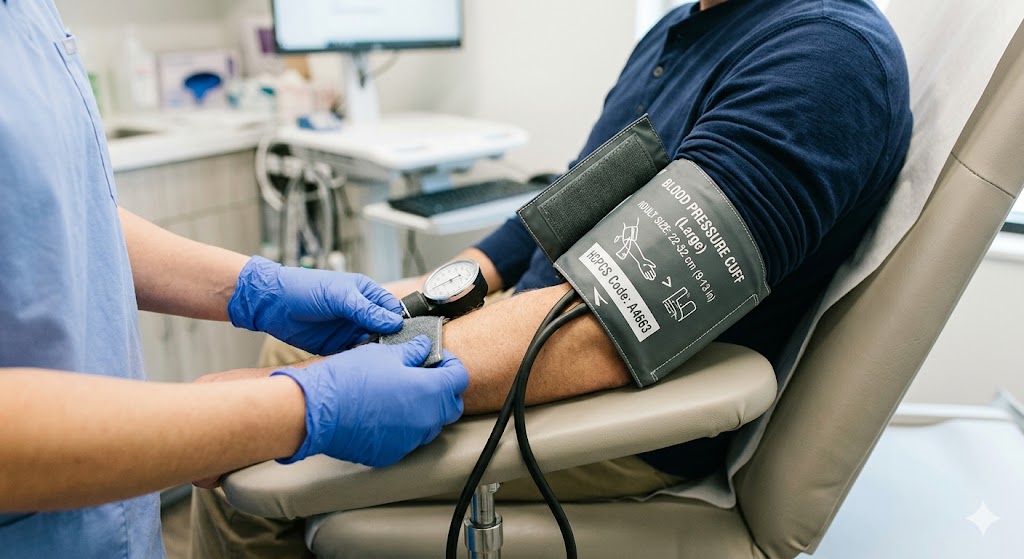
What Is HCPCS and Why Does It Matter for a Blood Pressure Cuff?
HCPCS stands for Healthcare Common Procedure Coding System. It is a set of codes used to bill Medicare, Medicaid, and private insurance companies for medical equipment, supplies, and services.
There are two levels:
- Level I – CPT codes (for procedures and services).
- Level II – Alphanumeric codes for products, supplies, and durable medical equipment (DME).
A blood pressure cuff falls under Level II HCPCS codes.
Why does this matter? Without the correct code, your claim gets denied. You do not get paid. The patient may be billed incorrectly. And everyone ends up frustrated.
Using the right HCPCS code for a blood pressure cuff ensures:
- Faster reimbursement.
- Fewer audits.
- Clear communication between suppliers, doctors, and insurers.
Important Note: Do not assume one code fits all cuffs. Payers look at the type of cuff, who uses it, and whether it is part of a monitor.
The Main HCPCS Codes for Blood Pressure Cuffs
Let us get straight to the point. Below are the most common HCPCS Level II codes used for blood pressure cuffs in the United States.
| HCPCS Code | Description | Typical Use |
|---|---|---|
| A4660 | Blood pressure cuff, complete set (includes cuff, bulb, and gauge) | Manual aneroid sphygmomanometer, reusable |
| A4663 | Blood pressure cuff replacement (cuff only, no bulb or gauge) | Replacement for lost or worn cuff |
| A4670 | Automatic blood pressure monitor | Digital/electronic devices, often with memory |
| E1399 | Durable medical equipment, miscellaneous | When no specific code exists (requires documentation) |
Let us break each one down in plain language.
A4660 – Complete Manual Blood Pressure Cuff Set
This is the classic manual blood pressure cuff. You know the one: a fabric cuff, a rubber bulb to pump air, and a round dial gauge (aneroid).
When to use A4660:
- Selling a complete manual unit to a patient for home use.
- Supplying a reusable cuff to a clinic or nursing facility (non-hospital setting).
- Billing Medicare or private insurance for DME.
Reimbursement tip: Many insurers require a doctor’s prescription (often called a Certificate of Medical Necessity or CMN) for A4660. Without it, expect a denial.
A4663 – Replacement Cuff Only
Sometimes the cuff wears out before the gauge or bulb breaks. Or a patient loses the cuff during travel. In those cases, you do not need to bill for a whole new set.
When to use A4663:
- The patient already owns a compatible manual monitor.
- Only the fabric cuff needs replacement.
- The bulb and gauge are still functional.
Reimbursement tip: Some payers limit how often you can bill A4663. Medicare, for example, may allow one cuff replacement every 12–24 months unless medical necessity is documented.
A4670 – Automatic (Digital) Blood Pressure Monitor
Digital monitors are extremely popular for home use. They are easy to operate, often store readings, and may even detect irregular heartbeats.
When to use A4670:
- Supplying an electronic, battery-powered or AC-adapted blood pressure monitor.
- The device includes a built-in cuff or attachable cuff.
- The patient has a documented need for automatic readings (for example, arthritis, poor vision, or cognitive issues).
Caution: Medicare and many private insurers do not routinely cover A4670 for general home use. Coverage often requires prior authorization and proof that a manual cuff cannot be used.
E1399 – Miscellaneous DME (Use Carefully)
This is a catch-all code. You use it when no other HCPCS code accurately describes the item.
Examples for blood pressure cuffs:
- A specialized large or extra-large cuff (above standard adult sizes).
- A pediatric cuff not part of a complete kit.
- A cuff designed for a specific brand of monitor not listed elsewhere.
Warning: E1399 almost always requires a detailed invoice and a letter of medical necessity. Payers will ask, “Why did you not use A4660 or A4663?” You must have a good answer.
Which HCPCS Code Is Most Common for Home Use?
Let us be honest. For most home users, the most frequently billed code is A4660 for a complete manual kit. Why? Because Medicare and many state Medicaid programs still prefer manual devices. They are simpler, less expensive, and do not rely on batteries or electronics.
Digital monitors (A4670) are more user-friendly, but harder to get covered.
If you are a patient buying a cuff out of pocket, you do not need to worry about HCPCS codes. The code matters only when you submit an insurance claim.
When Is a Blood Pressure Cuff Covered by Insurance?
This is where things get a little tricky. But do not worry – we will keep it simple.
Insurance coverage for a blood pressure cuff depends on three main factors:
- Medical necessity – Does the patient have a diagnosed condition that requires regular home blood pressure monitoring? Examples include hypertension, heart failure, chronic kidney disease, or preeclampsia in pregnancy.
- Prescription – Most payers require a doctor’s order stating the specific type of cuff needed.
- Supplier status – The cuff must come from a Medicare-enrolled DME supplier (if billing Medicare).
Medicare Coverage Rules
Medicare Part B covers DME, including blood pressure cuffs, but only under certain conditions.
- Manual cuffs (A4660) – Covered for patients with documented hypertension or other cardiovascular conditions. A face-to-face encounter with the prescribing doctor is required within six months prior to the order.
- Replacement cuffs (A4663) – Covered only if the original cuff is worn out or lost. You may need to return the old cuff.
- Digital monitors (A4670) – Generally not covered for routine home use. Some Medicare Advantage plans may offer coverage, but traditional Medicare denies A4670 in most cases.
Private Insurance and Medicaid
Private insurers vary widely. Some follow Medicare’s lead. Others are more flexible. Always check the patient’s policy or call the provider relations line.
Medicaid coverage differs by state. Many states cover A4660 and A4663. Few cover A4670 without prior authorization.
Documentation You Must Keep
Good documentation protects you and the patient. It also makes audits less stressful.
For any HCPCS code for a blood pressure cuff, keep these six items in your records:
- Doctor’s prescription (signed and dated).
- Certificate of Medical Necessity (CMN) if required by payer.
- Proof of delivery (POD) with patient signature.
- Medical records supporting hypertension or related diagnosis (ICD-10 codes).
- Invoice showing the exact item, brand, and model.
- Documentation of any face-to-face visit (for Medicare).
Pro Tip: Do not assume a verbal order is enough. Get everything in writing. A handwritten prescription on a prescription pad is still valid.
Common Billing Mistakes to Avoid
Even experienced billers make errors. Here are the most frequent ones I see with blood pressure cuff claims.
Mistake #1 – Using A4670 for a Manual Cuff
This happens more often than you think. A4670 is for automatic monitors. If you bill A4670 for a manual kit, the claim will deny. Worse, it may trigger an audit for upcoding.
Mistake #2 – No Diagnosis Code Link
An HCPCS code alone is not enough. You must link it to an appropriate ICD-10 code.
Examples of valid diagnosis codes:
- I10 – Essential (primary) hypertension.
- I11.9 – Hypertensive heart disease without heart failure.
- O13 – Gestational hypertension (for pregnancy-related use).
If you link a blood pressure cuff to a diagnosis like “routine physical” (Z00.00), expect a denial.
Mistake #3 – Billing for a Replacement Too Soon
Payers have frequency limits. For A4663, many allow one replacement every 12 months unless the cuff is damaged by accident (in which case, document the accident).
Mistake #4 – Forgetting Modifiers
Sometimes a modifier is required. For example:
- NU – New equipment (first time providing the item).
- RR – Rental (rare for cuffs, but possible).
- RA – Replacement of a DME item.
Check your payer’s guidelines.
Cuff Sizes and HCPCS Codes: What You Need to Know
One question I hear often: Does the size of the cuff change the HCPCS code?
The honest answer is no – but with a catch.
The codes A4660, A4663, and A4670 do not distinguish between small adult, adult, large adult, or thigh cuffs. The same code applies regardless of size.
However, if you supply a specialized cuff (like a neonatal cuff or a very large bariatric cuff), some payers may ask you to use E1399 instead because standard codes do not fit.
For example:
- Standard adult cuff → A4663.
- Bariatric thigh cuff (extra long, for a 24-inch+ arm circumference) → E1399 with documentation.
Important Note: Do not invent a code. Do not use A4663 for a bariatric cuff just to avoid E1399. That is incorrect billing and can be considered fraud.
HCPCS Code for Blood Pressure Cuff in a Hospital vs. Home Setting
The setting changes how you bill. Let us compare.
| Setting | Typical Code | Who Bills? | Notes |
|---|---|---|---|
| Hospital inpatient | Not billed separately (bundled into DRG) | Hospital | Cuff is part of room/equipment costs |
| Hospital outpatient (clinic) | Usually bundled | Hospital | Not separately reimbursed |
| DME supplier for home | A4660, A4663, A4670 | Supplier | Requires prescription |
| Nursing facility (SNF) | A4660 (if separately billable) | Supplier or SNF | Part B may cover if patient not in Part A covered stay |
| Retail purchase (cash) | No code needed | N/A | Patient pays out-of-pocket |
If you are a patient receiving a cuff during a hospital stay, you will not see a separate line item on your bill. If you take a cuff home after discharge, that is a DME supply.
How to Look Up HCPCS Codes Yourself
You do not need to rely on memory. Use these free tools to verify codes.
- CMS HCPCS Lookup Tool – Official and updated quarterly.
- PDAC (Pricing, Data Analysis, and Coding) contractor – Medicare’s verification site.
- Local DME MAC (like Noridian, CGS, or Palmetto GBA) – Regional guidelines.
Always check the effective date. Codes change. A4660 today might be replaced tomorrow (unlikely, but possible).
Real-World Examples (Case Scenarios)
Let me show you three realistic situations. Read them carefully.
Example 1: Elderly Patient with Hypertension
Patient: 72-year-old woman, diagnosed with stage 2 hypertension. She has poor fine motor skills due to arthritis.
Doctor orders: Digital blood pressure monitor for home use.
Correct HCPCS code: A4670
Result: Medicare denies because traditional Medicare does not cover A4670. Patient appeals with documentation of arthritis. Denial upheld. Patient pays out-of-pocket or her supplement plan pays.
Lesson: Even with medical necessity, coverage is not guaranteed. Check before ordering.
Example 2: Middle-Aged Man with Lost Cuff
Patient: 55-year-old man, known hypertension. He has an existing manual cuff. He lost the fabric cuff while traveling.
Doctor orders: Replacement cuff only.
Correct HCPCS code: A4663
Result: Insurance pays if >12 months since last replacement. If less than 12 months, they may deny unless documented loss (e.g., stolen, destroyed in fire).
Lesson: Keep records of prior supplies.
Example 3: Bariatric Patient
Patient: 45-year-old woman, BMI 52, arm circumference 28 inches. Standard cuffs do not fit.
Doctor orders: Extra-large bariatric cuff (no monitor – she already has a compatible gauge and bulb).
Correct HCPCS code: E1399 (miscellaneous DME) because no specific code exists for bariatric-only cuffs.
Result: Payer requests additional documentation. Supplier provides a letter of medical necessity and a photo showing the size difference. Claim pays at a negotiated rate.
Lesson: For non-standard items, document twice as much.
Pricing and Reimbursement Expectations
Let us talk money. I cannot give you exact dollar amounts because rates vary by:
- Payer (Medicare, Medicaid, commercial).
- Region (state or even county).
- Supplier contract status.
But I can give you reasonable estimates based on published 2024–2025 Medicare fee schedules (adjusted for your understanding).
| HCPCS Code | Medicare allowed amount (approx.) | Typical patient coinsurance (20%) |
|---|---|---|
| A4660 | $18 – $28 | $3.60 – $5.60 |
| A4663 | $12 – $18 | $2.40 – $3.60 |
| A4670 | Usually not covered | N/A (patient pays retail) |
| E1399 | Varies (contract rate) | Varies |
If you are a supplier, your actual reimbursement will depend on your DME MAC region. If you are a patient, these numbers give you a rough idea of what insurance might pay.
Important: Do not bill a patient more than the insurance allowed amount if you are a participating provider. That is balance billing, and it is illegal for Medicare and many commercial plans.
Frequently Asked Questions (FAQ)
1. Is there a specific HCPCS code for a wrist blood pressure cuff?
No. There is no separate HCPCS code for wrist cuffs. They are generally billed under A4670 (automatic monitor) if they are electronic. Manual wrist cuffs are rare. Many insurers do not cover wrist cuffs at all due to accuracy concerns.
2. Can I bill a blood pressure cuff under a CPT code instead of HCPCS?
No. CPT codes are for services and procedures. A blood pressure cuff is a supply or piece of equipment. Use HCPCS Level II codes.
3. Do I need a different code for a pediatric cuff?
No. Pediatric cuffs fall under the same codes (A4660, A4663, A4670). However, some payers may question medical necessity for a child without a diagnosed condition. Always attach a valid diagnosis.
4. How often can I bill A4663 (replacement cuff)?
Medicare allows replacement when the cuff is worn out or lost. In practice, many suppliers wait 12 months between replacements unless the patient provides proof of damage. Check your local DME MAC policy.
5. What if my patient has no insurance and wants a receipt for FSA/HSA reimbursement?
No HCPCS code is required for FSA/HSA receipts. However, a detailed receipt showing the product description, date, and price is sufficient. Many suppliers still include the HCPCS code for clarity.
6. Where can I find the official HCPCS code list?
Download it directly from the CMS website: CMS HCPCS Quarterly Updates (external link, free access).
7. Why did my claim get denied even with the correct HCPCS code?
Common reasons: missing prescription, invalid ICD-10 code, no prior authorization, patient not eligible on date of service, or supplier not enrolled in Medicare. Check the remittance advice code.
Additional Resource Link
For the most up-to-date local coverage determinations (LCDs) on blood pressure cuffs and DME billing rules, refer to your regional DME MAC.
👉 Recommended Resource: Medicare DME MAC Contacts and Coverage Policies – This official CMS page helps you find the correct contractor for your state and access detailed LCDs.
Final Checklist Before Submitting a Claim
Before you hit “submit” on that electronic claim or mail a paper CMS-1500, run through this checklist.
- HCPCS code matches the exact product (manual vs. automatic, complete vs. replacement).
- Prescription is signed, dated, and includes the specific item.
- Diagnosis code (ICD-10) supports medical necessity.
- Modifiers (NU, RR, RA) are correct.
- Patient’s insurance is active on the date of service.
- Supplier is enrolled and in-network (if required).
- Frequency limits respected (e.g., not billing A4663 too soon).
- Documentation saved locally (digital or paper).
Conclusion: Three Key Takeaways
First, use A4660 for a complete manual cuff set, A4663 for a replacement cuff only, and A4670 for automatic monitors – but verify coverage first. Second, always pair the HCPCS code with a valid diagnosis and a signed doctor’s prescription to avoid denials. Third, when in doubt, check your local DME MAC guidelines or use E1399 with strong documentation for non-standard cuffs.
Disclaimer: This article is for educational and informational purposes only. It does not constitute legal, medical, or billing advice. Coding rules, payer policies, and reimbursement rates change frequently. Always verify current HCPCS codes and coverage guidelines with the official CMS website or your specific payer before submitting claims.