Medical billing feels like learning a foreign language. The codes, the modifiers, the endless documentation—it all piles up quickly. Yet, for suppliers, clinicians, and even patients managing chronic conditions, finding the correct code matters. It determines whether a claim gets paid or rejected. It affects access to necessary equipment. Among the many devices that require precise coding, the blood pressure monitor stands out as one of the most commonly prescribed and misunderstood items.
This guide focuses entirely on the HCPCS code for a blood pressure monitor. You will discover exactly which code applies to different situations, how to document properly, what payers expect, and how to avoid denials. No fluff. No recycled content. Just practical, actionable information written in plain English.
Understanding HCPCS Codes in Simple Terms
Before diving into the specific code, stepping back to understand the system helps. HCPCS stands for Healthcare Common Procedure Coding System. Pronounced “hick-picks,” this system organizes medical services and supplies into alphanumeric codes. Medicare, Medicaid, and private insurers use these codes to process claims.
HCPCS divides into two levels. Level I includes CPT codes, which cover procedures and services performed by physicians. Level II covers supplies, equipment, and services not found in CPT. Blood pressure monitors fall squarely into Level II. These codes start with a letter followed by four digits. The letter often signals the category. For durable medical equipment, the code frequently starts with “E.”
Suppliers submit claims using these codes. Payers then match the code to coverage policies. If the code does not match the policy, the claim stops. This makes code selection critical. Guessing leads to delays, denials, and frustration.
Why Precise Coding Matters for Blood Pressure Monitors
A blood pressure monitor seems straightforward. You wrap a cuff around the arm, press a button, and read the numbers. Yet, from a billing perspective, nuances multiply. Is the monitor manual or digital? Does the patient use it at home or in a facility? Is the device part of a larger system, like a dialysis machine? Each scenario may point to a different code.
Using the wrong code triggers audits. Payers may claw back payments. Patients may receive unexpected bills. A supplier’s reputation suffers. Therefore, understanding the exact HCPCS code for a blood pressure monitor protects everyone involved. It ensures smooth claims, proper reimbursement, and patient satisfaction.
The Primary HCPCS Code for a Blood Pressure Monitor
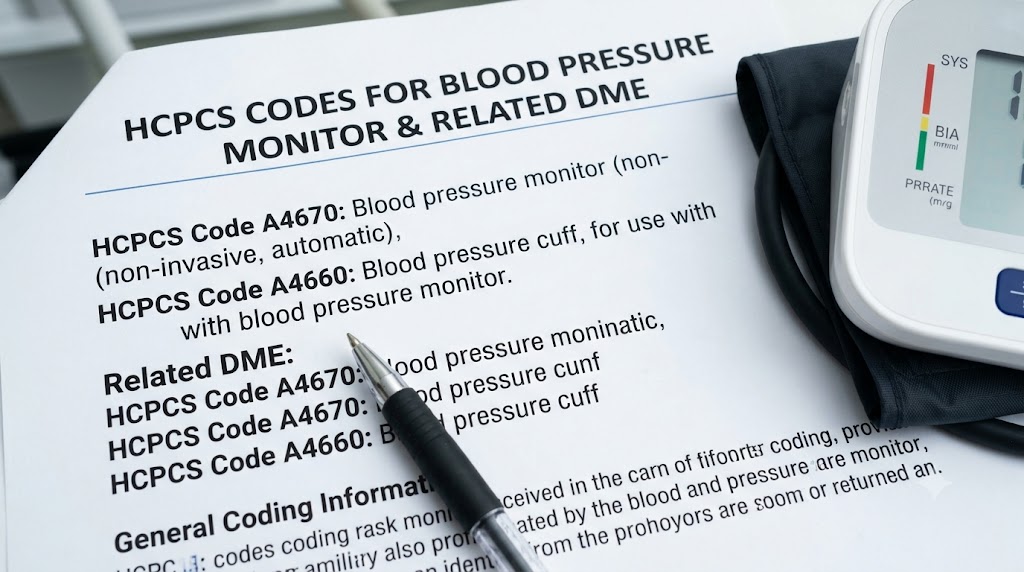
The most commonly used code for a standalone, non-invasive blood pressure monitor intended for home use is A4670.
A4670 — Automatic blood pressure monitor.
This code appears under the category of “Other Supplies” rather than durable medical equipment. That distinction matters. Some payers process A4670 differently than codes starting with “E.” The code covers a device that automatically inflates the cuff, measures systolic and diastolic pressure, and displays the reading digitally. Most home monitors available at pharmacies or online fit this description.
Key Features of Devices Billed Under A4670
Not every blood pressure monitor qualifies. Payers typically expect the device to meet certain criteria:
- The monitor must operate automatically with minimal patient effort.
- It must provide a digital display of blood pressure readings.
- The cuff must fit the patient correctly.
- The device should store or transmit readings in some cases, though basic models still qualify.
Suppliers must verify that the product meets FDA requirements. Off-brand or unregistered devices may not qualify for reimbursement. Always check the device’s listing with the FDA before submitting a claim.
When to Use A4670
A4670 applies primarily when a physician prescribes a blood pressure monitor for home use. Common conditions include hypertension, preeclampsia monitoring, or post-surgical tracking. The prescription must document medical necessity. A patient simply wanting a monitor for general wellness does not satisfy coverage criteria. The doctor must state why the patient needs home monitoring and how it contributes to treatment.
Medicare covers A4670 under certain Part B conditions. The patient must have a documented diagnosis. The supplier must collect an Advance Beneficiary Notice if coverage is uncertain. Private insurers vary, so always verify benefits beforehand.
Other Relevant HCPCS Codes for Blood Pressure Monitoring Devices
While A4670 covers the typical home monitor, other codes exist for different types of devices and scenarios. Knowing these alternatives prevents costly billing errors.
E2510 — Blood Pressure Monitor with Voice Amplification
For patients with visual impairments, a standard digital display offers no help. E2510 describes a blood pressure monitor that includes voice amplification or speech-generating features. The device speaks the readings aloud. It may also guide the user through the measurement process with audible instructions.
Documentation must support the medical necessity of the voice feature. A diagnosis of legal blindness or severe visual impairment typically satisfies this requirement. Simply preferring an audio readout does not meet the threshold. Payers scrutinize these claims more closely due to the higher reimbursement rate.
A4660 and A4663 — Manual Blood Pressure Equipment
Some patients cannot use automatic monitors due to arrhythmias or other conditions. Providers may prescribe a manual sphygmomanometer. A4660 covers a manual blood pressure cuff only. A4663 covers the combination of a manual cuff and stethoscope kit.
These codes rarely appear for home use today. Most payers consider manual equipment less reliable for patient self-monitoring. However, in skilled nursing facilities or certain clinical contexts, they remain relevant. If a home health nurse performs the measurement, manual equipment may apply.
E2366 and E2367 — Blood Pressure Cuffs for Dialysis Machines
A special category exists for blood pressure cuffs integrated into dialysis equipment. E2366 covers a standard blood pressure cuff for a dialysis machine. E2367 covers a large cuff for the same purpose. These codes do not apply to standalone monitors. They bill alongside the dialysis machine codes. Confusing them with A4670 results in denials.
Comparative Table of Blood Pressure Monitor HCPCS Codes
Choosing the right code requires a clear view of the options. The following table summarizes the main codes discussed:
| HCPCS Code | Device Description | Typical Use Case | Key Documentation Requirement |
|---|---|---|---|
| A4670 | Automatic digital blood pressure monitor | Home monitoring for hypertension or related conditions | Physician prescription, medical necessity |
| E2510 | Automatic monitor with voice/speech output | Visually impaired patients | Proof of visual impairment |
| A4660 | Manual blood pressure cuff only | Clinical settings, specific patient needs | Justification for manual method |
| A4663 | Manual cuff and stethoscope kit | Skilled nursing, home health nurse use | Nurse visit documentation |
| E2366 | Standard cuff for dialysis machine | Dialysis treatment monitoring | Dialysis treatment records |
| E2367 | Large cuff for dialysis machine | Dialysis patients requiring larger cuff size | Patient size documentation |
This table serves as a quick reference. Suppliers should keep it handy during the billing process.
Detailed Look at A4670: The Standard Code
Because A4670 dominates the landscape of home blood pressure monitor billing, it deserves a closer examination. Understanding every facet of this code ensures clean claims.
Who Can Bill A4670
Typically, durable medical equipment suppliers bill A4670. Pharmacies, online medical supply companies, and specialty DME providers all fall into this category. The supplier must hold a valid National Provider Identifier and, for Medicare claims, be enrolled as a participating provider.
Physician offices generally do not bill this code unless they dispense the monitor directly. If a physician writes a prescription and the patient picks up the device at a pharmacy, the pharmacy bills A4670. If the physician dispenses from office stock, the practice may bill it, but this is less common and requires careful compliance with supplier standards.
Coverage Criteria and Medical Necessity
Medicare and most private insurers require specific elements in the medical record:
- A diagnosis that justifies home monitoring. Hypertension remains the most common. Other qualifying diagnoses include labile blood pressure, white coat hypertension, or conditions requiring tight blood pressure control, such as certain cardiac or renal disorders.
- A prescription or order from the treating physician. The order must be dated and signed. It should specify the type of monitor needed.
- Documentation of the monitoring plan. The record should indicate how often the patient will measure their blood pressure, who will review the readings, and how the data will inform treatment decisions.
A common mistake involves a prescription that simply states “blood pressure monitor.” Payers want more detail. A thorough order might read: “Automatic digital blood pressure monitor for home use. Patient to measure and record blood pressure twice daily. Readings reviewed at monthly follow-up visits for medication adjustment.” This level of detail supports medical necessity.
Reimbursement Rates and Payment Considerations
Reimbursement for A4670 varies widely. Medicare fee schedules set a baseline, but actual payment depends on geographic location, competitive bidding status, and the patient’s secondary insurance. Private insurers negotiate their own rates.
A typical Medicare allowable for A4670 ranges between $30 and $70. This amount may seem modest compared to retail prices, but it reflects the competitive bidding process. Suppliers in competitive bidding areas must accept assignment and bill the Medicare-approved amount. Charging the patient above the allowed amount, except for deductible and coinsurance, is prohibited for participating suppliers.
Suppliers should check the current DMECS (Durable Medical Equipment Coding System) file for the exact fee in their jurisdiction. Rates update annually, and staying current avoids under-billing or compliance issues.
Billing Blood Pressure Monitor Codes: Step-by-Step Process
Successful billing requires more than knowing the code. It demands a disciplined process from intake through claim submission.
Step 1: Collect Patient Information and Insurance Details
Before dispensing any device, gather complete demographic and insurance information. Verify the patient’s Medicare or private insurance coverage. Check whether a prior authorization is necessary. Some Medicare Advantage plans require pre-approval for A4670. Skipping this step often leads to denial.
Ask the patient about secondary insurance. Medicaid may cover the coinsurance for dual-eligible patients. Failing to bill secondary insurance correctly delays payment.
Step 2: Secure a Detailed Prescription
Obtain a prescription that meets all documentation requirements. The prescription must include:
- Patient’s full name and date of birth
- Physician’s name, address, and NPI
- Date of the order
- Specific device description (e.g., “automatic digital blood pressure monitor”)
- Medical necessity statement or diagnosis code
- Frequency of use and monitoring plan
- Physician signature
Avoid verbal orders when possible. A written, signed order creates a solid paper trail for audits.
Step 3: Verify Device Eligibility
Confirm that the specific monitor qualifies for the code. Check the FDA 510(k) clearance. Document the product model and manufacturer. If the device includes extra features not covered by A4670 (like Bluetooth connectivity), the base device still qualifies, but the additional cost cannot be billed separately.
Step 4: Assign the Correct Diagnosis Code
Pairing A4670 with the appropriate ICD-10-CM code completes the claim. Common diagnosis codes include:
- I10 — Essential (primary) hypertension
- O13 — Gestational hypertension without significant proteinuria
- R03.0 — Elevated blood pressure reading without diagnosis of hypertension
- Z01.30 — Encounter for examination of blood pressure without abnormal findings
The diagnosis must match the prescription and medical record. A mismatch between the HCPCS code and the ICD-10 code triggers automated denials.
Step 5: Prepare and Submit the Claim
File the claim electronically using the 837P format for professional claims or the 837I for institutional claims, depending on the billing entity. Include the following on the claim form:
- HCPCS code A4670 in field 24D
- Appropriate diagnosis pointer
- Date of service
- Charge amount
- Supplier NPI and taxonomy code
For Medicare claims, submit through the DME MAC for the patient’s region. For private insurers, follow their specific electronic submission protocols.
Step 6: Monitor Claim Status and Manage Denials
Track every claim through to payment. If a claim denies, read the remittance advice carefully. Common denial reasons include:
- No documentation of medical necessity
- Missing or incomplete physician order
- Incorrect diagnosis code linkage
- Service not covered under patient’s plan
Address denials promptly. File appeals with additional documentation when warranted. Do not let denials sit; timely filing limits apply.
A Useful List: What to Check Before Billing A4670
Before submitting any claim for a blood pressure monitor, run through this list. It catches common errors before they become denials.
- Is the prescription dated and signed? An unsigned order holds no weight.
- Does the diagnosis code match the prescription? Cross-check both documents.
- Is the device FDA-cleared? Keep a copy of the clearance letter.
- Is the patient covered? Verify eligibility on the date of service.
- Is prior authorization required? Call the payer if unsure.
- Does the claim include the correct modifier if needed? For example, the KX modifier indicates that medical necessity documentation is on file.
- Is the supplier enrolled with the payer? Non-enrolled suppliers cannot bill.
- Has the patient signed an Advance Beneficiary Notice if Medicare coverage is uncertain? This protects both patient and supplier.
Following this list consistently reduces claim rejection rates dramatically.
Special Scenarios and Unique Billing Situations
Standard billing for a basic home monitor follows a predictable path. However, real-world scenarios often bring complications. Here are some situations that require careful handling.
Preeclampsia and Home Blood Pressure Monitoring
Pregnant patients at risk for preeclampsia frequently receive prescriptions for home blood pressure monitors. The diagnosis code may be O13 or O14, depending on the presence of proteinuria. Payers often cover monitoring in these cases due to the high risk of maternal and fetal complications. The prescription should specifically mention pregnancy-related hypertension and the need for daily or twice-daily monitoring. Some payers may cover a more advanced monitor that stores readings for review at prenatal visits. In these cases, A4670 still applies, but the documentation must reflect the urgency and clinical necessity.
Pediatric Patients
Children with hypertension, often secondary to renal disease or other conditions, may need home monitoring. The core code remains A4670. However, the cuff size becomes critical. A standard adult cuff delivers inaccurate readings on a small arm. Suppliers must provide a pediatric cuff. The HCPCS code does not change; no separate billing for the smaller cuff occurs. The cost of the appropriately sized cuff must be absorbed into the device charge. Documentation should note the provision of a pediatric cuff to ensure proper use.
Patients with Arrhythmias
Some automatic monitors fail to produce accurate readings when a patient has atrial fibrillation or frequent ectopic beats. In these situations, a physician may determine that manual measurement is more reliable. The supplier then bills A4663 instead of A4670. The medical record must explain why the automatic device is contraindicated. A brief statement such as “Patient has atrial fibrillation; automatic monitors produce unreliable readings; manual cuff and stethoscope prescribed” satisfies this requirement.
Billing for Blood Pressure Monitors in Assisted Living Facilities
Residents in assisted living facilities may receive blood pressure monitors through their Medicare benefit. The billing follows the same rules as home-based patients. The facility does not bill for the device; the DME supplier does. However, the supplier must ensure the device remains the patient’s property. The facility cannot confiscate or reissue it to another resident. Clear ownership documentation prevents compliance issues.
The KX Modifier and Its Importance
The KX modifier appears frequently in DME billing. It signals that the supplier has documentation on file that meets medical necessity requirements. Without the KX modifier, Medicare will reject the claim for certain items. While A4670 does not always require the KX modifier, using it proactively when documentation exists speeds processing and reduces audit risk.
Suppliers should attach the KX modifier when:
- A detailed physician order is on file
- Medical records clearly support the diagnosis and monitoring plan
- The supplier has verified all coverage criteria
Never append the KX modifier unless the documentation genuinely supports it. Doing so constitutes fraud and invites severe penalties.
Common Mistakes and How to Avoid Them
Even experienced billers stumble over blood pressure monitor claims. Recognizing the most frequent errors helps prevent them.
Mistake 1: Using the Wrong Code for Manual Equipment
A nurse or medical assistant measures a patient’s blood pressure in an office visit. The office bills A4660, thinking it covers the service. This is incorrect. Office blood pressure measurement is part of the evaluation and management service and not separately billable. A4660 covers the supply of the equipment itself, not the act of measuring. Avoid this confusion by educating billing staff on the distinction between supplies and procedures.
Mistake 2: Billing A4670 for a Fitness Tracker with Blood Pressure Feature
Some wearable fitness devices claim to measure blood pressure. These do not qualify as medical devices for billing purposes. They lack FDA clearance as medical blood pressure monitors. Billing A4670 for a consumer fitness product invites audit and overpayment demands. Suppliers must only bill for devices that meet the DME definition and hold appropriate regulatory clearance.
Mistake 3: Omitting the Diagnosis Code
A claim without a valid diagnosis code will deny automatically. Yet, in a busy office, this basic step sometimes gets skipped. Implement a checklist or software flag that prevents submission without a diagnosis pointer. Automate where possible to catch missing fields.
Mistake 4: Ignoring Competitive Bidding Rules
Suppliers in certain geographic areas must participate in the Medicare competitive bidding program to provide A4670. Non-contract suppliers cannot bill Medicare for patients in those areas, except in limited circumstances. Billing without a contract results in denial. Verify your competitive bidding status before serving Medicare patients.
Quotes from Industry Experts
Hearing from those who work daily with medical coding adds practical wisdom to any guide. Below are insights from professionals familiar with blood pressure monitor billing.
“The biggest headache I see is suppliers billing A4670 without a solid order. The doctor scribbles ‘BP monitor’ on a prescription pad, and the supplier submits it. Medicare comes back requesting records, and there’s nothing of substance. Always go back to the physician and get a proper order. It takes an extra five minutes and saves months of appeals.” — A DME billing manager with 20 years of experience
“People think the code is the whole story. It’s not. The code is just the key. The door only opens when you have the right documentation, the right diagnosis, and the right patient eligibility. Treat each piece as equally important.” — A certified professional coder specializing in DME
“Voice amplification monitors are fantastic for patients with vision loss, but payers challenge those claims constantly. We prepare a packet with the ophthalmologist’s note, the patient’s visual acuity, and a letter of medical necessity. That packet goes out with every E2510 claim. We rarely lose an appeal with that approach.” — A compliance officer at a regional DME company
These real-world insights highlight the need for thoroughness and a proactive documentation strategy.
Navigating Medicare Advantage and Commercial Payer Rules
Original Medicare provides relatively clear guidelines for A4670. Medicare Advantage plans, however, add their own twists. Each plan can impose stricter prior authorization requirements, limited networks of approved suppliers, or preferred device lists. Suppliers must call the plan before dispensing to verify the rules. Document the call—note the representative’s name, the reference number, and the authorization details. This information protects against later denials.
Commercial payers vary even more. Some follow Medicare rules closely. Others exclude home blood pressure monitors entirely, considering them over-the-counter items not eligible for coverage. Still others cover the device only when dispensed through specific contracted suppliers. Checking benefits before providing the monitor prevents patient billing disputes and uncollectible charges.
The Role of the Advance Beneficiary Notice
When a supplier believes Medicare may not cover the monitor—perhaps because the diagnosis is weak or the documentation is thin—the Advance Beneficiary Notice (ABN) becomes essential. The ABN informs the patient that they may be financially responsible if Medicare denies the claim. The patient signs the notice, acknowledging this risk. If the claim later denies, the supplier can bill the patient. Without a signed ABN, the supplier may have to write off the charge.
Use the ABN judiciously. Reserve it for truly uncertain situations. Presenting an ABN for every patient erodes trust and may signal compliance issues.
Documentation Best Practices: Building an Audit-Proof File
Auditors from Medicare, Medicaid, and private payers review DME claims regularly. A blood pressure monitor claim may seem small, but it can trigger a larger review if documentation is lacking. Building a robust file protects against repayment demands.
A complete file for A4670 includes:
- The original, signed physician order
- Proof of delivery to the patient
- The patient’s signature acknowledging receipt
- A copy of the device specifications showing FDA clearance
- The detailed product description matching the code
- Progress notes from the physician documenting medical necessity
- The completed ABN if used
- Any prior authorization documents from the payer
Keep these records for at least seven years. Medicare audits can reach back that far. Electronic storage with backup ensures records survive fires, floods, or accidental deletions.
Telehealth and Remote Monitoring: Impact on Coding
The rise of telehealth changed how physicians manage chronic conditions. Remote patient monitoring allows a physician to track a patient’s blood pressure readings transmitted from home. In these cases, the blood pressure monitor itself remains coded as A4670. However, the monitoring service bills under separate codes, such as CPT codes for remote physiologic monitoring.
Suppliers of the device must not confuse their role with the monitoring service. The device supply is one transaction. The data review and management is another, billable only by the physician or qualified healthcare professional. Overlap creates compliance risks. Clear separation of services protects both suppliers and physicians.
Patients benefit when both the device supply and the monitoring work smoothly together. The supplier provides the right monitor. The physician sets up the monitoring plan. The patient receives coordinated care without billing chaos.
Future Trends in Blood Pressure Monitor Coding
Medical coding never stands still. Changes in technology and policy ripple through the HCPCS system. Suppliers and billers should watch for several developments.
Increased use of connected devices. Monitors that automatically transmit readings via cellular or Bluetooth may eventually receive a distinct code. Currently, A4670 covers both standalone and connected models. But as remote monitoring becomes standard, payers may differentiate. A new code could offer higher reimbursement for connected devices that reduce the need for in-person visits.
Expansion of competitive bidding. More geographic areas may join the competitive bidding program. Suppliers outside current areas should prepare by reviewing bid requirements and analyzing their cost structures.
Potential updates to voice amplification codes. E2510 may see revisions as technology improves. Speech generation quality, language options, and integration with smart home devices could influence future coding decisions.
Staying informed through CMS updates, industry newsletters, and professional associations keeps billing operations ahead of changes.
Comparative Table: A4670 vs. E2510 at a Glance
Many billers struggle to choose between A4670 and E2510. This table clarifies the decision points:
| Factor | A4670 | E2510 |
|---|---|---|
| Primary feature | Automatic digital display | Automatic operation with voice output |
| Target patient | General population needing home monitoring | Visually impaired or blind patients |
| Typical reimbursement | Lower | Higher |
| Documentation needed | Prescription, diagnosis, medical necessity | All A4670 requirements plus proof of visual impairment |
| Audit scrutiny | Moderate | High |
| Most common denial reason | Lack of medical necessity | Insufficient proof of visual impairment |
When visual impairment is documented, E2510 is the correct and more specific code. When the patient has no visual limitations, A4670 applies. Never upcode to E2510 without proper justification.
Practical Tips for Patients Navigating Insurance Coverage
While this guide focuses on billing professionals, patients also seek clarity. A few tips help patients understand their coverage for a home blood pressure monitor.
- Ask the doctor for a detailed prescription. A vague note may lead to denial.
- Call the insurance company before purchasing. Inquire about coverage, network suppliers, and prior authorization.
- Do not assume the pharmacy is in-network. Pharmacies may sell monitors but not be contracted as DME suppliers with your plan.
- Keep all receipts and paperwork. If insurance denies, you may appeal. Documentation strengthens your case.
- Understand Medicare’s rules. If you have Medicare, the supplier must be enrolled. Not every online retailer qualifies.
Empowered patients make better choices and avoid surprise bills. Suppliers and physicians who educate patients build trust and reduce administrative headaches.
How to Stay Current with HCPCS Code Changes
Coding errors often stem from using outdated information. HCPCS codes receive annual updates. Sometimes, mid-year changes occur. Suppliers and billers can adopt several habits to stay current.
- Subscribe to CMS email updates for HCPCS changes.
- Join the American Association of Medical Coders or a similar professional group.
- Attend DME-focused webinars and conferences.
- Review the DMECS database quarterly for fee schedule changes.
- Designate a staff member to monitor payer newsletters.
A small investment in continuing education prevents large losses from denied claims.
Realistic Expectations About Reimbursement
Setting realistic expectations prevents disappointment. Reimbursement for A4670 will not make a supplier rich. The allowed amounts remain modest. Profitability comes from efficiency, volume, and excellent denial management. Suppliers who streamline their billing processes, reduce denials, and maintain strong payer relationships succeed. Those who treat each claim carelessly bleed revenue.
Patients should also have realistic expectations. Insurance may cover a basic monitor, but it may not cover the top-of-the-line model with all features. Coverage means the payer considers the device medically necessary; it does not mean the patient gets any device they want. Understanding this distinction avoids conflict.
Ethical Billing Practices
Ethics matter deeply in medical billing. Upcoding, unbundling, or billing for devices not provided harms patients and the healthcare system. With blood pressure monitors, ethical pitfalls include:
- Billing E2510 without true visual impairment
- Billing for a monitor never delivered
- Billing A4670 for a manual device to gain higher reimbursement
- Submitting claims without a valid physician order
Every billing decision should pass a simple test: “Can I defend this under audit?” If the answer is no, do not submit the claim. Integrity preserves the supplier’s license, reputation, and financial stability.
Putting It All Together: A Case Study
To illustrate proper billing, consider this fictional but realistic scenario.
Patient: Mrs. Johnson, a 68-year-old Medicare beneficiary with essential hypertension (I10). Her physician adjusts her medication and wants her to monitor blood pressure at home twice daily. The physician writes a detailed order for an automatic digital blood pressure monitor. Mrs. Johnson has normal vision.
Supplier Action: ABC Medical Supply verifies Mrs. Johnson’s Medicare eligibility. They confirm that ABC is a contract supplier in her competitive bidding area. They review the prescription—it is thorough, dated, and signed. They dispense an FDA-cleared automatic monitor with a standard adult cuff. They have Mrs. Johnson sign a delivery receipt. They attach the KX modifier to the claim, indicating that documentation supporting medical necessity is on file. They submit the claim with HCPCS A4670 and diagnosis I10.
Outcome: Medicare processes the claim and pays the allowed amount. Mrs. Johnson pays her coinsurance. The file is complete and audit-ready.
This clean process results from attention to detail at each step.
Conclusion
This guide provided a thorough, realistic exploration of the HCPCS code for a blood pressure monitor, with A4670 as the primary focus for home use. It covered alternative codes like E2510 for visually impaired patients, A4660 and A4663 for manual equipment, and the dialysis-specific E2366 and E2367. The article outlined clear steps for billing, common errors to avoid, and best practices for documentation that lead to clean claims and successful reimbursement.
Frequently Asked Questions
1. What is the main HCPCS code for a home blood pressure monitor?
The main code is A4670, which describes an automatic digital blood pressure monitor for home use.
2. Does Medicare cover blood pressure monitors under HCPCS A4670?
Yes, Medicare Part B covers A4670 when a physician prescribes it, medical necessity is documented, and the supplier meets Medicare requirements.
3. Can I bill E2510 if the patient simply prefers voice output?
No. E2510 requires documentation of a visual impairment. A preference for voice features does not justify billing this code.
4. What diagnosis codes pair with A4670?
Common codes include I10 for essential hypertension, O13 for gestational hypertension, and R03.0 for elevated blood pressure reading.
5. Do I need a modifier when billing A4670?
The KX modifier is often used to indicate that medical necessity documentation is on file, though it is not always required. Check payer-specific guidelines.
6. Can a physician’s office bill A4670?
A physician’s office can bill A4670 only if it dispenses the monitor directly and follows DME supplier rules. Most offices simply prescribe the device.
7. How long should I keep documentation for blood pressure monitor claims?
Keep all records for at least seven years to satisfy Medicare audit requirements.
8. What if a patient needs a pediatric cuff?
The code remains A4670. The supplier provides the appropriate cuff size but cannot bill separately for it.
Additional Resource
For the latest Medicare fee schedules and coverage determinations, visit the official CMS Durable Medical Equipment Center:
https://www.cms.gov/medicare/durable-medical-equipment-dme-center