
Navigating medical coding can feel like learning a foreign language. The alphanumeric jumble often creates confusion for healthcare providers, billers, and even patients trying to understand their medical statements. When it comes to frequently administered injectable antibiotics, few are as common as ceftriaxone sodium. Yet, despite its widespread use in emergency rooms, infusion clinics, and physician offices, there is persistent uncertainty surrounding the correct Healthcare Common Procedure Coding System code.
This guide aims to erase that confusion completely. We will explore every facet of billing for this essential third-generation cephalosporin. You will learn the primary code, how to apply it per Medicare guidelines, the role of the JW modifier for discarded drug amounts, and how to avoid the denials that plague so many practices. This is not a superficial overview. This is a deep, authoritative dive designed to serve as your permanent reference on the subject.
Understanding the Foundation: What is an HCPCS Code?
Before we pinpoint the specific identifier for this medication, we need to ground ourselves in the language of medical billing. Healthcare Common Procedure Coding System codes, universally abbreviated as HCPCS, represent a standardized taxonomy. The Centers for Medicare and Medicaid Services established this system to ensure uniformity in describing healthcare services, procedures, and, critically, supplies and drugs.
Think of HCPCS as the grand umbrella. Underneath it, you find two distinct levels. Level I is the Current Procedural Terminology code set. Physicians and facilities use these five-digit numeric codes to report medical procedures and services. Level II, which concerns us today, identifies products, supplies, and services not covered by CPT codes. This includes ambulance rides, durable medical equipment, prosthetics, orthotics, and the injectable pharmaceuticals administered in outpatient settings.
The typical Level II HCPCS code starts with a single letter followed by four numbers. The letter designates the chapter or category of the item. We see codes beginning with “J” specifically assigned for drugs administered other than oral methods. Chemotherapy drugs receive their own range, as do immunosuppressives. Anti-infectives, including our focus, fall squarely within the J-code family. Recognizing this structure is the first step to filing a clean claim that a payer will accept without friction.
The Exact HCPCS Code for Ceftriaxone Sodium
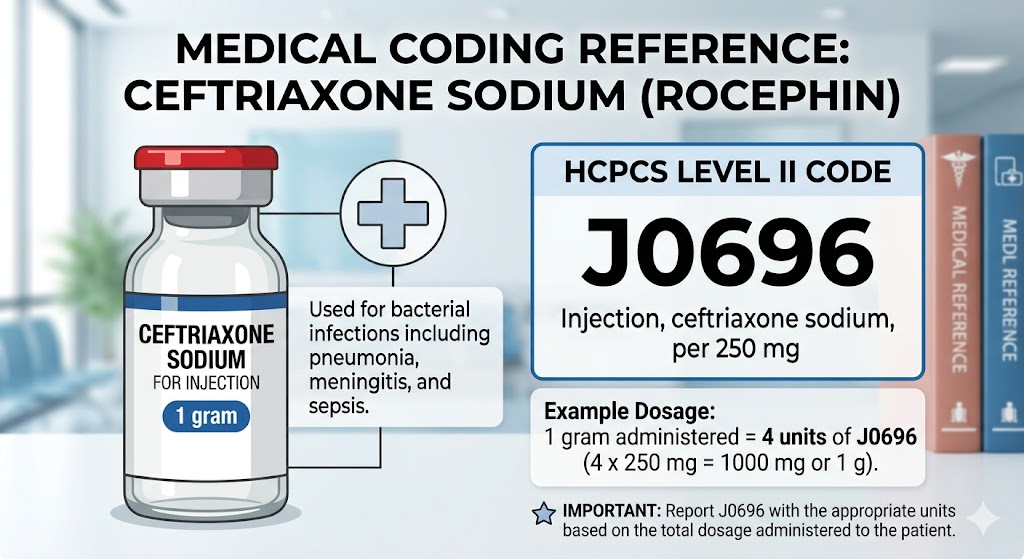
The primary identifier you seek is J0696.
Health care providers report this code for each 250 mg of ceftriaxone sodium administered via injection. This is the official descriptor established by CMS. It appears on claims submitted to Medicare, Medicaid, and private insurers who follow HCPCS conventions. The code first appeared on the national landscape in January 2004 and has remained the workhorse for billing this antibiotic ever since.
When a clinician writes an order for 1 gram of ceftriaxone to treat community-acquired pneumonia or a complicated urinary tract infection, the billing team translates that clinical order into coding language. They see 1 gram. They recognize that 1 gram equals 1000 milligrams. They see the code descriptor specifies 250 mg per unit. The mental math begins. Four units of J0696 represent that single therapeutic dose. Accurate claim construction hinges on that calculation.
Let’s pause to dispel a common point of confusion. Do not mistake J0696 for a generic injection administration code. CPT codes like 96372 describe the act of giving the injection, the syringe, the alcohol prep, the nurse’s time. The HCPCS J-code covers only the drug itself, the liquid in the vial. A complete claim for the patient encounter requires both the administration service code and the drug supply code working in tandem. Leaving one out means leaving legitimate revenue on the table.
Technical Breakdown: J0696 in Practice
Coding accuracy extends beyond memorizing an alphanumeric sequence. It demands strict attention to unit calculation and dosing documentation. A provider’s order sheet might state “Rocephin 500 mg IM now.” The coder converts this. Ceftriaxone is the generic name, Rocephin the well-known brand. 500 mg divided by the 250 mg per-unit standard equals exactly 2 units. The claim line reflects J0696 with a “2” in the units’ field.
Consider another scenario: a patient with severe cellulitis receives 2 grams intravenously in a skilled nursing facility. The order sheet says 2 g IV. That’s 2000 mg. 2000 divided by 250 equals 8 units. Are you seeing the pattern? The mathematical precision is non-negotiable. Payers build automated edits that flag claims showing mismatches between the billed units and the expected dose for the listed diagnosis. Reporting 1 unit for a pneumonia case where standard therapy demands 1 to 2 grams invites a swift denial.
The descriptor “injection, ceftriaxone sodium, per 250 mg” holds the key. Read it carefully. It does not say per vial. It does not say per dose. It says per 250 mg. A 1-gram vial reconstituted in a clinic contains four billable units. Failing to bill all four units when the full vial is administered represents a significant revenue loss. Overbilling units beyond what the clinician administered constitutes fraud. The middle path—precise, documented, defensible billing—keeps your compliance department at peace.
A Comparative Look: Ceftriaxone vs. Other Common Injectables
The world of injectable anti-infectives is vast. Coders frequently toggle between multiple J-codes within a single shift. Contextualizing J0696 against its clinical cousins helps lock the code into memory and reduces selection errors. The table below situates our primary code among other frequently reported parenteral antibiotics.
| Drug Name (Generic) | HCPCS Code | Billing Unit | Typical Adult Dose Range | Units Billed per Typical Dose |
|---|---|---|---|---|
| Ceftriaxone Sodium | J0696 | 250 mg | 1 to 2 grams | 4 to 8 |
| Ceftazidime | J0713 | 500 mg | 1 to 2 grams | 2 to 4 |
| Cefazolin Sodium | J0690 | 500 mg | 1 to 2 grams | 2 to 4 |
| Vancomycin HCl | J3370 | 500 mg | 1 to 2 grams | 2 to 4 |
| Meropenem | J2185 | 100 mg | 1 gram | 10 |
| Ertapenem Sodium | J1335 | 500 mg | 1 gram | 2 |
| Azithromycin | J0456 | 500 mg | 500 mg | 1 |
| Levofloxacin | J1956 | 250 mg | 500 to 750 mg | 2 to 3 |
A quick scan of this chart reveals a hidden danger zone: meropenem. Its billing unit is a scant 100 mg. A single 1-gram dose demands 10 units on the claim form. A coder accustomed to billing 2 units for a gram of ertapenem might accidentally bill only 2 units of meropenem by force of habit, slashing reimbursement by 80 percent for that line item. For ceftriaxone, the 250 mg unit represents a middle ground. It’s large enough to keep unit counts manageable but small enough to allow precise billing for pediatric or renal-adjusted doses.
The Revenue Integrity Perspective
Hospital revenue cycle directors view J0696 through a financial lens. They scrutinize charge capture processes. Did the nurse document the 100 mg waste from a single-dose vial? Did the pharmacy charge the correct National Drug Code that crosswalks cleanly to J0696? In the outpatient hospital setting, the chargemaster sets the price for one unit of J0696. For physician offices billing under the Physician Fee Schedule, the allowable amount depends on the average sales price plus a statutory add-on percentage.
Medicare publishes the ASP drug pricing files quarterly. Each January, April, July, and October, the reimbursement rate for one unit of J0696 may shift. A responsible billing manager downloads this file without fail. They update the practice management system. A practice billing the old rate leaves money behind or, worse, overcharges and faces a compliance risk. For a high-volume infectious disease practice, a few cents per unit difference across thousands of annual encounters compounds into a meaningful financial variance.
Private insurers often follow Medicare’s lead regarding coding structure, but their reimbursement methodologies diverge. Some negotiate a percentage above ASP. Others want the wholesale acquisition cost as a benchmark. A few capitated plans fold drug costs into an encounter rate. The biller’s eternal challenge lies in understanding the specific payer policy for J0696. The code is the constant; the payment logic is the variable. The clean claim, however, remains the universal entry ticket to reimbursement.
Claim Construction: Building a Clean Claim with J0696
A clean claim submits the first time and gets paid without human intervention. Building such a claim for a ceftriaxone injection requires seamless collaboration between clinical documentation and the billing office. Let’s walk through the anatomy of a defensible outpatient claim.
The diagnosis code must justify medical necessity. Ceftriaxone treats a broad spectrum, but payers expect a specific ICD-10-CM code that matches the pathogen and the site of infection. N39.0 for urinary tract infection, site not specified, often succeeds. J15.6 for pneumonia due to other aerobic Gram-negative bacteria works well. A41.9 for sepsis, unspecified organism, is a red flag on an outpatient claim and will trigger an edit. The coder must link the most specific diagnosis available directly to the J0696 line item.
The unit calculation must flow directly from the medication administration record. If the MAR states “1 g IVPB,” the claim must show 4 units. The administration CPT code, often 96374 for an intravenous push of a new drug, goes on a separate line. Modifiers come into play. If the provider wasted a portion of a single-dose vial, we enter the JW modifier world. If the administration occurred in the post-operative recovery room, modifier SG might be required for certain payers. The date of service must align with the actual infusion date. Simple errors, like a typo turning 4 units into 44, can result in demanding audit letters.
The JW Modifier: A Critical Compliance Element
Single-dose vials often contain more medication than a specific patient needs. The clinician draws up the prescribed 500 mg dose but a 1-gram vial is the only stock available. 500 mg goes to the patient. 500 mg remains in the vial and is discarded. Federal regulations and prudent payer contracts require providers to bill for the administered amount and the discarded amount in a highly specific way.
CMS issued a mandate effective January 1, 2017, requiring the use of the JW modifier to report discarded drug amounts from single-dose containers. The provider must document the wasted volume in the patient’s record. The claim then contains two lines for the drug. The first line, J0696, reports the administered amount (2 units for 500 mg) with no JW modifier. The second line, J0696, reports the discarded amount (2 units for 500 mg) with the JW modifier attached. Both amounts are eligible for reimbursement under most Medicare policies, though reimbursement for the discarded portion isn’t always guaranteed by commercial carriers.
Failing to use the JW modifier when required signals to an auditor that the provider either doesn’t track waste or bills inaccurately. A recovery audit contractor can extrapolate this finding across thousands of claims, creating a massive overpayment demand. Conversely, using JW on a multi-dose vial, from which the provider draws multiple doses for multiple patients, triggers a different kind of audit flag. Multi-dose vials do not generate billable waste under standard rules. The JW modifier and J0696 must dance in careful lockstep with the pharmacy’s purchasing records and the patient’s chart.
Payment Rates and the ASP System
Understanding the payment mechanism for J0696 grounds your billing in reality. Medicare does not pluck a price from the air. Section 1847A of the Social Security Act instructs CMS to pay for most Part B-covered drugs using the Average Sales Price methodology. Manufacturers submit quarterly data on their actual sales to U.S. purchasers. CMS calculates a volume-weighted average and publishes it.
The payment limit for one unit of J0696 equals 106 percent of the ASP for drugs under the Physician Fee Schedule, though the Budget Control Act sequestration temporarily adjusts that downward. For a hypothetical ASP of $1.20 per 250 mg unit, the allowed amount before sequestration hovers around $1.27. A 1-gram dose at 4 units yields an allowed amount of roughly $5.08. This may seem modest, but multiply it by a large volume of patients daily and the revenue impact becomes substantial.
It’s crucial to cross-reference the exact quarter’s ASP file on the CMS website. Let’s imagine a provider with a large infusion center serving a rural population. The oncologist there might incidentally prescribe ceftriaxone for a febrile neutropenia patient if the center doesn’t stock a preferred antibiotic. The biller must know both the oncology drug codes and J0696. The same ASP logic applies across the board. Meticulous tracking of each quarterly update protects revenue.
Common Clinical Contexts for J0696 Billing
To code well, you must grasp the clinical story. Ceftriaxone’s unique pharmacokinetics make it a favorite. Its long half-life allows once-daily dosing, a massive advantage for outpatient parenteral antibiotic therapy programs. Here are frequent settings where J0696 appears on claims.
The emergency department treats uncomplicated gonococcal infections with a 500 mg intramuscular injection. That’s 2 units of J0696, often paired with an oral dose of doxycycline or azithromycin. The emergency room coder must capture the J-code even in the chaotic pace of a 12-hour shift.
Outpatient infusion centers handle Lyme neuroborreliosis or complicated skin infections. A patient arrives daily for two weeks to receive 2 grams IV. The claim registers 8 units daily. The cumulative units across that treatment course climb quickly. The documentation must support the extended course with updated progress notes and lab monitoring.
Skilled nursing facilities under Part B may house residents receiving ceftriaxone for aspiration pneumonia. The pharmacy dispenses the drug and bills Medicare directly if it’s a Part B-covered stay. The skilled nursing facility Part B billing manual contains specific guidance on when a facility can bill J0696 versus when the drug falls under the consolidated billing package.
Pediatric Billing Nuances
Children are not simply small adults when it comes to drug dosing. Weight-based calculations govern pediatric prescribing. A 20-kilogram child with meningitis might receive 100 mg/kg/day, totaling 2 grams. That’s 8 units. An 8-kilogram infant with bacteremia receives 80 mg/kg/day, or 640 mg. The math becomes awkward. 640 mg divided by 250 mg equals 2.56 units. CMS does not permit fractional units. You must round down to the nearest whole unit.
The question of rounding direction carries compliance weight. If the drawn dose is 640 mg, the billable units from the administered portion are 2 (500 mg), with the remaining 140 mg documented as waste and billed with JW if from a single-dose vial. Overbilling 3 units for a 640 mg dose misrepresents the service. Auditors see this pattern and pounce. Pediatricians and children’s hospitals that use J0696 frequently invest in pharmacy software that auto-calculates correct units and flags mismatches before claims go out the door.
Additionally, state Medicaid programs covering children may have preferred drug lists that favor one cephalosporin over another. Even if J0696 is the correct code, a prior authorization may be necessary before the payer processes the claim. Skipping that step results in a denial, even with perfect coding and unit calculation. The clinical pharmacist often partners with the billing office to navigate these hurdles.
Medicare Administrative Contractor Specificities
Medicare doesn’t process claims in a monolithic block. Regional Medicare Administrative Contractors adjudicate claims. Each MAC issues local coverage determinations that refine national policy. A MAC in Jurisdiction J might publish an article titled “Billing and Coding: Injectable Cephalosporins.” In that article, they might reiterate the J0696 descriptor, list covered ICD-10 codes, and state their expectation for medical record documentation.
A provider in Florida under First Coast Service Options must not assume that a billing nuance accepted in Texas under Novitas Solutions applies universally. Local coverage articles create micro-climates of compliance. Savvy billing managers subscribe to their MAC’s email list. They read every update. If a MAC suddenly demands the NDC on claims for J0696 when previously it did not, the billing team responds instantly. Non-compliance risks a cascade of denials that choke cash flow.
Most MACs allow the JW modifier on a second line, as previously described. A rare few, historically, may have had different legacy instructions before the 2017 national mandate. Staying current with your specific MAC’s website is fundamental. Bookmark the page. Set a calendar reminder to check for updates monthly. Ignorance of a MAC instruction won’t shield you from a repayment demand.
National Drug Code Crosswalk
The HCPCS code J0696 serves as the billing umbrella. Beneath that umbrella, specific products from specific manufacturers carry unique National Drug Codes. The NDC identifies the labeler, product, and package size. While CMS does not typically require NDCs on physician office claims for drugs unless mandated by a state or specific program, the code crosswalk is essential for pharmacy billing and internal inventory management.
A common NDC for a 1-gram vial of ceftriaxone sodium might be 00409-4567-01, representing a specific manufacturer’s product. The hospital’s pharmacy information system maps this NDC to J0696 with a conversion factor of 4. When the nurse scans the vial at the point of care, the system knows to post 4 units to the patient’s billing account. If the pharmacy substitutes a 2-gram vial with a different NDC, the mapping must adjust. Incorrect NDC-to-HCPCS mapping is a major source of charge capture error.
Some state Medicaid agencies absolutely require NDC information on the outpatient claim. A claim for J0696 without the NDC in the designated loop or segment will reject. The back-end billing staff must understand when to pull the NDC from the pharmacy record and populate the claim form. Building a bridge between pharmacy data and the patient financial services department prevents lost charges and claim rejections.
Modifiers Beyond JW
Modifiers are two-character suffixes that provide additional information about a service without changing its basic definition. We have discussed JW for drug waste. Other modifiers affect J0696 claims in specific situations.
Consider modifier KX. Providers affix this to a claim when they meet specific medical policy requirements documented in a local coverage determination. If a MAC lists J0696 as medically necessary only for certain diagnoses and requires specific documentation in the chart, the provider attests to having that documentation on file by appending the KX modifier. Failure to append it when required leads to a denial.
Consider modifier GA. This waiver of liability statement signals that the provider issues an Advance Beneficiary Notice because they expect Medicare will deny the service as not medically necessary. If the physician decides to give ceftriaxone for a diagnosis that is never covered by Medicare and the patient signs an ABN, the claim goes out with GA on the J0696 line. This shifts potential financial liability to the patient if Medicare denies.
Consider modifier 25. A patient arrives for an office visit and receives a ceftriaxone injection. The visit is separately identifiable from the injection service. The coder attaches modifier 25 to the evaluation and management code. No modifier goes on J0696. However, understanding the interplay ensures the payer does not bundle the E&M into the drug administration reimbursement.
Common Denial Reasons and Practical Resolutions
Even the most knowledgeable billing teams encounter denials. The goal is to understand the root cause quickly and prevent recurrence.
One frequent denial reason is “Units billed exceed the maximum allowed per date of service.” This occurs when a coder misreads the descriptor and bills 1 unit for a 1-gram dose, then corrects it by adding another 3 units on a separate line, but the payer’s edit sees a cumulative 4 units and deems it excessive. The reality is that 4 units is standard for 1 gram, but the electronic edit might be calibrated incorrectly. The solution involves calling the payer, explaining the standard dosing, and often submitting a redetermination request with supporting literature.
Another common denial is “Diagnosis code not covered.” The payer lists J0696 as payable for a contracted set of diagnoses. If the physician’s stated diagnosis, like Z34.90 for supervision of normal pregnancy, appears on the claim, it will deny because a normal pregnancy is not a bacterial infection. However, if the patient actually had asymptomatic bacteriuria in pregnancy (O23.40) and the coder picked the wrong code, correcting the diagnosis resolves the denial. Internal audits should trap such mismatches before the claim goes out.
“Duplicate claim” denials happen when a corrected claim resubmission lacks the appropriate frequency code. A biller resubmits a claim to change units from 3 to 4 but doesn’t mark it as a resubmission. The payer’s system thinks it’s a duplicate and automatically rejects it. Using the correct bill frequency or resubmission code in box 22 of the CMS-1500 form is the straightforward fix.
Hospital Outpatient Department Coding: The APC Landscape
In the hospital outpatient setting, the reimbursement logic shifts from the Physician Fee Schedule to the Outpatient Prospective Payment System. J0696 usually receives a pass-through payment status or packs into the primary service depending on the year and CMS rulemaking. For many years, separately payable drugs received individual Ambulatory Payment Classifications. Recently, CMS has trended toward packaging drug costs into the primary procedure APC when the daily cost falls below a threshold.
If the hospital gives ceftriaxone as part of an emergency department visit for a level 4 patient, and the drug cost for J0696 falls below the $140 packaging threshold, CMS pays nothing separately for the drug. The reimbursement is deemed included in the payment for the ED visit. The hospital must still report J0696 on the claim for data collection and future rate-setting, but they do not receive a separate line-item payment. This reality frustrates hospital revenue cycle staff but must be accepted.
The chargemaster analyst must still keep the price for J0696 current and reasonable. Even if payment is packaged, future thresholds can change. Furthermore, if the drug is administered in a setting with no other primary separately payable service, it might become the standalone service that drives an APC payment. Understanding the annual OPPS Final Rule’s treatment of packaged drugs is a required competency for hospital outpatient coders.
Rural Health Clinics and Federally Qualified Health Centers
These safety-net providers bill under unique methodologies. An RHC or FQHC receives an all-inclusive rate per encounter. For most services, the encounter rate covers everything: the provider’s time, supplies, and injectable drugs like ceftriaxone. The clinic does not typically bill J0696 to Medicare for separate payment. Instead, the cost of the drug flows into their overall cost report and influences their future encounter rate calculation.
Some exceptions exist. If the RHC or FQHC provides a service that is not an RHC/FQHC service or if the patient has a distinct payer like a commercial insurer that reimburses line items, the clinic might bill J0696. These scenarios are niche. The coding staff at these facilities must consult their specific state Medicaid manuals and Medicare cost-reporting instructions. Billing J0696 in addition to the all-inclusive encounter rate to Medicare is a classic double-billing error that invites harsh recoupment.
The Role of Clinical Documentation Improvement
A claim for J0696 cannot survive a payer audit on coding accuracy alone. The clinical documentation must paint a complete picture. A physician note that says “infection, start ceftriaxone” is woefully insufficient. A note that says “Community-acquired pneumonia, CURB-65 score 2, sputum culture pending, start ceftriaxone 1g IV daily” is robust.
Clinical documentation improvement specialists work alongside physicians to cultivate these habits. They might ask the doctor a gentle query: “Can you specify the type and location of the pneumonia?” The physician adds “right lower lobe.” The coder now has specificity for a more refined ICD-10 code like J15.9 (unspecified bacterial pneumonia) or J13 (pneumonia due to Streptococcus pneumoniae) if later lab results confirm it. The tighter the link between the documented infection and the use of J0696, the less friction the claim encounters.
Documentation must also capture wasted drug amounts. “1-gram vial used, 500 mg given, 500 mg discarded” is the gold standard. Without this notation, the coder cannot defensibly add a JW modifier line. In a busy clinic, nurses often neglect this step. Creating a stamp, a quick checkbox in the EHR, or an automated prompt reduces this failure rate drastically.
Telemedicine and J0696: An Unlikely Pairing
We must address a contemporary question: can a provider bill J0696 for a drug ordered during a telehealth visit? The answer generally is no, because the HCPCS code represents the drug itself administered by a healthcare professional. If the provider electronically sends a prescription for ceftriaxone to a retail pharmacy, the pharmacy bills the patient’s drug benefit plan, not Part B. The distant prescriber does not bill J0696.
If a home health nurse visits the patient’s home during a telehealth consult and administers a ceftriaxone injection that the nurse brought with them, the home health agency bills for the visit and the drug separately under Part B home health rules. The telehealth physician bills only for the telehealth visit. The drug remains tied to the site of physical administration. This distinction prevents confusion in an increasingly virtual care landscape.
Coding Audits: Preparing Your J0696 Claims for Review
Assume that an auditor will scrutinize your J0696 claims. Preparing proactively prevents sleepless nights. Pull a random sample of 30 claims each quarter. Review the medical record against what you submitted. Check the following items without exception.
First, verify the physician’s order. Is it signed and dated? An unsigned verbal order without authentication is a deficiency. Second, verify the medication administration record. Does the documented dose in milligrams match the billed units? Recalculate the math manually. Third, look for the diagnosis code. Is it in the chart and does it reasonably support the use of a third-generation cephalosporin? Fourth, if you billed JW, is there a waste notation? Is it for a single-dose vial?
Document your audit findings. If you discover a 10 percent error rate where 3 out of 30 claims had mismatched units, implement immediate corrective action. This might involve re-educating the nursing staff on documenting waste or retraining the billing team on unit calculation. Correct the known erroneous claims with your MAC. Voluntary disclosure of minor errors builds goodwill compared to the adversarial posture of a RAC audit finding major errors.
Specialty Pharmacy and White Bagging
Some commercial insurers mandate that patients obtain injectable medications from a designated specialty pharmacy, a process called white bagging. The insurer’s preferred specialty pharmacy ships the ceftriaxone vial directly to the physician’s office or clinic. The clinic stores it and administers it. The pharmacy bills the drug under the pharmacy benefit, and the clinic bills only the administration fee. In this scenario, the clinic does not bill J0696 at all.
This model shifts financial risk and tracking complexity. The clinic must maintain a separate inventory of white-bagged drugs. They must ensure the NDC of the shipped product matches the patient and the insurer’s records. If a white-bagged vial gets damaged, the replacement process is convoluted. Coders in clinics engaged in white bagging must clearly flag the account so the billing system does not automatically charge J0696, which would result in a duplicate drug billing and a payer accusation of fraud.
International Perspectives: Coding Outside the U.S.
This guide focuses on the American HCPCS framework. However, a brief look abroad provides perspective. In Australia, the Medicare Benefits Schedule uses different item codes. In Canada, provincial health plans have their own billing manuals. In the UK, hospitals use OPCS codes and tariff-based payment for drugs in outpatient settings often follows a high-cost drug exclusion list. The granularity of billing units seen in HCPCS is somewhat unique to the U.S. system’s fee-for-service architecture.
For a multinational healthcare organization, standardizing charge capture for ceftriaxone across borders requires mapping HCPCS J0696 to the appropriate local code in each country’s enterprise resource planning system. This is a task for global revenue cycle teams, not individual billers. However, appreciating that J0696 is not universal prevents mistakes when interpreting international claims data.
Technology’s Role in Accurate Coding
Modern electronic health record systems embed coding logic into the workflow. When a physician enters an order for ceftriaxone 1g IV, the system can auto-populate the charge with J0696 and 4 units. This reduces manual selection error. However, technology introduces its own failure modes. A poorly maintained charge description master can map the drug to an obsolete or incorrect code. An update from the EHR vendor might inadvertently change the billing unit conversion factor.
Revenue cycle analysts must test the EHR after every upgrade. They enter a mock order for ceftriaxone and trace the charge all the way to the claim scrubber. They verify the units and the presence of the NDC. They ensure the JW modifier is available for selection. This hands-on testing catches systemic errors before they affect hundreds of patients. Trusting technology without verification is a betrayal of the revenue integrity mission.
Additionally, computer-assisted coding tools powered by natural language processing can read the physician’s note and suggest J0696. These tools require ongoing tuning. They might misinterpret “start ceftriaxone” in the “Plan” section as an administered drug when the patient actually received the first dose in the emergency department whose bill is separate. Human coder oversight of AI suggestions remains essential.
The Financial Impact of a Single Unit Error
Let’s quantify a unit error to underscore why this matters. Assume a busy urgent care center bills an average of 20 units of J0696 per day. The practice erroneously bills 1 unit for each 500 mg dose instead of 2, because a mistrained staff member thinks J0696 is “per 500 mg.” That’s a 50 percent undercharge on every administration. At a hypothetical reimbursement of $1.27 per unit, the daily loss is $25.40. Annually, across 312 operating days, that’s a $7,924.80 loss from a single code for a single antibiotic.
Now reverse it. The practice overbills by 1 unit consistently. The claims go out, get paid, and later an auditor reviews a sample. The extrapolated overpayment and the associated penalties could easily run into tens of thousands of dollars. The stark math clarifies why precision with J0696 is a core financial and compliance objective, not a tedious clerical detail. The coder entering units wields enormous financial agency with each click.
Patient Transparency and the J-Code
Patients increasingly demand price transparency. They may receive an explanation of benefits listing J0696 and ask, “What is this?” The billing office must be ready to explain in plain language. “J0696 is the code the insurance industry uses for the ceftriaxone antibiotic you received as an injection. It was necessary to treat your infection.” A confused patient can escalate to complaints, bad debt, or online reviews maligning the practice.
Proactive communication helps. Some practices provide a patient-friendly billing sheet at checkout listing the generic name next to the code. “Ceftriaxone injection (J0696) – units representing your 1-gram dose.” This small gesture demystifies the statement. In an era where patients shoulder greater cost-sharing via high-deductible health plans, trust and transparency are currency. Helping patients understand what they paid for increases satisfaction and reduces collection cycles.
Compounding Pharmacies and J0696
An unusual scenario arises when a compounding pharmacy prepares a mixture using ceftriaxone in a sterile elastomeric pump for continuous infusion. The final product is not a standard FDA-approved vial. How does one code this? Typically, one does not use J0696 directly. The compounding pharmacy bills for its service and ingredients, often using codes for the infusion device and not a simple J-code. If a physician purchases the compounded product and administers it in the office, they face a coding dilemma. Many commercial payers have policies that consider compounded drugs not separately billable beyond the ingredient cost, which might be reported with a miscellaneous J-code like J3490, not J0696.
This area is fraught with payer-specific guidance. A provider should request a pre-determination before administering a compounded ceftriaxone product. The documentation must include the formulation, the clinical rationale for compounding over a standard infusion, and an itemized breakdown of costs. Using J0696 for a compounded pump almost guarantees a denial, because the payer will correctly note that the administered item was not a standard 250 mg unit dose of the single drug.
Working with the ASP Pricing Files
Let’s drill deeper into the practical use of the CMS ASP pricing files. The downloadable Excel spreadsheet lists J0696 along with its payment limit. The file also includes a column for the ASP itself and sometimes the wholesale acquisition cost. A billing manager might observe that the ASP has declined for three consecutive quarters. This indicates market competition from generic manufacturers.
They might also notice a footnote indicating that the drug is subject to a Competitive Acquisition Program in certain regions historically. While the CAP for Part B drugs is largely defunct, older references still circulate. It is critical to ensure you are working from the most current file and not a draft version. Bookmarking cms.gov/medicare/medicare-part-b-drug-average-sales-price is non-negotiable.
If your practice uses a clearinghouse, the clearinghouse software typically updates the allowable automatically. But should you trust it blindly? No. Run a comparison report. Bill a dummy claim and see how the payer adjudicates the allowed amount. If the allowed amount per unit does not match the ASP plus 6 percent minus sequestration, investigate immediately. A payer may have an outdated fee schedule loaded. This proactive reconciliation catches underpayments that static processes miss.
Distinguishing J0696 from Local Anesthetics and Other Mixing Agents
Sometimes, a provider administers ceftriaxone with lidocaine for intramuscular injection to reduce pain. The lidocaine is a separate drug with a separate HCPCS code, such as J2001 for injection, lidocaine HCl. The claim should have two drug lines: J0696 for the ceftriaxone and J2001 for the lidocaine. Never bundle the lidocaine units into the J0696 unit count. This is a fundamental coding error. The nurse documents the exact milligrams of each drug. The coder calculates units separately. The lidocaine line has its own JW considerations if waste occurs.
The saline or sterile water used to reconstitute the powder is considered a supply and integral to the injection administration service. There is no separate HCPCS code for the diluent. The CPT administration code covers the syringe, needle, alcohol, and diluent. Trying to unbundle saline as a separate supply line item triggers an automatic edit and marks the coder as in need of retraining.
Lessons from the Office of Inspector General
The OIG periodically releases reports targeting Part B drug payments. While I cannot reference a specific report number here, history shows the OIG often identifies cephalosporin billing as an area with significant overpayment due to incorrect unit counting. Their methodology involves examining claims where the number of J0696 units billed for a single date of service exceeds a statistically improbable threshold. They then request the medical records and recalculate.
A classic OIG finding: a physician routinely administers 500 mg but bills for 1 gram (2 units versus 4) because they mistakenly bill per vial, not per dose. Or a provider bills for the entire vial content even when administering a smaller dose and fails to document waste, effectively billing for discarded drug without the JW modifier and often without a single-dose vial designation. Reading the OIG’s public reports and implementing their recommendations in your compliance plan is a proactive defense.
Your compliance officer should conduct an annual risk assessment focusing on J0696 and other high-volume injectables. The assessment asks: Do we have a policy on unit billing? Do we audit it? Is the policy enforced? Documenting this process demonstrates a good-faith effort to comply, which reduces liability under the False Claims Act should an error occur.
The Future: Value-Based Care and Drug Coding
The shift toward value-based payment models and bundled episodes will likely transform how J0696 is used. In a bundled payment for a pneumonia admission, the hospital receives a single payment for the entire episode, including all drugs. J0696 becomes a cost element rather than a revenue driver. The hospital still tracks utilization via the HCPCS code to understand its internal cost, but the external billing significance diminishes.
In the oncology care model and other outpatient bundles, a similar dynamic may emerge for supportive drugs like ceftriaxone. The coding might pivot entirely to tracking and quality measurement. A hospital that administers ceftriaxone when a narrower-spectrum antibiotic would suffice might see a quality metric flag. The data encoded by J0696 units will feed algorithms that evaluate provider efficiency. The unit precision remains vital for data integrity, even if direct line-item payment fades.
A Comprehensive Step-by-Step Billing Workflow
Let’s synthesize this knowledge into a repeatable daily workflow. This is the blueprint for your team’s desktop reference.
Step one: The clinician evaluates the patient and documents the infection diagnosis with specificity. They write an order for ceftriaxone with dose, route, and frequency.
Step two: The nurse reviews the order, selects the appropriate vial from the Pyxis or pharmacy stock, and prepares the dose. The nurse documents in the MAR exactly how many milligrams were administered and how many milligrams were discarded from a single-dose vial, if any.
Step three: The charge capture system, whether automated or manual, translates the administered milligrams into units of J0696 based on the 250 mg per unit descriptor. It assigns the diagnosis pointer to the relevant ICD-10 code. It flags the JW line if waste is documented.
Step four: The biller or coding specialist reviews the charge in the scrubber before claim submission. They ask: Is the unit math correct? Is the diagnosis linked? Are modifiers present and correct? They check the payer’s specific policy requirements, including any prior authorization or NDC mandates.
Step five: The claim is released. Post-payment, the payment posting team verifies the allowed amount per unit matches the expected ASP or contracted rate. Underpayments are appealed. Overpayments are refunded. The loop closes with a quarterly audit sampling.
Final Thoughts on Mastering J0696
Mastery of the ceftriaxone sodium HCPCS code represents a microcosm of excellence in medical coding. It demands technical precision, clinical literacy, regulatory awareness, and financial acumen. The code J0696 is a seemingly simple string of five characters, but behind it lies a world of policy, pharmacology, and patient care. When you code it correctly, you honor the clinical work of the provider and protect the financial health of the organization.
Keep this guide within arm’s reach. Share it with new hires. Use it as a training tool during annual compliance education. The goal is to make accurate J0696 billing as instinctive as breathing for your revenue cycle team. When the next quarterly ASP update arrives, when the next MAC article is published, when the next OIG report drops, you’ll be ready.
Conclusion
This article provided a comprehensive roadmap for the HCPCS code J0696, detailing its unit-of-measure basis, modifier requirements, and real-world application. You learned how to build a clean claim, calculate units precisely, and apply the JW modifier for discarded ceftriaxone. With a thorough understanding of payer policies, ASP pricing, and audit risk, you can now bill for this essential antibiotic with complete confidence and accuracy.
Frequently Asked Questions
What is the HCPCS code for ceftriaxone sodium?
The HCPCS code for ceftriaxone sodium is J0696. This code describes an injection of ceftriaxone sodium per 250 mg.
How do I calculate billing units for J0696?
Divide the total administered milligrams by 250. A 1-gram (1000 mg) dose equals 4 units. Always document the exact milligram dose in the chart.
Can I bill for ceftriaxone waste using the JW modifier?
Yes. If you use a single-dose vial and discard a portion, report the administered amount on one line with J0696 and the discarded amount on a second line with J0696 and the JW modifier.
What is the current Medicare reimbursement rate for J0696?
Medicare updates the rate quarterly based on the Average Sales Price file. Check the latest ASP pricing file on the official CMS website for the exact per-unit allowable amount.
Is J0696 used for Rocephin?
Yes. Rocephin is the trade name for ceftriaxone sodium. Providers report the generic product and the brand product using the same HCPCS code, J0696, unless the payer directs otherwise.
Additional Resource
Centers for Medicare & Medicaid Services: Part B Drug Average Sales Price
Access the official quarterly ASP pricing files to verify the current Medicare payment limit for J0696 and all other Part B-covered drugs.
https://www.cms.gov/medicare/medicare-part-b-drug-average-sales-price
Disclaimer:
This article provides general information regarding HCPCS coding and is not a substitute for professional coding advice, legal counsel, or official payer policy. Coding requirements change frequently and vary by payer and jurisdiction. Always verify current guidelines with your specific Medicare Administrative Contractor, commercial payer contracts, and certified professional coders.


