Navigating the world of medical billing requires precision. A single wrong digit can mean the difference between a paid claim and a rejected one. When you are dealing with injectable drugs in a physician’s office, hospital outpatient department, or ambulatory surgery center, the Healthcare Common Procedure Coding System (HCPCS) becomes your daily language.
This guide focuses specifically on the HCPCS code for ampicillin. We will dissect the exact codes you need, the billing units, the common pitfalls, and the documentation requirements. We aim to make you confident in submitting clean claims for this common antibiotic. Whether you are a professional coder, a biller, a practice manager, or a clinician wanting to understand the business side, this resource serves you.
We will explore not just the code for ampicillin sodium alone, but also the code for the combination drug ampicillin-sulbactam. These two medications, while related, have distinct codes. Confusing them is a classic error that delays reimbursement. By the end of this deep dive, you will know the correct HCPCS codes, how to calculate units based on the National Drug Code (NDC), and how to align your claims with Medicare administrative contractor guidelines.
Understanding HCPCS Codes and Injectable Drugs
The Healthcare Common Procedure Coding System (HCPCS) Level II is a standardized set of codes. Healthcare providers use these codes to bill Medicare, Medicaid, and private insurers for services, supplies, and drugs not covered by CPT codes. For injectable medications like ampicillin, HCPCS codes are essential. They identify the drug, the dosage, and the route of administration.
The Difference Between CPT and HCPCS Codes
Many people blur the line between Current Procedural Terminology (CPT) codes and HCPCS Level II codes. A clear distinction matters.
CPT codes, maintained by the American Medical Association, describe medical procedures and services. A physician uses a CPT code to bill for an office visit or a surgical procedure. HCPCS Level II codes, often just called HCPCS codes, identify products, supplies, and services not included in the CPT system. The Centers for Medicare & Medicaid Services (CMS) maintains the HCPCS Level II set.
Ampicillin falls squarely into the HCPCS Level II territory. The code for the drug itself begins with the letter “J.” These J codes populate the drug section of the HCPCS manual. Payers expect to see a J code for the ampicillin product, and a separate CPT code for the administration service, if the provider performs the injection.
Key Concept: The HCPCS code for ampicillin represents the drug supply. The CPT code for an injection represents the work of administering that drug. You must report both if the physician’s practice purchases and administers the medication.
Why Accurate HCPCS Coding for Ampicillin Matters
Correct coding for ampicillin impacts more than just the claim. It influences your practice’s financial health, audit risk profile, and patient care perception.
Ampicillin claims that use the wrong HCPCS code face a swift denial. Resubmitting claims costs staff time and delays cash flow. A pattern of incorrect J code billing can trigger a payer audit. An auditor might scrutinize not just ampicillin claims, but a broader sample of your drug billing.
Accurate coding also supports clinical data integrity. Public health researchers and antibiotic stewardship programs analyze claims data. They track antibiotic usage patterns, resistance trends, and adverse events. A miscoded Unasyn claim that should be an ampicillin claim corrupts that data set. Your precision contributes to better population health analytics.
The Primary HCPCS Code for Ampicillin Sodium
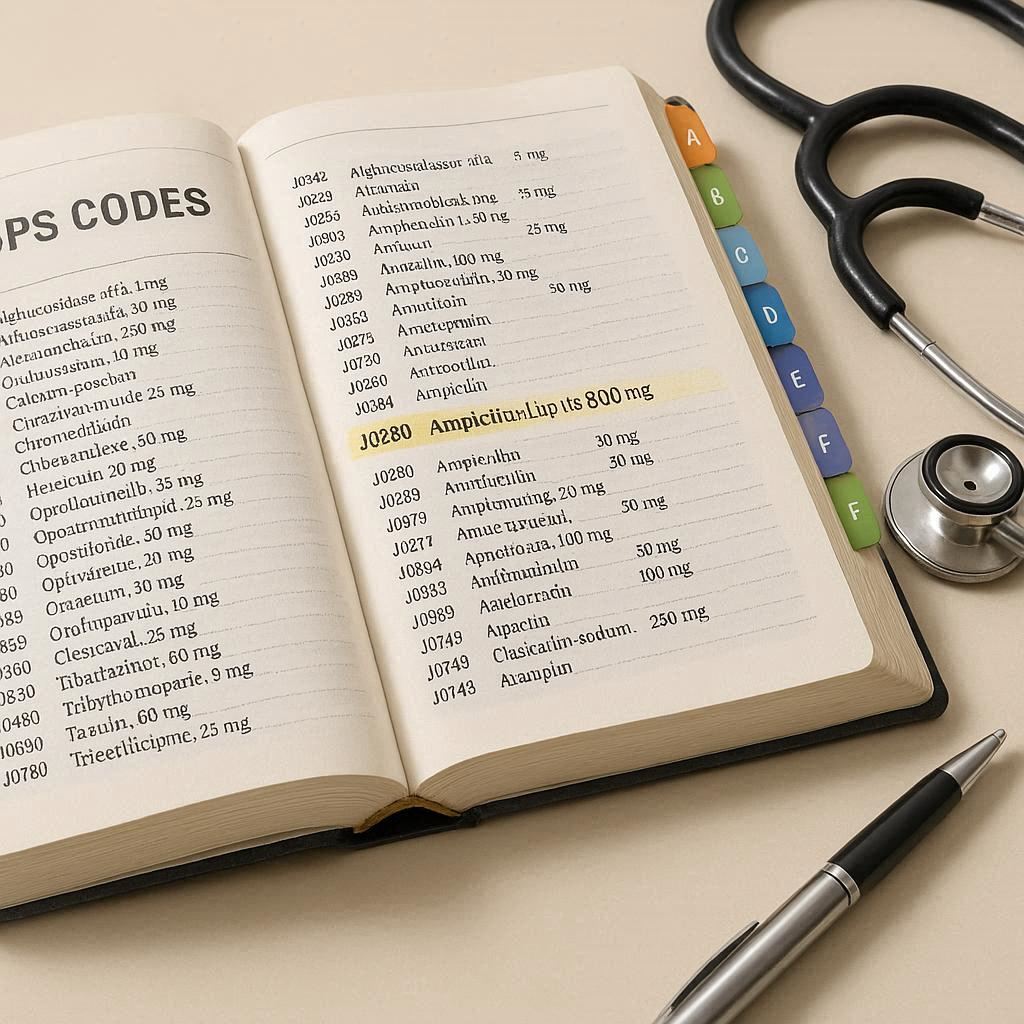
Let’s get to the exact answer you came for. The primary HCPCS code for ampicillin sodium injection is J0290. This code represents “Injection, ampicillin sodium, 500 mg.” The dosage descriptor is the critical piece of information here. The code covers 500 milligrams of the drug. If you administer a different amount, you must adjust your billing units mathematically.
J0290: Detailed Breakdown and Billing Unit
J0290 is a long-standing code in the HCPCS set. It has been the standard identifier for ampicillin sodium for many years. The full code descriptor reads: “Injection, ampicillin sodium, 500 mg.”
This means the billing unit is 500 mg. When you look at the claim form, the units field represents the number of 500 mg increments you administered. This concept trips up many new billers. You do not bill “1 unit” for a 1-gram dose. You bill “2 units” because 1 gram equals 1000 milligrams, and 1000 divided by 500 equals 2.
Let’s illustrate this with a table showing common doses and the correct billing units for J0290.
| Administered Dose of Ampicillin Sodium | Total Milligrams | Calculation (Total mg / 500 mg) | Units of J0290 to Bill |
|---|---|---|---|
| 250 mg | 250 mg | 250 / 500 | 0.5 |
| 500 mg | 500 mg | 500 / 500 | 1 |
| 1 gram | 1000 mg | 1000 / 500 | 2 |
| 2 grams | 2000 mg | 2000 / 500 | 4 |
Important Note on Decimal Units: Many payers, including Medicare, do not allow fractional billing units for J0290. A 250 mg dose would often be non-billable under the J-code system because you cannot bill 0.5 units. In this scenario, the provider might need to waste the remaining 250 mg from a single-dose vial and bill for the full 500 mg unit, if documentation supports the wastage. Always check your specific payer’s policy on fractional billing. Some may allow it for J0290, but it is rare. The safest path involves using the most appropriate vial size and documenting any unavoidable wastage.
NDC-to-HCPCS Crosswalk for Ampicillin Sodium
The National Drug Code (NDC) is the FDA’s identifier for specific drug products. The HCPCS code is the billing identifier. You need a crosswalk between the two to ensure you are billing the correct HCPCS code for the specific product you have on your shelf. A single HCPCS code like J0290 can map to dozens of NDCs from different manufacturers.
Medicaid programs and many commercial payers now require NDC reporting alongside the HCPCS code. You will submit the J0290 code, the correct NDC, the NDC unit of measure, and the NDC quantity.
Below is a sample crosswalk. Note that NDCs change frequently as manufacturers enter and exit the market. Always verify the NDC on your actual vial or package against a trusted database.
| HCPCS Code | NDC Labeler Code | Product Description | NDC Unit of Measure |
|---|---|---|---|
| J0290 | 00409-2232 | Ampicillin Sodium 1 g Add-Vantage Vial | ML |
| J0290 | 00409-2244 | Ampicillin Sodium 2 g Vial | ML |
| J0290 | 00781-3407 | Ampicillin Sodium 500 mg Vial | ML |
| J0290 | 00781-3408 | Ampicillin Sodium 1 g Vial | ML |
| J0290 | 00781-3409 | Ampicillin Sodium 2 g Vial | ML |
When filling out a claim form, the NDC quantity calculation uses the NDC unit of measure. If the NDC unit is ML, you calculate the total milliliters of reconstituted drug administered. This step requires attention to the drug’s concentration after reconstitution. We will cover NDC billing math in a dedicated section later.
Medicare Administrative Contractor (MAC) Coverage for J0290
Medicare coverage for ampicillin hinges on medical necessity. MACs publish Local Coverage Determinations (LCDs) that specify which diagnoses support payment. A claim for J0290 without a covered diagnosis will almost certainly be denied.
Ampicillin is a penicillin-class antibacterial. MACs generally cover it for infections caused by susceptible strains of bacteria. You will see coverage for respiratory tract infections, urinary tract infections, bacterial meningitis, and certain gastrointestinal infections, among others. The LCD will list covered ICD-10-CM codes. Always check your jurisdiction’s LCD for the most current list.
For example, a patient with bacterial pneumonia due to an organism sensitive to ampicillin may be covered. A patient receiving ampicillin for a viral illness will not be covered. The medical record must clearly document the infection and the medical necessity for this specific antibiotic.
Pro Tip: Bookmark your MAC’s website. Before billing J0290 for a new indication, do a quick LCD search. Type “ampicillin” into the LCD search bar. Review the policy document. This simple habit prevents a significant percentage of medical necessity denials.
The HCPCS Code for Ampicillin-Sulbactam (Unasyn)
Ampicillin is often combined with sulbactam, a beta-lactamase inhibitor. Sulbactam has little direct antibacterial activity on its own. Its job is to protect ampicillin from destruction by certain bacterial enzymes. This combination extends ampicillin’s spectrum of activity to include beta-lactamase-producing strains of Staphylococcus aureus, Haemophilus influenzae, and Bacteroides fragilis, among others. The brand name for this combination is Unasyn.
The HCPCS code for this combination drug is not J0290. It is J0295. The code descriptor is “Injection, ampicillin sodium/sulbactam sodium, per 1.5 g.”
J0295: Detailed Breakdown for Unasyn Billing
J0295 has a different billing unit structure than J0290. While J0290 is per 500 mg of ampicillin alone, J0295 is per 1.5 grams of the combination product. The 1.5-gram total represents 1 gram of ampicillin plus 0.5 grams of sulbactam. This 2:1 ratio is standard for the commercial product.
You must calculate your units based on the total weight of the combination drug, not just the ampicillin component. A standard single-dose vial of Unasyn contains 3 grams of total drug (2 g ampicillin + 1 g sulbactam).
The table below clarifies the unit calculation for J0295.
As with J0290, fractional billing for J0295 is typically not accepted. A 375 mg dose, which might be used in a pediatric patient, presents a billing challenge. The claim would show 0.25 units, which most claims processing systems will reject. In this case, you would need to contact the payer for guidance or explore alternative billing methods like using a pharmacy benefit. Some providers will bill 1 unit with documentation of the wasted portion, but payer policies vary dramatically on this practice. We strongly advise confirming the payer’s wastage policy in writing before billing for discarded drug.
Comparing J0290 and J0295: A Side-by-Side Analysis
Mixing up J0290 and J0295 is one of the most common drug coding errors we see. They sit adjacent in the code book, they share a root drug name, and they treat similar infections. Let’s put them side by side to eliminate any confusion.
Memory Aid: J0290 is the “5” code (500 mg). J0295 is the “15” code (per 1.5 g). Think 5 for 500, 15 for 1.5. This little numeric trick prevents transposition errors.
Administration Codes to Pair with Ampicillin HCPCS Codes
A complete claim for an ampicillin injection requires more than just the drug code. You must also report the administration service. For intravenous (IV) infusions and intravenous pushes in the facility setting, CPT codes rule. For injections (intramuscular or subcutaneous) and for certain outpatient settings, you may use CPT codes for therapeutic injections, or the facility may use their own revenue codes on a UB-04 claim form. We focus here on the most common professional and outpatient facility coding scenarios.
Intravenous Infusion and Injection CPT Codes
When a clinician administers ampicillin intravenously, the service qualifies as a therapeutic infusion. CPT codes from the 96360-96379 range apply. The specific code depends on the duration of the infusion and whether it is the initial or sequential service.
The most common administration codes paired with J0290 or J0295 include:
- 96374: Intravenous push, single or initial substance/drug. If the nurse pushes ampicillin over a few minutes via a syringe, this is the correct CPT code.
- 96365: Intravenous infusion, for therapy, prophylaxis, or diagnosis; initial, up to 1 hour. If ampicillin is mixed in a minibag and infuses over 30 minutes, this is the initial service code.
- 96366: Intravenous infusion, each additional hour. If the infusion runs beyond the first hour, add this code for each additional hour or part thereof.
- 96375: Intravenous push, each additional sequential drug. If ampicillin is the second or third IV push drug through the same line, this add-on code applies.
The hierarchy is important. An infusion for 20 minutes is still an infusion, not a push, if it uses a bag and tubing. A true IV push happens via a syringe directly into a running line or a saline lock. Consult CPT guidelines for the precise definitions of push vs. infusion.
Intramuscular Injection Reporting
Ampicillin can also be given by intramuscular (IM) injection. The appropriate CPT code is 96372, “Therapeutic, prophylactic, or diagnostic injection; subcutaneous or intramuscular.” This code covers the administration work. You bill 1 unit of 96372 per IM injection session, regardless of the number of punctures, provided all injections are the same drug. The drug itself still bills with the J0290 code.
NDC Billing for Ampicillin: A Step-by-Step Guide
We touched on NDC codes earlier. Now we must dig deeper. NDC reporting has become a standard requirement for physician-administered drugs across state Medicaid programs and many commercial payers. The NDC identifies the exact product, manufacturer, and package size. This allows payers to calculate rebates under the Medicaid Drug Rebate Program and to track drug utilization precisely.
Finding the Correct NDC for Your Ampicillin Product
The NDC on your claim must match the NDC on the vial or package you used. You cannot copy an NDC from a spreadsheet and hope it’s correct. The physical product in your inventory is the source of truth.
Walk to your medication storage area now. Pick up a vial of ampicillin or ampicillin-sulbactam. The NDC is on the label. It may be on the vial itself or on the outer carton. A standard NDC has three segments separated by dashes: the labeler code (manufacturer), the product code, and the package code. The format is typically 5-4-2 digits, but it can also be 4-4-2 or 5-3-2.
The 11-digit NDC without dashes is what you will enter into the claim form. Remove all hyphens, spaces, and special characters. If an NDC is 00409-2232-01, the 11-digit format is 00409223201. For a 4-4-2 NDC like 0781-3407-95, the 11-digit format is 07813407095. A leading zero is required in the appropriate segment to create the 5-4-2 structure. Most practice management software systems now do this conversion automatically, but it is wise to verify.
Calculating NDC Units for Claim Submission
The NDC unit of measure and NDC quantity field cause more confusion than any other part of drug billing. The HCPCS unit is 500 mg for J0290. The NDC unit is typically milliliters (ML) for a liquid injectable. You must calculate the volume of reconstituted drug you administered and report that volume as the NDC quantity.
Here is a step-by-step process for a typical 1-gram dose of ampicillin sodium:
- Identify the NDC unit of measure from the code set. It will be ML.
- Check the reconstitution instructions on the vial label. A 1-gram vial might state: “Add 3.5 mL of Sterile Water for Injection. Resulting concentration: 250 mg/mL.” The total volume after reconstitution is 4 mL.
- Calculate the volume for the desired dose. You need 1 gram (1000 mg). At 250 mg/mL, you need 1000 / 250 = 4 mL.
- The NDC quantity you bill is 4. You enter “4” in the NDC quantity field, and “ML” in the unit field.
Critical Warning: Always use the concentration AFTER reconstitution, not the amount of diluent added. Some vials have a powder volume that adds to the total final volume. The package insert will give you the exact total volume. If you administer 2 grams from a 2-gram vial that reconstitutes to 8 mL total, your NDC quantity is 8 mL.
For a 3-gram dose of Unasyn, the process is similar. A 3-gram Unasyn vial might reconstitute to approximately 10 mL total. If you draw up and administer the entire 3 grams, the NDC quantity is 10 ML. If you draw up only half (1.5 grams), the NDC quantity is 5 ML. Your HCPCS unit for that half-dose would be 1 unit of J0295 (since 1.5 g / 1.5 g = 1 unit). The NDC quantity and HCPCS units are two independent math problems on the same claim line. They must both be correct.
Modifiers Relevant to Ampicillin Claims
Modifiers provide additional context to a HCPCS or CPT code. They can indicate that a service was distinct, that a drug was wasted, or that a specific policy applies. For ampicillin claims, one modifier stands out: the JW modifier for discarded drug.
The JW and JZ Modifiers for Drug Wastage
Medicare and many other payers require you to report wastage of single-dose vials or single-use packages. This policy applies to ampicillin, which typically comes in a single-dose vial. Once you pop the top on a sterile vial, you cannot save it for another patient. Any drug you draw up but do not administer is discarded. You can bill for this unavoidable waste under specific rules.
The policy works as follows:
- JW Modifier: You append this to a separate claim line to identify the amount of discarded drug. One line is for the administered dose with no JW modifier. A second line is for the discarded amount, using the JW modifier. You do not charge extra for this service; the claim line for the discarded amount has no associated charge.
- JZ Modifier: Effective July 1, 2023, Medicare requires the JZ modifier on a single claim line when no drug was discarded from a single-dose container. This attests that you used every drop. If you bill for a 500 mg dose from a 500 mg vial, you report J0290 with the JZ modifier to say “no waste.”
Example for J0290 with Waste:
A physician orders 1.5 grams of ampicillin. You have two 1-gram vials. You reconstitute both. From Vial 1, you use the full 1 gram. From Vial 2, you use 500 mg and discard the remaining 500 mg.
- Line 1: J0290 x 2 (administered dose of 2000 mg, but wait, the order is 1.5 g, so administered dose is 1.5 g). Let’s correct this.
- The administered dose is 1.5 g (1500 mg). HCPCS units for 1500 mg at 500 mg/unit = 3 units.
- Line 1: J0290 x 3 units (charge line for administered dose).
- Line 2: J0290-JW x 1 unit (discarded 500 mg, zero dollar charge line).
- Total drug from inventory: 2 grams. Administered: 1.5 grams. Discarded: 500 mg. You bill for 4 units total (3 administered + 1 discarded). Reimbursement may be based on the total 4 units, the amount reasonably necessary to deliver the service.
The documentation must clearly state the amount administered and the amount wasted in the patient’s medical record. Without this documentation, the JW line is not supportable.
Coding for Special Populations and Settings
Ampicillin coding does not exist in a vacuum. The patient’s age, the location of service, and the payer all add layers of complexity. We will address the most common scenarios that require a coding adjustment.
Coding for Pediatric Patients
Pediatric dosing for ampicillin is weight-based. A neonate might receive 50 mg/kg. This often results in doses that are not neat multiples of 500 mg. As discussed, a 250 mg dose is 0.5 units of J0290. Most payers reject fractional units.
The solution often involves using the JW modifier creatively, but only when a single-dose vial is drawn up and a portion is discarded. If you need 250 mg, you might draw up 500 mg into a syringe, administer 250 mg, and discard the remaining 250 mg. You would then bill J0290 x 1 unit for the administered amount (since payers often require you to round up the administered HCPCS units to the nearest whole unit if you are billing for waste) and J0290-JW x 1 unit for the discarded portion, with clear documentation. This is a payer-specific nuance. Some pediatric hospitals negotiate a per-diem rate for all drugs and bypass J-code billing entirely.
For ampicillin-sulbactam in pediatrics, the 375 mg dose (1.5 g/4) is common. Billing 0.25 units of J0295 is generally not successful. The same JW modifier approach would apply. You would use a 1.5-gram vial, administer 375 mg, discard the rest, document it meticulously, and bill 1 unit of J0295-JW for the discarded amount and 1 unit of J0295 for the administered dose (rounding up to the nearest billing unit). Checking your state’s Medicaid policy on this before claim submission is essential.
Hospital Outpatient Department (HOPD) Coding
In the hospital outpatient setting, claims are submitted on the UB-04 form. The revenue code is the primary financial identifier. The HCPCS code provides the detail. For ampicillin, the typical revenue code is 0250 (Pharmacy, General Classification) or 0636 (Drugs Requiring Detailed Coding).
The HOPD will report the revenue code line with the J0290 or J0295 HCPCS code, the number of units, and the total charge. The payment under the Outpatient Prospective Payment System (OPPS) might be packaged or paid separately depending on the status indicator of the HCPCS code.
J0290 and J0295 have historically had a “K” status indicator, meaning they are separately payable drugs when furnished in a hospital outpatient setting. This contrasts with “N” status items, which are packaged into the payment for the primary service. A status indicator of “K” means the drug payment is an additional amount added to the ambulatory payment classification (APC) payment for the clinic visit or procedure. CMS updates these status indicators quarterly via the Addendum B files. The coder must ensure the current quarter’s OPPS Addendum B supports separate payment.
Physician Office and Ambulatory Surgery Center (ASC) Settings
In the physician office, the drug is typically billed on a CMS-1500 form along with the administration CPT code. Payment for J0290 or J0295 is usually based on the Average Sales Price (ASP) methodology. Medicare publishes the ASP Drug Pricing Files quarterly. Your fee schedule for J0290 should be updated with each new file to ensure accurate reimbursement.
For an Ambulatory Surgery Center, the drug billing follows the ASC payment system. Some drugs, including certain antibiotics used in the surgical procedure, may be packaged into the ASC surgical procedure payment. Others may be separately payable. In a 2024 ASC payment final rule, CMS clarified that drugs with a per-day cost of less than a certain threshold are packaged. You must check the current ASC Drug File to determine if J0290 is separately payable in your specific clinical scenario. A prophylactic dose of Unasyn given before a surgical incision might be considered part of the surgical package and not separately billed. A therapeutic dose for an established infection would more likely be separately payable, but verification of the policy is always required.
Documentation Requirements to Support Ampicillin Claims
A clean claim begins with a pristine medical record. Auditors look for specific elements to support the billing of HCPCS codes like J0290 and J0295. Missing one element can lead to a full take-back of the payment plus interest.
The documentation must contain a complete and legible order from the physician or qualified non-physician practitioner. A nursing note alone is not sufficient. The order must include the drug name, the dose, the route, and the frequency.
The medication administration record (MAR) or nursing notes must detail:
- The exact drug name and strength.
- The actual dose administered in milligrams or grams.
- The route of administration (IV push, IV infusion, IM).
- The date, time, and duration of the administration.
- The lot number and expiration date of the vial.
- The amount wasted, if any.
- The signature and credentials of the administering clinician.
For the physician’s professional component, the progress note must show medical necessity. The note should state the diagnosis being treated. For an infection, a specific diagnosis like “Streptococcal pharyngitis” or “Intra-abdominal abscess” is better than “Infection NOS.” The note should also reference any culture and sensitivity data that supports the use of ampicillin over a narrower or broader-spectrum agent.
Documentation Best Practice: Create a specific “drug wastage” field in your electronic health record. When a nurse documents the administration of a medication like ampicillin from a single-dose vial, make a field pop up that requires an entry for “Amount Discarded.” If zero, the nurse enters “0.” This builds the JW/JZ audit trail seamlessly into the clinical workflow.
Common Billing Errors and How to Avoid Them
Even experienced coders make mistakes. The pressure of a high-volume billing office can lead to pattern errors. Recognizing the most common ampicillin billing errors is the first step to preventing them.
Error 1: Confusing J0290 and J0295
This error is the most frequent. A pharmacy dispenses Unasyn, but the coder reflexively picks J0290 because the medication name sounds like “ampicillin.” The claim is denied as an incorrect code. The fix is a systematic verification step. Always match the HCPCS code to the NDC on the medication administration record. If the NDC crosswalks to J0295, you have an absolute check against using J0290.
Error 2: Incorrect Units Based on Vial Size
A 1-gram vial of ampicillin does not equal 1 unit of J0290. It equals 2 units. Many coders look at the vial size and bill that many units. A 1-gram vial of Unasyn is often mistaken for 1 unit of J0295, when it is actually 2 units (since the vial is 3 grams total, and 3/1.5 = 2). The unit calculation must always be the dose administered, divided by the dosage descriptor, regardless of the vial.
Error 3: Omitting the JW or JZ Modifier
Since the JZ modifier became mandatory for Medicare, the absence of both a JW and a JZ modifier on a single-dose vial claim will stop the claim in the pre-payment edits. The clearinghouse may reject it outright. Building the JZ modifier into the practice management software as the default for single-dose vial drugs can prevent this.
Error 4: Failing to Update ASP Pricing
If you bill a J-code with the pricing from three quarters ago, you are leaving money on the table or overbilling. Either way, it’s a compliance risk. A quarterly task to download the new ASP file and compare your fee schedule prices is non-negotiable.
Reimbursement Landscape: Medicare, Medicaid, and Commercial Payers
The reimbursement rate for a HCPCS code varies significantly by payer type. Understanding these differences helps the practice budget and forecast.
Medicare Part B Reimbursement
Medicare reimburses separately payable Part B drugs at 106% of the Average Sales Price (ASP) for most products. This is set by law under the Social Security Act. CMS publishes the ASP file quarterly. To find the current allowance for J0290, you can visit the CMS ASP Drug Pricing Files webpage. The payment allowance per unit fluctuates based on manufacturer price changes. As of recent files, the allowance per 500 mg is often under one dollar per unit.
Payment for J0290 and J0295 in the outpatient hospital setting under OPPS is also based on ASP plus a percentage, but the specific formula for hospitals differs slightly to account for the unique hospital drug cost structures and pharmacy overhead.
Medicaid Fee-for-Service
Medicaid programs in each state set their own payment methodologies. Most use a version of the Estimated Acquisition Cost (EAC) or Wholesale Acquisition Cost (WAC) minus a percentage. The NDC reporting is mandatory. The state calculates the rebate from the manufacturer using the NDC and utilization data. Without the correct NDC, the claim will not pay. State-specific provider manuals will list the exact formula. Some states require a prior authorization for certain antibiotics, especially in the outpatient setting, to ensure medical necessity.
Commercial and Managed Care Payers
Commercial payers often follow Medicare guidelines, but they carve out their own rates. You may have a negotiated contract with Aetna, UnitedHealthcare, or a Blue Cross plan. The contract might say “drugs paid at ASP + 15%” or it might simply reference a contracted fee schedule. The key concept is that your G-code and J-code modifiers still apply. Many commercial plans adopted the JW/JZ modifier policy. Ignoring their policies leads to denials.
Auditing Your Ampicillin Claims: A Proactive Approach
An internal audit process protects the practice from external shocks. A quarterly or biannual review of a sample of ampicillin claims uncovers issues before a payer auditor does.
Here is a simple checklist for an internal audit of 10 J0290/J0295 claims:
- Pull the medical record for the date of service.
- Verify the physician order matches the drug and dose billed.
- Check the MAR for the exact NDC of the product administered.
- Compare the NDC to a verified crosswalk. Does it map to the HCPCS code billed?
- Calculate the HCPCS units manually from the administered dose. Does it match the units on the claim?
- Calculate the NDC quantity based on the reconstituted volume administered.
- If waste is billed, is the administered dose, the wasted amount, and the total drawn up clearly documented?
- Check the modifier used. For a single-dose vial, was JZ or JW used appropriately?
- Verify the ICD-10 code billed is on the payer’s current LCD for the drug, if applicable.
If the audit finds a 95% or higher accuracy rate, your processes are functioning well. If not, targeted education and a system fix are required immediately.
The Future of Injectable Drug Coding
The landscape is shifting. CMS and commercial payers are moving toward more granular data collection and value-based purchasing for drugs. Several trends will directly affect J-code billing for antibiotics like ampicillin.
Biosimilar and Generic Drug Transparency: Payers want to know if you used a high-cost brand or a lower-cost generic. NDC-based billing allows them to compare. The push for accurate NDC reporting will only intensify.
Electronic Prior Authorization (ePA): For certain high-utilization antibiotics, expect an increase in ePA requirements. The payer may want to see the culture results before the antibiotic is administered in a non-emergent outpatient setting.
Single-Dose Vial Policy Expansion: The wastage policy is a target for cost savings. As drug prices rise, payers are auditing JW modifiers more aggressively. They may mandate the use of smaller vial sizes if they are commercially available and medically appropriate.
Biosimilars and Antibiotics: While ampicillin itself is an old generic, the coding principles learned here apply to newer, complex injectable antibiotics. Mastering the foundational concepts of HCPCS coding, unit math, and modifier usage positions a coder to adapt easily to any new drug code CMS releases.
Staying connected to professional organizations like the American Academy of Professional Coders (AAPC) or the American Health Information Management Association (AHIMA) helps you stay current with these changes.
A Detailed Case Study: Billing a Complex Ampicillin-Sulbactam Regimen
Let’s put theory into practice. A 45-year-old patient presents to an outpatient infusion center with a complicated diabetic foot infection with osteomyelitis. The infectious disease physician orders Unasyn 3 grams IV every 6 hours. The nurse administers the first dose during the visit, an infusion lasting 45 minutes.
Here is the step-by-step billing for that single visit:
- Evaluation & Management: The physician sees the patient in a facility setting. The progress note supports a high-complexity visit. They bill 99215 with modifier 25 (separate, significant service), based on the documentation of medical decision making.
- Drug HCPCS Code: The Unasyn 3-gram bag is prepared. The NDC on the vial verifies it maps to J0295.
- Drug Units: The administered dose is 3 grams of the combination drug. 3 g / 1.5 g per unit = 2 units of J0295.
- Drug NDC: The NDC is 00409-2235-01. The reconstituted vial volume is 10 mL. The entire 10 mL was used. NDC quantity: 10 ML.
- Administration CPT Code: This is an initial IV infusion, 45 minutes. 96365 x 1 is the correct code for the infusion service.
- Modifiers: The drug is from a single-dose vial, and the full 3 grams was used. No waste. The JZ modifier is appended. The claim line reads: J0295-JZ.
- Diagnosis Coding: The primary ICD-10-CM code is M86.671 (Other chronic osteomyelitis, right ankle and foot). Secondary codes include E11.621 (Type 2 diabetes mellitus with foot ulcer) and L97.511 (Non-pressure chronic ulcer of other part of right foot limited to breakdown of skin).
The clean claim passes all edits, and the practice receives payment for the drug and the infusion service.
Frequently Asked Questions
We gather here the most common questions we receive from coders and billers about the HCPCS code for ampicillin.
What is the difference between J0290 and J0295?
J0290 is for ampicillin sodium alone, with a billing unit of 500 mg. J0295 is for the combination ampicillin-sulbactam (Unasyn), with a billing unit of 1.5 grams of the total combination product. They are not interchangeable.
Can I bill for a 250 mg ampicillin dose with J0290?
Most payers do not allow fractional billing. A 250 mg dose is 0.5 units. Since this is rarely payable as a single line, the best practice is to document the wasted portion from a single-dose vial and bill the full 500 mg unit, provided the medical necessity for the single-dose vial is clear.
Is the JZ modifier always required for ampicillin?
For Medicare Part B claims, yes. Effective July 1, 2023, any claim for a drug from a single-dose container with no waste must have the JZ modifier on the single claim line. Many Medicare Advantage and commercial plans have adopted the same policy.
Where can I find the most current ASP pricing for J0290?
The CMS ASP Drug Pricing Files are posted quarterly on the CMS website. You can search “ASP Drug Pricing Files CMS” and locate the current quarter’s Excel or PDF file.
How do I find the NDC for a specific generic ampicillin vial?
Look at the vial label or the outer carton in your inventory. The NDC is printed on it. You can also search the FDA’s online NDC Directory using the product description.
Additional Resources
- CMS ASP Drug Pricing Files: Direct link to the official reimbursement rates updated quarterly: https://www.cms.gov/medicare/payment/all-fee-service-providers/medicare-part-b-drug-average-sales-price/asp-pricing-files
- FDA National Drug Code Directory: The authoritative source for verifying NDCs and labeler information: https://www.accessdata.fda.gov/scripts/cder/ndc/
Conclusion
Mastering the HCPCS code for ampicillin requires precision with J0290 for the standalone drug and J0295 for the ampicillin-sulbactam combination, always calculating units based on the dosage descriptor. Accurate billing hinges on pairing the correct drug code with proper administration CPT codes, mandatory modifiers like JW or JZ, and meticulous NDC reporting. By implementing a systematic verification process and maintaining thorough documentation, you can ensure clean claims, defend against audits, and secure the full reimbursement your practice deserves.
Disclaimer: This article provides educational information about HCPCS coding. Coding and billing requirements change frequently. Always verify the current code descriptors, payer policies, LCDs, and NDC crosswalks before submitting claims. This information does not constitute legal or official coding advice. Consult your Medicare administrative contractor and professional coding manuals for definitive guidance.
Copied from: HCPCS Codes 2026 Guide – DeepSeek – <https://chat.deepseek.com/a/chat/s/b2e61989-75e7-40b2-8c64-3052ad55f71d>