Let’s be honest: medical coding can feel like learning a secret language. And when the treatment involves something as versatile as botulinum toxin—used for everything from chronic migraines to smoothing forehead lines—the codebook gets complicated fast.
You might be a neurologist treating cervical dystonia, a physiatrist managing spasticity, or a billing specialist trying to get a claim paid. The pressure is real. One wrong digit can mean a denied claim, a frustrated patient, and lost revenue.
This guide cuts through the noise. We will walk through the exact CPT codes for botulinum toxins, the critical differences between them, the medications they link to, and the rules you must follow.
Think of this as your no-sweat, plain-English map to coding botulinum toxin injections correctly the first time.
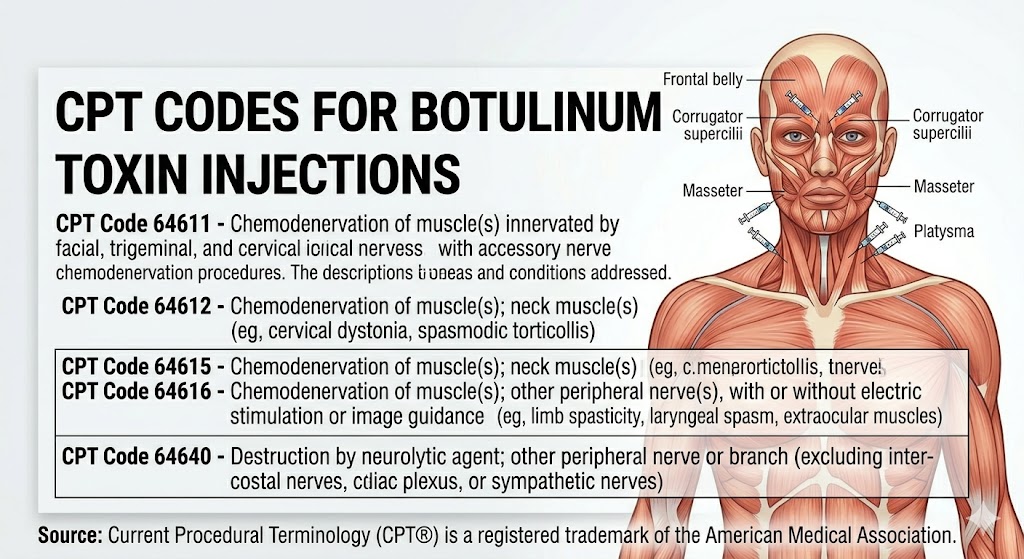
Why Botulinum Toxin Coding Is Tricky (And How We’ll Fix That)
Before we dive into the numbers, let’s name the problem. Botulinum toxin isn’t just one thing. It’s a powerful neurotoxin that appears in two very different worlds: medicine and aesthetics. A single substance, but the coding logic flips completely depending on why you’re injecting it.
Here are the three big reasons coders get headaches over this:
- The Medical vs. Cosmetic Split. Payers care deeply about the diagnosis. A code for treating a painful neurological condition is useless if the documentation suggests a cosmetic purpose, and vice versa.
- Different Drugs, Different Rules. Each brand—Botox, Dysport, Xeomin, Myobloc—has its own J-code for the drug itself. You must report these on the same claim form, often with strict billing units.
- Guidance-Dependent Coding. Many codes are “by needle guidance.” Was it electromyographic (EMG) guidance? Ultrasound? Did you use a hollow needle to inject the chemodenervation agent? The answer leads you to different code sets.
Our job now is simple. We will break this down, piece by piece.
The Master List: Botulinum Toxin CPT and HCPCS Codes at a Glance
Stop scrolling forums and guessing. Here is the complete, clean list you’ll use every day. Bookmark this table.
| Code Type | Code | Descriptor | When to Use |
|---|---|---|---|
| CPT (Procedure) | 64612 | Chemodenervation of muscle(s); muscle(s) innervated by facial nerve, unilateral | For benign essential blepharospasm, hemifacial spasm (one side). |
| CPT (Procedure) | 64615 | Chemodenervation of muscle(s); muscle(s) innervated by facial, trigeminal, cervical spinal and accessory nerves, bilateral | For chronic migraine protocol, often described as the “botox for migraines” code. |
| CPT (Procedure) | 64616 | Chemodenervation of muscle(s); neck muscle(s), excluding muscles of the larynx, unilateral | For cervical dystonia (spasmodic torticollis) treated on one side. |
| CPT (Procedure) | 64642 | Chemodenervation of one extremity; 1-4 muscle(s) | For focal spasticity in an arm or leg, affecting 1 to 4 muscles. |
| CPT (Procedure) | 64643 | each additional extremity, 1-4 muscle(s) | Add-on code, used with 64642 when treating another extremity. |
| CPT (Procedure) | 64644 | Chemodenervation of one extremity; 5 or more muscles | For focal spasticity in an arm or leg, affecting 5 or more muscles. |
| CPT (Procedure) | 64645 | each additional extremity, 5 or more muscles | Add-on code, used with 64644 when treating another extremity. |
| CPT (Procedure) | 64646 | Chemodenervation of trunk muscle(s); 1-5 muscle(s) | For truncal dystonia or spasticity, affecting 1 to 5 muscles. |
| CPT (Procedure) | 64647 | Chemodenervation of trunk muscle(s); 6 or more muscles | For truncal dystonia or spasticity, affecting 6 or more muscles. |
| HCPCS (Drug) | J0585 | Injection, onabotulinumtoxinA, 1 unit | Botox®. Each unit is billed per 1 unit. Report alongside the procedure code. |
| HCPCS (Drug) | J0586 | Injection, abobotulinumtoxinA, 5 units | Dysport®. Billed in 5-unit increments. A huge source of billing errors. |
| HCPCS (Drug) | J0587 | Injection, rimabotulinumtoxinB, 100 units | Myobloc®. Billed in 100-unit increments. |
| HCPCS (Drug) | J0588 | Injection, incobotulinumtoxinA, 1 unit | Xeomin®. Each unit is billed per 1 unit. |
Important Note: J-codes are for the medication you put into the syringe. CPT codes are for the work of injecting it. Payers require both on a professional claim form (like a CMS-1500). Missing one means you’ve just given away an expensive drug for free.
Part 1: The Medical Treatment Codes (CPT 64612-64647)
These codes live in the nervous system section of the CPT book. They describe “chemodenervation”—a clinical term for blocking nerve signals with a chemical. For our purposes, that chemical is a botulinum toxin.
Section A: Head, Neck, and Migraine Codes
CPT 64612: Unilateral Facial Nerve
This is the code for treating muscle spasms on one side of the face, specifically those innervated by the seventh cranial nerve. Think of a patient with a persistent eye twitch or a cheek that won’t relax.
- Common Diagnosis Link: Benign essential blepharospasm, unilateral hemifacial spasm.
- Coding Tip: The word “unilateral” is your trigger. If the physician treats both sides of the face, you might need to append modifier -50 (Bilateral Procedure), but check payer rules first. Many prefer a single line with modifier -50, while others want two separate lines with -RT and -LT.
CPT 64615: The Migraine Protocol Code
CPT 64615 is a code many neurologists know by heart. It describes chemodenervation of muscles innervated by a broad set of nerves (facial, trigeminal, cervical spinal, and accessory) on both sides.
This is the classic “PREEMPT” paradigm for chronic migraine. The provider injects a fixed set of 31 to 39 sites across the forehead, temples, back of the head, and shoulders.
- Key Rule: Do not report CPT 64615 with 64612, 64616, or the extremity codes for the same encounter. It’s a standalone, comprehensive service for this specific indication.
- Documentation Must-Have: The chart must clearly state the patient has chronic migraine (15 or more headache days per month) and has failed or couldn’t tolerate other preventative medications. Insurers often require prior authorization based on this evidence.
CPT 64616: Cervical Dystonia
Here, the physician injects muscles in the neck, but explicitly not the larynx. This is the go-to code for spasmodic torticollis, where the head turns, tilts, or pulls uncontrollably.
- Unilateral Again: Note this code describes one side. If the patient’s dystonia pattern pulls their head in a way that requires treating muscles on both sides, report modifier -50 or follow bilateral payer rules.
- EMG Guidance is Wrapped In: When you see these codes, the work of needle electromyographic guidance is bundled into the primary procedure code. You do not separately report 95873 or 95874.
Section B: Extremity and Trunk Spasticity Codes
This family of codes covers a massive therapeutic area: spasticity from stroke, spinal cord injury, multiple sclerosis, or cerebral palsy.
The Logic of the Extremity Codes (64642-64645)
CPT 2024 gave us a clear structure. You first count the muscles injected in a single extremity. Then, you choose your base code.
Critical Coding Rule: Add-on codes 64643 and 64645 are only for the other extremity. You cannot use them to report additional muscles in the same arm or leg. If you inject 8 muscles in one arm, the code is simply 64644. You stop there for that limb.
The Trunk Codes (64646-64647)
The trunk area includes the paraspinal muscles, intercostals, pectorals, and abdominal wall. The split is straightforward based on a hard number: 5.
- Injecting 1, 3, or 5 trunk muscles? Report 64646.
- Injecting 6, 7, or 10 trunk muscles? Report 64647.
- Documentation is King: The procedure note absolutely must list each muscle injected and the dose administered. A generic “bilateral lumbar paraspinals” is not enough. You need to name the muscles: “right iliopsoas, left quadratus lumborum,” etc.
Part 2: The Drug Codes (HCPCS Level II)
Now, let’s look at what goes in the syringe. The HCPCS J-codes represent the actual drug cost. Your practice pays for this product upfront, and this is how you get reimbursed for the inventory.
J0585: OnabotulinumtoxinA (Botox®)
Botox is billed per unit. If the provider injects 155 units into the bladder for overactive bladder, you bill 155 units of J0585. Simple.
J0586: AbobotulinumtoxinA (Dysport®) – The Unit Trap
Here is the single most common and costly billing mistake in botulinum toxin coding.
Dysport’s HCPCS descriptor is “5 units.” This means one unit of J0586 equals 5 units of the actual Dysport medication.
- The Math: A provider injects 250 Dysport units. You must divide 250 by 5. The number you put in box 24G of the CMS-1500 is 50. Fifty J0586 units.
- The Cost of Getting It Wrong: If you bill 250 units of J0586, you are reporting 1,250 Dysport units. This is gross overbilling, a red flag for audits, and can lead to recoupment and penalties.
A Note from a Coder: I’ve seen a practice lose tens of thousands of dollars in revenue because a well-meaning staff member billed the full vial quantity as J0586 units. Always triple-check the math on Dysport claims. Build a calculator step into your charge entry process.
J0587: RimabotulinumtoxinB (Myobloc®)
Myobloc is billed in 100-unit increments. Divide the administered dose by 100. A 2,500-unit dose becomes 25 units on the claim form.
J0588: IncobotulinumtoxinA (Xeomin®)
Like Botox, Xeomin is a 1:1, clean, per-unit code. No conversion math. This makes it the easiest to track and bill correctly.
Wastage and Vial Billing: Getting Paid for Every Drop
Botulinum toxin is not cheap. Vials are single-use, and once reconstituted, they must be used within a short window. Often, you treat a patient, and a significant amount of expensive drug gets discarded.
You can bill for this, and you should. Use the JW and JZ modifiers.
- JW Modifier: Drug amount discarded. If you open a 200-unit Botox vial and inject 155 units, you bill two lines:
- J0585, 155 units (no JW)
- J0585, 45 units (JW modifier)
- JZ Modifier: Zero drug amount discarded. Mandated by CMS for many drugs. If you use the entire vial, append JZ to the single drug line. This proves you had no wastage.
Commercial payers are increasingly adopting the JZ requirement. Check your LCDs (Local Coverage Determinations) and medical policies.
Modifiers: The Small Details That Stop Big Denials
A string of seemingly tiny two-character codes can make or break a claim. Here’s how they apply to botulinum toxin services.
- Modifier -50: Bilateral Procedure. Use when a unilateral code (64612, 64616) is performed on both sides. Payer preference dictates whether to bill one line with -50, or two lines with -RT and -LT.
- Modifiers -RT and -LT: Right and Left Side. Essential for extremity spasticity coding. A claim for 64642 on the right arm and 64643 on the left arm needs these modifiers to distinguish the sides clearly.
- Modifier -59: Distinct Procedural Service. Use this if the provider treats two separate conditions or sites that normally bundle. For instance, treating cervical dystonia (64616) and an extremity for spasticity (64642) might require -59 on one code to bypass a National Correct Coding Initiative (NCCI) edit. Always check your NCCI edits before billing.
A Real-World Case Study: Coding a Complex Spasticity Visit
Let’s make this tangible. A patient with upper and lower limb spasticity from a stroke comes for their quarterly injections. The physiatrist documents the following:
- Right arm: Biceps brachii, brachialis, flexor carpi radialis, flexor digitorum profundus (4 muscles). Total 200 U Dysport.
- Left arm: Biceps brachii (1 muscle). Total 50 U Dysport.
- Total Dysport administered: 250 U.
The Correct Claim Line by Line:
| Line | Code | Modifier | Quantity | Detail |
|---|---|---|---|---|
| 1 | 64642 | RT | 1 | Chemodenervation right arm, 1-4 muscles |
| 2 | 64643 | LT | 1 | Chemodenervation left arm, 1-4 muscles |
| 3 | J0586 | None | 50 | Dysport 250 U / 5 = 50 billable units |
Notice, you do not bill two separate 64642 codes. The add-on code 64643 exists specifically for the second limb. This is a clean, audit-proof claim.
Cosmetic Use: A Completely Different Ballgame
The codes we’ve discussed are for medical necessity. When a patient wants a brow furrow smoothed or crow’s feet softened, you leave these codes behind completely.
Cosmetic botulinum toxin injections are not covered by insurance. You will not use 64612 or J0585. Instead, practices typically use:
- CPT 64999: Unlisted procedure, nervous system. Some practices report this to the payer with a GY modifier (Item or service statutorily excluded) to generate a denial for a secondary insurance or to provide the patient with a receipt.
- Internal “S” or “C” Codes: Many large practices and plastic surgery centers create their own internal billing codes to track cosmetic inventory and revenue. These never leave the practice on an insurance claim.
Patients must sign an Advance Beneficiary Notice (ABN) or a standard cosmetic consent form acknowledging their full financial responsibility.
Take a Breath: A Simple Decision Flowchart
When a superbill lands on your desk, ask these questions in this exact order.
- Medical or Cosmetic?
- Medical → Go to Question 2.
- Cosmetic → Stop. Collect payment upfront. Do not bill insurance.
- Where is the injection site?
- Face/Neck for spasm or migraine? → 64612, 64615, or 64616.
- Extremity for spasticity? → Count muscles, pick 64642-64645.
- Trunk? → Count muscles, pick 64646 or 64647.
- What drug was used?
- Botox → J0585 (1 unit = 1 unit).
- Dysport → J0586 (divide administered units by 5).
- Myobloc → J0587 (divide administered units by 100).
- Xeomin → J0588 (1 unit = 1 unit).
- Was any drug wasted?
- Yes → Add JW line.
- No → Append JZ modifier to the single drug line.
Navigating Prior Authorizations Like a Pro
Accurate coding is just half the battle. Most payers require prior authorization for medical botulinum toxin. They want to know it’s not a shot in the dark.
A bulletproof prior auth packet includes:
- The exact CPT code you’ll use.
- The J-code and total planned units.
- The specific, linked ICD-10-CM code (e.g., G24.3 for spasmodic torticollis, G43.0 for chronic migraine without aura).
- Clinical notes showing failure, contraindication, or intolerance to first-line therapies.
- The FDA-approved protocol you’re following.
Submitting a vague request is a guaranteed delay. Be painfully specific.
Chart Documentation: Write It Right, Get Paid Right
If it’s not documented, it wasn’t done. Insurers and auditors will look for these elements.
- Informed Consent: Signed and dated.
- Muscle Map: A clear list of each muscle injected. “Right gastrocnemius, left hamstring” is far better than “bilateral legs.”
- Guidance Used: If EMG or ultrasound was used for needle placement, it must be noted. Even though guidance is bundled, it proves medical necessity for the injection targeting.
- Dose Per Muscle: The exact amount of drug (in the drug’s own units) placed in each site.
- Total Dose: A summed total matching the billed J-code units.
- Wastage Statement: A simple line: “A 200-unit vial of Botox was used. 155 units injected, 45 units discarded.” This single sentence justifies your JW modifier line.
“In medical billing, the pen is truly mightier than the needle. A perfectly documented procedure note is a perfectly payable claim.”
ICD-10-CM Codes: The Necessary Partner
CPT codes tell the story of what you did. ICD-10-CM codes tell why you did it. Getting this link right is non-negotiable. Here’s a quick-reference table for the most common scenarios.
A denials management tip: If you’re getting a medical-necessity denial on a valid dystonia code, check that the plan doesn’t require a secondary code for the underlying condition (like a history of stroke).
Auditors Are Watching: Red Flags That Trigger an Audit
An honest practice shouldn’t fear an audit, but you should know what draws the eye.
- Exact same dose, every patient. A provider who injects 200 units of Botox into every single migraine patient, with no variation, looks like a one-size-fits-all recipe, not individualized care.
- Dysport unit math errors. A claim for 300 units of J0586 when the typical Dysport vial is 300 or 500 units might be a conversion error. An auditor will look.
- Modifier -50 misuse. Using the bilateral modifier when the patient’s chart clearly describes a unilateral procedure.
- Missing JZ modifier on single-vial drugs. CMS will simply deny these claims in many jurisdictions.
FAQ: Your Top Questions, Answered Directly
What is the CPT code for Botox for migraines?
The CPT code for the injection procedure is 64615 (chemodenervation of muscles innervated by facial, trigeminal, cervical spinal and accessory nerves, bilateral). The drug itself is billed separately using J0585 for Botox.
Why was my claim for CPT 64616 denied?
The most common reason is a missing or incorrect modifier. CPT 64616 is a unilateral code. If the provider treated both sides of the neck, you must append modifier -50 or use RT/LT modifiers according to your payer’s specific billing guidelines.
Do I bill EMG guidance separately with chemodenervation codes?
No. For CPT codes 64612-64647, the work of needle EMG guidance is bundled into the primary surgical procedure. Do not separately report 95873 or 95874.
How do I bill Dysport correctly with J0586?
This is the most critical math step in neurotoxin billing. J0586 represents 5 units of Dysport. Take the total administered dose and divide by 5. If 300 Dysport units were injected, you bill 60 units of J0586. Every single time.
Can I bill for the Botox we had to throw away?
Yes. Use the JW modifier on a separate claim line for the discarded amount. For example, if you used a 200-unit vial and injected 150 units, bill one line for 150 units of J0585 and a second line for 50 units of J0585 with the JW modifier. If you use the entire vial with zero waste, use the JZ modifier.
Additional Resource
For the most current Medicare payment rates and National Correct Coding Initiative (NCCI) edits that define which code pairs cannot be billed together, consult the official CMS website:
NCCI Edits – Centers for Medicare & Medicaid Services
Conclusion: Clarity in a Complex Field
Mastering botulinum toxin coding means matching the clinical story with the exact code that describes it, from the precise muscle groups to the specific drug units. The key distinction lies in the medical purpose—the CPT chemodenervation codes from 64612 to 64647—versus the cosmetic world where those codes don’t apply. By pairing those procedure codes with the correct HCPCS drug identifiers and capturing every unit, including necessary wastage with JW and JZ modifiers, you transform a complex documentation task into a clean, payable claim.
Disclaimer: This article is for informational and educational purposes only. It does not constitute legal, financial, or professional medical coding advice. CPT codes are copyright of the American Medical Association. Coding rules and payer medical policies change frequently. Always verify current codes, modifiers, and coverage criteria with the specific payer and the most recent authoritative coding manuals before submitting claims.