
Falls are a serious concern in healthcare settings. They can lead to injuries, longer hospital stays, and a lower quality of life for patients. If you work in a hospital, nursing home, or rehabilitation center, you already know how important it is to keep people safe.
The Centers for Medicare & Medicaid Services (CMS) has clear rules about fall prevention. These guidelines are not just suggestions. They are part of the Conditions of Participation (CoPs). If your facility does not follow them, you risk losing funding, facing surveys, or paying heavy fines.
But do not worry. This guide breaks down everything you need to know. We will keep things simple, practical, and easy to apply. You will learn what CMS expects, how to create a fall prevention plan, and how to document your work correctly.
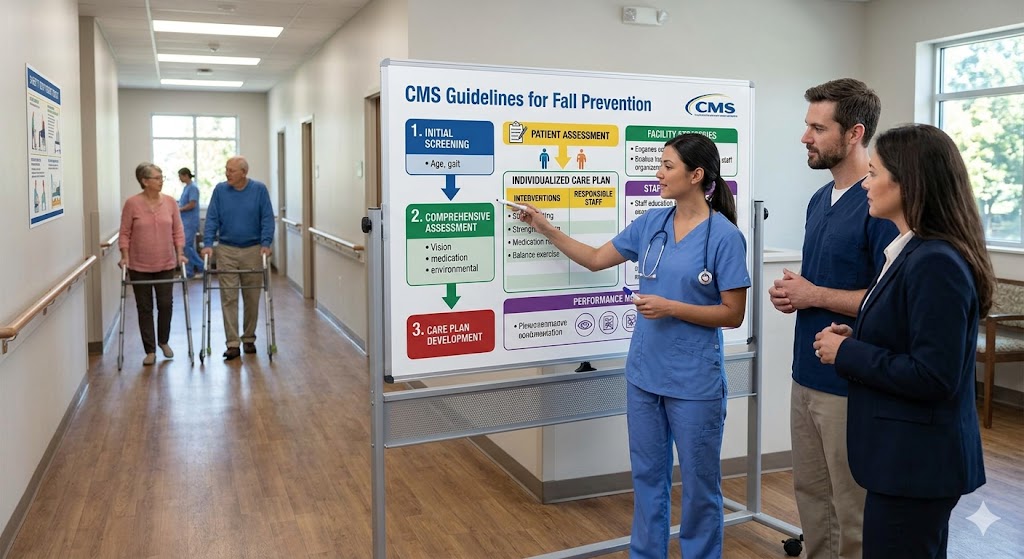
Why CMS Focuses on Fall Prevention
Falls are the most common reported accidents in hospitals and long-term care facilities. According to CMS data, between 700,000 and 1,000,000 falls occur in U.S. hospitals each year. Many lead to fractures, head trauma, or even death.
CMS cares about falls for two main reasons. First, patient safety is a top priority. Second, falls are often preventable. When a fall happens, it can be a sign that a facility is not providing adequate care. That is why CMS includes fall prevention in its CoPs for hospitals, critical access hospitals, and skilled nursing facilities.
Important Note for Readers: CMS does not require that falls never happen. That would be unrealistic. Instead, CMS requires that you have an effective, evidence-based program to identify fall risks and take reasonable steps to reduce them.
What Are the CMS Guidelines for Fall Prevention?
The official CMS guidelines for fall prevention live inside several regulatory manuals. The most important ones are:
- State Operations Manual (SOM) – Appendix A (for hospitals)
- Appendix PP (for long-term care facilities)
- Quality Reporting Programs (QRP)
Let us look at the core requirements.
For Hospitals (Acute Care)
According to the CMS Conditions of Participation for hospitals (42 CFR 482.23), you must do the following:
- Conduct a fall risk assessment for each patient within 24 hours of admission.
- Reassess whenever the patient’s condition changes (after surgery, a fall, or a new medication).
- Implement interventions based on the risk level (e.g., bed alarms, non-slip socks, low beds).
- Educate the patient and family about fall risks and safety measures.
- Document everything in the patient’s medical record.
For Skilled Nursing Facilities (SNFs)
Under the Reform of Requirements for Long-Term Care Facilities (effective November 2017), CMS requires that each resident:
- Receives an initial fall risk assessment upon admission.
- Has a person-centered care plan that addresses fall risks.
- Receives environmental safety checks.
- Has access to assistive devices (call lights, grab bars, walkers) in good working order.
CMS also monitors fall-related incidents through the MDS (Minimum Data Set) and the Quality Measure (QM) for falls with major injury.
Step-by-Step: How to Build a CMS-Compliant Fall Prevention Program
You do not need a huge budget or a team of experts to meet CMS guidelines. What you need is a consistent, honest, and patient-focused system. Here is a realistic way to build yours.
Step 1: Perform a Validated Fall Risk Assessment
CMS does not force you to use one specific tool. But you must use a tool that is evidence-based and validated. Popular choices include:
- Morse Fall Scale (common in hospitals)
- Hendrich II Fall Risk Model (good for acute care)
- STRATIFY (used in some geriatric units)
You can choose any tool. The key is to apply it the same way for every patient and document the score.
What to assess:
- History of falls (especially in the last 3 months)
- Mobility and gait problems
- Mental status (confusion, delirium, dementia)
- Medications (sedatives, diuretics, antihypertensives)
- Toileting needs (urgency, frequency)
- Sensory deficits (vision, hearing)
Step 2: Create a Personalized Care Plan
Once you have the risk level (low, moderate, or high), you must write a care plan. This plan should live in the patient’s chart. It must include:
- Specific interventions tailored to the patient
- Who is responsible for each action
- When to reassess
Example for a high-risk patient:
- Bed in lowest position with brakes locked
- Bed alarm or chair sensor
- Non-slip footwear at all times
- Call light within reach
- Hourly rounding by nursing staff
- Family member present if possible
Step 3: Implement Environmental Safety Measures
CMS surveyors will walk through your facility. They will look for basic safety features. Make sure you have:
- Good lighting in rooms and hallways
- Handrails in corridors and bathrooms
- Low beds (or mats beside high beds)
- Clear pathways (no clutter or cords)
- Accessible call lights
- Non-slip flooring in bathrooms
- Grab bars near toilets and showers
Important Note for Readers: Environmental fixes are often the cheapest and most effective. A loose rug or a dimly lit hallway can cause a fall. Walk your unit with fresh eyes once a week.
Step 4: Educate Staff, Patients, and Families
Education is not a one-time event. CMS wants to see ongoing training. Your staff must know:
- How to use the risk assessment tool
- How to respond to a fall (post-fall protocol)
- How to use equipment (alarms, lifts, gait belts)
For patients and families, give clear, simple instructions. Use a handout or a whiteboard in the room. Write things like:
- “Call don’t fall – use your call light.”
- “Keep your walker close.”
- “Wear your yellow socks (non-slip).”
Step 5: Document, Document, Document
This is where many facilities fail. CMS surveyors do not care if you think you did something. They care if you wrote it down.
You must document:
- Initial fall risk score and date
- Reassessment dates and reasons
- Interventions offered and provided
- Education given to patient/family
- Any falls or near-falls
- Post-fall investigation and care plan updates
If it is not in the record, it did not happen. That is a harsh but true rule in regulatory compliance.
Common CMS Citations for Fall Prevention
Knowing where other facilities fail helps you avoid the same mistakes. According to CMS enforcement data, the most common fall-related deficiencies include:
| Tag Number | Deficiency Description |
|---|---|
| F689 (LTC) | Free of accident hazards / adequate supervision to prevent accidents |
| F656 (LTC) | Develop / implement a person-centered care plan |
| F684 (LTC) | Quality of care – receive treatment to prevent accidents |
| A-0144 (Hosp) | Nursing services – patient safety and fall prevention |
Example citation: A facility installed bed alarms but did not check if they worked. A patient fell, and the alarm did not sound. CMS cited them under F689 for failing to maintain safety equipment.
To avoid this, create a simple checklist. Test all alarms and call lights at the start of every shift. Sign and date the checklist. Keep it on file.
The Post-Fall Protocol: What CMS Expects
Even with the best program, falls will happen. CMS knows this. What matters is how you respond. A good post-fall protocol has five steps.
1. Immediate Care
Check the patient for injury. Do not move them if you suspect a fracture or head injury. Call for help. Take vital signs. Document the time and location of the fall.
2. Clinical Assessment
Perform a head-to-toe exam. Look for bruises, swelling, or pain. Check neurological status if the patient hit their head. Order x-rays if needed.
3. Root Cause Analysis (RCA)
Ask: Why did this fall happen? Was the risk assessment wrong? Did the patient ignore instructions? Was the call light broken? Was the bed locked?
Write a short, factual summary. Do not blame the patient. Focus on systems.
4. Care Plan Update
Based on the RCA, change the care plan. If the patient fell getting out of bed to use the bathroom, add scheduled toileting every two hours. If they fell because they were dizzy, review their medications.
5. Reporting
Report the fall internally to your quality improvement team. If there was a major injury, you may need to report it to state authorities. For long-term care, record the fall in the MDS within 7 days.
Quotation from CMS guidance:
“A single fall does not necessarily indicate non-compliance. However, a pattern of falls, especially with injury, combined with a lack of assessment or intervention, will result in a citation.” – CMS State Operations Manual, Appendix PP
CMS Fall Prevention Guidelines Comparison: Hospitals vs. Skilled Nursing Facilities
Many providers work across settings. Here is a quick table to show the differences in CMS requirements.
| Element | Hospitals (Acute Care) | Skilled Nursing Facilities |
|---|---|---|
| Initial assessment | Within 24 hours of admission | Within 14 days of admission (but typically sooner) |
| Reassessment | When condition changes | Quarterly and with significant change |
| Required tool | Validated tool (facility chooses) | Any validated tool (e.g., Braden for skin, Morse for falls) |
| Care plan | Must be updated after each fall | Person-centered; updated after each fall |
| Reporting | Internal QI; no mandatory national reporting for single falls | Report via MDS; major injuries reported to state |
| Survey focus | Did nursing staff follow the care plan? | Is the environment safe? Is supervision adequate? |
As you can see, both settings require a proactive approach. But long-term care has more ongoing monitoring because residents live there for months or years.
Practical Tools to Stay Compliant
You do not need fancy software. Many facilities use simple, low-tech tools to meet CMS guidelines for fall prevention. Here are some ideas that work in real-world settings.
The “Fall Risk” Visual Cue
Hang a colored sign outside the patient’s door:
- Yellow = moderate risk
- Red = high risk
- Green = low risk
This helps every staff member—from nurses to housekeeping—know who needs extra help.
The Hourly Rounding Log
Create a simple paper log attached to the clipboard at the nurses’ station. For each hour, staff checks:
- Call light within reach
- Bed locked and low
- Non-slip footwear on
- Toileting offered
- Water within reach
Sign and date each round. Surveyors love seeing these logs.
The Family Safety Card
Give families a small card on admission. It says:
“Help us prevent falls. Please remind your loved one to use the call light. Keep their walker close. Tell a nurse if they seem confused or unsteady. Thank you!”
This turns families into partners, not obstacles.
Weekly Environmental Checklist
Walk each room and hallway once a week. Use a checklist like this:
| Item | Pass | Fail | Action taken |
|---|---|---|---|
| No loose cords on floor | ☐ | ☐ | |
| Handrails secure | ☐ | ☐ | |
| Bathroom grab bars tight | ☐ | ☐ | |
| Call light works | ☐ | ☐ | |
| Lighting adequate | ☐ | ☐ | |
| Mats or low beds in high-risk rooms | ☐ | ☐ |
Keep the checklist for 12 months. CMS may ask to see it.
How to Prepare for a CMS Survey on Fall Prevention
A CMS survey can be stressful. But preparation makes it manageable. Here is what surveyors will likely do.
What Surveyors Observe
- Tours: They walk the unit looking for trip hazards, broken equipment, and poor lighting.
- Staff interviews: They ask nurses and aides, “How do you know if a patient is at risk for falls? Show me the care plan.”
- Patient interviews: They ask patients, “Did anyone tell you how to call for help? Do you know why you have a bed alarm?”
- Record reviews: They pull 10–20 charts and check for risk assessments, care plans, and post-fall documentation.
Common Survey Questions and Good Answers
Q: How often do you reassess fall risk?
A: “Upon admission, after any change in condition, after a fall, and when we discharge a patient to another facility or home.”
Q: What do you do for a patient who refuses fall precautions?
A: “We document the refusal, educate the patient and family about risks, try to understand why they refuse, and offer alternatives. We then notify the provider and document everything.”
Q: Show me your fall prevention training for new staff.
A: “Here is our orientation checklist. All new nurses and aides complete a 30-minute module on fall risk assessment, use of bed alarms, and post-fall protocol. They also shadow an experienced nurse for two shifts.”
If you cannot answer these questions on the spot, review your program today.
Important Note for Readers: Do not try to hide falls from surveyors. CMS considers this a serious violation. Always report falls accurately, even if they show a gap in your program. Honesty leads to improvement plans, not automatic fines.
The Relationship Between CMS Guidelines and Other Standards
You may also follow guidelines from other organizations. It helps to know how they fit with CMS.
| Organization | Focus | Alignment with CMS |
|---|---|---|
| CDC (STEADI) | Outpatient fall risk screening | CMS accepts STEADI tools for community settings but not alone for inpatient |
| AHRQ (Falls Toolkit) | Hospital fall prevention | Fully aligned; CMS often recommends AHRQ resources |
| Joint Commission | National Patient Safety Goal #3 (NPSG 09.02.01) | CMS and TJC align closely; meeting TJC usually means meeting CMS |
| OSHA | Staff injury prevention (lifts, transfers) | Separate but related; staff safety supports patient safety |
If you meet CMS guidelines, you are already very close to meeting Joint Commission requirements. That saves you time and effort.
Measuring Success: Quality Indicators for Fall Prevention
CMS uses data to compare facilities. You can use the same metrics to track your own progress.
Process measures (did you do the work?)
- Percentage of patients assessed within 24 hours
- Percentage of high-risk patients with a care plan within 48 hours
- Percentage of staff trained annually on fall prevention
Outcome measures (did it work?)
- Fall rate per 1,000 patient days
- Fall-related injury rate (major injuries)
- Recurrent fall rate (same patient falls again)
Benchmark your rates against national data. For hospitals, a good target is 3–4 falls per 1,000 patient days. For nursing homes, the average is about 3.5 falls per 1,000 resident days.
If your numbers are much higher, look for patterns. Do falls happen more on night shifts? After staff changeovers? In rooms farther from the nurses’ station?
Special Situations: Dementia, Delirium, and Bariatric Patients
CMS guidelines do not have separate rules for different populations. But your interventions must adapt. Here is how.
Patients with Dementia
They may not remember to use a call light. They may wander at night.
- Try: Low beds with floor mats, motion sensors, wandering alarms on doors.
- Avoid: Physical restraints. CMS strongly discourages restraints for fall prevention. They cause more injuries than they prevent.
Patients with Delirium (post-op or infection)
Delirium comes on suddenly. These patients are very high risk.
- Try: Family sitter, frequent reorientation, non-pharmacological sleep aids (eye masks, quiet hours).
- Document: The cause of delirium (UTI? Medication?). Treat the cause, and the fall risk often drops.
Bariatric Patients
Standard beds and call lights may not work for patients over 300 pounds.
- Try: Bariatric beds (wider, lower to ground), reinforced commodes, ceiling lifts.
- Check: CMS expects you to have equipment that fits your patient population. If you serve bariatric patients, you need bariatric fall prevention equipment.
Creating a “Just Culture” Around Falls
One of the biggest barriers to good fall prevention is fear. When staff fear punishment for falls, they hide them. When they hide them, you cannot fix the real problem.
CMS encourages a “just culture.” That means:
- Human error (forgetting to lock a bed once) = coaching, not punishment.
- At-risk behavior (rushing rounds because of short staffing) = look at system issues.
- Reckless behavior (ignoring fall risk protocol repeatedly) = accountability.
Share this philosophy with your team. When a fall happens, ask: “What can we learn?” not “Who is to blame?”
Quotation from a CMS surveyor (paraphrased from training materials):
“We do not expect perfection. We expect a good faith effort to assess, plan, intervene, and improve. When I see a facility that hides falls, I know they do not have a safety culture.”
Frequently Asked Questions (FAQ)
1. Does CMS require hourly rounding for fall prevention?
No, CMS does not mandate hourly rounding by name. But CMS requires “adequate supervision” and “interventions appropriate to the patient’s needs.” For high-risk patients, hourly rounding is best practice and helps you meet that standard.
2. Can a family member refuse fall precautions for a patient?
No. The patient’s safety is the facility’s responsibility. If a family member refuses interventions (e.g., bed alarm), explain the risks. If they still refuse, document the discussion and notify your risk manager. You may need to transfer the patient if you cannot safely provide care.
3. What is the penalty for not following CMS fall prevention guidelines?
Penalties vary. You could receive a deficiency on your survey. That leads to a Plan of Correction. Serious or repeated violations can lead to fines ($1,000–$10,000 per day), termination from Medicare/Medicaid, or both.
4. How long do I keep fall prevention records?
Keep risk assessments, care plans, and post-fall investigations for at least 5 years. Check your state law; some states require longer. CMS expects you to produce records for any survey within the last 3 years.
5. Do home health agencies have CMS fall prevention requirements?
Yes. Home Health agencies must follow CMS Conditions of Participation at 42 CFR 484. They must assess fall risk at start of care and each visit. They must educate patients and families. They must report falls to the physician and update the plan of care.
6. What is the single most effective fall prevention intervention?
According to research and CMS guidance, bed alarms alone do not prevent falls. The most effective intervention is multifactorial: risk assessment + personalized care plan + environmental safety + patient education + ongoing reassessment. No single magic bullet exists.
Additional Resource
For the most up-to-date, official CMS documents on fall prevention, visit:
🔗 CMS Quality Safety & Oversight – Fall Prevention Resources
https://www.cms.gov/medicare/provider-enrollment-and-certification/surveycertificationgeninfo/policy-and-memos-to-states-and-regions
This page contains memos, surveyor guidance, and toolkits. Bookmark it and check for updates every 6 months.
Conclusion
The CMS guidelines for fall prevention are clear, practical, and focused on patient safety. You do not need to be perfect. You need a working system that assesses risk, creates personalized care plans, provides a safe environment, educates everyone involved, and documents every step. Falls will still happen. But when they do, your honest response and your commitment to learning will keep you compliant and your patients safer. Start with one small change today—test a call light, update a care plan, or review one chart. That is how lasting change begins.
Disclaimer: This article provides general educational information about CMS guidelines for fall prevention. It is not legal advice. Regulations and survey practices may change. Always consult your facility’s compliance officer or legal counsel for specific guidance.
