Hidradenitis suppurativa (HS) presents unique coding challenges. The condition often requires extensive surgical excision that goes far beyond simple lesion removal. Getting the reimbursement right depends on understanding exactly which codes apply and how to document the procedure properly.
This guide walks you through the CPT codes for hidradenitis excision in 2026, including the critical distinctions between integumentary and musculoskeletal coding pathways.
Understanding Hidradenitis Suppurativa and Why Coding Matters
Hidradenitis suppurativa is a chronic inflammatory skin condition characterized by painful nodules, abscesses, and sinus tracts. It typically affects areas with apocrine glands—the axillae, groin, buttocks, and inframammary regions.
When medical management fails, surgical excision becomes necessary. The extent of surgery varies dramatically. Some patients need removal of isolated lesions. Others require wide excision of entire anatomical regions.
This variation in surgical complexity is precisely why proper CPT coding matters so much. Undercoding leads to lost revenue. Overcoding invites audits.
The Coding Challenge
Unlike a straightforward cyst excision, hidradenitis surgery often involves:
- Removal of multiple interconnected sinus tracts
- Excision extending into subcutaneous tissue and sometimes fascia
- Complex wound closure techniques
- Staged procedures over multiple sessions
The coder must evaluate exactly what the surgeon did and translate that into the most accurate code or combination of codes.
Primary CPT Codes for Hidradenitis Excision in 2026
For 2026, several CPT code families apply to hidradenitis excision. The key distinction lies in how deep the excision goes and what anatomical structures the surgeon removes.
Integumentary System Codes (Skin and Subcutaneous Tissue)
These codes cover excision of lesions confined to the skin and subcutaneous tissue. They apply when the surgeon does not remove muscle, fascia, or other deeper structures.
| CPT Code | Description | Typical Application |
|---|---|---|
| 11450 | Excision of skin and subcutaneous tissue for hidradenitis, axillary; with simple or intermediate repair | Single axilla, straightforward closure |
| 11451 | Excision of skin and subcutaneous tissue for hidradenitis, axillary; with complex repair | Single axilla requiring complex closure |
| 11462 | Excision of skin and subcutaneous tissue for hidradenitis, inguinal; with simple or intermediate repair | Groin area, straightforward closure |
| 11463 | Excision of skin and subcutaneous tissue for hidradenitis, inguinal; with complex repair | Groin area requiring complex closure |
| 11470 | Excision of skin and subcutaneous tissue for hidradenitis, perianal, perineal, or umbilical; with simple or intermediate repair | Perineal/umbilical region |
| 11471 | Excision of skin and subcutaneous tissue for hidradenitis, perianal, perineal, or umbilical; with complex repair | Perineal/umbilical with complex closure |
Important Note: Codes 11450-11471 are specific to hidradenitis suppurativa excision. Always check the 2026 CPT manual for any revisions, as codes can change annually.
Musculoskeletal System Codes
When the excision extends into deeper structures—removing fascia, muscle, or apocrine gland-bearing tissue en bloc—musculoskeletal codes may be more appropriate.
| CPT Code | Description | When to Use |
|---|---|---|
| 23066 | Biopsy, soft tissue of shoulder area; deep | Not for therapeutic excision |
| 23076 | Excision, tumor, soft tissue of shoulder area, subcutaneous; less than 3 cm | Size-dependent, limited depth |
| 27047 | Excision, tumor, soft tissue of pelvis and hip area, subcutaneous; less than 3 cm | Groin/inguinal region, subcutaneous |
| 27618 | Excision, tumor, soft tissue of leg or ankle area, subcutaneous; less than 3 cm | For lesions extending to lower extremities |
Wide Excision Codes
For radical or wide excision procedures that remove large areas of affected tissue, surgeons may use:
| CPT Code | Description |
|---|---|
| 28043 | Excision, tumor, soft tissue of foot or toe, subcutaneous; less than 1.5 cm |
| 28045 | Excision, tumor, soft tissue of foot or toe, subcutaneous; 1.5 cm or greater |
Key Distinction: The “excision of skin and subcutaneous tissue for hidradenitis” codes (11450-11471) should be used when the primary purpose is treating hidradenitis. General soft tissue tumor excision codes apply when the documentation doesn’t specify hidradenitis or when payers specifically require them.
Code Selection Decision Tree
Use this step-by-step approach to select the right code:
- Identify the anatomical location.
- Axillary → 11450 or 11451
- Inguinal → 11462 or 11463
- Perianal/perineal/umbilical → 11470 or 11471
- Determine the depth of excision.
- Skin and subcutaneous only → Use integumentary codes
- Including fascia or muscle → Consider musculoskeletal codes
- Assess the type of repair.
- Simple or intermediate closure → lower number (11450, 11462, 11470)
- Complex closure → higher number (11451, 11463, 11471)
- Check for multiple sites.
- Bilateral procedures → Use modifier 50 or RT/LT modifiers
- Multiple distinct areas → Report each with appropriate modifiers
Documentation Requirements for Clean Claims
Payers scrutinize hidradenitis excision claims carefully. Complete documentation supports medical necessity and code selection.
Essential Documentation Elements
- Diagnosis confirmation: Document HS severity using Hurley staging (I, II, or III)
- Failed conservative treatment: Note antibiotics, biologics, lifestyle modifications attempted
- Preoperative findings: Describe the number, location, and size of lesions, sinus tracts, and scarring
- Operative details:
- Exact anatomical location(s)
- Dimensions of excised tissue
- Depth of excision
- Closure method and complexity
- Whether drains were placed
- Specimen disposition: Pathology submission details
Sample Documentation Statement
text
Copy
Download
Preoperative diagnosis: Hidradenitis suppurativa, Hurley stage III, bilateral axillae.

Procedure: Wide local excision of bilateral axillary hidradenitis with complex closure, left side measuring 8.2 cm x 4.5 cm, right side measuring 7.8 cm x 4.2 cm.

Operative findings: Extensive sinus tract formation with fibrotic tissue extending into subcutaneous fat. All affected tissue excised to level of fascia. No muscle involvement.

Closure: Complex layered closure with advancement flaps bilaterally. Jackson-Pratt drains placed.
With documentation like this, coding becomes straightforward: 11451-50 (bilateral axillary excision with complex repair).
Modifier Use for Hidradenitis Excision
Modifiers tell the complete story when a single code doesn’t capture the full picture.
Commonly Used Modifiers
| Modifier | Description | When to Apply |
|---|---|---|
| -50 | Bilateral procedure | Both axillae, both groins in same session |
| -LT / -RT | Left / Right side | Unilateral procedures; some payers prefer these over -50 |
| -59 | Distinct procedural service | Separate anatomical areas not normally coded together |
| -58 | Staged procedure | Planned return to OR for further excision |
| -78 | Unplanned return to OR | Complication requiring return to OR |
Modifier 59 Example
A surgeon excises hidradenitis from the left axilla and also treats separate disease in the perineal region during the same session. You would report:
- 11451-LT
- 11470-59
The -59 modifier indicates the perineal procedure was distinct from the axillary procedure.
2026 Coding Updates and Changes
While CPT code sets typically don’t undergo radical yearly overhauls, staying current matters. For 2026, be alert for:
- Category III code transitions to Category I (new technology codes that become permanent)
- Revised guidelines on wound repair classification
- Telehealth E/M code updates that may affect pre- and post-operative visits
- Medicare physician fee schedule changes affecting reimbursement rates
Tip: Subscribe to the AMA CPT Network and your specialty society coding newsletters to receive real-time updates. The AAPC and AHIMA also publish annual code change summaries.
Reimbursement and RVU Considerations
Relative Value Units (RVUs) for hidradenitis excision codes reflect the significant work involved.
| CPT Code | Work RVU (Approximate) | Global Period |
|---|---|---|
| 11450 | ~8.5 | 10 days |
| 11451 | ~12.0 | 10 days |
| 11462 | ~8.0 | 10 days |
| 11463 | ~11.5 | 10 days |
| 11470 | ~7.5 | 10 days |
| 11471 | ~11.0 | 10 days |
Note: RVUs fluctuate with the annual Medicare Physician Fee Schedule. These figures represent approximate ranges based on recent years; 2026 values may differ.
Prior Authorization
Many commercial payers require prior authorization for hidradenitis surgery. Submit:
- Clinical notes documenting failed medical management
- Hurley stage classification
- Proposed surgical plan with CPT codes
- Photographs when supported by payer policy
Common Coding Pitfalls and How to Avoid Them
Pitfall 1: Using Lesion Excision Codes Instead of Hidradenitis-Specific Codes
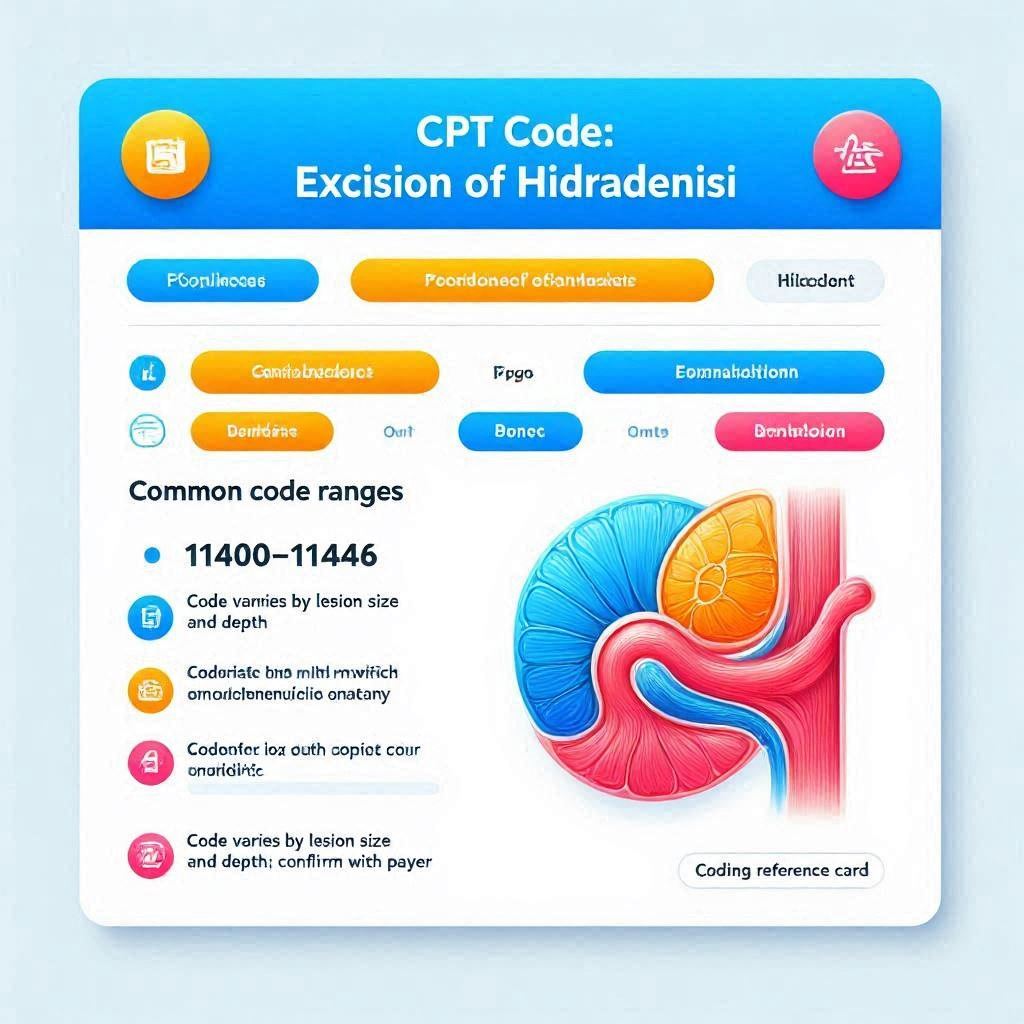
Using generic codes like 11400-11446 (benign lesion excision) undercodes the complexity. Hidradenitis surgery typically involves more extensive dissection than a simple cyst or lipoma removal.
Solution: Always check whether hidradenitis-specific codes (11450-11471) describe the procedure before defaulting to generic lesion codes.
Pitfall 2: Undervaluing Wound Repair
The distinction between intermediate and complex repair directly affects reimbursement. Complex repair involves layered closure, extensive undermining, or use of tissue advancement techniques.
Solution: When the surgeon performs scar revision, extensive undermining, or layered closure with drains, document this explicitly and use the complex repair code.
Pitfall 3: Failing to Report Bilateral Procedures Correctly
Medicare and many payers reduce the second procedure payment for bilateral surgeries. Using the wrong modifier can trigger incorrect denials or payments.
Solution: Use modifier -50 for bilateral procedures on the same day. Check payer-specific policies—some require RT and LT modifiers instead.
Pitfall 4: Bundling Issues
Certain services bundle into the primary surgical code during the global period. E/M services for the same condition typically don’t get separate payment during the 10-day global period.
Solution: Understand the global period rules. Use modifier -24 for unrelated E/M services, -25 for significant separately identifiable E/M on the same day as surgery, and -78 for complication-related returns.
Flap and Graft Procedures in Hidradenitis Reconstruction
Extensive hidradenitis excision sometimes leaves defects too large for primary closure. Surgeons may use skin grafts or local flaps.
Skin Graft Codes
| CPT Code | Description |
|---|---|
| 15002 | Surgical preparation of recipient site, first 100 sq cm |
| 15100 | Split-thickness autograft, trunk, first 100 sq cm |
| 15120 | Split-thickness autograft, face, scalp, neck, etc. |
Adjacent Tissue Transfer Codes
| CPT Code | Anatomical Area |
|---|---|
| 14040 | Forehead, cheeks, chin, etc.; 10 sq cm or less |
| 14060 | Eyelids, nose, ears, lips; 10 sq cm or less |
| 14301 | Any area; each additional 30 sq cm |
Report these reconstruction codes in addition to the excision code when the closure method exceeds what’s included in the primary procedure’s repair designation.
Payer-Specific Considerations
Different insurers interpret coding rules differently. What Medicare accepts might differ from what UnitedHealthcare or Aetna requires.
Medicare
Medicare generally follows NCCI (National Correct Coding Initiative) edits. Check the NCCI manual and PTP (procedure-to-procedure) edits for code pair restrictions.
Commercial Payers
- UnitedHealthcare: May require site-of-service authorization for axillary procedures
- Aetna: Often applies medical necessity reviews using their clinical policy bulletins
- Cigna: May request photographic documentation for HS severity
- Blue Cross Blue Shield plans: Coverage varies by state; check local coverage determinations
Action Item: Maintain a payer-specific reference sheet with common requirements, denial patterns, and appeal processes.
Wound Care and Postoperative Coding
During the global period, routine postoperative care bundles into the surgical payment. However, certain services generate separately billable encounters.
Separately Billable Postoperative Services
- Treatment of complications (use modifier -78)
- Unrelated E/M services (use modifier -24)
- Wound care for a different anatomical site
- Negative pressure wound therapy (NPWT) initiation or management
Negative Pressure Wound Therapy
For wounds left open to heal by secondary intention, NPWT may apply:
| CPT Code | Description |
|---|---|
| 97605 | NPWT, wound surface area ≤ 50 sq cm |
| 97606 | NPWT, wound surface area > 50 sq cm |
Staged Procedures and Multiple Surgeries
Severe hidradenitis often requires staged procedures. The surgeon may address one anatomical area at a time or perform serial excisions as part of a treatment plan.
Coding for Staged Surgeries
- Each stage gets billed as a separate procedure with its own global period
- Use modifier -58 for planned staged procedures during the global period
- Document the staging plan clearly in the preoperative note
Example Plan Documentation:
text
Copy
Download
Stage 1: Left axillary excision (scheduled for 01/15/2026)
Stage 2: Right axillary excision (planned for 03/01/2026)
Stage 3: Perineal excision (planned for 05/15/2026)
This documentation supports -58 modifier use and defends against payer challenges.
The Role of Medical Therapy Documentation
Payer medical necessity for surgery often hinges on failed medical management. Document these elements:
- Antibiotic therapy: Duration, agents used, response
- Biologic therapy: Adalimumab (Humira) or other TNF inhibitors, treatment duration, response
- Intralesional steroids: Number of injections, response
- Lifestyle modifications: Weight loss, smoking cessation, loose clothing
- Topical treatments: Clindamycin, resorcinol, response
A template documenting these failures strengthens authorization requests and appeals.
Integrating E/M Services with Surgical Codes
A patient undergoing hidradenitis surgery may have an E/M visit on the same day as the procedure.
Same-Day E/M Rules
An E/M service is separately billable with modifier -25 when:
- The E/M identifies a significant, separately identifiable service
- The documentation supports medical decision-making beyond the surgical evaluation
- The E/M is not simply the preoperative assessment bundled into the surgery
Scenario:
A patient presents for surgical scheduling. During the visit, the surgeon also evaluates a new, unrelated skin finding requiring separate workup. This supports an E/M code with modifier -25 in addition to the planned procedure code on the surgery date.
Coding Audit Preparation
If your practice is audited—whether by a payer, RAC, or internal compliance team—you’ll need organized documentation.
Audit-Ready Records Include:
- Signed operative report with all required elements
- Path report correlation
- Preoperative photographs (when taken)
- Failed medical management documentation
- Prior authorization records
- Clear medical necessity statements
Maintaining these records in an organized, accessible format reduces audit stress and supports successful outcomes.
Table: Quick Reference Summary
| Clinical Scenario | Primary CPT Code | Modifier | Global Period |
|---|---|---|---|
| Unilateral axillary HS excision, intermediate closure | 11450 | -LT or -RT | 10 days |
| Bilateral axillary HS excision, complex closure | 11451 | -50 | 10 days |
| Unilateral inguinal HS, simple closure | 11462 | -LT or -RT | 10 days |
| Perineal HS excision, complex repair with flap | 11471 + 14040 (or appropriate flap code) | -51 (if multiple procedures) | 10 days (90 for flap) |
| Staged axillary procedure during global period | 11451 | -58 | 10 days |
Frequently Asked Questions
What is the correct CPT code for excision of hidradenitis suppurativa in the axilla with complex closure?
CPT 11451 describes excision of skin and subcutaneous tissue for hidradenitis in the axillary region with complex repair. For bilateral procedures, append modifier -50.
Can I bill for a skin graft separately from the hidradenitis excision code?
Yes. When the defect requires a skin graft or flap for closure beyond what’s included in the complex repair designation, report the appropriate graft or flap code in addition to the primary excision code.
What modifier should I use for staged hidradenitis excisions?
Use modifier -58 for planned or staged procedures during the global period of a previous surgery. This indicates the subsequent procedure was planned prospectively.
Do Medicare and commercial payers cover hidradenitis surgery?
Yes, when medical necessity is established. Coverage typically requires documentation of failed conservative management including antibiotics and, for moderate-to-severe disease, a trial of biologic therapy.
How do I code hidradenitis excision when the surgeon removes fascia?
When the excision includes fascia removal, consider musculoskeletal codes that describe deeper soft tissue excision (such as 23076 for shoulder area tumors) rather than the integumentary hidradenitis-specific codes, which are limited to skin and subcutaneous tissue.
What diagnosis code supports hidradenitis excision?
Use ICD-10-CM codes from the L73.2 category: Hidradenitis suppurativa. Specificity is available for different anatomical sites—document the exact location to support code selection.
Additional Resources
For ongoing coding guidance, consult:
- American Medical Association CPT Codebook: The definitive source for CPT codes and guidelines, updated annually
- AAPC Coding Forums: Peer-to-peer coding discussions and expert guidance
- American Academy of Dermatology Coding Resource Center: Specialty-specific coding tools and updates
- CMS NCCI Edit Lookup: Check procedure-to-procedure edits before billing
- Local Medicare Administrative Contractor (MAC) LCDs: Jurisdiction-specific coverage determinations
Key Resource Link: Visit the AMA CPT website (www.ama-assn.org/practice-management/cpt) for the most current code set information and any 2026 updates.
Conclusion
Proper coding for hidradenitis excision in 2026 requires understanding the distinction between integumentary codes designed specifically for HS and musculoskeletal codes for deeper excisions. Accurate anatomical documentation, repair complexity classification, and modifier application form the foundation of compliant reimbursement. Staying current with payer policies and code changes protects your practice’s revenue while maintaining audit-ready records.
Disclaimer: This article provides general coding information for educational purposes. Coding rules vary by payer, and regulations change. Consult current CPT manuals, payer policies, and certified coding professionals before submitting claims. Nothing in this article constitutes legal, billing, or clinical advice.