An above-knee amputation (AKA) represents a profound surgical intervention, one that fundamentally alters a patient’s life. As a medical coder or billing specialist, you understand that this is not a single, simple procedure code. Behind the clinical act lies a world of precise documentation, anatomical detail, and payer-specific rules. The stakes are high. An incorrect code doesn’t just delay a claim—it misrepresents the surgeon’s work and can trigger audits.
The landscape of surgical coding is not static. Each year brings updates from the American Medical Association (AMA), and 2026 is no exception. Whether you’re a seasoned orthopedic coder or new to surgical billing, understanding the nuances of the CPT code for AKA in 2026 is critical for your practice’s financial health.
This guide is your comprehensive resource. We will walk through the primary code, its critical components, and the subtle distinctions that separate correct coding from a denial. We will explore documentation requirements and look at how the code fits into the broader patient care episode. Let’s begin by anchoring ourselves in the core code for 2026.
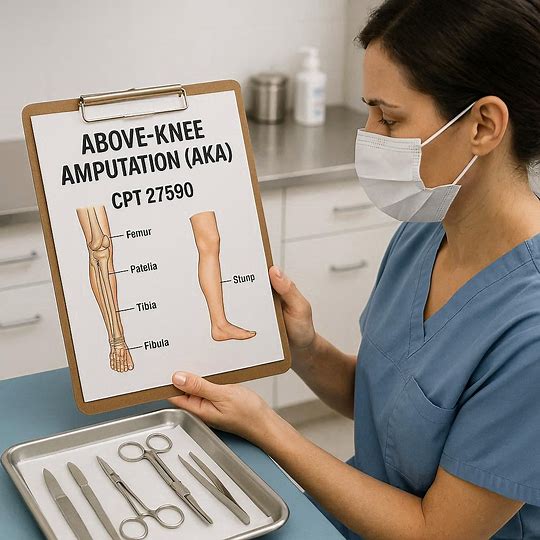
The Foundational Code: 27590 in 2026
For a primary, elective above-knee amputation performed through the femur, the CPT code set remains anchored by 27590. Barring a major structural overhaul from the AMA—which is rare for established musculoskeletal procedures—this code continues to represent the standard of care in 2026.
27590: Amputation, thigh, through femur, any level.
This descriptor is deceptively simple. The phrase “any level” is the first and most important rule you must internalize. The code 27590 does not differentiate between a distal femoral amputation and a high, subtrochanteric trans-femoral amputation. The work, the approach, and the anatomical considerations differ immensely, but for a standard non-traumatic, non-revision case, the code umbrella remains the same.
Key Insight: The AMA’s CPT code set rarely creates new codes for nuanced surgical approaches unless a fundamentally new technology or technique becomes widespread. For 2026, the established code 27590 is your starting point.
Why “Any Level” Matters
This rule prevents unbundling. A surgeon cannot bill a higher-fee code because the amputation was “more difficult” at a higher level through the femur. The complexity is inherent in the procedure’s global surgical package. This is a cornerstone of orthopedic coding integrity.
Important 2026 Update: Expanded Telehealth and Post-Op Care
While the core surgical code hasn’t changed, the 2026 updates brought a significant clarification. The Centers for Medicare & Medicaid Services (CMS) has further integrated digital monitoring into global surgical packages. For 27590, this means that certain remote patient monitoring (RPM) services for the 90-day global period are now more clearly defined. You must track these services for potential separate reporting with modifier -24, if a distinct, separately identifiable E/M service occurs beyond standard post-op wound checks.
Dissecting the Procedure: What’s Bundled into 27590?
Understanding what is included in the surgical package is just as important as knowing the code itself. When a surgeon reports 27590, they are billing for a comprehensive service package. Knowing these boundaries prevents billing for services that are considered part and parcel of the amputation.
Components of the Global Surgical Package
The following are integral to 27590 and are not separately reportable:
- Local infiltration, metacarpal/metatarsal/digital block, or topical anesthesia.
- Surgical approach: The skin incision through multiple tissue layers.
- Transection of the femur: Using an oscillating saw.
- Dissection and individual ligation of major vessels: The femoral artery and vein, and their branches.
- Transection and management of the sciatic and femoral nerves: A critical step where the nerve is pulled down under tension, sharply divided, and allowed to retract well proximal to the weight-bearing stump.
- Myodesis or myoplasty: The crucial process of stabilizing the muscles. Myodesis involves suturing the adductor and extensor muscles to the bone through drill holes, providing a powerful, balanced stump.
- Closure: Layered closure of the fascia, subcutaneous tissue, and skin over a drain.
- Application of a rigid or soft post-operative dressing: The immediate fitting of a stump shrinker or rigid cast.
Pro Tip: Do not report a separate code for nerve transection or muscle stabilization. The phrase “any level” in the code description for 27590 explicitly bundles these essential surgical steps, even though they are the most technically demanding parts of the operation.
Modifier Mastery: Telling the Full Story
A code without an appropriate modifier is an incomplete story. Modifiers are the language you use to communicate unique clinical circumstances to a payer. For CPT code 27590 in 2026, modifier use has become even more scrutinized.
The Laterality Modifier: A Non-Negotiable
The simplest, yet most critical, modifier is the anatomical one.
- LT (Left side)
- RT (Right side)
Most commercial payers and Medicare Advantage plans in 2026 require these modifiers on any code describing a paired organ or limb. A claim for 27590 without LT or RT is likely an instant rejection in an automated claims scrubber.
Key Modifiers for AKA in 2026
| Modifier | Definition | Application for 27590 in 2026 | Risk of Misuse |
|---|---|---|---|
| -50 | Bilateral Procedure | Applicable if a patient undergoes a bilateral AKA during the same operative session. This is rare and typically only in catastrophic trauma or severe dysvascular disease. Bill on a single line with modifier -50. | Overuse. Most payers require a single line with -50, not two lines with LT and RT. |
| -58 | Staged or Related Procedure | Use when a planned return to the operating room is needed for a complication like a wound dehiscence or a formal stump revision during the global period. | Diagnostic information must support that this was not a simple return to the OR for an unrelated issue. |
| -78 | Unplanned Return to OR | Use for an unplanned return to the OR for a related complication, such as bleeding, infection, or early stump breakdown. | This indicates an emergency. The documentation must clearly show the emergency nature. |
| -24 | Unrelated E/M Service | Use for a distinct, separately identifiable evaluation and management service during the 90-day global period. Example: The patient presents with an unrelated skin rash or a cardiac issue. | Never use for a routine post-operative wound check. That is part of the global package. |
A 2026 Warning on Modifier -59/X{EPSU}
The Medicare-specific modifiers (XE, XP, XS, XU) remain the preferred route over the broad -59 modifier. If a distinct procedural service is performed on the same day as the amputation, the burden of proof is on the provider. A separate, distinct organ system or a different encounter is not a valid application of XS (Separate Structure) when operating on the same limb. The 2026 Office of Inspector General (OIG) Work Plan specifically highlights the overuse of -59 on musculoskeletal procedures as a continued audit focus.
Documentation That Defends the Code
In the eyes of an auditor, a claim without a solid operative report is just a request for money. The operative report for an AKA must be a robust, stand-alone legal document that justifies every element of the code.
Your surgeon must paint a picture with words. A minimalistic note is a liability. Here is what a defensible operative report for CPT 27590 must contain in 2026.
The Non-Negotiable Elements of the Operative Report
- Pre-operative Diagnosis: This must be specific and linked to the need for amputation. Is it a non-healing Wagner Grade 4 diabetic foot ulcer with osteomyelitis? Is it an ischemic rest pain from non-reconstructable peripheral arterial disease? Just “gangrene” is insufficient.
- Post-operative Diagnosis: Should match or be a clarified version of the pre-op diagnosis.
- Anesthesia: Type (general, regional with sedation) and who administered it.
- Indications for Surgery: A detailed narrative. This is the most critical part for medical necessity. It must explain:
- The patient’s non-salvageable condition.
- Failed prior treatments (revascularization attempts, wound care, antibiotic courses).
- The immediate threat to life or limb.
- A statement that the surgeon discussed risks, benefits, and alternatives with the patient and informed consent was obtained.
- A Detailed, Chronological Operative Note:
- Patient Positioning & Prep: “The patient was placed supine on the operating table. A well-padded pneumatic tourniquet was placed high on the thigh. The left lower extremity was prepped and draped in the usual sterile fashion.”
- Incision: The exact length, location, and orientation. “A fish-mouth incision was made, creating anterior and posterior skin flaps of 12 cm and 10 cm, respectively, measured from the superior pole of the patella.”
- Dissection & Vessel Control: Name the vessels. “The femoral artery and vein were identified in the adductor canal, individually ligated with 0-silk sutures, and then suture-ligated with 2-0 Vicryl.”
- Nerve Management: This is vital. “The sciatic nerve was isolated, gently pulled down, infiltrated with 0.25% Marcaine, sharply transected with a scalpel, and allowed to retract well proximally into the soft tissues.”
- Bone Transection & Myodesis: “The periosteum was elevated, and the femur was transected 12 cm proximal to the knee joint line using an oscillating saw. Four unicortical drill holes were placed in the lateral femoral cortex. The adductor magnus and quadriceps tendons were secured to the bone through these drill holes using #5 Ethibond sutures, creating a balanced myodesis.”
- Closure & Dressing: Describe the layered closure, drain placement (e.g., 15-French Blake drain), and the exact type of post-operative dressing.
Critical Compliance Note for 2026: Payers are increasingly using AI-powered recovery audit contractors. These tools look for discrete data points. A report stating “vessels were ligated” scores a weaker medical necessity match than “the sclerotic femoral artery was isolated from the femoral vein and ligated in an atherosclerotic field.” The “sclerotic” and “atherosclerotic” descriptors confirm the link to the diagnosis of peripheral arterial disease.
The Critical Role of Medical Necessity
This is the most frequent cause of a denied claim. Medical necessity is not just a checkbox; it’s the logical story that connects the patient’s diagnosis to the amputation. The documentation must clearly answer, “Why now?” and “Why this level?”
A Linking Diagnosis is Mandatory:
- A patient with diabetes might have an AKA due to a non-healing foot ulcer. The diagnoses must be linked: E11.51 (Type 2 diabetes mellitus with diabetic peripheral angiopathy without gangrene) and L97.524 (Non-pressure chronic ulcer of left foot with necrosis of bone).
- A patient with PAD might have an AKA after a failed bypass. The diagnosis I70.262 (Atherosclerosis of native arteries of extremities with gangrene, left leg) directly tells the story.
Without this linked, causal chain, the payer sees two unrelated problems and denies the major surgical procedure.
Differentiating the Primary AKA from Stump Revision and Secondary Procedures
A primary amputation is one thing. A return to the operating room for a problem with the stump is another. This is a major coding fork in the road for 2026.
Stump Revision (27596)
When a patient’s existing amputation stump develops a problem—such as a painful neuroma, excessive soft tissue, or a bone spur—the surgeon performs a revision. The correct code is 27596: Amputation, thigh, through femur, any level; revision.
This is not a primary amputation. The pre-operative diagnosis is no longer the original disease (like PAD or cancer). It’s now a mechanical or neurological complication of the amputation stump. Using 27590 for a revision is a coding error that will be flagged. The operative note must describe removing an exostosis, resecting a ball neuroma of the sciatic nerve, or trimming excess soft tissue from a healed stump.
Secondary Closure (13160)
In some cases, the initial AKA wound is left open due to gross contamination or infection. This is a planned secondary closure. When the patient returns to the OR days later for a definitive closure of that skin flap, the correct code is not an amputation code. It is a complex repair code, specifically 13160: Secondary closure of surgical wound or dehiscence, extensive or complicated.
This code captures the significant work of preparing the wound edges and closing a clean, granulating wound bed. It is a distinct surgical procedure with a new 90-day global period (or shorter, depending on the payer’s rules on staged procedures). Modifier -58 (Staged Procedure) is essential to link it to the original amputation.
AKA in the Context of Other Procedures
An above-knee amputation rarely happens in isolation within the healthcare system. It’s often the final chapter in a long saga of limb salvage attempts. Understanding the coding for those preceding procedures provides crucial context.
AKA vs. Revascularization
A patient does not typically go directly from a diagnosis of PAD to an AKA. There is a long history of endovascular and open surgical revascularization.
- Failed Femoral-Popliteal Bypass: The original bypass code (e.g., 35556) was likely billed months or years earlier. The AKA (27590) is a consequence of the bypass failure, not a related staged procedure.
- Endovascular Interventions: Previous atherectomies (37229) or balloon angioplasties (37224) are also part of the history.
The key for the coder is to ensure the amputation claim has a diagnosis code that reflects the end-stage ischemia, such as late graft failure or progression of native vessel disease to a non-salvageable state.
AKA and the Total Knee Arthroplasty Patient
A particularly devastating scenario is a periprosthetic joint infection of a total knee replacement that cannot be cured. The sequence often looks like this:
- 27487: Revision of total knee arthroplasty, with or without allograft; femoral and both tibial components. This is a heroic attempt to save the joint.
- 11981: Insertion of antibiotic-eluting spacer. A temporary measure.
- 27590: Amputation, thigh, through femur, any level. When infection is uncontrollable, the limb is sacrificed.
In this context, the diagnosis code for the AKA will be T84.53XA (Infection and inflammatory reaction due to internal right knee prosthesis, initial encounter) as a contributing factor, shifting the medical necessity narrative from vascular disease to an infectious/orthopedic catastrophe.
2026 Reimbursement and Relative Value Units (RVUs)
Coding is the language; the Relative Value Unit (RVU) is the math that translates work into payment. CPT 27590 has a significant RVU weight, reflecting its profound intensity.
The Three Components of an RVU
Understanding the total RVU for 27590 helps you grasp the payment rate, which is then adjusted by the Medicare Conversion Factor (CF) in 2026. Let’s assume a hypothetical 2026 CF of $33.87 for this illustration. (Always check the finalized Physician Fee Schedule).
| RVU Component | Description | 2026 Hypothetical Value for 27590 | What This Means |
|---|---|---|---|
| Work RVU (wRVU) | The surgeon’s time, technical skill, and physical/mental effort and stress. | 19.50 | This is the dominant factor. An AKA is among the most intense musculoskeletal procedures. |
| Practice Expense RVU (peRVU) | The direct and indirect practice costs (nursing staff, supplies, equipment, office overhead). | 13.20 | High; reflecting the specialized post-op wound care supplies and longer global period overhead. |
| Malpractice RVU (mpRVU) | The professional liability insurance cost for the procedure. | 2.85 | Reflects the high-risk nature of the surgery. |
| Total RVU | Sum of the three components. | 35.55 |
Hypothetical Payment Calculation:
35.55 Total RVU × $33.87 Conversion Factor = **$1,204.06**
*Note: This is a hypothetical national Medicare non-facility payment amount, unadjusted for geographic practice cost indices. It serves only as an illustration. Actual 2026 rates may vary.*
The 90-Day Global Period: A Financial Obligation
The 27590 code has a 90-day global surgical period. This is a binding commitment. For 90 days following the surgery, every routine post-operative visit, wound check, staple removal, and post-op pain management is included in the single fee of $1,204.06.
You cannot bill a separate office visit (99213) for a routine 3-week wound check. This is the most common and easily audited billing mistake. The practice’s revenue cycle software must be configured to automatically zero out these charges. In 2026, with CMS’s focus on shared savings and cost control, overbilling in global periods is a prime target for extrapolated repayment demands.
The Future Landscape: Beyond the CPT Code
The 2026 CPT code for AKA is a static number in a dynamic world. The procedure of 2036 might carry a different code, driven by technology. As a medical coder, your expertise will need to grow in two key directions.
1. Coding for Advanced Prosthetic Integration: Osseointegration
Osseointegration (OI) is a revolutionary procedure where a metal implant is surgically anchored into the femur, allowing a prosthetic to attach directly to the bone without a traditional socket. This technique moves the AKA from a purely ablative procedure to a reconstructive one.
Currently, coders often must use an unlisted code (27599, Unlisted procedure, femur or knee) for OI, which requires a detailed operative report and a direct conversation with the payer’s medical director. However, the AMA’s CPT Editorial Panel is actively tracking the rising volume of OI. A Category I CPT code specifically for “Transfemoral Osseointegration Implant Insertion” is not a matter of if, but when. 2026 may not be the year, but monitoring the AMA’s Category III codes for OI will keep you ahead of the curve.
2. AI-Assisted Documentation and Coding
Your role is shifting from pure code entry to an expert auditor of AI suggestions. Soon, natural language processing (NLP) will scan a surgeon’s operative report and suggest 27590. Your job will be to verify the AI’s interpretation, ensure it captured the key differentiators (myodesis vs. simple closure, nerve management), and audit the linked diagnosis for medical necessity integrity. Your human expertise in correcting an AI’s oversimplification will be your most valuable asset.
5 Key Takeaways for Mastering the AKA Code in 2026
Let’s consolidate this knowledge into actionable rules you can apply today.
- Master the Base, Become Fluent in the Context: The code 27590 is your foundation. Your true value comes from knowing its boundaries—what is bundled, what is a complication (stump revision), and what is a distinct, new procedure.
- Diagnosis Tells the “Why”: A procedure code alone is hollow. The diagnosis code that links the patient’s disease to the amputation is the anchor of medical necessity. Spend as much time auditing the diagnosis pointers as you do the CPT code.
- The Operative Report Is Your Shield: A claim is a request; an operative report is a defense. Train your surgeons to document nerve traction, vessel ligation in a diseased field, and the technique of myodesis. These details are your audit-proof armor.
- Respect the Global Period’s Borders: The 90-day post-operative window for 27590 is a clearly defined fence. Straying outside it with routine visits is the fastest path to a compliance violation.
- Stay in Learning Mode for 2026 and Beyond: The shift from purely ablative surgery to restorative techniques like osseointegration will change our codes. The annual CPT book is a starting point; subspecialty society resources and direct payer communications are your ongoing education.
Frequently Asked Questions (FAQ)
Q1: Is CPT code 27590 the only code I will ever use for an above-knee amputation?
No. 27590 is for the primary, definitive amputation. You will use other codes for different scenarios: 27596 for a formal stump revision on a healed stump, or 13160 for a planned secondary closure of a wound that was left open. For a traumatic amputation requiring significant debridement, different injury codes from the laceration/repair sections may apply before the closure.
Q2: What diagnostic support must be in the chart to defend a 27590 claim against an audit?
The chart must demonstrate a clear medical necessity through a linked, causal chain. You need a specific pre-operative diagnosis (e.g., I70.262, Atherosclerosis of native arteries of extremities with gangrene, left leg) and a detailed indication section in the operative note explaining why the limb was non-salvageable. Office notes documenting failed prior treatments, such as vascular bypasses, wound care, or IV antibiotics, are essential.
Q3: Can I bill an E/M service separately during the 90-day global period of the AKA?
Yes, but only under strict conditions. You must use the -24 modifier. The E/M service must be for a diagnosis that is clearly unrelated to the amputation or its post-operative care. For example, a patient’s visit for an unrelated urinary tract infection or a skin rash on the contralateral arm is separately billable. A visit to check the healing amputation stump is never separately billable; it’s part of the global package.
Q4: In 2026, has there been a change in how Medicare reimburses for the post-operative supplies included in 27590?
The supplies for the immediate rigid post-operative dressing remain bundled into the practice expense RVU of 27590. The 2026 update clarified that specific high-cost negative-pressure wound therapy systems, when placed on a closed surgical incision (not an open wound), may require a separate evaluation for coverage under a specific device code if they meet strict medical policy criteria. Routine stump shrinkers and soft dressings are inclusive.
Q5: How do I code for a bilateral above-knee amputation performed in the same session?
Report 27590 on a single service line with the modifier -50. Most Medicare and commercial payers in 2026 prefer this method over reporting 27590-RT on one line and 27590-LT on a second. Always verify your specific payer’s guidelines, as some contractors have a published preference. Billing it correctly ensures you receive the 150% payment for the bilateral procedure without a claim rejection for suspected duplication.
Additional Resource
For the most current, authoritative guidance directly from the source, you should always consult the American Medical Association (AMA) CPT Network. Their website provides the official code descriptors and guidelines.
Conclusion
Mastering the CPT code for an above-knee amputation in 2026 requires more than memorizing 27590. It demands a deep understanding of the bundled surgical package, a defensive mindset for documentation, and a strict adherence to the 90-day global period rules. By connecting a narrative diagnosis to the technical operative details and applying modifiers with precision, you transform a billing claim into a compliant, audit-proof financial asset. Stay vigilant for future changes in osseointegration coding, as this is where the procedure’s future lies.