Medical coding for dermatological procedures can feel like navigating a labyrinth. One of the most common, yet surprisingly nuanced, encounters in primary care, urgent care, and emergency departments is the removal of a tick. On the surface, the task seems trivial—grasp, pull, discard. However, when the clinical encounter meets the complexities of the Current Procedural Terminology (CPT) system, the documentation and billing process requires precision.
This definitive guide explores the correct CPT code for tick removal in 2026. We will dissect the anatomical requirements, the difference between simple and complex extractions, and the specific documentation needed to withstand a payer audit. Whether you are a seasoned coder, a medical biller, or a healthcare provider trying to keep up with the shifting landscape of evaluation and management (E/M) coding, this article provides the clarity you need.
Understanding the Current Procedural Terminology (CPT) Framework
Before we zero in on the specific digits for tick removal, we must establish a foundational understanding of how the CPT system categorizes surgical and medical procedures. The American Medical Association (AMA) maintains the CPT code set, which is divided into three categories. For the purposes of foreign body removal, and specifically parasite extraction, we operate exclusively within Category I codes. These are the five-digit numeric codes that represent services widely performed by healthcare professionals and approved by the Food and Drug Administration (FDA).
The integumentary system, which houses the skin and subcutaneous tissues, spans the code range 10030 through 19499. Within this vast section, the surgical subsection for “Incision and Drainage” and “Foreign Body Removal” lives in the 10120–10121 range, while the broader “Removal of Skin Tags” and debridement services sit nearby. The code we need resides in the realm of foreign body removal. A tick, in the lexicon of medical coding, is not simply a bug. It is a living foreign body embedded in the dermis. Coding guidelines treat it differently than a penetrating shard of glass or a splinter of wood because of the biological risk of infection and disease transmission.
Staying updated for 2026 is critical. While the core code for tick removal has remained stable for years, the surrounding rules for Evaluation and Management (E/M) services, modifiers, and telehealth have shifted. In 2026, coders must pay particular attention to the revised definitions of “substantive portion” of a visit and how split/shared billing rules apply in facility settings if a non-physician practitioner (NPP) performs the service.
The Primary CPT Code: 10120
If you only memorize one fact from this guide, let it be this: the CPT code for simple tick removal is 10120. The official descriptor for this code is: “Incision and removal of foreign body, subcutaneous tissues; simple.”
At first glance, this descriptor might seem slightly mismatched. You might not always make an “incision” in the traditional scalpel sense to remove a tick. However, the AMA and the Centers for Medicare & Medicaid Services (CMS) recognize the mechanical separation of the tick’s mouthparts from the skin as a manual surgical procedure that falls under this category. The “simple” designation refers to the absence of a complex layered closure, the minimal depth of the foreign body, and the lack of requirement for general anesthesia.
Using 10120 tells the payer that the provider performed a minor surgical procedure to extract a discrete object from the subcutaneous layers. The “subcutaneous” component is key. If the tick is simply crawling on the surface of the skin and the patient flicks it off themselves, no procedure occurred. If the provider uses tweezers to grasp a tick that has not yet anchored its hypostome into the skin, the service might not rise to the level of 10120. The code implies that the foreign body was lodged under the skin surface, which aligns perfectly with the biological mechanism of a tick attaching to a host.
CPT 10120 vs. E/M Codes: Why the Distinction Matters
One of the most common coding errors in urgent care settings is billing an Evaluation and Management (E/M) code alongside 10120 without proper justification, or conversely, billing an E/M code when the work performed was entirely surgical. The National Correct Coding Initiative (NCCI) bundles many E/M services into minor surgical procedures.
A minor surgical procedure includes inherent components: a brief focused history, the physical examination of the lesion, the consent process, and uncomplicated follow-up care. When a patient presents exclusively for the removal of a tick, and the provider swiftly removes it without managing any other systemic conditions, billing a separate E/M service is often inappropriate. You should report only the 10120.
However, reality in the clinic is rarely that simple. In 2026, with the continued emphasis on medical decision making (MDM) in the outpatient E/M definitions, the decision to bill an E/M code with a modifier -25 depends entirely on the documentation of a “significant, separately identifiable service.”
Consider these two scenarios:
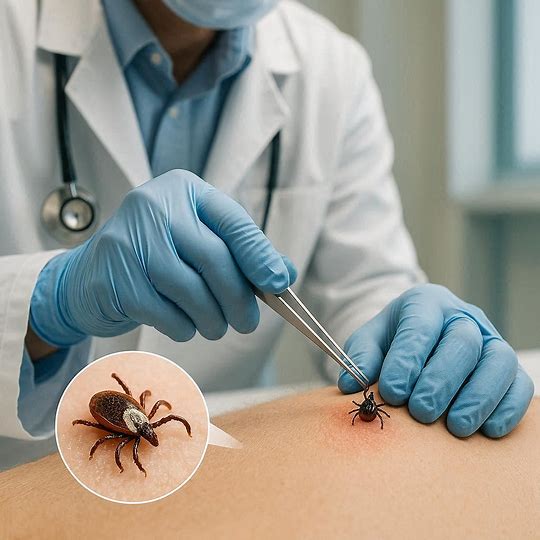
- Scenario A: A mother brings her 7-year-old child to the pediatrician. “He has a tick behind his ear. I’m too scared to pull it out.” The provider examines the site, notes a small, engorged deer tick lodged in the postauricular crease, and removes it intact using forceps. The provider applies a bandage.
- Correct Coding: 10120 only. The evaluation was inherent to the procedure.
- Scenario B: A 55-year-old male presents to an urgent care center in a Lyme-endemic area with a tick embedded on his calf for three days. He reports feeling run-down and mentions a circular, expanding rash on his thigh that he noticed this morning. The provider evaluates the rash, discusses the clinical diagnosis of Erythema Migrans, orders labs for Lyme serology, prescribes a 14-day course of Doxycycline, and then removes the tick.
- Correct Coding: 99214 (or appropriate E/M level based on MDM) with modifier -25, plus 10120. The management of the suspected Lyme disease constitutes a separately identifiable evaluation that goes significantly beyond the standard pre-procedural work.
The “Complex” Counterpart: CPT 10121
Nature does not always cooperate with a clean extraction. Sometimes, the tick’s mouthparts break off deep below the surface. Other times, the host has scratched the site, causing a secondary infection and abscess formation that obscures the foreign body. In these cases, a simple tweezer extraction (10120) is not physically possible without a more invasive approach.
This is where CPT code 10121 enters the picture. The descriptor reads: “Incision and removal of foreign body, subcutaneous tissues; complicated.”
Using 10121 requires documentation of the “complicated” nature. Was a layered closure necessary? Did the provider have to use an ultrasound or fluoroscopic guidance (though you would often report guidance separately) to locate the retained hypostome? Did the procedure require extensive blunt dissection or sharp debridement of the surrounding tissue to isolate the mouthparts?
A 2026 prospective audit risk involves upcoding from 10120 to 10121. Payers are increasingly scrutinizing “complicated” foreign body removals. To justify 10121 for a tick, the operative note must paint a vivid picture. It should describe the degree of fibrosis around the retained hypostome, the inability to grasp the object with standard forceps, and the use of a scalpel blade (#11 or #15) to excise a core of tissue containing the foreign body. If the provider simply digs a little deeper with tweezers but does not use a scalpel or perform a layered closure, 10120 remains the correct code.
Anatomy of a Tick Bite: Clinical Context for Accurate Coding
Coders and auditors often disassociate the clinical presentation from the billing sheet. To correctly apply the CPT code for tick removal 2026, you must appreciate the structural biology of the tick’s mouth. The Ixodidae family (hard ticks) possesses a structure called the hypostome. This is essentially a barbed, straw-like feeding tube that they insert into the host’s epidermis and superficial dermis. They secrete a cement-like substance that anchors the mouthparts securely.
When a patient arrives, the provider is not just grabbing an insect; they are disengaging a living anchor coated in biological cement. The act of breaking the cement seal and retracting the barbed hypostome without leaving remnants behind is the “incision and removal” process. The “incision” can be the micro-dissection caused by the forceps tips sliding alongside the hypostome to the cement plug.
Documentation should reflect this biological reality. The note should state: “Tick identified, attached to the [location]. Mouthparts embedded in the dermis. Gentle traction applied parallel to the skin plane to disengage the hypostome without torsion. Intact tick extracted. Wound inspected; no retained mouthparts visible.” This simple paragraph supports the medical necessity of 10120.
When the Procedure Fails: Retained Hypostome
Sometimes, despite the provider’s best efforts, the body of the tick detaches from the head, leaving the mouthparts embedded in the skin. Visually, this appears as a small black splinter. At this precise moment, the coding path diverges.
If the provider elects to pursue the retained mouthparts with a needle or scalpel, they are performing a different procedure. The initial attempt may have been “simple,” but the secondary extraction might reach the “complicated” threshold if it requires significant probing. However, you cannot bill for two separate removals from the same site. You bill the final, definitive procedure.
If the provider decides against digging for the mouthparts and instead advises the patient to leave them (a common and accepted practice, as the body will eventually expel the foreign material through normal skin turnover), the procedure has effectively ceased being a surgical extraction. In this specific instance, some coders argue that the service reverts to a Nurse Visit (99211) or a low-level E/M code if counseling was provided. However, if the provider successfully removes the main body and destroys the hypostome via curettage or punch biopsy, 10120 or 10121 still stands as the comprehensive code.
Coding Scenarios and Use Cases for 2026
Theory means little without practical application. Let’s walk through several realistic scenarios you will likely encounter in the 2026 fiscal year. We will analyze the correct coding, modifier usage, and diagnosis linkage.
Scenario 1: The Asymptomatic Wood Tick
A father brings his 10-year-old son to the family medicine clinic. They were camping in a non-Lyme-endemic region over the weekend. The father pulled a tick off the family dog but is uncomfortable removing the one on his son’s shoulder. The provider examines the site. A non-engorged wood tick is attached superficially. The skin shows no erythema or warmth. The provider grasps the tick at the head with Adson forceps and removes it in one piece. The site is cleaned, and the patient is discharged.
- CPT Code: 10120
- Diagnosis Code: S90.869A (Insect bite, unspecified lower leg, initial encounter—or specify the shoulder site accurately; W57.XXXA (Bitten or stung by nonvenomous insect and other nonvenomous arthropods, initial encounter) is an external cause code, not a primary diagnosis. Use a specific S-code for the bite wound).
- Rationale: Simple removal. No E/M billed because the history and exam were minimal and directly related to the procedure.
Scenario 2: The Embedded Deer Tick with Prophylaxis
A 40-year-old female presents to the emergency department in July 2026. She lives in Connecticut and pulled a very small, engorged deer tick off her abdomen 24 hours ago. She is terrified. She brings the tick in a baggie. The provider identifies it as Ixodes scapularis, estimates the engorgement time at >48 hours, and prescribes a single dose of Doxycycline for prophylaxis.
- Did the provider perform a removal? No. The patient removed it. The provider is only performing risk assessment and prophylaxis.
- CPT Code: No 10120 code is billable. Bill E/M code 99283 (or appropriate level) based on the Medical Decision Making (MDM). The MDM involves the risk of Lyme disease transmission and prescription drug management. Modifier -25 is not needed because no surgical code is used.
- Diagnosis Code: Z20.828 (Contact with and (suspected) exposure to other viral communicable diseases), Z29.8 (Encounter for other specified prophylactic measures).
Scenario 3: Tick Granuloma Excision
A 45-year-old hiker presents with a persistent nodule on his right calf for six months. He recalls a tick bite at that site. The nodule is itchy and has not resolved. The dermatologist diagnoses a tick bite granuloma (a delayed hypersensitivity reaction to retained mouthparts). The provider injects local anesthetic, makes an elliptical incision around the nodule, dissects down to the superficial fascia, and removes a 0.5 cm fibrous nodule with a central black speck. The wound is closed with a single deep layer of 4-0 Vicryl and a running 4-0 Prolene suture on the surface.
- CPT Code: This is no longer a simple foreign body removal. The procedure is the excision of a benign lesion. Report 11403 (Excision, benign lesion, trunk, arms, or legs; excised diameter 0.6 to 1.0 cm) or the appropriate size code. Do not use 10121. The provider is treating the chronic immune response and scar tissue, not the acute mechanical extraction of a bug.
- Diagnosis Code: L92.8 (Other granulomatous disorders of the skin and subcutaneous tissue).
Table: CPT Code Selection Decision Tree
| Clinical Presentation | Procedure Performed | Correct CPT Code | Modifier Considerations |
|---|---|---|---|
| Attached tick, easy visualization, minimal erythema | Simple forceps extraction, no incision | 10120 | None, unless a significant E/M was also performed (-25) |
| Retained mouthparts, localized infection, purulence | Incision with #11 blade, dissection, removal of debris | 10121 | None, unless a significant E/M was also performed (-25). Ensure documentation supports “complicated.” |
| Patient removed tick; presents for disease risk check only | History, exam, prophylaxis prescription | E/M Code (99202-99215) | No surgical code applicable. |
| Tick crawling on skin (unattached) | Nurse removes with tape | No charge / Nurse visit | Not a surgical procedure. No CPT for removing unattached bugs. |
| Chronic nodule/granuloma from old bite | Elliptical excision and layered closure | 114xx (Benign lesion excision) | Closure is bundled into excision code. |
The Critical Link: ICD-10 Diagnosis Codes for Tick Encounters
Medical necessity is the fulcrum on which reimbursement balances. The CPT code 10120 describes the what—the incision and removal of a foreign body. The ICD-10-CM code describes the why—the diagnosis that justifies the procedure. If you mismatch these, the claim will fail even if the CPT code is perfect.
In 2026, coders must be meticulous about specificity. The ICD-10-CM guidelines instruct us to code first the wound, then the external cause, and finally the encounter status.
Primary Diagnosis Options:
- S90.869A – Insect bite (nonvenomous) of unspecified lower leg, initial encounter. (Select the most specific site code; for the arm, you might select S40.869A).
- S70.369A – Insect bite (nonvenomous) of unspecified thigh, initial encounter.
- W57.XXXA – Bitten or stung by nonvenomous insect and other nonvenomous arthropods, initial encounter. Note: This is an external cause code. It usually cannot stand as the sole primary diagnosis on a professional claim. It supplements the injury code (the S-code).
- Z20.828 – Contact with and (suspected) exposure to other viral communicable diseases (use this if the focus is on Lyme risk but no obvious skin infection is present).
- L08.89 – Other specified local infections of the skin and subcutaneous tissue (use this if there is erythema, cellulitis, or purulence around the bite).
The “Initial” vs. “Subsequent” Encounter Trap:
A common billing error involves the 7th character. The “A” (initial encounter) signifies that the patient is receiving active treatment for the injury. Active treatment includes the surgical removal of the foreign body. Therefore, even if the patient saw another doctor yesterday for the same bite, your removal procedure is active treatment. Code the encounter as “Initial” (“A”) for the removal visit. You do not switch to “D” (subsequent) just because time has passed. “D” is for routine care during the healing phase, like dressing changes. A tick removal halts the active phase.
Modifiers: Unlocking Reimbursement in 2026
Modifiers are the two-digit suffixes that tell the insurance plan a story about the exceptional circumstances of the service. In the context of the CPT code for tick removal 2026, three modifiers dominate the conversation.
Modifier -25: Significant, Separately Identifiable E/M Service
As discussed earlier, this is the most audited modifier in America. To use Modifier -25 on an E/M code appended to 10120, you must prove that the E/M was “above and beyond” the usual pre- and post-operative work of the procedure. The provider must have performed an assessment that generated a management plan distinct from the removal itself.
- Valid Use: “Patient presents with tick bite; also reports a 3-day history of fever and myalgias. Provider evaluates for systemic infection, orders Lyme titer and CBC, and prescribes Doxycycline. Procedure: tick removal.”
- Invalid Use: “Patient presents for tick removal. Provider takes a brief history regarding the timing of the bite and removes the tick.” The history of the bite is not a separately identifiable E/M; it’s the pre-op assessment.
Modifier -59: Distinct Procedural Service
You will rarely use Modifier -59 with 10120 on the tick itself. However, you might use it if the provider removes two distinct foreign bodies at different anatomical sites.
- Example: A child fell into a bush. They have a tick embedded on the left forearm and a large wooden splinter embedded in the right palm. The provider removes both.
- Coding:
- 10120 (Tick, forearm)
- 10120-59 (Splinter, palm) or 10121 if the splinter is complicated.
The Modifier -59 tells the payer that the second 10120 is not a duplicate billing error; it represents a distinct, separate procedure at a different location. Ensure distinct documentation for each site.
Modifier -76: Repeat Procedure by Same Physician
This is exceptionally rare for a tick removal. It would apply if the same provider removed a tick, the wound healed, and on the same day but during a later, disconnected encounter, the patient returned with a new tick bite. You would apply -76 to the second procedure. In most cases, this is not a practical scenario.
Documentation Requirements for a Bulletproof Claim
A procedure note for tick removal should not be a one-liner. Payers—especially Medicare Administrative Contractors (MACs) and commercial recovery audit contractors (RACs)—are employing natural language processing (NLP) tools in 2026 to scan documentation for support of the billed code.
If you bill 10120, your note must explicitly answer “yes” to these silent audit questions:
- Was there a foreign body? “An engorged tick identified.”
- Was it subcutaneous? “Mouthparts firmly anchored into the superficial dermis.”
- Did an incision or mechanical dissection occur? “Attached tick was dislodged using blunt dissection with forceps.” (Words like “dislodged” or “excised” are stronger than “removed”).
- Was the entire foreign body extracted? “Tick removed intact. Hypostome confirmed present and not retained. Wound inspected under magnification.”
For 10121, the documentation must escalate:
- “Due to prior manipulation, the tick body detached, leaving the hypostome deeply embedded.”
- “A wheal of 1% lidocaine with epinephrine was injected to control bleeding.”
- “A #11 scalpel blade was used to create a 3 mm incision parallel to the skin lines over the retained material.”
- “Blunt dissection was performed, and a 1 mm fragment of black chitinous material (the hypostome) was retrieved.”
- “The resulting defect was closed with a single 5-0 Nylon suture.”
Without the mention of the scalpel incision or the layered closure, a payer will downgrade the 10121 to a 10120, taking back the difference in relative value units (RVUs).
The Role of Magnification and Tools
In recent years, dermatoscopes have become common in general medicine. If a provider uses a dermatoscope to visualize the hypostome to ensure complete removal, they should photograph it and note it. This evidence supports the medical necessity of the “simple” procedure by demonstrating the complexity of the identification. However, do not bill a separate dermatoscopy code (like 96931) as it is considered bundled into the procedural evaluation in 2026.
Common Mistakes and How to Avoid Them
Over the years, auditing patterns have revealed a consistent set of errors that plague claims for foreign body removal. Avoiding these mistakes will protect your practice from recoupment demands.
Mistake 1: Billing for Unattached Ticks
Perhaps the most egregious coding violation is billing 10120 when the tick is simply walking on the patient’s skin or clothing. The CPT code book specifically references the integumentary and subcutaneous system. If the parasite has not breached the skin barrier, there is no surgical procedure. This is a nurse visit or self-care. Billing a surgical code constitutes a false claim.
Mistake 2: Double-Dipping with Laboratory Codes
Sometimes, a provider will send the tick for identification or Lyme testing. Pathologists may bill a surgical pathology code (88304) for the evaluation of the tick. However, the provider performing the removal cannot bill for the lab test unless they own the lab and personally perform the interpretation under a CLIA certificate. Furthermore, most experts in 2026 advise against testing the tick itself, as the presence of Borrelia burgdorferi in the tick does not guarantee transmission, and standard prophylaxis guidelines rely on clinical factors, not tick testing results. If a provider chooses to send the tick to a reference lab, they must handle the specimen handling code (99000) appropriately but should not bill the interpretive pathology code unless they actually performed the microscopy.
Mistake 3: Billing 10121 for a “Difficult Pull”
There is a difference between a “difficult pull” and a “complicated procedure.” If the provider exerts substantial traction, and the tick finally releases with a snap, but no incision is made, the code is still 10120. The difficulty of the work is captured by the relative value units (RVUs) already assigned to 10120. Upcoding to 10121 requires the scalpel or the layered closure. “I had to pull really hard” does not meet the audit criteria for complexity.
Mistake 4: Ignoring the Global Period
CPT 10120 carries a 10-day global surgical period in the Medicare Physician Fee Schedule. This is frequently forgotten in primary care. When you bill 10120, any subsequent visits for standard post-operative care of that site (dressing changes, checking the wound for healing) are bundled into the surgical fee for 10 days.
- Exception: If the patient returns within the 10-day window with a significant complication (e.g., a spreading cellulitis), you can bill an E/M service with Modifier -24 (Unrelated Evaluation and Management Service by the Same Physician During a Postoperative Period). The diagnosis of the new infection is distinct from the standard post-op care.
Table: 2026 RVU Comparison (National Physician Fee Schedule Estimates)
| CPT Code | Description | Work RVUs | Total Non-Facility RVUs | Global Period | Typical Allowable (Estimate) |
|---|---|---|---|---|---|
| 10120 | Removal of FB, simple | 0.77 | 1.44 | 10 Days | $85 – $110 |
| 10121 | Removal of FB, complicated | 1.40 | 2.60 | 10 Days | $150 – $190 |
| 99213 | Established Outpatient E/M, Level 3 | 0.97 | 1.70 | N/A | $70 – $90 |
| 99214 | Established Outpatient E/M, Level 4 | 1.50 | 2.60 | N/A | $110 – $140 |
Note: These values are approximate and vary by Medicare locality and commercial payer fee schedules. Always verify with your specific fee analyzer for 2026.
Telehealth and Tick Removal in 2026
The digital transformation of healthcare continues to influence dermatological and primary care coding. Can you bill a CPT code for tick removal 2026 via telehealth? The answer is a definitive “No.” CPT code 10120, by its very definition, is a manual, hands-on surgical procedure. There is currently no CPT code for “virtual tick removal.” This constitutes a direct physician-patient physical interaction.
However, the telehealth visit plays a crucial role in the triage process, which indirectly affects coding.
A patient may have a video visit because they are worried about a tick bite.
- Triage Only: The provider sees the tick on camera, confirms the diagnosis, and instructs the patient on safe home removal. The provider prescribes prophylactic doxycycline.
- Coding: You bill the E/M telehealth visit (e.g., 99213-95) based on MDM. You do not bill 10120. The patient did the procedure.
- Referral to Office: The provider sees a deeply embedded tick in a sensitive area (e.g., auditory canal) and says, “Please come to the office immediately. We cannot risk home removal.”
- Coding: The provider bills the telehealth visit for the assessment.
- Later in the day: The provider performs the removal in the office. You must combine the E/M work from the telehealth visit and the in-person visit into one single E/M service for the date. You do not bill two separate E/Ms. You then bill the 10120. The bundled E/M service that encompasses both the video and the in-person pre-op assessment is billed with modifier -25 if significant.
Special Populations: Pediatrics and Geriatrics
Coding is not a one-size-fits-all discipline. The application of 10120 varies when applying it to specific demographics, particularly when sedation is involved.
Pediatric Tick Removal
Ticks are a rite of passage in many suburban childhoods. Removing a tick from a screaming, squirming 4-year-old is not a “simple” task in the clinical sense. However, the physical size of the procedure is still usually 10120. The challenge lies in the management of the patient’s anxiety.
If the provider requires the help of a medical assistant to hold the child still, this is considered incidental to the procedure. However, if the child is so terrified that the provider cannot safely use a scalpel (for a 10121 removal) without conscious sedation, a separate sedation service may be billable. In 2026, coders should review the payer guidelines for Moderate Conscious Sedation codes (99156-99157). If you administer intranasal midazolam to safely retrieve retained mouthparts, you can bill the sedation codes in addition to the 10121. The documentation must include the pre-sedation exam, the sedation time (intra-service time must be documented from the initial push of the drug until the procedure ends and the patient is stable), and the post-sedation monitoring.
Geriatric Considerations
Elderly skin presents unique mechanical challenges. Often, the skin is thin, friable, and taking a biopsy or performing a complex extraction can result in skin tears. Furthermore, many elderly patients are on anticoagulation (Warfarin, Apixaban). A simple traction removal (10120) that causes a small amount of oozing is straightforward. However, if the tick bite has induced a fragile sub-epidermal hematoma due to anti-coagulation, and the provider must perform careful hemostasis with electrocautery after the removal, the procedure remains 10120, but the note should robustly describe the added complexity of the hemostasis to justify the use of the surgical tray and the time spent. You generally cannot upcode to 10121 simply because the patient is on blood thinners unless the bleeding risk forced the provider to switch from a simple extraction to a formal incision and suture closure.
The Economics of Tick Removal: A 2026 Perspective
From a patient’s perspective, a tick removal feels like a simple tweak. From a billing perspective, the economics often feel upside down. The payment for 10120 (approximately $100 in some regions) covers the provider’s work, the clinical staff’s time, the sterile tray, the forceps, the gauze, the antiseptic, and the biohazard disposal of the tick.
Many insurance plans, particularly high-deductible health plans (HDHPs), have shifted the cost of this minor procedure entirely onto the patient. A practice manager in 2026 must be prepared for the phone call from the irate parent: “You charged me $120 to pull a tick off!”
This is why coding accuracy is a customer service tool. If you upcode a 10120 to a 10121, the price jumps significantly. If that jump is not justified, the practice loses on the appeal, the patient pays more, and the trust erodes. Conversely, if the provider did excise a granuloma, billing it as a benign lesion excision (114xx) accurately reflects the work and garners an appropriate reimbursement ($200-$350) for the surgical skill required.
CCI Edits and Bundling Logic for 2026
The National Correct Coding Initiative (NCCI) Policy Manual is the definitive rulebook for determining what codes cannot be reported together. For CPT 10120, the edits are logical but strict.
- Dressing Application: Application of a sterile bandage or dressing is a component of the surgical package. Do not bill for surgical trays (A4550) or simple bandages separately to Medicare.
- Local Anesthesia: The injection of Lidocaine is an inherent component of the procedure. You cannot unbundle a local infiltration anesthetic injection from 10120 or 10121. The drug itself is consumed by the practice cost, but the injection code (e.g., 64455 for a nerve block) is inappropriate for a direct local infiltration around a tick bite.
- Cautery: If a small amount of chemical cautery (silver nitrate) is applied, this is bundled. If significant electrocautery is required (as might be the case with a hemorrhagic granuloma), it remains bundled into the integumentary procedure.
Coders must run their claims through an encoder scrubber updated with the Q1 2026 CCI edits. Pay particular attention to “Column 1/Column 2” pairs. If you find that 10120 is a Column 1 code and a culture or debridement code is Column 2, you need to ensure they are on different sites or use appropriate modifiers if permitted.
Quotations from Industry Experts
Listening to the voices of certified coders and auditors brings the black-and-white text to life. Here are insights based on consensus advice from the American Academy of Professional Coders (AAPC) community and compliance experts regarding dermatological coding:
“The most common audit flag for tick removal isn’t the CPT code—it’s the -25 modifier. I tell my providers: if the tick is the sole reason for the visit, the E/M is a mirage. It doesn’t exist.” — A Senior Medical Auditor, reflecting on 2026 trends.
“Many coders think ‘I had to dig around for it’ justifies 10121. That’s not true. If you open a sterile needle and tease the mouthparts out, it’s still 10120. ‘Complicated’ involves a blade and a closure. The documentation must scream ‘incision.'” — A Certified Professional Coder, speaking at a regional conference.
“In 2026, we are seeing AI-assisted audits. If the note says ‘tick removed,’ and the code is 10121, the AI flags it immediately. The provider must document the density of the subcutaneous tissue and the precise technique used to justify the complexity.” — A Healthcare Compliance Consultant.
The Future of Entomological Coding
Looking beyond 2026, the coding of vector-borne disease encounters will likely evolve. As climate change alters tick migration patterns, alpha-gal syndrome (mammalian meat allergy) transmitted by the Lone Star tick is dramatically rising. Currently, there is no distinct “high-complexity” tick removal code for this emerging risk. The CPT Editorial Panel may, in the future, need to address “complex medical decision making related to high-risk tick removal” or create specific add-on codes for the provision of prophylactic measures and education.
For now, 10120 and 10121 remain the workhorses, and the risk of disease transmission must be captured through the diagnosis codes (e.g., Z20.89 for exposure to alpha-gal, or Z29.1 for prophylactic immunotherapy if relevant) rather than a specific surgical CPT code. Coders must watch for permanent changes to the E/M guidelines as the AMA continues to revise the definitions of “time” and “MDM.”
Summary and Actionable Checklist for Coders
Ensure your 2026 claims for tick removal are perfect by following this summary checklist:
- Identify the Depth: If the tick is not attached, do not bill a surgical code.
- Select the Correct Procedure Code: Choose 10120 for simple forceps extraction. Choose 10121 only if an incision with a scalpel and/or layered closure was required.
- Diagnosis Linkage: Link S-codes for the specific bite site. Use Z20.828 for exposure prophylactic management.
- Modifier -25 Audit: Ask, “Did I treat a systemic complaint that stands alone?” If the answer is no, submit only the 10120.
- Global Period Management: Remind scheduling staff that wound checks within 10 days are covered by the procedure payment.
- Document the Hypostome: The note must confirm intact removal or explicitly state the plan for retained fragments.
Conclusion
The accurate submission of the CPT code for tick removal in 2026 hinges on a dual understanding of intricate billing rules and the biological nature of the procedure itself. We demystified the primary code, CPT 10120, and its complex counterpart, 10121, while establishing the critical boundaries of E/M modifiers, global periods, and audit-proof documentation. By mastering the subtle clinical distinctions between a simple extraction and an excisional procedure, medical coders ensure both healthy revenue cycles and compliant medical records that stand up to any scrutiny.
Frequently Asked Questions (FAQ)
Q: What is the specific CPT code for removing a tick in 2026?
A: The primary code is 10120. This describes a simple incision and removal of a foreign body from the subcutaneous tissue. If the mouthparts are retained and require a deep scalpel incision and sutures, use 10121.
Q: Can I bill an office visit (E/M) along with the tick removal code?
A: Only if you append Modifier -25. You must provide a significant, separately identifiable evaluation and management service (such as assessing a skin rash and prescribing antibiotics for Lyme disease) that is distinct from the procedure itself.
Q: Does the 10120 code include the use of local anesthesia?
A: Yes. The injection of local anesthetic, or the use of a numbing agent, is considered an inherent component of the minor surgical procedure and is not separately billable.
Q: What if the tick is not attached to the skin?
A: If the tick is crawling on the skin or clothing, you cannot bill CPT 10120. This is not a surgical procedure. The service may be an E/M visit for counseling or a nurse visit for removal of the bug from the room.
Q: Why was my claim for 10121 denied?
A: The most likely reason is lack of documentation supporting a “complicated” removal. Payers need evidence of an incision with a scalpel or a layered closure. A note simply saying “the tick was difficult to pull” does not justify 10121.
Additional Resource
For the most current guidance on Evaluation and Management (E/M) coding changes that impact your use of Modifier -25 with minor procedures, visit the official AMA CPT website:
https://www.ama-assn.org/practice-management/cpt