Medical billing requires precision. A single misplaced digit or forgotten modifier can delay a claim for weeks or even result in a denial. Among the many modifiers that professional coders work with daily, Modifier AS holds a unique place. It is not the most common modifier, but when the clinical scenario calls for it, using it correctly becomes essential for compliant reimbursement.
This article explains everything you need to know about Modifier AS. We will cover its definition, proper usage, documentation requirements, reimbursement impact, and how it compares to other surgical modifiers. Whether you are a new medical coder, an experienced biller, or a practice manager reviewing claim denials, this guide will serve as your go-to reference.
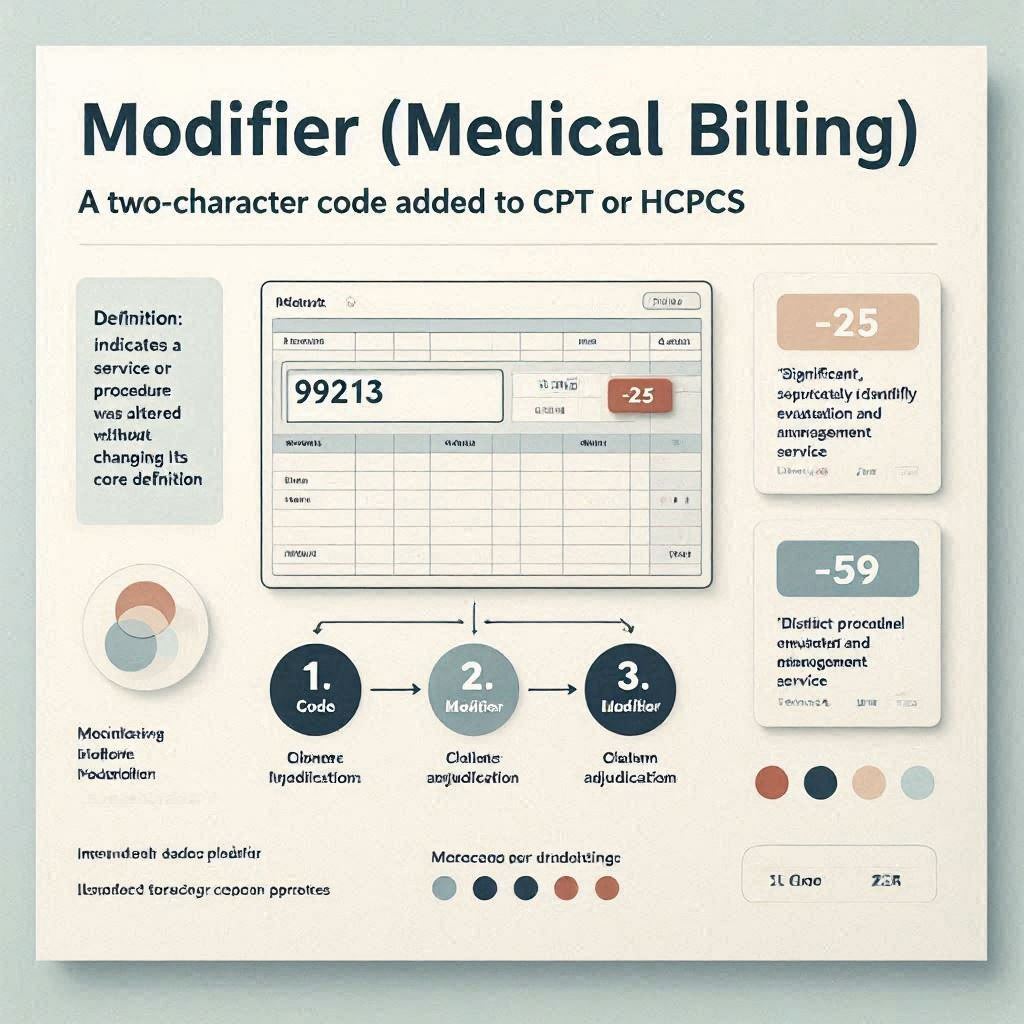
Understanding Surgical Modifiers in Medical Billing
Before we dive specifically into Modifier AS, it helps to understand where it fits within the broader category of surgical modifiers. Surgical modifiers give payers additional information about a procedure. They explain who performed a service, how it was performed, or why it differed from the standard description.
The Role of Modifiers in Claims Processing
Modifiers are two-character codes—either numeric or alphanumeric—appended to CPT or HCPCS codes. They tell the payer that a service was altered in some way but that the basic code description still applies. Without modifiers, payers would process every claim as if the procedure happened exactly as the CPT code describes.
Think of a modifier as a footnote to the procedure code. It adds context. In surgery, that context often involves multiple procedures during the same session, bilateral procedures, discontinued procedures, or the involvement of multiple practitioners.
Why Surgical Modifiers Matter for Reimbursement
Payers use modifiers to adjust reimbursement. Some modifiers increase payment, such as those indicating a procedure was bilateral. Others decrease payment, like those showing a surgical team worked together. A few modifiers simply provide information without directly changing the dollar amount. Modifier AS falls into this last category in many cases, though its presence can certainly affect whether a claim is paid or denied.
Using the wrong modifier can trigger an audit. Consistent errors with surgical modifiers raise red flags with payers and may lead to repayment demands. That is why understanding each modifier’s precise definition and application is critical.
What is Modifier AS? Definition and Purpose
Modifier AS stands for “Assistant at Surgery for non-physician practitioner.” It identifies that a non-physician practitioner—specifically a Physician Assistant (PA), Nurse Practitioner (NP), or Clinical Nurse Specialist (CNS)—served as the surgical assistant during a procedure.
The Official Definition
The Centers for Medicare & Medicaid Services (CMS) and the American Medical Association (AMA) define Modifier AS as follows:
“Modifier AS indicates that a non-physician practitioner (PA, NP, or CNS) served as an assistant at surgery.”
This definition is straightforward. When appended to a surgical procedure code, the modifier tells the payer that the assistant was not another physician but rather a qualified non-physician practitioner.
Who Qualifies as a Non-Physician Practitioner for Modifier AS?
Not every healthcare professional qualifies to use Modifier AS. The modifier specifically applies to three recognized categories:
- Physician Assistants (PAs) – Licensed practitioners who practice medicine under physician supervision.
- Nurse Practitioners (NPs) – Advanced practice registered nurses with graduate-level education and prescriptive authority in most states.
- Clinical Nurse Specialists (CNSs) – Advanced practice registered nurses with specialized clinical expertise in a defined area of nursing practice.
Other personnel who may assist in surgery, such as Registered Nurse First Assistants (RNFAs), surgical technologists, or licensed practical nurses, do not meet the criteria for Modifier AS. Claims for their services follow different billing rules, if direct billing is allowed at all.
The Key Distinction: Physician Assistant vs. Non-Physician Practitioner
Modifier AS makes an important distinction. When a physician serves as an assistant at surgery, coders use Modifier 80. When a resident or intern assists, different teaching physician rules apply. Modifier AS exists specifically to identify the involvement of PAs, NPs, and CNSs in the assistant role.
This distinction matters because payers often have different reimbursement rates and coverage policies for non-physician surgical assistants compared to physician surgical assistants.
When to Use Modifier AS: Clinical Scenarios
Modifier AS applies in specific, well-defined circumstances. Understanding when to use it—and when not to—prevents claim denials and compliance issues.
Primary Surgeon is a Physician
The most common scenario involves a physician serving as the primary surgeon, with a PA, NP, or CNS assisting. The primary surgeon bills the procedure code without an assistant modifier. The non-physician practitioner bills the same procedure code with Modifier AS appended.
Example: Dr. Smith performs a total knee arthroplasty. Sarah, a Physician Assistant, assists throughout the procedure. Dr. Smith bills 27447. Sarah bills 27447-AS.
The Assistant’s Role Must Be Medically Necessary
Payers only reimburse for surgical assistants when their involvement is medically necessary. The assistant must actively participate in the surgery, not simply observe or hand instruments without any clinical decision-making. Typical duties include:
- Providing exposure to the surgical field
- Assisting with hemostasis
- Suturing tissue layers
- Manipulating tissues
- Operating equipment under the primary surgeon’s direction
Documentation must support the medical necessity of having an assistant. The operative report should describe what the assistant did and why the procedure required an extra pair of skilled hands.
Procedures That Qualify for an Assistant at Surgery
Not all surgical procedures warrant an assistant. Medicare and other payers maintain lists indicating which procedures generally allow an assistant. The Medicare Physician Fee Schedule includes an indicator for each procedure code:
- Indicator “0” – Assistant at surgery is never allowed.
- Indicator “1” – Assistant at surgery is allowed only with documentation of medical necessity.
- Indicator “2” – Assistant at surgery is generally allowed.
- Indicator “9” – The concept of an assistant does not apply.
Before submitting a claim with Modifier AS, verify that the procedure code has an appropriate assistant-at-surgery indicator. Submitting the modifier on a procedure with indicator “0” will result in an automatic denial.
Common Procedures Where Modifier AS Appears
Certain surgical specialties use Modifier AS more frequently than others. These include:
- Orthopedic Surgery – Joint replacements, complex fracture repairs, spinal fusions
- Cardiothoracic Surgery – Coronary artery bypass grafting, valve replacements
- Neurosurgery – Craniotomies, complex spinal procedures
- General Surgery – Major abdominal procedures, complex hernia repairs
- Vascular Surgery – Aortic aneurysm repairs, peripheral bypass procedures
- Obstetrics and Gynecology – Cesarean hysterectomies, complex pelvic surgeries
In each case, the complexity of the procedure and the need for four hands in the surgical field justify the assistant’s presence.
Modifier AS vs. Other Surgical Assistant Modifiers: A Comparative Table
Medical coders must distinguish between several modifiers that describe assistants at surgery. Using the wrong one leads to denials or incorrect payments. The table below compares Modifier AS with related modifiers.
| Modifier | Description | Who Bills It | Typical Payer Response |
|---|---|---|---|
| AS | Assistant at surgery by a non-physician practitioner (PA, NP, CNS) | The PA, NP, or CNS who assisted | Paid at 85% of the Medicare physician fee schedule amount (when applicable) |
| 80 | Assistant at surgery by a physician | The physician who assisted | Paid at 16% of the surgical fee schedule amount |
| 81 | Minimal surgical assistant | A physician providing minimal assistance | Paid at a reduced rate compared to Modifier 80 |
| 82 | Assistant at surgery when a qualified resident is unavailable | A physician assisting in a teaching hospital | Paid at the full assistant rate; used to document unavailability of residents |
| SA | Surgical assistant – non-physician (commercial payers) | PA, NP, or CNS assisting; used primarily with commercial insurers | Varies by payer contract |
Key Differences to Remember
Modifier AS is specific to non-physician practitioners. Modifier 80 and 81 apply only to physicians. Modifier 82 is a special case used in teaching settings. Some commercial payers prefer Modifier SA instead of AS, though Medicare uses AS exclusively for this purpose.
The reimbursement difference is substantial. A physician assistant billing with Modifier AS typically receives a higher percentage of the fee schedule than a physician billing with Modifier 80, reflecting different payment methodologies for non-physician practitioners.
Reimbursement Rules for Modifier AS
Understanding payment rules for Modifier AS helps practices estimate revenue and avoid billing errors. Reimbursement varies by payer, setting, and procedure.
Medicare Payment for Modifier AS
Under Medicare Part B, services provided by PAs, NPs, and CNSs are generally reimbursed at 85% of the Medicare Physician Fee Schedule (MPFS) amount. This applies whether the non-physician practitioner is the primary provider or an assistant at surgery.
When a PA assists at surgery and bills with Modifier AS, Medicare pays 85% of the approved assistant-at-surgery fee. For a procedure with a total surgical payment of $1,000 to the primary surgeon, the assistant fee might be $160. The PA would receive 85% of that $160, or $136.
Commercial Payer Policies
Commercial insurers set their own reimbursement rates for surgical assistants. Some follow Medicare’s lead and pay a percentage of the fee schedule. Others negotiate flat rates or hourly rates with practices. It is important to verify each payer’s policy before submitting claims.
Some commercial payers require prior authorization for surgical assistant services. Failing to obtain authorization may result in denial even if the claim includes correct coding. Always check the payer’s medical policy for assistant-at-surgery coverage.
Incident-To Billing and Modifier AS
In some outpatient settings, services provided by non-physician practitioners may qualify for “incident-to” billing, where the claim goes out under the supervising physician’s National Provider Identifier (NPI) at 100% of the fee schedule. However, incident-to rules do not apply in the operating room. Surgical assistant services must always bill directly under the non-physician practitioner’s own NPI with Modifier AS.
Modifier AS and Global Surgical Packages
Surgical procedures paid under a global fee include pre-operative, intra-operative, and post-operative care. The primary surgeon’s reimbursement covers all three components. The assistant’s fee covers only the intra-operative portion. The assistant does not separately bill for pre- or post-operative visits related to the surgery.
This means the non-physician practitioner who assists should not bill evaluation and management (E/M) services for routine post-operative care within the global period. Those services are included in the primary surgeon’s global fee.
Documentation Requirements for Modifier AS
Proper documentation supports the use of Modifier AS and protects against audit findings. Insufficient documentation is a common reason for claim denials and recoupments.
What the Operative Report Must Include
The operative report should clearly document:
- The names and roles of all practitioners present during the procedure.
- The specific actions the assistant performed.
- The medical reason why an assistant was necessary.
- The duration of the assistant’s involvement.
A simple statement like “Jane Doe, PA, assisted throughout the procedure” may not satisfy all auditors. Better documentation reads: “Jane Doe, PA, provided surgical exposure, assisted with hemostasis, and performed closure of the deep tissue layers under direct supervision. The complexity of the adhesiolysis required continuous assistance.”
Teaching Facility Considerations
In teaching hospitals, the involvement of residents complicates assistant billing. Medicare generally considers residents available to assist and does not pay separately for attending physicians as assistants unless Modifier 82 applies. However, PAs, NPs, and CNSs may still assist and bill using Modifier AS in teaching settings if their role is distinct from resident education.
Documentation in teaching facilities should clearly differentiate the non-physician practitioner’s role from any educational supervision provided to residents.
Common Denial Reasons and How to Avoid Them
Claims with Modifier AS sometimes face denials. Understanding the most common reasons helps billers prevent them.
Denial: Assistant at Surgery Not Covered for This Procedure
This denial occurs when the procedure code has an assistant-at-surgery indicator of “0.” Prevention requires checking the Medicare Physician Fee Schedule or the commercial payer’s policy before submitting the claim. If the procedure does not allow an assistant, the service will not be paid regardless of medical necessity.
Denial: Documentation Does Not Support Medical Necessity
Even for procedures that generally allow assistants, payers may deny individual claims if the operative report does not adequately describe why an assistant was necessary. To prevent this, ensure operative reports always include a clear statement of medical necessity for the assistant.
Denial: Incorrect Modifier Usage
Using Modifier 80 instead of AS, or vice versa, can trigger a denial. Double-check that the modifier matches the credentials of the person who assisted. If a PA assisted, use AS. If a physician assisted, use 80 or 81.
Denial: Duplicate Claim
Sometimes a primary surgeon and assistant both submit claims with the same code but without modifiers. The payer sees two claims for the same procedure on the same patient on the same date and denies one as a duplicate. Always append the appropriate modifier to the assistant’s claim.
Modifier AS in Different Healthcare Settings
The rules around Modifier AS can shift slightly depending on where the surgery takes place. Understanding these nuances helps ensure correct billing across all locations.
Hospital Outpatient Departments
In hospital outpatient departments, both the facility and the practitioners submit claims. The non-physician practitioner bills the professional component with Modifier AS. The hospital bills the facility fee separately, typically without any assistant modifier on the facility claim.
Ambulatory Surgery Centers (ASCs)
ASCs have specific payment rules. The facility fee paid to an ASC often includes the cost of surgical assistants who are employed by the center. If a PA employed by the ASC assists, the PA’s professional claim with Modifier AS may be denied because the payer considers the assistant service bundled into the facility payment. Check each payer’s ASC billing guidelines.
Inpatient Hospital Settings
For Medicare Part A inpatient stays, surgical services are typically bundled into the Diagnosis-Related Group (DRG) payment to the hospital. However, professional services—the surgeon’s and assistant’s fees—still bill separately under Part B. Modifier AS applies to the assistant’s professional claim just as it would in an outpatient setting.
State-Specific Considerations for Modifier AS
Scope-of-practice laws for PAs, NPs, and CNSs vary by state. These variations affect whether a non-physician practitioner can legally serve as a surgical assistant and bill for that service.
States with Full Practice Authority for NPs
In states where Nurse Practitioners have full practice authority, they may practice and bill independently without physician supervision. In these states, an NP who assists at surgery can typically bill with Modifier AS without additional documentation of supervision.
States Requiring Supervision or Collaboration
In states that require physician supervision or collaborative agreements for PAs or NPs, the billing practitioner must ensure that the operative report or other documentation reflects the required supervisory arrangement. While the modifier itself does not change, the supporting documentation may need additional detail.
Payer Requirements Beyond State Law
Even if state law permits independent practice, some commercial payers maintain their own credentialing and billing requirements. Always verify payer-specific policies for non-physician practitioners serving as surgical assistants.
How Modifier AS Affects Modifier 51 and Multiple Procedures
When multiple surgical procedures occur during the same operative session, coders must apply multiple procedure rules alongside assistant modifiers.
Modifier 51 and Assistant Services
Modifier 51 indicates multiple procedures performed at the same session. The primary surgeon appends Modifier 51 to the secondary procedure codes. The assistant, if involved in multiple procedures, also appends Modifier 51 to secondary codes in addition to Modifier AS.
For example, if a PA assists with both a primary procedure (code A) and a secondary procedure (code B), the claim would list:
- Code A-AS
- Code B-AS-51
The order of modifiers matters in some billing systems, though many modern payers use ranking software that processes modifiers regardless of sequence.
Bilateral Procedures and Modifier AS
When a bilateral procedure requires an assistant, the primary surgeon uses Modifier 50. The assistant does the same while also appending Modifier AS. So for a bilateral procedure code C, the assistant bills:
- Code C-50-AS
Reimbursement for the assistant on bilateral procedures typically follows the same rules as for the primary surgeon: 150% of the unilateral rate, with the assistant receiving their contracted percentage of that amount.
Modifier AS and Telehealth
The rise of telehealth has introduced new questions about surgical modifiers. While surgery itself cannot occur via telehealth, the pre- and post-operative components sometimes can.
Pre-Operative Evaluations
A PA who will assist in a surgery may perform the pre-operative history and physical via telehealth. This service bills under the PA’s NPI with the appropriate telehealth modifier, not Modifier AS. Modifier AS only applies to the actual intra-operative assistance.
Post-Operative Care
During the global surgical period, the primary surgeon or their team handles post-operative care. If a practice uses telehealth for follow-up visits within the global period, no separate bill applies—these visits are included in the global fee. Modifier AS does not enter into post-operative telehealth billing.
Best Practices for Billing with Modifier AS
Following a consistent, documented workflow reduces errors and improves clean claim rates when billing for non-physician surgical assistants.
1. Verify Credentialing Before Surgery
Ensure the PA, NP, or CNS is properly credentialed with each payer. Without current credentialing, claims will deny regardless of correct modifier use. Credentialing can take 90 to 120 days, so plan ahead.
2. Confirm Procedure Eligibility
Check the payer’s assistant-at-surgery policy for the specific procedure code before the surgery. For Medicare, consult the MPFS indicator list. For commercial payers, check their online provider manuals or call provider relations.
3. Document Clearly and Completely
Work with your surgical team to ensure operative reports consistently document the assistant’s role, specific actions, and the medical necessity of their presence.
4. Submit Claims Promptly
Most payers have timely filing limits ranging from 90 days to one year. Submit claims with Modifier AS as soon as the operative report is finalized and signed.
5. Track Denials and Appeals
Monitor denial trends. If a particular payer repeatedly denies claims with Modifier AS, investigate the pattern. It may indicate a credentialing issue, a medical policy change, or a need for better documentation.
6. Educate the Surgical Team
Surgeons, PAs, NPs, and coders should all understand the billing requirements for surgical assistants. Regular education sessions help keep everyone current on changing payer policies.
Case Studies: Modifier AS in Practice
The following examples illustrate correct and incorrect use of Modifier AS in real-world scenarios.
Case Study 1: Correct Usage – Orthopedic Surgery
Dr. Johnson performs a primary total hip arthroplasty (CPT 27130). Emily, a certified Physician Assistant, assists throughout the entire procedure. The operative report documents Emily’s role in providing exposure, assisting with femoral canal preparation, and closing the wound. The procedure code has an assistant-at-surgery indicator of “2” (generally allowed).
Dr. Johnson bills: 27130
Emily bills: 27130-AS
Medicare pays Dr. Johnson the full surgical fee and pays Emily 85% of the assistant fee. The claim processes without issue.
Case Study 2: Incorrect Usage – RNFA Billing
Dr. Patel performs a complex abdominal surgery (CPT 44140). The hospital employs a Registered Nurse First Assistant (RNFA) who assists. The coder bills the RNFA’s service as 44140-AS.
The claim denies. Medicare does not recognize RNFAs as eligible to bill independently with Modifier AS. Only PAs, NPs, and CNSs qualify. The hospital must absorb the cost of the RNFA or arrange for billing under different rules if the payer allows it.
Case Study 3: Denial Due to Documentation
Dr. Lee performs a lumbar laminectomy (CPT 63005). A Nurse Practitioner assists. The operative report states only: “John Smith, NP, was present during the procedure.” The NP bills 63005-AS.
The payer requests medical records. After review, the payer denies the claim, stating that documentation does not support the medical necessity of an assistant. The practice appeals with a revised operative report, but the appeal fails because documentation must be contemporaneous.
Case Study 4: Teaching Hospital Scenario
In a teaching hospital, Dr. Garcia performs a coronary artery bypass graft (CPT 33533). A resident assists, and a PA also assists by harvesting the saphenous vein graft. The PA bills 33533-AS.
The claim is scrutinized because Medicare expects residents to provide assistance in teaching hospitals. The operative report clearly documents that the PA harvested the vein graft, a separate component of the procedure distinct from the resident’s role. The claim is paid because the documentation supports the PA’s distinct medical necessity.
Frequently Asked Questions About Modifier AS
What is the difference between Modifier AS and Modifier SA?
Modifier AS is the Medicare-recognized modifier for non-physician surgical assistants. Modifier SA serves the same purpose for some commercial payers. Always verify which modifier each payer prefers. Using SA for Medicare claims will result in denial.
Can a PA bill Modifier AS and another procedure code during the same surgery?
Generally no. The assistant role is considered part of the single procedure they assisted with. If the PA performs a separate, distinct procedure that is not the assistant role, that would require separate documentation and billing. This situation is unusual and requires careful review.
Does Modifier AS affect the global period?
No. The assistant’s use of Modifier AS does not change the global surgical period, which remains tied to the primary surgeon’s claim. The assistant cannot bill for follow-up care during the global period.
What if the primary surgeon is also a non-physician practitioner?
In some states and for some procedures, a PA or NP may serve as the primary surgeon. If another non-physician practitioner assists, the assistant still uses Modifier AS. The primary surgeon bills without an assistant modifier.
How does Modifier AS work with robotic-assisted surgery?
Robotic-assisted surgery does not change the modifier rules. If the procedure requires a non-physician assistant at the bedside while the surgeon operates the console, that assistant bills with Modifier AS if they are a PA, NP, or CNS.
Can Modifier AS be used for minor procedures?
Usually not. Minor procedures typically have an assistant-at-surgery indicator of “0” or “1” with a very high bar for medical necessity. In most cases, payers consider minor procedures not complex enough to warrant an assistant.
What documentation proves medical necessity for an assistant?
The operative report should describe the procedure’s complexity and the specific tasks the assistant performed. Generalized statements are insufficient. The documentation must make clear why the primary surgeon could not perform the procedure safely or effectively without assistance.
Additional Resources
For further reading and official guidance, the following resources are invaluable:
- CMS Medicare Claims Processing Manual (Pub. 100-04, Chapter 12) – Contains detailed instructions on surgical assistant billing and modifier use.
- Medicare Physician Fee Schedule Lookup Tool – Available at cms.gov, this tool shows the assistant-at-surgery indicator for every procedure code.
- AMA CPT Professional Edition – The official source for modifier definitions and coding guidelines.
- National Government Services (NGS) Modifier Lookup – Offers payer-specific modifier guidance for Medicare Administrative Contractor regions.
Conclusion
Modifier AS serves a specific and important function in medical billing. It identifies a non-physician practitioner—a Physician Assistant, Nurse Practitioner, or Clinical Nurse Specialist—who served as an assistant at surgery. Correct use of this modifier ensures compliant reimbursement, prevents denials, and accurately reflects the clinical care provided.
To summarize: always verify that the procedure allows an assistant, document medical necessity thoroughly, confirm the assistant’s credentials, and use the correct payer-specific modifier. When documentation supports the service and the claim is coded correctly, reimbursement for non-physician surgical assistants proceeds without complications.
Frequently Asked Questions (FAQ)
Q: What is Modifier AS in medical billing?
A: Modifier AS indicates that a non-physician practitioner—specifically a Physician Assistant (PA), Nurse Practitioner (NP), or Clinical Nurse Specialist (CNS)—served as the assistant at surgery. It is appended to the surgical procedure code on the assistant’s professional claim.
Q: How does Modifier AS differ from Modifier 80?
A: Modifier 80 indicates a physician served as the assistant at surgery. Modifier AS indicates a non-physician practitioner (PA, NP, or CNS) served as the assistant. The modifiers cannot be used interchangeably because reimbursement rates and provider types differ.
Q: What reimbursement does Modifier AS typically yield?
A: Under Medicare, services billed with Modifier AS are generally paid at 85% of the Medicare Physician Fee Schedule amount for the assistant-at-surgery fee. Commercial payer rates vary by contract.
Q: Can a Registered Nurse First Assistant use Modifier AS?
A: No. RNFAs do not fall under the definition of a non-physician practitioner for purposes of Modifier AS. Medicare does not allow RNFAs to bill independently using this modifier, though some commercial payers may have separate policies.
Q: When should Modifier AS not be used?
A: Do not use Modifier AS when a physician assists (use Modifier 80 or 81), when the procedure does not allow an assistant, or when documentation does not support medical necessity for an assistant.