The landscape of medical billing contains hundreds of modifiers that serve as critical communication tools between healthcare providers and payers. Among these, the SC modifier holds a specific and important place, particularly for organizations dealing with Medicare claims. Yet many billers and coders navigate their entire careers with only a surface-level understanding of its true purpose.
This guide aims to change that.
We will explore the SC modifier in complete depth. You will learn not only what it is, but exactly when to apply it, the consequences of misuse, and how it fits into the broader ecosystem of value-based care. The goal is to provide you with a resource so comprehensive that you can return to it whenever a question arises about this essential billing element.
Understanding the Basics of Modifiers in Medical Billing
Before we dive specifically into the SC modifier, stepping back to understand what modifiers do in the broader sense creates a necessary foundation. Without this context, the specific rules surrounding one modifier can seem arbitrary rather than logical.
A modifier is a two-character code—either numeric or alphanumeric—appended to a CPT or HCPCS code. Its job is simple but vital: it tells the payer that something about the service or procedure was different from the standard descriptor, without changing the core definition of the code itself.
Think of modifiers as the footnotes of a medical claim. They add clarity. They preempt questions. They justify why a particular service might fall outside normal parameters.
Why Modifiers Exist
The healthcare system could, in theory, create a unique code for every possible permutation of a medical service. But that approach would result in an unmanageable code set numbering in the millions. Instead, the system uses base codes that describe common procedures and then relies on modifiers to indicate special circumstances.
These circumstances might include:
- A service that was increased or reduced in scope.
- A procedure performed on a different anatomical site than usual.
- A situation where multiple procedures were performed during the same session.
- A scenario indicating that a service was part of a specific program or initiative.
The SC modifier falls primarily into that last category, but its implications ripple through documentation, reimbursement, and compliance in ways that demand careful attention.
What Is the SC Modifier? A Clear Definition
The SC modifier stands for “Medically Necessary Service or Supply.” It is a HCPCS Level II modifier, which means it belongs to the family of codes maintained by the Centers for Medicare & Medicaid Services (CMS) rather than the American Medical Association.
When a provider appends the SC modifier to a claim line, the provider is certifying that the item or service being billed is medically necessary. While “medical necessity” is a foundational requirement for almost all covered services in federal healthcare programs, the SC modifier serves a specific documentation purpose for certain items that might otherwise face automatic denial or heightened scrutiny.
The Official Description
According to CMS guidelines, the SC modifier indicates that a provider has supplied a medically necessary service or item. The provider uses this modifier to affirm that the service meets the accepted standards of medicine and is not experimental, investigational, or provided primarily for the convenience of the patient or provider.
This may sound redundant on the surface. After all, Medicare only pays for medically necessary services. However, the explicit application of the SC modifier often ties to durable medical equipment, certain surgical procedures, or services tied to specific coverage determinations where documentation of necessity must be exceptionally clear from the moment the claim is submitted.
The History and Regulatory Origin of the SC Modifier
Understanding why the SC modifier exists requires a brief journey into Medicare’s regulatory history. The modifier didn’t emerge from a vacuum; it was created as a direct response to persistent challenges in claims adjudication.
In the early 2000s, CMS identified a growing problem: certain items and services were being billed to Medicare without sufficient documentation of medical necessity at the front end. This led to a high volume of claims denials, appeals, and administrative burden on both the provider community and the Medicare Administrative Contractors (MACs).
The Shift Toward Front-End Accountability
Rather than relying solely on post-payment audits to police medical necessity, CMS began introducing tools that pushed the documentation burden forward in the claims process. The SC modifier was part of this shift.
By requiring providers to explicitly attest to medical necessity through a modifier, CMS created a mechanism where claims could be processed more efficiently. The modifier signals to the MAC that the provider has evaluated the service against coverage criteria and has determined it to be necessary.
This does not mean the claim is immune from audit. It does, however, reduce the likelihood of an automatic or technical denial related to medical necessity documentation.
When to Use the SC Modifier: Specific Scenarios
The SC modifier is not a universal tool. Applying it to every claim line would be incorrect and could even trigger compliance concerns. It applies to specific, defined situations, most of which fall under Medicare Part B.
Durable Medical Equipment (DME)
One of the most common applications involves durable medical equipment. When a provider supplies an item that Medicare covers under specific conditions, the SC modifier can be required to distinguish between standard coverage and situations where the item is being provided based on a particular medical necessity determination.
For example, certain types of power mobility devices might require the SC modifier when the patient’s condition meets specific coverage criteria that differ from the standard indications. The modifier tells the MAC, “This device is medically necessary for this patient for these documented reasons.”
Surgical Procedures with Limited Coverage Policies
Some surgical procedures have narrow coverage guidelines. When a provider performs such a procedure and believes the case falls within those guidelines, appending the SC modifier can proactively address the medical necessity requirement.
Consider a procedure that Medicare typically covers only when conservative treatments have failed. The provider documents that conservative treatments did indeed fail, performs the procedure, and bills with the SC modifier to affirm that the coverage criteria are met.
Services Tied to National Coverage Determinations (NCDs)
National Coverage Determinations are rules issued by CMS that dictate whether Medicare will pay for particular items or services nationwide. Some NCDs explicitly require the use of the SC modifier when a provider delivers a service that meets the criteria outlined in the determination.
Failing to include the modifier in these cases can result in an automatic denial, even if the documentation in the medical record fully supports medical necessity. The modifier is not optional in these scenarios; it is a condition of payment.
Distinguishing the SC Modifier from Other Common Modifiers
Medical billing involves dozens of commonly used modifiers, and it is easy to confuse their purposes. The table below clarifies how the SC modifier compares to others you might encounter in similar contexts.
| Modifier | Purpose | Common Application |
|---|---|---|
| SC | Medically necessary service or supply | DME, procedures with specific NCD requirements |
| KX | Requirements specified in the medical policy have been met | Therapy caps, certain DME items |
| GA | Waiver of liability statement on file | Services expected to be denied as not medically necessary |
| GY | Item or service statutorily excluded | Services never covered by Medicare |
| GZ | Item or service expected to be denied as not medically necessary, no ABN obtained | Services where provider anticipates denial |
At first glance, SC and KX can seem similar. Both signal that conditions have been met. The critical difference is that KX is typically used when specific thresholds or requirements from a Local Coverage Determination (LCD) have been satisfied, while SC is tied more directly to the affirmation of medical necessity itself, often in contexts where CMS or the MAC requires explicit certification.
The Relationship Between the SC Modifier and Medical Necessity
Medical necessity is the cornerstone of Medicare coverage. Section 1862(a)(1)(A) of the Social Security Act states that no payment may be made for items or services that are “not reasonable and necessary for the diagnosis or treatment of illness or injury or to improve the functioning of a malformed body member.”
This is the statutory basis for every medical necessity determination. The SC modifier is, in effect, a direct line back to this foundational requirement.
What Medical Necessity Really Means
In practical terms, a medically necessary service is one that:
- Is consistent with the symptoms, diagnosis, and treatment of the patient’s condition.
- Meets accepted standards of medical practice.
- Is not provided primarily for the convenience of the patient, the patient’s family, or the provider.
- Is the most appropriate level of service that can be safely provided.
When a provider appends the SC modifier, they are certifying that all of these criteria have been met and that supporting documentation exists in the patient’s medical record.
“The SC modifier is not a substitute for documentation. It is a certification that the documentation already exists and supports the claim.” This principle, echoed by Medicare compliance officers, underscores the fact that billing accurately is not just about selecting the right codes—it is about ensuring the clinical record tells a complete and consistent story.
Common Mistakes When Applying the SC Modifier
Errors involving the SC modifier generally fall into a few predictable categories. Recognizing these patterns can help your organization avoid denials and potential audit exposure.
Mistake 1: Using SC as a Default Modifier
Some billers, uncertain about whether a claim requires the modifier, decide to append it “just in case.” This approach is problematic. The SC modifier makes a specific certification. Using it inappropriately can be interpreted as a false claim, particularly if the documentation does not actually support the level of medical necessity the modifier asserts.
Mistake 2: Forgetting to Apply SC When Required
The opposite error is equally costly. When an NCD, LCD, or article from a MAC explicitly requires the SC modifier, leaving it off can result in an immediate denial. These denials are often technical in nature, meaning the MAC never evaluates the medical record because the claim itself is considered incomplete.
Mistake 3: Confusing SC with KX or GA
As noted in the comparison table earlier, these modifiers serve distinct purposes. Applying KX when SC is required—or vice versa—can result in processing errors. In some cases, the claim may be denied. In others, it may be paid incorrectly, creating a future overpayment liability.
Mistake 4: Failing to Maintain Supporting Documentation
The SC modifier is a promise. That promise must be backed by evidence. If an auditor reviews a claim and finds that the medical record does not support the certification of medical necessity, the consequences can include recoupment of payment, interest, and in severe cases, allegations under the False Claims Act.
Step-by-Step Guide: How to Properly Apply the SC Modifier
Let’s walk through the process of determining whether and how to use the SC modifier on a claim. This systematic approach reduces the risk of error.
Step 1: Review the Relevant Coverage Policy
Before billing, identify whether an NCD, LCD, or MAC article governs the service or item you are providing. These policies will specify any modifier requirements. If the policy mentions the SC modifier, note the exact circumstances under which it applies.
Step 2: Confirm Medical Necessity Criteria Are Met
Do not rely on memory. Pull the specific coverage criteria from the policy and compare them to the patient’s clinical documentation. Every condition must be satisfied. If any criterion is missing, address it before proceeding—either by obtaining additional documentation or reconsidering whether the service is actually covered.
Step 3: Document Thoroughly in the Medical Record
The patient’s chart must contain clear, specific evidence that each coverage criterion has been met. This includes physician orders, progress notes, diagnostic test results, and any other relevant clinical information. The documentation should tell a story that any reviewer can follow.
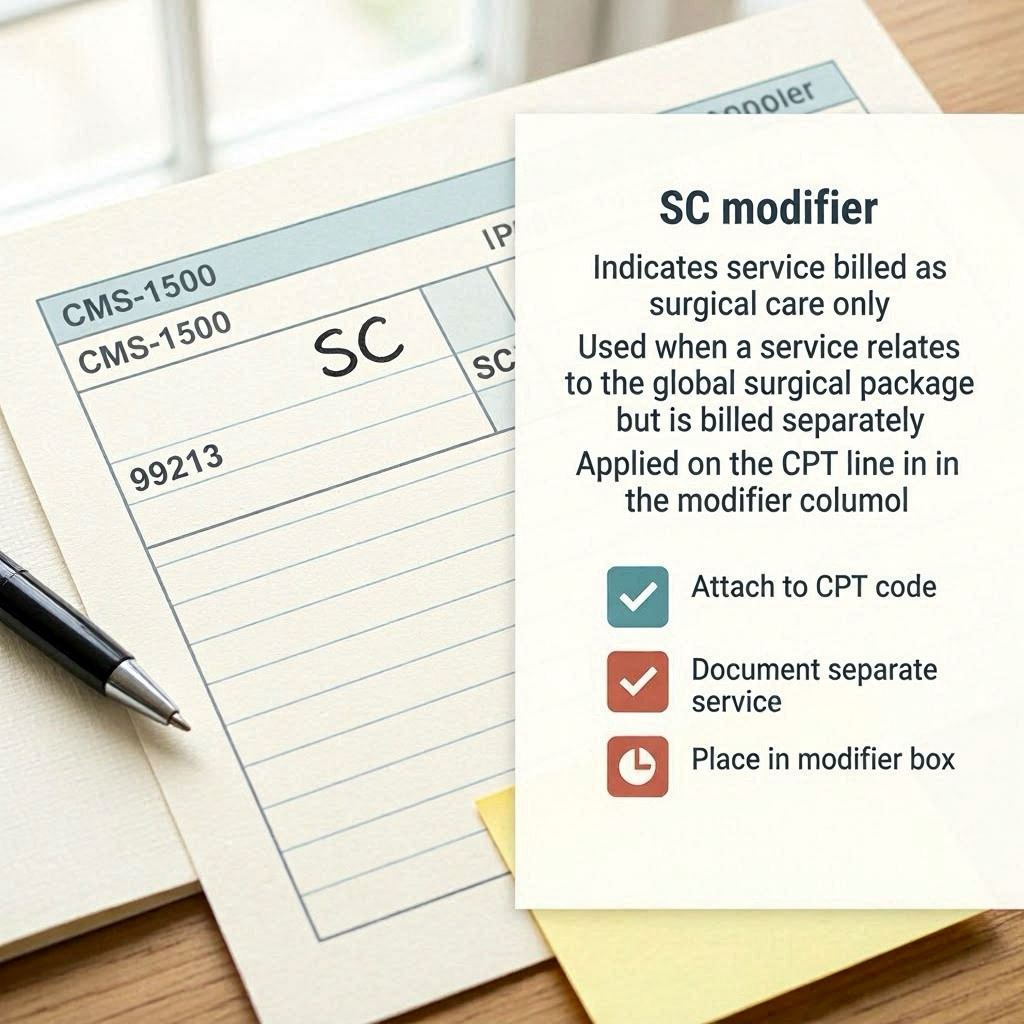
Step 4: Append the SC Modifier to the Appropriate Line
When preparing the claim, add the SC modifier to the line item for the service or item that required the certification. Do not append it to unrelated lines. In most billing systems, modifiers are entered in a dedicated field following the procedure code.
Step 5: Maintain a Record of the Rationale
Although this is not part of the claim itself, some organizations find it helpful to keep an internal note or audit log indicating why the SC modifier was used on a particular claim. This can be invaluable if the claim is later reviewed.
The SC Modifier and Medicare Audits: What to Expect
Medicare audits strike fear into many healthcare organizations, but understanding how the SC modifier interacts with the audit process can transform anxiety into preparedness.
When a MAC or a Recovery Audit Contractor (RAC) reviews a claim that includes the SC modifier, the central question is predictable: Does the documentation support the certification of medical necessity that the modifier represents?
Targeted Probe and Educate (TPE) Reviews
Medicare uses a program called Targeted Probe and Educate to review claims from selected providers. If your organization bills items or services that frequently require the SC modifier, you may be more likely to be selected for a TPE review. The good news is that TPE is designed to be educational, not punitive—provided your documentation is in order.
During a TPE review, the MAC will request medical records for a sample of claims. If the SC modifier was used, the reviewer will check whether the clinical documentation meets the coverage criteria. If it does, the claims are allowed and the probe period may end. If it does not, the reviewer will identify the deficiencies, and your organization will have an opportunity to correct them before further rounds of review.
What Auditors Look For
Auditors examining an SC modifier claim typically focus on these elements:
- The physician’s order and its specificity.
- Clinical evidence supporting the diagnosis that justifies the service.
- Records showing that conservative treatments (if required) were attempted and failed.
- Clear documentation linking the service to the patient’s functional limitations or medical needs.
A well-documented record should make these elements obvious. An auditor should not have to search or infer. The story of medical necessity should be visible on the surface.
How the SC Modifier Affects Reimbursement
The financial dimension of the SC modifier is straightforward in concept but important to understand precisely.
The SC modifier itself does not increase or decrease the reimbursement rate for a service. It is not a payment modifier in the sense that it triggers a different fee schedule amount. Instead, it is a compliance and processing modifier. Its presence—or absence—affects whether a claim is paid at all, not how much is paid.
Preventing Denials and Avoiding Revenue Loss
The primary financial impact of the SC modifier relates to denial avoidance. When the modifier is required but missing, the claim will likely be denied. The provider then faces a choice: write off the service as uncollectible or go through the time-consuming appeals process.
Appeals carry their own costs. Staff time, administrative burden, and the opportunity cost of delayed revenue all add up. Using the SC modifier correctly from the start is a form of revenue cycle protection.
The Cost of Incorrect Usage
Conversely, appending the SC modifier when it is not appropriate can create overpayment exposure. If a MAC later determines that the service was not medically necessary despite the certification, the payment may be recouped. In some cases, this can occur years after the initial payment, making it difficult to locate the supporting documentation and complicating the appeal process.
The SC Modifier in the Context of Value-Based Care
The healthcare industry’s shift from fee-for-service to value-based care adds another dimension to the SC modifier’s relevance.
Value-based care emphasizes outcomes, efficiency, and appropriateness of services. Medical necessity sits at the very heart of this philosophy. A procedure that is not medically necessary is, by definition, low-value care—it exposes the patient to risk without the prospect of meaningful benefit and consumes resources that could be directed toward effective interventions.
The SC Modifier as a Quality Indicator
While the SC modifier is fundamentally a billing tool, some organizations have begun to look at its usage patterns as a proxy for documentation quality and clinical appropriateness. A practice that consistently and accurately uses the modifier demonstrates a disciplined approach to patient selection and claims preparation.
In an environment where payers increasingly evaluate providers on quality metrics, this type of rigor can have secondary benefits. It signals to partners and payers that the organization takes medical necessity seriously and has the documentation practices to prove it.
Educational Strategies for Billing and Coding Teams
Implementing correct SC modifier usage across an organization requires more than a policy memo. It requires thoughtful education and ongoing reinforcement.
Building a Training Program
An effective training program on the SC modifier should include:
- A plain-language explanation of what the modifier means and why it exists.
- Real-world case studies showing correct and incorrect usage.
- Hands-on practice with sample claims that reflect the organization’s actual service mix.
- A clear explanation of the consequences of errors, both for the organization and for the patients it serves.
Training should not be a one-time event. Periodic refresher sessions help keep the principles current, especially as coverage policies evolve.
Creating Quick-Reference Tools
Billing teams work under time pressure. They cannot be expected to memorize every modifier rule for every possible scenario. Quick-reference tools—whether digital or printed—can bridge the gap between training and daily practice.
A well-designed reference might include:
- A list of services or items that commonly require the SC modifier.
- A decision flowchart for determining whether the modifier applies in a given case.
- The key differences between SC and easily confused modifiers.
- Contact information for the compliance or billing compliance team if questions arise.
The Interaction Between the SC Modifier and Advance Beneficiary Notices (ABNs)
The Advance Beneficiary Notice of Noncoverage is a document providers issue to Medicare beneficiaries when they believe Medicare may not cover a particular service. The ABN allows the patient to make an informed decision about whether to receive the service and accept financial responsibility if Medicare denies the claim.
When SC and ABNs Intersect
The SC modifier and ABNs serve complementary but distinct purposes. The SC modifier is a provider’s certification that a service is medically necessary. An ABN is a notice to the patient that a service might not be covered.
These two tools should not contradict each other. If a provider obtains a signed ABN for a service and then bills that service with the SC modifier, a contradiction exists. The ABN suggests the provider believes the service might not be covered due to medical necessity concerns, while the SC modifier certifies that it is medically necessary.
In most cases, a service should not carry both an SC modifier and an ABN related to medical necessity. Doing so creates confusion for the MAC and for the patient, and it raises questions about the provider’s internal processes.
The Future of the SC Modifier: Trends and Predictions
The world of medical billing does not stand still, and modifiers evolve alongside the broader healthcare landscape. What might the future hold for the SC modifier?
Increased Specificity Requirements
One trend that appears likely is the move toward even greater specificity in medical necessity documentation. CMS has demonstrated a consistent interest in ensuring that claims accurately reflect the clinical circumstances of each patient. Modifiers may become more granular, or additional documentation requirements may attach to the SC modifier in specific clinical contexts.
Integration with Electronic Health Records
As electronic health records (EHRs) become more sophisticated, the potential exists for automated prompts that guide providers toward correct modifier usage. An EHR that recognizes when a particular service is being ordered could suggest the SC modifier based on the diagnosis codes and clinical documentation already present in the record. This type of clinical decision support could reduce errors and improve compliance.
The Role of Artificial Intelligence
Artificial intelligence and machine learning are beginning to make inroads into revenue cycle management. These tools can analyze large volumes of claims data to identify patterns associated with denials. Over time, AI may help predict with high accuracy whether a particular claim requires the SC modifier based on historical outcomes, reducing reliance on human memory and manual reference.
Real-World Case Studies Involving the SC Modifier
Learning from actual scenarios, anonymized to protect confidentiality, can cement the principles we have discussed.
Case Study 1: The Missed Denial Pattern
A medium-sized orthopedic practice noticed that claims for a particular knee procedure were being denied at a rate that was unusually high compared to their peers. Upon investigation, they discovered that the MAC’s LCD for this procedure required the SC modifier for patients over a certain age. The practice’s billing team had been unaware of this requirement.
The fix was straightforward: update the billing protocols and train the team. However, the practice had already lost significant revenue on claims that were denied and never appealed because the denial reason was not carefully analyzed the first few times it occurred.
Lesson: Denial analysis is not just about working individual denials. It is about identifying systemic issues. A single missed modifier can be a pattern hiding in plain sight.
Case Study 2: The Audit That Validated Good Practices
A DME supplier was selected for a TPE review. The MAC requested records for 30 claims involving power mobility devices, all of which had been billed with the SC modifier. The supplier was able to produce thorough documentation for every claim, including detailed physician orders, mobility evaluations, and home assessments.
The review resulted in zero denials, and the MAC closed the probe after the first round. The supplier’s director of compliance noted that the SC modifier had served its purpose: it accurately reflected the documentation that had been maintained all along.
Lesson: When the SC modifier is used correctly and backed by solid documentation, it functions as intended—smoothing the claims process and affirming the provider’s commitment to compliance.
Frequently Asked Questions About the SC Modifier
What does SC stand for in medical billing?
SC stands for “Medically Necessary Service or Supply.” It is a HCPCS Level II modifier used to indicate that a provider has determined the billed item or service meets Medicare’s medical necessity requirements.
Is the SC modifier the same as the KX modifier?
No. While both modifiers indicate that certain conditions have been met, the KX modifier is typically used to signal that specific requirements in an LCD have been satisfied, such as therapy caps. The SC modifier is a broader certification of medical necessity.
What happens if I forget to include the SC modifier when it is required?
If a coverage policy requires the SC modifier and you omit it, the claim will likely be denied as a technical error. You may be able to correct and resubmit the claim, but this delays payment and creates additional work.
Can I use the SC modifier on claims to commercial insurers?
The SC modifier is specific to Medicare. Some commercial payers may recognize it, but you should verify each payer’s modifier acceptance policies. Most commercial insurers have their own modifier requirements.
Does the SC modifier guarantee that my claim will be paid?
No. The SC modifier certifies that the service is medically necessary, but the claim can still be denied for other reasons, including lack of supporting documentation, eligibility issues, or billing errors. The modifier addresses medical necessity certification specifically.
How long should I keep documentation supporting SC modifier claims?
Medicare requires providers to retain records for at least six years from the date of service. Given the potential for audits, many compliance experts recommend keeping documentation longer, particularly for high-value claims or services with complex coverage criteria.
Can the SC modifier be used with telehealth services?
Medicare’s telehealth coverage policies will specify modifier requirements. If a telehealth service is covered under a policy that requires the SC modifier, then it should be used. Always consult the specific policy for the service you are billing.
A Quick-Reference Checklist for SC Modifier Compliance
Before submitting a claim with the SC modifier, run through this checklist to reduce the risk of error.
- I have verified that the service or item is covered under a relevant NCD, LCD, or MAC policy.
- The policy explicitly requires or permits the SC modifier for this service.
- The patient’s medical record contains documentation that meets every coverage criterion.
- The physician’s order is current, specific, and signed.
- I have not obtained an ABN for this service related to medical necessity concerns.
- The SC modifier is appended only to the line item to which it applies.
- I have confirmed that no contradictory modifiers are present on the same line.
- I have retained or flagged the supporting documentation for potential audit requests.
The Importance of Staying Current with Modifier Rules
Medicare policies are living documents. NCDs and LCDs change. MACs issue updated articles. What was true about the SC modifier last year may not be true today.
Establish a regular cadence for reviewing policy updates. This could be monthly or quarterly, depending on the volume and variety of services your organization bills. Designate a team member to monitor the CMS website and any communications from your MAC.
When a policy changes, update your training materials and quick-reference guides immediately. Do not let outdated information circulate within your billing team. The cost of an error based on old policy can be significant.
Conclusion
The SC modifier is a small but powerful element of the medical billing code set. Its purpose is to certify that a service or item is medically necessary, aligning the claim with Medicare’s foundational coverage requirements from the moment of submission. When used correctly, it helps prevent denials, supports compliance, and reflects an organization’s commitment to accurate billing practices. The key to mastering it lies in understanding the specific coverage policies that require it, maintaining thorough documentation, and training billing teams to recognize when and how it should be applied.
Additional Resources
For the most current information on HCPCS modifiers and Medicare coverage policies, visit the official CMS website:
CMS.gov: HCPCS Level II Modifiers
Disclaimer: This article is intended for educational and informational purposes only. It does not constitute legal, compliance, or billing advice. Coverage policies and modifier requirements vary by payer, jurisdiction, and over time. Always consult official CMS guidance, your Medicare Administrative Contractor, and qualified compliance professionals for decisions related to your specific circumstances.