Precision in medical coding is not just a professional aspiration; it is an absolute necessity for the financial health of any anesthesia practice. When we move from the bony structures of the spine to the delicate and life-sustaining blood vessels of the neck, the margin for coding error shrinks to zero. CPT Code 00604 represents one of the most specific and high-stakes entries in the anesthesia section. It covers anesthesia services for procedures on the cervical blood vessels, a category that includes the carotid arteries, the jugular veins, and other critical conduits that feed the brain and drain the head. A deep understanding of this code is non-negotiable for medical coders, anesthesiologists, and Certified Registered Nurse Anesthetists (CRNAs) who navigate the high-pressure environment of vascular surgery.
The stakes of carotid surgery are immense. A single misplaced clamp or a minute of hypotension can lead to a devastating stroke. The anesthesia provider must maintain an exquisite balance of cerebral perfusion pressure, cardiac output, and anticoagulation. The monitoring is intense, often including intra-arterial blood pressure, electroencephalogram (EEG), or somatosensory evoked potentials. CPT 00604 captures this level of critical care. However, simply knowing the code number is not enough. You must know when to apply it, how it differs from codes for the chest or the head, and how to document the service so that the claim withstands the most rigorous audit.
In this comprehensive guide, we will dissect CPT 00604 in its entirety. We will explore the surgical procedures it maps to, such as carotid endarterectomy and subclavian bypass. We will break down base units, time calculations, and the intricacies of medical direction in a neurovascular case. We will also clarify the common mix-ups with codes for cervical spine procedures and other vascular territories. By the time you finish this article, you will possess the knowledge to code for cervical vascular anesthesia with absolute confidence and accuracy.
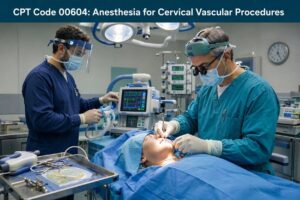
CPT Code 00604
Understanding the Scope: What Are Cervical Vascular Procedures?
To correctly apply CPT Code 00604, you must first visualize the anatomical territory it covers. The code descriptor is “Anesthesia for procedures on the cervical blood vessels.” This refers specifically to the major arteries and veins that run through the neck, excluding those inside the cranial cavity and those within the chest. The neck is a packed conduit where the airway, the digestive tract, and the great vessels all travel in close proximity. This anatomical crowding is what makes anesthesia for this region particularly demanding.
The most prominent cervical blood vessel is the carotid artery. The common carotid artery bifurcates into the internal and external carotid arteries around the level of the C3-C4 vertebrae. The internal carotid artery supplies the brain with oxygenated blood, while the external carotid supplies the face, scalp, and neck. A blockage at the carotid bifurcation, usually due to atherosclerosis, can cause a transient ischemic attack (TIA) or a full-blown stroke. The classic surgical treatment is a carotid endarterectomy, where the surgeon opens the artery and scrapes out the plaque.
Other cervical vessels include the vertebral arteries, which travel through the bony foramina of the cervical spine to join the basilar artery and supply the brainstem. Surgery on the vertebral artery is far less common but extremely high risk. The subclavian artery and its branches, along with the internal and external jugular veins, also fall under this category. Procedures like subclavian-carotid bypass or repair of a traumatic jugular vein laceration would map to 00604. The common thread is that the primary surgical target is a blood vessel located in the neck. The diagnosis codes will usually point to cerebrovascular disease (I65.2), carotid artery stenosis (I65.21), or vascular trauma (S15.0).
It is vital to distinguish this code from those covering intrathoracic vessels, which fall under the “Intrathoracic” anesthesia section. If the surgeon operates on the aortic arch or the innominate artery via a sternotomy, you are no longer in the neck. That is a chest case, and a different anesthesia code applies. The line is drawn at the thoracic inlet, roughly the level of the clavicles and the first rib. The anesthesia provider must be aware of this boundary because the surgical approach dictates the physiological trespass into the chest cavity.
The Carotid Endarterectomy: The Classic 00604 Procedure
The carotid endarterectomy (CEA) is the quintessential procedure that requires CPT 00604. This operation represents a delicate dance between the surgeon and the anesthesiologist. The surgeon must clamp the carotid artery to open it and remove the plaque. During this clamp time, the brain on that side relies entirely on collateral blood flow from the circle of Willis. The anesthesiologist must keep the patient’s blood pressure normotensive or slightly hypertensive to drive that collateral flow. If the blood pressure drops, the patient could wake up with a new stroke.
Anesthesia techniques for CEA vary. Some surgeons prefer general anesthesia, while others prefer a regional cervical plexus block with monitored anesthesia care (MAC). The latter allows the surgeon to assess the patient’s neurological status continuously. The patient is awake, and the surgeon can ask them to squeeze a toy or wiggle their toes. If the patient becomes confused or weak after clamping, the surgeon knows a shunt is needed to bypass the clamped area.
From a coding perspective, the choice of anesthesia does not change the CPT code. Whether you perform a general endotracheal anesthetic with an arterial line and EEG monitoring, or a superficial and deep cervical plexus block with light sedation, the primary service billed is still 00604. The base units reflect the inherent risk of the procedure itself, not just the technique used to manage that risk. However, the time units will differ. An awake carotid endarterectomy under regional block often takes less time at the front end because there is no induction or emergence delay. The patient is awake, the surgery starts, and the patient can be sent to recovery immediately after the last suture.
The documentation for 00604 during an awake CEA must be extremely detailed. The record must show the patient’s level of consciousness, the adequacy of the block, and the continuous conversation with the patient during the clamp time. The surgeon’s note might say “patient moved left hand during test clamp, shunt placed.” Your anesthesia record must corroborate this and show that you managed the airway and the hemodynamic response to the shunt placement. This precise documentation supports the medical necessity of the MAC technique and the continued attendance of the anesthesia provider.
CPT Code 00604: Definition and Base Unit Value
The official definition from the American Medical Association (AMA) is straightforward: “Anesthesia for procedures on the cervical blood vessels.” This single code covers a wide array of vascular surgeries. Unlike spine codes that are segmented by cervical, thoracic, and lumbar regions, the vascular codes are more grouped. However, the base unit value assigned to 00604 recognizes the high risk.
In the standard American Society of Anesthesiologists (ASA) Relative Value Guide, CPT 00604 carries a base unit value of 5 units. This is consistent with many high-risk neurovascular procedures. Some payers, particularly in high-cost geographic localities, may assign a base value of 6. You must always verify with your local Medicare Administrative Contractor (MAC). The 5 base units reflect the need for direct arterial pressure monitoring, the potential for sudden massive blood loss, the risk of cerebral ischemia, and the management of anticoagulation and its reversal.
Let us see how this compares to other neck procedures. Anesthesia for thyroid surgery (00320) might carry only 4 or 5 base units because the airway is a primary concern, but the vascular risk is lower. Anesthesia for a radical neck dissection (00320 as well) shares the airway concern but lacks the focused cerebral perfusion pressure management of a carotid case. The 5 base units for 00604 are a premium payment for a premium risk. The anesthesia provider must be ready to administer vasopressors to raise blood pressure or vasodilators to treat hypertension after the plaque is removed and the baroreceptors in the carotid sinus are exposed. These rapid hemodynamic shifts are the hallmark of the CEA and justify the base unit value.
Reimbursement Formula and Time Calculation
Anesthesia billing always circles back to the formula: (Base Units + Time Units) x Conversion Factor. For 00604, the time calculation must be flawless. The start time is when the anesthesiologist or CRNA begins preparing the patient for induction or block placement. The stop time is when the patient is safely placed under post-anesthesia care and the provider is no longer in continuous attendance.
Time is reported in 15-minute increments for Medicare, though some private payers use 10-minute or exact-minute reporting. For a carotid endarterectomy, a typical procedure might take 120 minutes from induction to emergence. That equates to 8 time units (120 / 15 = 8). Add the 5 base units, and you have 13 total units. This total is multiplied by the payer’s conversion factor. If the case takes longer due to a difficult dissection or a need for intraoperative angiography, the time units increase. You must document the reason for the extra time in the anesthesia record. A note such as “Surgery prolonged due to dense scar tissue from prior radiation, total clamp time 45 minutes” explains the extended units to any auditor.
The physical status modifier is particularly relevant for vascular patients. A patient with carotid stenosis often has generalized atherosclerosis. They may have coronary artery disease, hypertension, diabetes, and a history of smoking. They are rarely a P1 (healthy). More often, they are P3 (severe systemic disease). If they have unstable angina or end-stage renal disease, they might be a P4. The P3 or P4 modifier is added to the code: 00604-P3. While Medicare does not directly pay more for the P modifier, it is a critical data element. If the case time is extended because of the patient’s severe cardiac disease, the P3 modifier supports the medical necessity of that extended time.
| Service Component | Example Case |
|---|---|
| CPT Code | 00604 |
| Base Units | 5.0 |
| Total Anesthesia Time | 135 minutes |
| Time Units (15-min increments) | 9.0 (135 / 15) |
| Total Units | 14.0 |
| Modifiers | AA-P3 (Anesthesiologist performed, severe systemic disease) |
| Conversion Factor (example) | $22.00 |
| Total Claim Value | 14.0 x $22.00 = $308.00 |
This table illustrates a standard claim. The value lies in the time units. If the same case took 200 minutes due to a shunt complication, the time units jump to 13.3, and the total claim value increases significantly. The documentation must support those extra minutes.
Medical Direction in High-Stakes Vascular Anesthesia
Carotid artery surgery is a critical moment for a patient. The brain is at risk. The heart is under stress. Because of these stakes, many anesthesiologists choose to personally perform the case rather than medically direct it. However, the reality of staffing often means an anesthesiologist will medically direct a CRNA for this procedure. When this happens, the rules of medical direction must be followed with zero deviation.
The anesthesiologist must document the seven steps we have previously discussed: pre-anesthetic evaluation, prescribing the plan, personal participation in the most demanding portions, ensuring qualified individuals perform delegated tasks, monitoring the course at frequent intervals, remaining immediately available for emergencies, and providing post-anesthesia care. For a carotid endarterectomy, the most demanding portions are often the induction and the moment of carotid clamping and unclamping. The anesthesiologist should document their presence at these specific times.
The medical direction modifier QK (direction of 2-4 concurrent cases) is used by the anesthesiologist, and QX is used by the CRNA. The claims must be dual-submitted with identical times. A common audit trigger for 00604 is a mismatch in the documented time for the anesthesiologist and the CRNA. Both records must reflect the same start and stop times. If the anesthesiologist leaves the room after clamp placement and does not return until emergence, they must still be “immediately available.” This means they cannot be doing another case in a distant building. They must be on the same floor, reachable within minutes.
Some commercial payers have a policy that for any surgery involving the brain or major cerebral vessels, medical direction by an anesthesiologist is required. They may reject a QZ (CRNA independent) claim for a carotid endarterectomy. You must know your payer contracts. If a CRNA does practice independently for a 00604 case, the documentation must demonstrate their specific training and competence in neurovascular anesthesia. The surgeon’s trust is not a documentation element, but the CRNA’s credentials and the hospital’s privileging are.
Monitoring Requirements and Billing
The standard of care for a carotid endarterectomy includes invasive arterial blood pressure monitoring. The anesthesia provider often places a radial arterial line before induction to have beat-to-beat pressure monitoring. This placement is part of the global anesthesia service and is not separately billed. However, the documentation of the arterial line placement, the number of attempts, and the time it takes all add to the total anesthesia time. Do not “roll the clock” early just to place the line, but start the anesthesia time as soon as you begin the line placement under the pre-operative preparation phase. The line is a standard part of the anesthetic and its placement time is billable.
Some procedures on the cervical blood vessels, such as repair of a subclavian artery aneurysm, may require one-lung ventilation if the surgical approach involves a thoracotomy. In these cases, the line between a neck case and a chest case blurs. The primary surgical site still dictates the anesthesia code. If the primary pathology is the subclavian artery and the surgeon accesses it via a supraclavicular incision, 00604 is appropriate. If the surgeon performs a median sternotomy to access the innominate artery, the intrathoracic codes (00560, 00562) take over. The coder must read the operative note to determine the primary incision and the main anatomical territory.
Distinguishing 00604 from Other Cervical Codes
The neck is a small area, and the CPT codes for this region can be easily confused. The most common error we see is a mix-up between CPT 00600 (cervical spine) and CPT 00604 (cervical blood vessels). The descriptors are similar, but the clinical realities are entirely different.
CPT 00600 covers the vertebrae, the discs, and the spinal cord. The patient may be positioned prone or supine with the head in a Mayfield head holder. The surgeon is decompressing the spinal cord or fusing bones. The anesthesia concerns are airway management with manual in-line stabilization and neuromonitoring.
CPT 00604 covers the carotid, jugular, and other vessels. The patient is usually supine with the head turned to the side. The surgeon is clamping arteries, using heparin, and placing patches or bypass grafts. The anesthesia concerns are cerebral perfusion, anticoagulation management, and cardiac rhythm stability. The monitoring often includes cerebral oximetry or EEG.
Another potential confusion is with CPT 00300, anesthesia for procedures on the integumentary system of the neck. A plastic surgeon excising a superficial neck mass is not doing a cervical vascular procedure, even if the mass is near the carotid. The primary surgical target is the skin and subcutaneous tissue. The code 00300, with its lower base unit, is correct. Only when the surgeon’s scalpel touches the blood vessel itself, or when the procedure is directly on the vessel wall, does 00604 apply.
Consider this table of distinctions.
| CPT Code | Primary Target | Surgical Specialty | Key Anesthesia Concern |
|---|---|---|---|
| 00604 | Cervical blood vessels (carotid) | Vascular Surgery | Cerebral perfusion, hemodynamics |
| 00600 | Cervical spine and spinal cord | Neurosurgery, Orthopedic Spine | Airway, spinal cord integrity |
| 00300 | Integumentary system (neck skin) | Plastic Surgery, General Surgery | Airway management |
| 00520 | Intrathoracic vessels | Cardiothoracic Surgery | One-lung ventilation, cardiac output |
This table is a quick reference, but the operative note is the final authority. The surgeon might perform a “carotid body tumor resection.” The carotid body is a small organ at the carotid bifurcation. Its resection is a vascular procedure, even though the tumor is not the vessel lumen itself. The surgery requires meticulous dissection of the carotid artery wall. This maps to 00604. The diagnosis code for a carotid body tumor (D35.5) supports this.
Documentation Essentials for CPT 00604
If you want your 00604 claims to glide through the adjudication process without a hitch, your documentation must tell a compelling clinical story. The story must start with the pre-operative evaluation. The patient’s cerebrovascular history is paramount. Document the date of their last TIA or stroke. Document their current neurological status. “Patient has right-sided weakness from a prior left-hemisphere stroke.” This justifies the P3 modifier and the need for tight blood pressure control.
The intraoperative record must be a beat-by-beat account. For a carotid case, the record must clearly show the clamp time and the unclamp time. A simple notation: “Carotid clamped 09:15, unclamped 09:42.” During this period, the vital signs should reflect the deliberate hypertension. The record should show a mean arterial pressure of 90-100 mmHg. If a vasopressor drip is used, the drip rate and the titration must be recorded. The rationale: “MAP maintained >90 mmHg during clamp per surgeon request to optimize collateral cerebral flow.” This shows active care.
The record must also document the anticoagulation management. Heparin is usually given, and protamine might be given to reverse it. Record the doses and the times. The anesthesia record must also include any neurological assessments if the patient is awake. “Patient asked to squeeze left hand, grip strong.” If the patient becomes confused or weak, this is a critical event that must be highlighted. The surgeon might place a shunt. The anesthesia record must document the shunt placement and the response.
Here is a checklist of items that must appear on a top-tier 00604 anesthesia record.
-
Pre-op neurological baseline.
-
Induction agents and airway technique.
-
Invasive monitoring details (arterial line site).
-
Baseline vital signs.
-
Clamp time (start and stop).
-
Unclamp time.
-
Heparin dose and Protamine dose.
-
Vasopressor usage and rates.
-
Fluid management.
-
Emergence details and post-extubation neurological exam.
-
Total anesthesia start and stop times.
Managing Hemodynamic Events
The hemodynamic rollercoaster of a carotid endarterectomy is legendary. After the clamp is released, the freshly opened artery exposes the baroreceptors in the carotid sinus to a new, often higher, pressure wave. This can trigger a profound vagal response: bradycardia and hypotension. The anesthesiologist must be ready to administer atropine or glycopyrrolate for the bradycardia and a vasopressor for the pressure.
Every one of these interventions must be on the record. If the patient has a period of severe bradycardia (heart rate of 30 bpm) that requires atropine, the time spent treating that event is entirely billable. It is a critical part of the anesthesia management. An auditor might see a 15-minute period where the surgical progress note is blank, but your record shows medication administration and a note: “Severe bradycardia to 30 bpm post-unclamp, carotid sinus hypersensitivity, treated with Atropine 0.5mg IV x2, pressure supported with Neo drip.” This justifies the time and the service.
If the patient experiences an intraoperative stroke, the anesthesia record becomes a medico-legal document of the highest importance. The documented blood pressure readings, the timing of drug administration, and the communication with the surgeon are all scrutinized. From a coding perspective, if a stroke occurs and the case time is extended by 2 hours for a rescue procedure (like an intraoperative angiogram and stent), you bill all that time. The diagnosis code on the claim might need to be changed to reflect the intraoperative complication (I97.81, intraoperative cerebrovascular infarction). The original diagnosis of carotid stenosis remains, but the complication code explains the extraordinary time units.
Workers’ Compensation and CPT 00604
Although less common than spine injuries, cervical vascular injuries do occur in the workers’ compensation arena. A heavy equipment operator in a motor vehicle accident might suffer a traumatic dissection of the carotid artery. A construction worker might be struck by a falling object, causing a penetrating injury to the jugular vein. When these cases go to the operating room, the anesthesiologist bills using 00604.
Workers’ compensation billing for 00604 requires meticulous attention to state-specific rules. The official medical fee schedule (OMFS) of that state dictates the allowable amount. You must obtain pre-authorization and attach the authorization number to the claim. The workers’ compensation adjuster will want to see a causal link between the work injury and the surgery. The diagnosis code must be specific to the trauma, such as S15.0 (Injury of carotid artery). You cannot use the generic atherosclerosis code (I65.2) for a work-related trauma case.
Documentation of the mechanism of injury is very helpful. “Patient was operating a forklift that overturned. Sustained blunt force trauma to the right neck. CT angiogram shows a right carotid dissection with pseudoaneurysm.” This narrative in the pre-anesthesia evaluation frames the entire claim. The workers’ comp fee schedule may allow an additional payment for the severity of the case. Make sure you know the ground rules so you do not undercharge or overcharge.
Auditing CPT 00604: What Triggers a Review
The Recovery Audit Contractors (RACs) and the Office of Inspector General (OIG) know that 00604 cases are high-dollar items. A multi-hour carotid bypass or a complicated re-do endarterectomy can generate a large claim. The audit algorithms are designed to sniff out improper billing.
The primary trigger is a time outlier. If the average CEA anesthesia time in your state is 150 minutes, and your group consistently bills 300 minutes, the system flags you. The auditor requests 20 sample records. They will look at the surgical start and stop times. They will look at the “wheels in, wheels out” times on the hospital operating room log. Your anesthesia record must match these within a reasonable margin. If your recorded start time is 30 minutes before the patient entered the OR, you have a problem. The anesthesia start time must be when you begin preparing the patient in the OR or an equivalent induction area. It cannot be when the patient is in the pre-op holding area and you are simply taking a history, because that is part of the bundled pre-evaluation. The physical preparation—placing monitors, starting IV lines, pre-oxygenating—is what kicks off the billable time.
Another trigger is the unbundling of monitoring. An anesthesia claim for 00604 that also includes a separate line item for “cerebral oximetry interpretation” or “EEG monitoring” is a red flag. The anesthesiologist does not bill a professional fee for reading the EEG. The neurophysiologist bills that. The anesthesiologist uses the information to guide their management, which is bundled into the anesthesia code. Any attempt to unbundle standard monitoring will lead to a swift denial and a possible fraud investigation.
The Anesthesia Coder’s Checklist for 00604
Before you hit “submit” on any 00604 claim, run through this checklist. It will save you countless hours of rework and appeal writing.
-
Verify the Primary Procedure: Read the surgeon’s op note. Is the primary target a blood vessel in the neck? Yes? Proceed.
-
Confirm the Base Units: Check your payer contract. Is it 5.0? 6.0? Enter it correctly.
-
Calculate Time: Start time to stop time. Is the stop time clearly documented? Is there a gap in the record? Subtract any non-billable time if the provider left the room and did not transfer care (but continuous anesthesia care means they are always attending).
-
Assign Physical Status Modifier: Does the pre-op H&P support a P3 or P4? Match the modifier to the diagnoses.
-
Apply Medical Direction Modifier (if needed): Are the QK and QX claims identical in time and units? Do they have matching dates? Is the case count for the anesthesiologist within the legal limit?
-
Match Diagnosis Codes: The anesthesia claim must list the diagnosis that supports the surgery. Carotid stenosis, traumatic injury, etc.
-
Attach Documentation: If your MAC requires documentation for time over a certain threshold, attach the anesthesia record electronically.
This checklist turns a complex process into a series of simple yes/no questions. If any answer is “no,” stop and fix the issue before the claim goes out.
Regional Anesthesia and Cervical Plexus Blocks
The cervical plexus block is the perfect technique for an awake carotid endarterectomy. The block is performed at the C2-C4 nerve roots, blocking the superficial and deep branches. This provides anesthesia to the neck, allowing the surgeon to operate while the patient is conscious. How does this affect the coding of 00604? It does not change the CPT code. 00604 covers all anesthesia techniques for the procedure. The block is the primary anesthetic. It is not a “post-operative pain block” billed separately. It is the main event.
The time to perform the block is included in the total anesthesia time. The start time begins when you begin the block procedure, which includes positioning the patient, ultrasound scanning, and injecting the local anesthetic. The continuous attendance requirement means the provider stays at the patient’s head, monitoring sedation and the block’s effectiveness, ready to convert to general anesthesia if the block is inadequate or a complication occurs.
If the anesthesiologist places a cervical plexus block and then leaves the room, and a nurse monitors the patient’s sedation, that is not Monitored Anesthesia Care. That is a surgical block with nursing sedation. The anesthesia professional fee would not be billed for the continuous surgical time, only for the block placement. This is a totally different billing scenario, and 00604 would not apply. You would bill the nerve block injection code. This distinction is critical. For 00604 to be billed, the provider must be continuously present.
Complex Cervical Vascular Reconstructions
Beyond the straightforward carotid endarterectomy, CPT 00604 also covers the most extreme neck vascular procedures. Consider a carotid-subclavian bypass for subclavian steal syndrome. This involves a supraclavicular incision and a tunneling of a graft. The anesthesia time can be extensive.
Consider a vertebral artery bypass. The vertebral artery is deep, running through the bone. The surgical approach can be posterior and requires the patient to be in a prone or sitting position. The anesthesia provider must manage the airway and the cerebral blood flow to the posterior circulation. The base units remain 5, but the time units will be very high. These procedures are often performed in academic medical centers, and the attending anesthesiologist might be documenting teaching time. “Dr. Fellow performed the induction under my direct supervision. I was present for the entire induction period and the critical portion of the bypass.” This narrative supports the teaching physician’s claim for the time.
In vascular trauma, such as a gunshot wound to the neck, the patient may arrive in the operating room in hemorrhagic shock. The anesthesiologist must simultaneously resuscitate the patient and anesthetize them. This is a P4 or P5 scenario. The documentation must capture the rapid sequence induction, the massive transfusion protocol, and the ongoing resuscitation. The time units will be high, and the case will likely be flagged for review. The clinical story is one of emergency, life-saving intervention. The documentation must scream urgency.
Conclusion
CPT Code 00604 is the designated code for anesthesia during cervical vascular procedures, covering high-stakes surgeries like carotid endarterectomy that demand precise hemodynamic control and continuous monitoring. Accurate billing requires a thorough understanding of its 5 base units, meticulous time documentation starting from patient preparation, and the correct application of physical status and medical direction modifiers. By strictly adhering to documentation standards and distinguishing it clearly from spine or other neck codes, you can ensure compliant, audit-proof claims for this critical neurovascular service.
FAQ
What is the base unit value for CPT 00604?
The standard base unit for CPT 00604 is 5 units, reflecting the high risk of cerebrovascular surgery, though some payers may assign a 6.
Can I bill CPT 00604 for a cervical spine surgery?
No, cervical spine procedures map to CPT 00600. CPT 00604 is strictly for surgeries on blood vessels like the carotid and jugular veins.
Does an awake carotid endarterectomy use the same CPT code?
Yes, CPT 00604 covers all anesthesia techniques including general, regional cervical plexus block, and monitored anesthesia care (MAC).
Can I bill separately for neuromonitoring during a carotid case?
No, anesthesiologists cannot bill separately for interpreting EEG or cerebral oximetry. Professional monitoring fees are billed by the neurophysiologist.
What modifier should an anesthesiologist use when directing a CRNA for a 00604 case?
The anesthesiologist should use the QK modifier for medical direction of 2-4 concurrent cases, while the CRNA uses the QX modifier.
Additional Resources
For detailed guidance on the Relative Value Guide and official coding policies, please visit the American Society of Anesthesiologists: https://www.asahq.org/