
You are sitting in the dental waiting room, and the quiet hum of a drill from the back office sends a familiar shiver down your spine. Dental anxiety is a real, physiological response, not a character flaw. For millions of patients, the difference between canceling an appointment and calmly receiving necessary care is a small, scentless gas flowing through a nasal mask. Laughing gas, or nitrous oxide, is the most common and accessible form of dental sedation. But as you schedule a filling or a crown, a practical question cuts through the anxiety: how much more will this calming service add to my bill?
This article is a clear-eyed financial analysis of nitrous oxide sedation in dentistry. We will break down the per-visit cost, the billing codes, the insurance realities, and the clinical factors that make this line item on your treatment plan a genuine value, not just an optional luxury.
The Line Item: How Laughing Gas is Billed
Nitrous oxide sedation is not bundled into the cost of a filling or a crown. It is billed as a separate, stand-alone service. The procedure is remarkably consistent across practices: a small, scented nasal mask is placed over your nose, and you breathe a mixture of nitrous oxide and oxygen. The dentist controls the precise percentage of gas, titrating it to your comfort level. Within minutes, you feel a warm, floating sensation of relaxation and detachment. You remain fully conscious and able to respond to commands. When the procedure is complete, the dentist flushes the system with pure oxygen, and the effects dissipate within minutes. You can drive yourself home.
The dental billing code for this service is D9230. This code is defined as “analgesia, anxiolysis, inhalation of nitrous oxide.” The fee for this code is typically a flat, per-visit charge, not a per-minute or per-hour charge. This is an important financial detail. Whether your procedure takes 30 minutes or two hours, the laughing gas fee is the same. This predictability is a significant advantage over other forms of sedation.
The cost of D9230 in a typical general dental practice ranges from $50 to $150 per visit. In a major metropolitan area with a higher cost of living, the fee can reach $200. In a rural practice, it may be as low as $40. The average national cost settles comfortably around $75 to $100. This is the number you should have in your mind when you ask your dentist for a pre-treatment estimate.
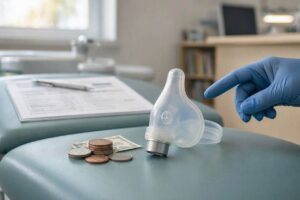
How Much More Does The Dentist’s Laughing Gas Cost?
The Hidden Economics: What the Fee Covers
A skeptical patient might look at the laughing gas fee and see a profit center for the practice. After all, you are just breathing air through a mask, right? This view misunderstands the regulatory and equipment infrastructure behind that small nasal hood.
The gas itself is a relatively minor consumable. Nitrous oxide is an inexpensive pharmaceutical agent. The real cost you are paying is for the sophisticated delivery system. A modern nitrous oxide machine is a precision medical device that incorporates multiple, non-negotiable safety features. It includes a fail-safe mechanism that automatically shuts off the nitrous oxide flow if the oxygen pressure drops. It has an oxygen flush button for immediate, 100% oxygen delivery. It requires regular, documented calibration and maintenance by a biomedical technician. The machine itself costs several thousand dollars, and its upkeep is a fixed overhead for the practice.
Furthermore, the practice must maintain a system for safely scavenging the exhaled gas. A vacuum system whisks the patient’s exhaled breath out of the operatory to prevent chronic, low-level exposure to the clinical team. This environmental safety system is a significant installation cost. Your $75 fee is contributing to the capital cost of the machine, its maintenance, the disposable nasal masks and tubing (single-use for infection control), and the dentist’s certification and training in sedation. Many states require a specific permit for a dentist to administer nitrous oxide, involving a board-approved course and ongoing continuing education. You are paying for a regulated, safe, and credentialed medical service, not just the gas molecules.
Laughing Gas vs. Other Sedation Options: The Cost Comparison
To understand the value of a $75 laughing gas fee, you must compare it to the other levels of sedation available in dentistry. The cost increases exponentially with the depth of sedation and the complexity of monitoring required.
| Sedation Option | Billing Code(s) | Cost Range (per visit) | Key Characteristic |
|---|---|---|---|
| Nitrous Oxide | D9230 | $50 – $150 | Mild anxiolysis. Rapid onset and recovery. Patient drives home. |
| Oral Conscious Sedation | D9248 (non-IV) | $200 – $500 | A pill (e.g., Halcion). Deeper relaxation, amnesia. Requires an escort. |
| IV Moderate Sedation | D9241/D9242 | $500 – $1,000+ | Intravenous. Profound relaxation, strong amnesia. Requires an escort, advanced monitoring. |
| General Anesthesia | D9220/D9221 | $800 – $2,500+ | Complete unconsciousness. Hospital or surgical center. Anesthesiologist required. |
Oral conscious sedation is the next step up. You take a prescribed sedative pill an hour before your appointment. You arrive drowsy and will have significant amnesia of the procedure. The cost, ranging from $200 to $500, reflects the pre-operative consultation to assess your medical history, the prescription itself, and the heightened monitoring of your vital signs during the procedure. You must have a responsible adult drive you to and from the appointment. This is a hidden cost of time and inconvenience for your companion.
Intravenous (IV) sedation involves a needle in your arm and a continuous drip of sedative medication. The fee is significantly higher because it requires a dentist with an IV sedation permit, advanced airway management training, and a dedicated assistant to monitor your blood pressure, heart rate, and oxygen saturation every few minutes. The drugs, the IV catheter, and the emergency reversal agents are all direct costs.
When you compare the $75 fee for nitrous oxide to the $500 fee for IV sedation, the value proposition becomes clear. Laughing gas provides a mild, titratable, and profoundly safe anxiolysis at a fraction of the cost and with zero recovery downtime. For a patient with mild to moderate anxiety, it is the most financially and logistically efficient choice.
The Insurance Reality for Code D9230
The relationship between dental insurance companies and nitrous oxide sedation is often a source of patient frustration. Many standard PPO dental plans consider sedation a non-essential, comfort-based service and simply do not cover it. They view it as an elective add-on, much like a cosmetic procedure. Your insurer may deny the claim for D9230 entirely, leaving you with the full out-of-pocket responsibility.
However, there is a specific, clinically justified exception. If your dentist can document that nitrous oxide is medically necessary for the safe delivery of dental care—for example, due to a severe gag reflex, a diagnosed anxiety disorder, or a physical or cognitive disability that prevents you from cooperating—the insurance company may approve the benefit. This requires the dental team to submit a narrative with the claim, explaining the medical necessity.
Your action as a patient is simple. Call the member services number on your insurance card before the appointment. Ask this specific question: “Does my plan cover procedure code D9230 for inhalation of nitrous oxide, and if so, at what percentage and under what medical necessity criteria?” The customer service representative will look up your specific employer’s contract. Some premium plans cover it at 50% to 80%, subject to your deductible. The knowledge of your exact benefit allows you to walk into the appointment financially prepared, without a surprise bill.
When Laughing Gas is a Clinical Necessity, Not a Luxury
There is a class of patient for whom nitrous oxide is not a pleasant extra. It is the single clinical element that allows dentistry to happen at all. For a patient with a hyperactive gag reflex, even a standard set of bitewing X-rays can be impossible without triggering vomiting. Nitrous oxide suppresses the gag reflex reliably and safely. The $75 fee is the price of access to diagnostic radiographs.
For a patient with a severe intellectual or developmental disability, the dental chair can be a terrifying, overstimulating environment. A mild dissociative agent like nitrous oxide can create enough of a sensory buffer to allow a compassionate dentist to perform a gentle cleaning and exam without physical restraint or general anesthesia. This is not a spa-like relaxation; it is a gentle, humane bridge to necessary medical care. In these contexts, the fee is not a line item to be negotiated. It is an essential, cost-saving measure that prevents the need for far more expensive and risky general anesthesia in a hospital setting.
Conclusion
The dentist’s laughing gas adds a predictable, modest cost of $50 to $150 to your dental visit. This fee is not a charge for a gas molecule; it is an investment in a regulated medical device, a credentialed safety protocol, and the clinical art of anxiety control. When compared to the significantly higher cost and logistical burden of oral or IV sedation, nitrous oxide stands as the most economical and convenient bridge to calm, barrier-free dental care. For the anxious patient, it is often the line item that makes the entire procedure possible, not just more pleasant.
Frequently Asked Questions
Can I use laughing gas for a simple dental cleaning?
Yes. Nitrous oxide can be used for any dental procedure, from a routine hygiene appointment to a complex surgical extraction. If anxiety makes a routine cleaning stressful for you, your dentist can administer laughing gas. The fee is the same flat per-visit charge regardless of the procedure length.
Will laughing gas put me to sleep?
No. Nitrous oxide is a minimal sedation agent. You remain fully conscious, able to breathe on your own, and able to respond to the dentist’s questions and commands. You will feel relaxed, floaty, and somewhat detached, but you are not asleep. This is precisely why it is so safe and why you can drive yourself home afterward.
Is there any reason I cannot have nitrous oxide?
There are a few medical contraindications. Patients who are pregnant, have a diagnosed vitamin B12 deficiency, or have certain conditions like chronic obstructive pulmonary disease or a recent inner ear surgery may not be suitable candidates. Your dentist will review your complete medical history before recommending nitrous oxide to ensure it is safe for you.
Additional Resource:
For a patient-oriented explanation of different sedation options and safety standards, visit the American Dental Association’s page on dental sedation: https://www.mouthhealthy.org/all-topics-a-z/anesthesia-and-sedation


