
You have stood by your spouse through their military service. You have navigated the complex, often exhausting world of Veterans Affairs benefits, hospital appointments, and disability ratings. Your spouse, a handicapped veteran, receives their medical care through the VA system. Now, you face a pressing health need of your own. Your teeth hurt. You need a cleaning, a filling, or perhaps something more extensive. The out-of-pocket cost at a private dentist is a weight you cannot easily carry. You ask yourself a question born of love, sacrifice, and practical necessity: can a handicapped veteran’s wife receive dental care at a reduced cost?
This article is a compassionate, clear-eyed guide to the landscape of dental benefits for the spouses of veterans. We will distinguish between the veteran’s own VA dental eligibility and the very different rules that apply to family members. We will explore CHAMPVA, the program that does offer dental coverage to certain qualifying spouses. And we will identify alternative pathways to affordable care, because your oral health is not a luxury. It is a non-negotiable component of your overall well-being.
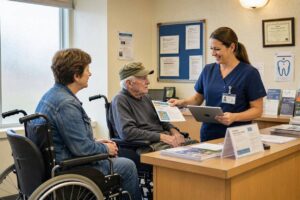
Can A Handicapped Veteran’S Wife Receive Dental Care At A Reduced Cost?
Table of Contents
ToggleThe Hard Truth: VA Dental Care is for the Veteran, Not the Spouse
The first and most critical distinction to understand is that the Department of Veterans Affairs (VA) dental benefits are, with extremely rare exceptions, for the veteran only. The comprehensive, low-cost dental care provided at VA medical centers and clinics is a benefit of service, extended to the veteran based on their disability rating, service connection, or special circumstances such as being a former prisoner of war. This benefit does not automatically extend to the veteran’s spouse or family members.
A handicapped veteran with a 100% service-connected disability may be eligible for comprehensive VA dental care at a significantly reduced or zero cost. This is a vital, earned benefit for the veteran. But when the veteran’s wife walks into a VA dental clinic as a patient, she is not eligible for treatment simply by virtue of her marriage. The VA system is not a family health insurance plan. It is a system of care for the qualifying veteran. This is the hard, structural truth that leads so many military spouses to feel they have been left behind. You have not been forgotten, but the benefit your spouse earned is, by law, theirs. Your path to reduced-cost care is a different one.
The Exception: CHAMPVA and Dental Coverage
There is a specific, federal program that does offer comprehensive medical and limited dental coverage to the spouses and children of certain veterans. It is called the Civilian Health and Medical Program of the Department of Veterans Affairs, or CHAMPVA. Understanding whether you qualify for CHAMPVA is the single most important step you can take in your search for affordable dental care.
CHAMPVA is not for every military spouse. The eligibility criteria are specific. You may be eligible for CHAMPVA if you are the spouse or child of a veteran who:
-
Is permanently and totally disabled from a service-connected condition, as rated by the VA.
-
Died from a service-connected condition.
-
Died on active duty and the dependents are not eligible for TRICARE.
-
Was permanently and totally disabled at the time of death from a service-connected condition.
If your handicapped veteran spouse is rated at 100% permanent and total disability, you, as the spouse, likely qualify for CHAMPVA. This is the pathway. You must apply for CHAMPVA benefits through the VA. The application requires documentation of the veteran’s disability rating and the marriage. Once enrolled, you receive a CHAMPVA identification card.
The coverage provided by CHAMPVA is significant for medical care, acting as a secondary payer to Medicare, if you are eligible, or as a primary plan. For dental care, the coverage is more limited but exists. CHAMPVA offers a specific dental insurance plan, CHAMPVA Dental Insurance Program (CHAMPVA DIP), administered by a private insurance company. This is a voluntary, opt-in dental plan. You pay a monthly premium, and in return, you receive coverage for preventive, basic, and major dental services at negotiated rates. The premiums are subsidized, making them lower than many open-market individual plans. This is a reduced-cost pathway to comprehensive dental care for a qualifying spouse. It is not free. It is an earned, subsidized benefit.
A Crucial Action: Call the CHAMPVA helpline directly at 1-800-733-8387. Do not rely on a neighbor’s or a forum’s interpretation. Ask the representative: “Based on my spouse’s service-connected disability rating of [state the rating], am I eligible for CHAMPVA benefits?” This single phone call can open a door you did not know existed.
TRICARE and the Retiree Distinction
If your veteran spouse is a military retiree, having served a full 20-year career and receiving retired pay, the landscape shifts again. You may be eligible for TRICARE, the Department of Defense’s health care program for uniformed service members, retirees, and their families. TRICARE offers the TRICARE Dental Program (TDP), a voluntary, premium-based dental plan for eligible family members.
The TRICARE Dental Program provides comprehensive dental coverage with low cost-shares for preventive care and negotiated rates for restorative and major services. The monthly premiums are generally lower than comparable civilian plans. If your spouse is a retired veteran and you are not already enrolled in the TRICARE Dental Program, verify your eligibility immediately. This is a structured, reliable path to reduced-cost care that many eligible military families overlook. The distinction is critical: a veteran who served a short term and was medically discharged with a disability is not a retiree. TRICARE eligibility requires a qualifying length-of-service retirement or a specific medical retirement status. Do not assume. Verify.
The Dental School and Hygiene School Pathway
If you do not qualify for CHAMPVA or TRICARE, the path to reduced-cost care moves to the civilian world. A university dental school or a community college dental hygiene program is a time-tested, reliable source of affordable, high-quality dental care. These are teaching institutions. The care is provided by students, but every single step of the way is closely supervised by licensed, experienced faculty dentists.
The fee schedule at a dental school clinic is typically 30% to 50% lower than a private practice. A cleaning by a hygiene student, while it will take significantly longer than a private office visit, is often priced at $20 to $50. A filling might cost $50 to $100. A crown might be $400 to $600. The trade-off is time. Appointments are long, and the treatment plan is often completed over many visits. For a spouse with a limited budget and a flexible schedule, this is a pathway to comprehensive care at a fraction of the private market cost. A call to the nearest dental school’s patient admissions office is the first step.
The Community Health Center and Sliding Fee Scale
Federally Qualified Health Centers (FQHCs) are community-based clinics that provide comprehensive primary and preventive care, including dental services. They are located in underserved areas across the country. An FQHC charges on a sliding fee scale based on your household income and size. You pay what you can afford, proportional to the federal poverty guidelines.
If your family’s income, based on the veteran’s disability payments and any other earnings, qualifies, your dental care at an FQHC could be reduced significantly. A routine cleaning might be $30. An extraction might be $60. These clinics are not charity operations. They are funded, regulated facilities with licensed dentists and hygienists. The care is professional and standards-based. To find an FQHC near you, use the Health Resources and Services Administration’s “Find a Health Center” tool online. Call and ask: “Do you offer dental services on a sliding fee scale, and what documentation do I need to prove my income and household size?”
The Veterans Service Organization as a Resource
Do not underestimate the power of a direct conversation with a Veterans Service Organization (VSO). Organizations such as the Disabled American Veterans (DAV), the American Legion, or the Veterans of Foreign Wars (VFW) employ trained service officers who understand the labyrinthine VA benefits system. They can help you determine eligibility for programs you might not know about, including state-level benefits for veterans’ dependents. Some states offer specific health care or dental care assistance programs for the spouses of disabled veterans. A VSO service officer can identify these state-specific resources. This consultation is free. It is a wise investment of an hour of your time.
Conclusion
A handicapped veteran’s wife can receive dental care at a reduced cost, but the pathway is not through her spouse’s VA dental benefits. It lies in a constellation of other programs: the CHAMPVA Dental Insurance Program for spouses of veterans rated permanently and totally disabled, the TRICARE Dental Program for military retiree families, the sliding fee scales at community health centers, and the teaching clinics at dental schools. The key is to verify eligibility for each of these programs systematically, starting with the phone call to CHAMPVA or TRICARE. Your health matters. The resources exist. They must be actively sought and claimed.
Frequently Asked Questions
Can I go to a VA dental clinic with my husband and get my teeth cleaned?
No. VA dental clinics are for the treatment of eligible veterans. Spouses are not treated at VA dental facilities, except in extremely rare, authorized humanitarian circumstances. You must seek care through a civilian provider or a CHAMPVA/TRICARE network dentist.
What is the CHAMPVA Dental Insurance Program?
It is a voluntary, premium-based dental plan administered by a private insurer for CHAMPVA-eligible spouses and dependents. You pay a monthly premium, typically lower than open-market plans, and receive comprehensive dental benefits with negotiated rates. It is one of the most direct paths to reduced-cost care for qualifying spouses.
Are there any free dental care days for veterans’ families?
Some non-profit organizations and private dental practices host free care days, such as “Dentistry from the Heart” events. These are one-time events providing a limited scope of care, usually a single extraction or filling. They are not a solution for ongoing, comprehensive care but can be a bridge for an acute problem. Search for free dental care events in your state through local dental societies.
Additional Resource:
To determine your eligibility for CHAMPVA and to apply, visit the official VA CHAMPVA page: https://www.va.gov/health-care/family-caregiver-benefits/champva/


