The Philippines has become a significant destination for dental tourism, attracting patients from Australia, North America, Europe, and across Asia seeking affordable dental care. Sedation dentistry addresses the needs of anxious patients, those undergoing lengthy procedures, and individuals with complex medical considerations. Understanding sedation dentistry costs in the Philippine context helps patients evaluate treatment options both for local residents and international visitors.
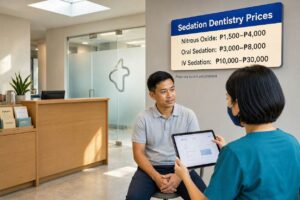
In the Philippines, sedation dentistry costs range from ₱3,000 to ₱25,000+ (approximately $55 to $460+ USD) depending on sedation type and duration. Oral conscious sedation costs ₱3,000-₱8,000 ($55-$145). IV sedation costs ₱12,000-₱25,000+ ($220-$460+). General anesthesia in a hospital setting costs ₱25,000-₱60,000+ ($460-$1,100+). These fees are typically separate from the dental procedure costs.
Understanding Sedation Dentistry in the Philippine Context
The Philippine dental market offers a wide spectrum of sedation services, from basic anxiety management to advanced hospital-based anesthesia. The level of training, facility requirements, and regulatory oversight vary significantly between providers.
Types of Sedation Available in the Philippines
Philippine dental clinics and hospitals offer several tiers of sedation services, though availability varies by location and provider qualifications.
Minimal Sedation (Anxiolysis):
Patients remain awake but relaxed. Achieved through oral medication or nitrous oxide inhalation. The patient responds normally to verbal commands. This represents the most commonly available sedation type across Philippine dental practices.
Moderate Sedation (Conscious Sedation):
Patients experience depressed consciousness but respond purposefully to verbal commands or light physical stimulation. Breathing remains adequate without intervention. Typically achieved through oral medication or IV administration.
Deep Sedation:
Patients experience depressed consciousness and may not respond readily to stimulation. Breathing may require assistance. This level of sedation is usually restricted to dental anesthesiologists and hospital settings in the Philippines.
General Anesthesia:
Complete loss of consciousness with loss of protective reflexes. Requires airway management and ventilation support. Restricted to hospital operating rooms and select ambulatory surgery facilities with appropriate equipment and personnel.
Philippine Regulatory Framework
The Philippine Dental Act and Philippine Board of Dentistry regulate dental practice, including sedation services. Dentists must hold specific permits for sedation and general anesthesia administration.
The Philippine Society of Dental Anesthesiology provides training and credentialing for dentists pursuing sedation certification. Board-certified dental anesthesiologists complete additional years of training beyond the standard dental degree.
Philippine dental anesthesiologists are relatively few in number, concentrated primarily in Metro Manila, Cebu City, and Davao City. Patients in provincial areas may have limited access to advanced sedation services.
Sedation Dentistry Costs by Type
Oral Conscious Sedation
Oral sedation involves taking prescribed medication before the dental appointment. The patient remains conscious but relaxed, often with limited memory of the procedure. This represents the most accessible and affordable sedation option in the Philippines.
Cost Range: ₱3,000 – ₱8,000 ($55 – $145 USD)
Medications Commonly Used: Benzodiazepines, antihistamines, or combination protocols
Best For: Mild to moderate dental anxiety; short to moderate-length procedures
Oral sedation costs include the pre-operative evaluation, medication, and intra-operative monitoring. Some clinics bundle oral sedation with treatment packages for dental tourism patients.
Availability:
Oral sedation is widely available in Metro Manila, Cebu, Davao, and other major cities. Many general dentists offer oral sedation for anxious patients. Fewer provincial practices provide this service.
Nitrous Oxide (Laughing Gas) Sedation
Nitrous oxide provides light sedation through inhalation. The patient remains conscious and responsive with reduced anxiety. Effects dissipate rapidly after the gas is discontinued, allowing patients to drive themselves home in most cases.
Cost Range: ₱2,500 – ₱6,000 ($45 – $110 USD) per session
Duration: Titrated throughout the procedure
Best For: Mild anxiety; needle phobia; short procedures
Nitrous oxide equipment requires initial investment that not all Philippine dental practices have made. Availability is moderate in urban areas and limited in rural locations.
Intravenous (IV) Sedation
IV sedation delivers medication directly into the bloodstream for rapid, titratable effect. A dental anesthesiologist or specially trained dentist inserts an IV line and administers sedative medications throughout the procedure.
Cost Range: ₱12,000 – ₱25,000+ ($220 – $460+ USD)
Duration: Per procedure; fees may increase for longer sessions
Best For: Moderate to severe anxiety; lengthy surgical procedures; patients with strong gag reflexes
IV sedation requires advanced training and emergency preparedness. Only dentists with specific sedation permits may administer IV sedation in the Philippines. The cost reflects the specialized training, medications, monitoring equipment, and additional personnel required.
Fee Structure:
Most Philippine providers charge a flat fee for the first hour of IV sedation with incremental charges for additional time. Complex medical patients may require additional pre-operative evaluation fees.
General Anesthesia
General anesthesia renders the patient completely unconscious. This is typically reserved for extensive surgical procedures, patients with special needs who cannot cooperate for dental treatment, or complex medical cases.
Dental Clinic Setting (Ambulatory): ₱25,000 – ₱45,000 ($460 – $825 USD)
Hospital Operating Room: ₱35,000 – ₱60,000+ ($640 – $1,100+ USD)
Hospital-based general anesthesia includes facility fees, anesthesiologist professional fees, nursing care, and recovery room charges. These fees are separate from the dental surgeon’s professional fees and any hospital admission charges.
Availability:
General anesthesia for dental procedures is available at major hospitals in Metro Manila (St. Luke’s Medical Center, Makati Medical Center, The Medical City) and select hospitals in Cebu and Davao. Ambulatory general anesthesia in dental clinics is less common and restricted to facilities with appropriate accreditation.
| Sedation Type | Cost (PHP) | Cost (USD Approx.) | Availability |
|---|---|---|---|
| Nitrous Oxide | ₱2,500 – ₱6,000 | $45 – $110 | Urban clinics |
| Oral Conscious Sedation | ₱3,000 – ₱8,000 | $55 – $145 | Widely available in cities |
| IV Sedation | ₱12,000 – ₱25,000+ | $220 – $460+ | Select clinics, major cities |
| General Anesthesia (Clinic) | ₱25,000 – ₱45,000 | $460 – $825 | Accredited ambulatory centers |
| General Anesthesia (Hospital) | ₱35,000 – ₱60,000+ | $640 – $1,100+ | Major hospitals |
Factors Affecting Sedation Costs in the Philippines
Geographic Location
Metro Manila commands the highest sedation fees, reflecting higher overhead costs, greater demand, and concentration of specialists. Provincial cities offer lower prices but fewer sedation options.
Metro Manila (Makati, BGC, Ortigas): Premium pricing, widest availability. Metro Manila (Quezon City, Manila proper): Moderate pricing, good availability. Cebu City: Moderate to premium pricing, good availability. Davao City: Moderate pricing, moderate availability. Provincial capitals (Bacolod, Iloilo, Cagayan de Oro): Lower pricing, limited availability. Rural areas: Lowest pricing, minimal sedation options.
Provider Qualifications
The training and credentials of the sedation provider significantly affect fees.
General Dentist (Oral Sedation): Lowest fees; limited to oral anxiolysis. Dentist with Sedation Training Certificate: Moderate fees; may offer IV sedation. Dental Anesthesiologist (Board-Certified): Higher fees; qualified for all sedation levels including general anesthesia. Medical Anesthesiologist: Highest fees; typically hospital-based practice.
The Philippine Society of Dental Anesthesiology maintains a directory of qualified sedation providers. Patients should verify credentials before undergoing moderate or deep sedation.
Procedure Duration and Complexity
Sedation fees often scale with procedure duration. A 30-minute simple extraction under IV sedation costs less than a 3-hour full-mouth rehabilitation. Some providers charge flat fees regardless of duration; others charge time-based rates.
Complex medical histories require more extensive pre-operative evaluation and intra-operative monitoring, increasing costs. Patients with cardiovascular disease, respiratory conditions, or obesity may require medical anesthesiologist involvement rather than dentist-administered sedation.
Clinic vs. Hospital Setting
Hospital-based sedation carries higher costs due to facility fees, mandatory laboratory testing, and institutional overhead. Clinic-based sedation costs less but may not be appropriate for patients with significant medical comorbidities.
Philippine hospital accreditation standards require specific protocols for sedation services. These standards improve safety but increase costs compared to clinic-based sedation.
Sedation Dentistry for Dental Tourists
The Philippines attracts dental tourists seeking affordable care combined with vacation experiences. Understanding sedation options helps international patients plan treatment.
Why Dental Tourists Choose Philippine Sedation Services
Cost savings represent the primary motivation. Sedation services in the Philippines cost 50-75% less than equivalent services in Australia, New Zealand, North America, and Europe.
An Australian patient paying AUD $800-1,200 for IV sedation at home might pay AUD $200-400 for equivalent sedation in the Philippines. When combined with procedure savings, the total treatment package often justifies international travel.
Dental Tourism Hubs
Metro Manila:
The primary hub for dental tourism, offering the widest range of sedation services. Clinics in Makati, Bonifacio Global City, and Ortigas cater specifically to international patients with English-speaking staff, international accreditation, and tourism coordination services.
Cebu City:
The second major dental tourism destination. Modern clinics offer sedation services at slightly lower prices than Manila. Cebu’s tourism infrastructure, beaches, and resorts appeal to patients combining treatment with vacation.
Clark and Angeles City (Pampanga):
Emerging dental tourism destinations with lower costs than Manila. Proximity to Clark International Airport and former U.S. military base infrastructure provides accessibility for international patients.
Davao City:
Growing dental tourism market with competitive pricing. Fewer sedation specialists than Manila or Cebu but adequate services for most patients.
Package Deals and All-Inclusive Pricing
Philippine dental tourism clinics increasingly offer all-inclusive packages bundling:
Dental procedure fees. Sedation services. Airport transfers and local transportation. Hotel accommodation. Tourism activities during recovery. English-speaking patient coordinators.
These packages simplify planning for international patients and may offer cost advantages over arranging services separately.
Sample Package Pricing:
Full-mouth rehabilitation with IV sedation, 7-day stay including accommodation and airport transfers: $8,000-$15,000 USD depending on procedure scope and accommodation level. Equivalent treatment in Australia or the United States might cost $40,000-$80,000+.
“Philippine dental tourism offers significant savings, but patients must research clinics carefully. International accreditation, board-certified sedation providers, and transparent all-inclusive pricing distinguish quality clinics from those cutting corners.” — Medical Tourism Association
Safety Considerations for Sedation Dentistry in the Philippines
Sedation safety depends on provider training, facility preparedness, and appropriate patient selection.
Evaluating Clinic Safety Standards
International patients and local residents alike should verify:
Provider Credentials:
Board certification in dental anesthesiology or documented sedation training. Current Philippine Dental Association membership. Permit from the Philippine Board of Dentistry for sedation services.
Facility Preparedness:
Emergency medications and equipment (defibrillator, airway management devices, reversal agents). Monitoring equipment (pulse oximeter, blood pressure, ECG for deeper sedation). Emergency protocols and documented staff training. Transfer agreements with nearby hospitals for complication management.
Patient Assessment:
Thorough pre-operative medical evaluation. Appropriate patient selection (not all patients are candidates for clinic-based sedation). Informed consent with explanation of risks and alternatives.
Red Flags for Substandard Sedation Services
Patients should be wary of providers who:
Offer deep sedation or general anesthesia without appropriate credentials. Cannot describe emergency protocols when asked. Lack visible monitoring equipment in treatment rooms. Do not perform pre-operative medical evaluation. Offer unusually low prices that seem too good to be true. Cannot name the specific sedative medications they use. Have no hospital transfer agreements for emergencies.
Accreditation and Quality Indicators
International accreditation through organizations like the Joint Commission International or the Philippine Department of Health’s accreditation programs indicates commitment to safety standards. Ask clinics about their accreditation status and safety protocols.
Sedation Dentistry for Specific Populations
Pediatric Sedation Dentistry
Children requiring extensive dental treatment often benefit from sedation. Philippine pediatric dentists with sedation training provide these services.
Cost: ₱5,000 – ₱20,000+ ($90 – $365+ USD) depending on sedation level
Availability: Pediatric dental specialists in major cities; limited in provincial areas
Hospital-based general anesthesia for pediatric dental rehabilitation is available at major hospitals. This is typically recommended for very young children, those with special needs, or cases requiring extensive treatment.
Special Needs Patients
Patients with physical, intellectual, or developmental disabilities may require sedation or general anesthesia for routine dental care. Philippine dental anesthesiologists frequently provide services for this population.
Hospital-based care is often recommended for special needs patients with complex medical histories. Coordination between the dental anesthesiologist, treating dentist, and medical specialists ensures safe care.
Geriatric Sedation Considerations
Older patients present unique sedation challenges due to medical comorbidities, polypharmacy, and altered drug metabolism. Philippine sedation providers should conduct thorough medical evaluations and may recommend medical anesthesiologist involvement for elderly patients with significant health conditions.
Frequently Asked Questions
How much does sedation dentistry cost in the Philippines in pesos?
Oral sedation costs ₱3,000-₱8,000. IV sedation costs ₱12,000-₱25,000+. General anesthesia costs ₱25,000-₱60,000+. Prices vary by provider, location, and procedure duration.
Is sedation dentistry safe in the Philippines?
Board-certified dental anesthesiologists and properly credentialed sedation providers in accredited facilities offer safe sedation services. Research provider qualifications and facility preparedness before treatment.
Do Philippine dentists offer nitrous oxide?
Yes, many urban clinics offer nitrous oxide sedation. Availability is less common in rural areas. Confirm availability when scheduling appointments.
Can I combine dental tourism with sedation dentistry?
Yes, Philippine dental tourism clinics routinely provide sedation services for international patients. All-inclusive packages simplify planning and may reduce costs.
Is general anesthesia available for dental procedures in the Philippines?
Yes, general anesthesia is available at major hospitals and select ambulatory surgical facilities, primarily in Metro Manila, Cebu, and Davao.
How do I verify a Philippine dentist’s sedation credentials?
Request to see their sedation permit from the Philippine Board of Dentistry. Contact the Philippine Society of Dental Anesthesiology for specialist verification. Review clinic accreditation status.
Will my health insurance cover sedation dentistry in the Philippines?
International health insurance may cover sedation for medically necessary procedures. Most dental tourism patients pay out-of-pocket. Verify coverage with your insurer before treatment.
How long does sedation recovery take in the Philippines?
Oral sedation recovery takes 2-6 hours. IV sedation recovery takes 6-12 hours before full alertness returns. General anesthesia recovery requires 24 hours. Dental tourism packages typically include adequate recovery time before flights.
Additional Resources
For more information about sedation dentistry in the Philippines:
-
Philippine Dental Association: www.pda.ph
-
Philippine Society of Dental Anesthesiology: Contact for specialist directory
-
Philippine Board of Dentistry: Professional Regulation Commission (PRC)
-
Department of Health – Philippines: www.doh.gov.ph (hospital accreditation verification)
-
Medical Tourism Association: www.medicaltourismassociation.com