When you visit the dentist to fix a chipped, stained, or misshapen tooth, you are often presented with two potential solutions: a veneer or a crown. Both are common cosmetic and restorative procedures that can dramatically improve your smile. However, when you look at the price tag, you might notice a surprising discrepancy. Porcelain veneers often cost more than dental crowns, sometimes significantly so.
This seems counterintuitive to many patients. After all, a crown is a “cap” that covers the entire tooth, while a veneer is just a thin shell on the front. If a crown uses more material and covers more surface area, why does it often cost less?
The answer lies not in the amount of material used, but in the complexity of the artistry, the time required, and the level of precision needed to make a veneer look natural. This guide will break down the specific factors that drive the cost of veneers higher than crowns, helping you understand where your money goes when you invest in a high-end smile makeover.
Why Do Veneers Cost More Than Crowns?
Understanding the Structural Difference
To understand the cost difference, you must first understand what these restorations are.
Dental Crowns
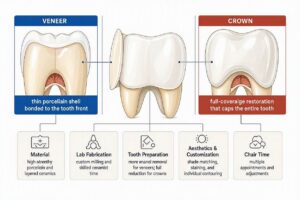
A dental crown is a “cap” shaped like a tooth. It fits over the entire visible portion of your tooth, starting at the gum line. It is designed to restore a tooth’s shape, size, strength, and appearance. You might need a crown if you have a large cavity, a cracked tooth, a root canal, or a broken filling. The primary goal of a crown is often functional restoration—making the tooth strong enough to chew again.
Dental Veneers
A porcelain veneer is a thin, custom-made shell of tooth-colored material. It is designed to cover only the front surface of the tooth. Veneers are used to fix aesthetic issues like discoloration, small chips, gaps, or slightly crooked teeth. While veneers do add some strength to the front of a tooth, their primary goal is cosmetic perfection.
The “Artistry Factor”: Why Aesthetics Drive Up the Price
The biggest reason veneers are more expensive is the level of aesthetic detail required. A crown must look good, but it also needs to be incredibly strong and functional. A veneer, on the other hand, is often placed on a perfectly healthy tooth for the sole purpose of improving its appearance. The standard for success is much higher for veneers.
1. The Illusion of Transparency
Natural teeth are not solid white blocks. They are made of layers of enamel and dentin that allow light to pass through and bounce back. This is called translucency. To make a veneer look like a natural tooth, the dental ceramist must layer different types of porcelain to mimic this property. If a veneer is too opaque, it looks fake, like a piece of white paint or a “chiclet.” Creating this lifelike transparency requires high-quality materials and intense skill.
2. Color Matching and Customization
When you get a crown on a back molar, no one sees it. The color just needs to be “close enough” to the surrounding teeth. But when you get a veneer on a front tooth, it sits right next to your other natural teeth. The ceramist must match the veneer’s color, shade, and texture perfectly to the adjacent teeth. This often requires multiple firings of the porcelain and custom hand-painting with stains to add character (like slight ridges or color variations) that mimic nature.
3. The Lab Technician’s Skill
Because of these demands, veneers require the expertise of a master ceramist. High-end dental labs that specialize in cosmetic work charge dentists more for their services. A crown for a back tooth can be milled by a machine or created by a less experienced technician. A front tooth veneer is often meticulously hand-layered by an artist who has spent years perfecting their craft. You are paying for their time and artistic eye.
A Detailed Cost Breakdown Comparison
Let’s look at a side-by-side comparison of the factors that influence the cost of each procedure.
| Factor | Dental Crown | Porcelain Veneer |
|---|---|---|
| Primary Goal | Strength and function. To protect a damaged tooth. | Aesthetics. To improve the beauty of a healthy tooth. |
| Tooth Preparation | Requires removal of a significant amount of tooth structure (shaving down the entire tooth). | Requires removal of a thin layer of enamel (about 0.5mm) on the front of the tooth. Less invasive. |
| Lab Fabrication | Can be milled from a block of ceramic or porcelain fused to metal. Less artistic layering is often required. | Requires meticulous, time-consuming hand-layering of porcelain to create lifelike color, texture, and translucency. |
| Materials | Porcelain, Zirconia, or Porcelain-fused-to-Metal (PFM). Strong, opaque materials are acceptable. | Usually high-quality feldspathic or lithium disilicate (e.max) porcelain. Requires premium translucent materials. |
| Dentist’s Time | Requires multiple steps, but often less chair time for adjustments and color matching. | Requires multiple appointments. The dentist spends significant time on temporary veneers, “try-in” appointments, and fine-tuning the fit and color with the lab. |
| Aesthetic Standard | “Good” or “Excellent.” | “Perfect” or “Undetectable.” The margin for error is zero. |
The Role of “Smile Design” in Veneer Pricing
When you get a crown, you are usually fixing one tooth. When you get veneers, you are often improving multiple teeth—typically the front six to ten teeth—to create a cohesive “smile makeover.” The process for veneers involves more than just making a tooth; it involves designing a smile.
Before any work begins, a cosmetic dentist will perform a “smile design” analysis. This is a detailed process where the dentist studies your facial features, lip line, gum line, and the shape of your teeth. They will often create a “wax-up” (a model of your future smile) and show it to you before touching your teeth. You may even get to try on “temporaries” made from this model to see if you like the shape.
This diagnostic and planning phase is intensive. It requires a dentist who has taken advanced courses in cosmetic dentistry. This expertise is part of the cost. A general dentist might be able to fabricate a functional crown, but a cosmetic dentist commands a higher fee for their ability to design a beautiful, natural-looking smile.
The Time Factor: Chairside and Laboratory Hours
Time is money in a dental office. A crown usually takes two appointments: one to prepare the tooth and take impressions, and a second to cement the final crown. The lab may take two weeks to make it.
Veneers are a much more time-consuming process:
-
Consultation & Smile Design: Extra appointments.
-
Preparation: The teeth are prepped, and temporaries are made.
-
Try-In: When the veneers come back from the lab, the dentist will place them on your teeth with a temporary paste. You will look in the mirror together. The color, shape, and fit are evaluated. If something is not perfect, the veneers go back to the lab for adjustments. This try-in step is critical for veneers but rarely done for single crowns.
-
Bonding: Only when you and the dentist are happy with the aesthetics are the veneers permanently bonded to your teeth. The bonding process itself is very technique-sensitive and takes time.
Every one of these extra appointments takes up valuable chair time in the dental office, contributing to the higher fee.
Are Crowns Ever More Expensive Than Veneers?
It is important to note that the general rule (veneers costing more) applies mostly to standard porcelain crowns and veneers. There are exceptions.
-
High-End Zirconia Crowns: A crown made of solid, multi-layered zirconia (like BruxZir or Lava) can be very expensive. However, these are usually placed on back teeth where aesthetics are less critical. The cost is driven by the strength of the material, not the artistry.
-
Specialist Fees: If a crown is placed by a prosthodontist (a specialist in restoring teeth) rather than a general dentist, the fee will be higher.
-
Complex Cases: If a crown is part of a complex full-mouth reconstruction involving jaw alignment issues, the overall cost of the crown treatment plan could be higher than a simple veneer case.
However, if you are comparing the cost of a standard crown on a single back tooth to the cost of a porcelain veneer on a front tooth at the same office, the veneer will almost always be more expensive.
The Value Proposition: Why the Investment Matters
If you are shocked by the cost of veneers, it helps to reframe your thinking. You are not just paying for a “piece of porcelain.” You are paying for a custom, hand-crafted work of art, created by a master technician and placed by a skilled dentist.
A well-made veneer can last 10 to 15 years or even longer. When you break down the cost over that lifespan, the daily investment is small. Furthermore, you are paying for the confidence that comes with a flawless, natural-looking smile.
For a crown, you are paying for the peace of mind that comes with a strong, healthy tooth that can chew comfortably. Both are valuable investments, but they serve different purposes. The price reflects the primary objective: strength for the crown, beauty for the veneer.
Conclusion
Veneers cost more than crowns because they are held to a much higher aesthetic standard. While crowns are designed for strength and function, veneers require incredible artistry, premium translucent materials, and meticulous attention to detail to look like natural teeth. You are paying for the time, skill, and expertise of a cosmetic dentist and a master ceramist to create a restoration that is not just functional, but virtually undetectable and beautiful.
Frequently Asked Questions (FAQ)
1. Can I get a crown instead of a veneer to save money?
While technically possible on a front tooth, a crown requires much more aggressive shaving of the natural tooth. On a healthy tooth, this is generally considered destructive dentistry. A veneer is the more conservative, and often more aesthetic, choice for a healthy front tooth. Saving a few hundred dollars now by unnecessarily crowning a tooth could lead to more expensive problems (like a root canal) later.
2. Why are “no-prep” veneers (like Lumineers) sometimes cheaper?
No-prep or minimal-prep veneers require little to no shaving of the tooth. The lab process is similar, but the dentist’s chair time is reduced significantly because the preparation appointment is much faster. However, the final aesthetic result depends heavily on the natural shape of your teeth. The low cost often reflects the reduced chair time, but the lab fees for the veneers themselves may still be high.
3. Is the lab fee always included in the price of a veneer?
In almost all comprehensive treatment plans, yes, the lab fee is bundled into the total price of the veneer. If you see a price for a veneer, it usually includes the cost of the dentist’s time and the laboratory work. Always ask for a breakdown to be sure.
4. Why do cosmetic dentists charge more for veneers than general dentists?
Cosmetic dentists invest heavily in advanced education, photography equipment, and relationships with high-end aesthetic labs. They also spend more time on the diagnostic and “smile design” phase of treatment. You are not just paying for the procedure; you are paying for the doctor’s expertise in ensuring the result looks incredible and fits your face.
5. Are composite resin veneers (bonding) cheaper than porcelain?
Yes, significantly. Composite resin veneers are sculpted directly onto the tooth by the dentist in a single visit. They cost a fraction of the price of porcelain. However, they stain more easily, are less durable, and do not have the same lifelike translucency as porcelain. They are a great temporary solution or a budget-friendly alternative.