The foundation of a healthy smile is built on two simple things: a regular dental examination and a professional cleaning. These routine visits are the most powerful tools we have to prevent tooth decay, gum disease, and a host of other oral health problems. Yet, many people delay or skip these appointments because they are worried about the cost.
This hesitation is understandable. Healthcare costs can be unpredictable, and dental work has a reputation for being expensive. However, when it comes to examinations and cleanings, the costs are actually quite predictable and manageable. Understanding these costs removes the fear of the unknown and empowers you to take control of your oral health.
This guide will break down the exact costs associated with a standard dental examination and cleaning. We will explore the different types of exams and cleanings, the factors that influence the price, and how insurance typically handles these services.
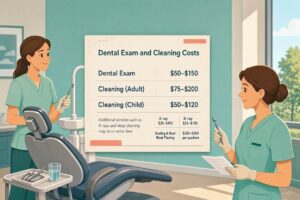
How Much Does A Dental Examination And Cleaning Cost?
The Value of a Routine Visit
Before we look at numbers, it is crucial to understand what you are paying for. A routine dental visit is not just a quick “polish.” It is a comprehensive medical assessment.
A standard visit usually consists of three main components:
-
The Examination (by the Dentist): The dentist visually inspects your teeth, gums, tongue, and the inside of your mouth. They are looking for cavities, signs of gum disease, oral cancer, and problems with existing dental work.
-
The X-Rays: X-rays allow the dentist to see what is happening between your teeth and below the gum line—areas invisible to the naked eye.
-
The Cleaning (by the Hygienist): A licensed dental hygienist removes plaque and tartar (hardened plaque), flosses your teeth, and polishes them to remove surface stains.
This combination of diagnostic and preventive care is what keeps small problems from becoming big, painful, and expensive ones.
The Cost of a Basic Dental Examination
The cost of a dental exam itself is usually the smallest part of the bill. However, there are different types of exams.
| Type of Exam | Description | Average Cost (Without Insurance) |
|---|---|---|
| Periodic Oral Evaluation | A standard checkup for an established patient. You see the dentist every 6 months. | $50 – $100 |
| Comprehensive Oral Evaluation | A thorough exam for a new patient. It is more detailed and time-consuming. | $75 – $150 |
| Limited/Problem-Focused Exam | An exam to check a specific issue (e.g., a toothache). | $50 – $100 |
| Emergency Exam | An exam for a dental emergency, often after hours. | $100 – $200 |
The Cost of X-Rays
Most dental problems start small and hidden. X-rays are essential for early diagnosis. The cost depends on the type of X-ray needed.
| Type of X-Ray | Description | Average Cost (Without Insurance) |
|---|---|---|
| Bitewing X-Rays (4 films) | Show the upper and lower back teeth. Used to check for cavities between teeth. | $40 – $100 |
| Periapical X-Ray (Single film) | Shows the entire tooth from crown to root. Used to diagnose problems with a specific tooth. | $25 – $50 |
| Panoramic X-Ray | A single image of the entire mouth, including the jawbone and sinuses. Usually taken every 3-5 years. | $60 – $150 |
Important Note: Many dentists require a full series of X-rays (FMX) or a panoramic X-ray for new patients. This is an added cost on your first visit but is a standard and necessary part of establishing a baseline for your oral health.
The Cost of a Dental Cleaning
As discussed in the California article, the type of cleaning you need depends on the health of your gums. This is the largest variable in the cost of a routine visit.
| Type of Cleaning | Description | Average Cost (Without Insurance) |
|---|---|---|
| Prophylaxis (Standard Cleaning) | For patients with healthy gums. Removes plaque and tartar above the gum line. | $75 – $200 |
| Full Mouth Debridement | A heavy-duty cleaning for patients with severe tartar buildup who have not seen a dentist in years. | $150 – $350 |
| Scaling and Root Planing (Deep Cleaning) | For patients with gum disease. Removes tartar from below the gum line. Requires anesthesia. Billed per quadrant. | $200 – $400 per quadrant |
The Total Cost for a Standard Visit
If you add it all up, what is the total bill for a typical “checkup and cleaning” for a patient with good oral health who does not need X-rays?
Estimated Total Cost (No Insurance):
-
Periodic Exam: $75
-
Standard Cleaning (Prophylaxis): $150
-
Total: $225
If you are a new patient needing a comprehensive exam, a full set of X-rays, and a standard cleaning, the total could be:
-
Comprehensive Exam: $125
-
Full Mouth X-Rays: $150
-
Standard Cleaning: $150
-
Total: $425
This is why “new patient specials” (which often bundle these for $99 or $150) are such a good deal.
The Role of Dental Insurance
For most insured patients, the cost of a routine examination and cleaning is zero. This is by design.
Dental insurance plans are built on the concept of prevention. They understand that paying for a $200 cleaning is much cheaper for them than paying for a $2,000 root canal and crown. Therefore, almost all dental insurance plans cover preventive care at 100%.
This means:
-
Periodic Exams: Covered at 100%.
-
Cleanings (Prophylaxis): Covered at 100% (usually twice per year).
-
Bitewing X-Rays: Covered at 100% (usually once per year).
The deductible often does not even apply to these services. You can walk out of the office without paying a dime.
What If I Don’t Have Insurance?
If you do not have dental insurance, a $200 to $400 bill for a routine visit is a significant expense. However, you still have options to manage the cost.
1. New Patient Specials
As mentioned, many dental offices offer heavily discounted rates for new patients to attract business. You can often find a deal that includes an exam, X-rays, and a cleaning for under $150. This is the cheapest way to get care at a private practice.
2. Dental Schools
Dental hygiene schools offer the absolute lowest prices for cleanings. Students need patients to practice on, and they are supervised by licensed professionals. A cleaning at a dental school can cost as little as $20 to $50.
3. Community Health Centers
If your income is low, you may qualify for a sliding fee scale at a community health center. These centers provide essential dental care at a price you can afford.
4. Dental Discount Plans
For an annual fee of around $100, you can join a dental discount plan. This gives you access to a network of dentists who have agreed to provide services at a reduced rate (often 20-40% off). This can bring a $150 cleaning down to $90.
The Cost of Avoiding the Dentist
It is easy to look at a $200 bill and decide to skip it. But this is a dangerous financial decision. The goal of a routine visit is to catch problems when they are small and cheap to fix.
Consider the cost of neglect:
-
A small cavity: Detected during an exam. Filled for $150.
-
An ignored cavity: Grows into the nerve. Requires a root canal ($1,200) and a crown ($1,300). Total: $2,500.
-
Mild gum inflammation (Gingivitis): Reversed with a standard cleaning for $150.
-
Ignored gum disease (Periodontitis): Requires deep cleaning ($1,200), possible gum surgery ($5,000+), and may lead to tooth loss.
The math is simple. The routine visit is the cheapest money you can spend on your teeth.
Conclusion
A dental examination and cleaning is an affordable investment in your health. For most insured patients, it is completely free. For uninsured patients, the cost can range from $150 to $400 or more, but strategies like new patient specials and dental schools can dramatically reduce this price. The true cost of skipping these visits is measured in thousands of dollars and lost teeth.
Frequently Asked Questions (FAQ)
Q: How often should I get a dental exam and cleaning?
A: The standard recommendation is every six months. However, if you have a history of gum disease or are prone to cavities, your dentist may recommend more frequent visits (e.g., every 3-4 months).
Q: Why do I need X-rays every year?
A: X-rays can detect cavities between the teeth and bone loss that are not visible during a visual exam. The frequency of X-rays is based on your individual risk for dental disease. If you have a low risk, you may only need them every 18-24 months.
Q: Is it cheaper to just get a cleaning without the exam?
A: No, you should never do this. It is illegal for a dental hygienist to perform a cleaning without a diagnosis from a dentist. More importantly, skipping the exam means you are missing the most valuable part of the visit—the doctor’s assessment of your overall oral health.
Q: Can a dental cleaning damage my teeth?
A: A professional cleaning performed by a licensed hygienist is very safe. It does not damage the enamel. It removes harmful plaque and tartar that cause disease.
Q: Why are X-rays so expensive when it is just a quick picture?
A: You are paying for the technology (the X-ray machine and digital sensors are very expensive), the time of the trained staff to take and process the image, and the dentist’s time and expertise to interpret the results.
Additional Resource:
To find low-cost dental care options in your area, including community health centers, you can use the search tool provided by the Health Resources and Services Administration (HRSA): https://findahealthcenter.hrsa.gov/